Beamer still with the Hokies

25 Display
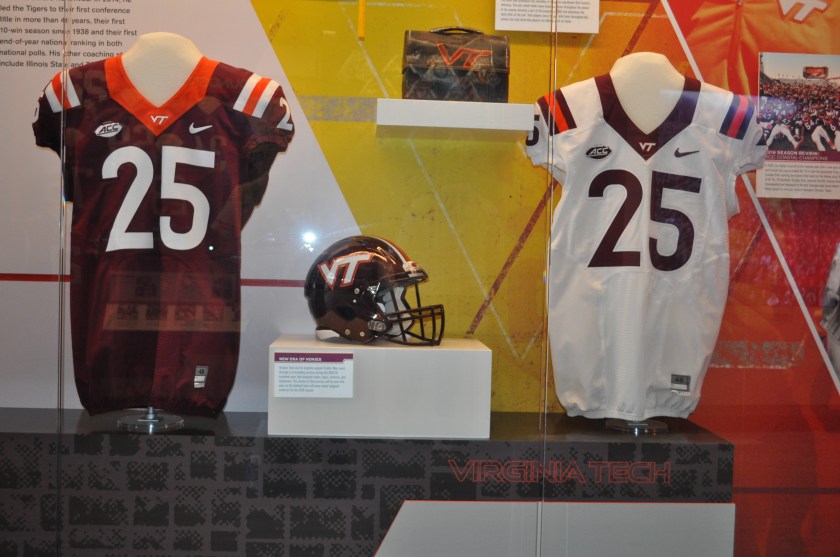
Blacksburg, Va., Nov. 9—25’s On Display. In the second year of the Beamer jersey tradition, the Merryman Athletic Facility puts Beamer’s number on the new Nike jersey designs. The exhibit shows both the 2017 home and away uniforms. Photo: Drew Davis.

by Drew Davis–

When head football coach Frank Beamer retired in 2015, Virginia Tech had to brace for change—change it had not had combatted for over 29 years. Yet out of this adjustment, under new head coach Justin Fuente, came a new tradition that kept a bit of the past.

The former Memphis football leader decided to reward a player each week with the retired No. 25 Beamer jersey to wear for excellent special teams play.

Now almost two seasons in, the tradition is still alive and well, and Blacksburg has seen a variety of players sporting the 25.

There’s been the fast.

Greg Stroman arguably had the greatest performance donning the two numbers, as the Richmond Times-Dispatch recaps.

For the homecoming game in 2016, the cornerback/return man scored on an 87-yard punt return touchdown and notched 155 All-Purpose yards against North Carolina.

There’s been the big.

 Ricky Walker became the largest to wear Beamer’s former numbers.

Hokiesports broke the news, as the three hundred pound defensive tackle would go on to have four tackles, three solo, one tackle for loss, and one pass batted down in a win against Duke.

 There’ve been the freshmen.

True freshmen wide receiver Divine Deablo and Australian-born punter Oscar Bradburn in 2016 and 2017 respectively wore the 25, as the newcomers too joined the newer tradition.

Of note, Deablo forced a fumble and the Bradburn had a 53-yard punt, both in victories.

Overall, Fuente says, “Thanks to Coach Beamer, his assistants and many talented student-athletes, Virginia Tech has become synonymous with special teams success.”

Now with Beamer gone, he remains with the team through the tradition and the special teams continue to succeed with great plays like Stroman’s and Deablo’s in the 25.

Beamer thinks this gesture shows the Hokies continue to be good hands.

“I couldn’t be more appreciative of the way Coach Fuente and everyone at [Virginia] Tech has handled the coaching transition. I think we have a great head coach who is going to continue to make Virginia Tech even better.”

Linebacker Tremaine Edmunds became the latest to wear the jersey numbers in Virginia Tech’s 28-22 defeat to Georgia Tech Saturday.


Veterans Day at Virginia Tech


6
Blacksburg, Va., Nov. 10- The Rock Memorial— Two cadets stand posted in front of The Rock memorial during one of the Veterans Day vigils at Virginia Tech. Photo: Alexis Johnson.

by Alexis Johnson–

For most Veterans Day is a time to honor the men and women who have served in the U.S. military, but for others Veterans Day at Virginia Tech takes on a whole new meaning.

According to the History of the Corps of Cadets, Virginia Tech started as a military school in 1872. Now the Corp makes up about 4 percent of the student body according to Virginia Tech Student Affairs.

Each year the Virginia Tech Corps of Cadets organizes and plans several events including remembrance ceremonies, the lowering of the flag, and the firing of Skipper, the Corps of Cadets’ cannon to recognize those that have served, specifically those from Virginia Tech. One event, in particular, is the annual guarding of The Rock hosted by the Robert Femoyer Service Squadron (RFSS), a leadership organization within the Virginia Tech Air Force ROTC program.

Located on the Upper Quad just outside of New Cadets Hall, The Rock is the Corps of Cadets memorial dedicated to Hokies who fought in World War I.

This year, two members of the RFSS, were selected to plan, organize, and coordinate 96 cadets and officers to participate in the guarding of The Rock. Cadets Sakdithep Phongpitakvises and Nyaima Brackner have been planning this event for months and say that it “provides excellent leadership and organizational skills.”

The event was held over a 24 hour period, beginning midnight Friday, Nov. 10, and ending midnight Saturday. Each cadet had the opportunity to sign-up for 30-minute time slots. In groups of two, cadets stood at attention guarding the memorial making a switch every 30 minutes.

“It’s a very small sacrifice compared to what all the veterans have sacrificed for us,” said Cadet Brackner. “It’s honestly just thirty minutes of our lives,” added Cadet Phongpitakvises, “you get a little taste of what they (veterans) go through and get a little taste of why you want to serve.”

According to Cadets Brackner and Phongpitakvises, standing at the rock is “a time for self-reflection.” In fact, their goal for this year was that each cadet who volunteered would reflect on the sacrifices that each veteran has made before them and the sacrifices that they themselves will make in the future.

“Part of the reason I stand in front of the rock and I guard it is to go back on self-reflection and I ask myself why am I in the core? Why do I want to serve?” said Phongpitakvises. “That’s the stuff that goes through my head as I’m standing at the rock and that’s what I want others to think about.”

“Why are you here? There must be a purpose to what you’re doing. If there is no purpose, then why are you doing it?” added Phongpitakvises.

The memorial also has a special stone in memory of Cadet Matthew La Porte who was killed in the April 16 shooting.


Salsa Night: Bringing out culture, dance moves


IMG_0059
Blacksburg, Va., Oct. 18–Sycamore Deli: Students file in for Salsa Night. The event attracts people of all cultures and ethnicities. Photo: Nathan Loprete

Virginia Tech is a school that consists of a variety of cultures and there is never a better time to learn about other cultures than when you’re in college. One of the opportunities to do so is on Wednesday night at Sycamore Deli who also hosts a variety of events throughout the school year. Located in downtown Blacksburg, Sycamore Deli turns down the lights and turns up the music for Salsa Night.

Those that don’t know how to dance can come early and get lessons from a group called Salsa Tech. Sebastian Andrade, who helps lead Salsa Tech talked about the importance of being familiar with different cultures and what Salsa Tech.

“The main mission for Salsa Tech is to promote the Latin-American culture. We want to take it out there for people to have it,” he said. Andrade also noted the importance of sharing the history behind dancing and festive celebrations with those that may not be familiar with it.

The idea of bringing together different cultures has even been visible from Virginia Tech. In 2015 Virginia Tech announced a new commitment to increasing diversity and bringing in more student from different backgrounds.

This idea of creating awareness about different cultures goes hand-in-hand with the local businesses who need more business during the week. Shift manager Michelle Berry thinks Salsa Night has been a hit for the past few years.

“I’ve been working Salsa Night for three and half years now. You see people that come their first time and don’t know anything and now they’re on the stage dancing,” she said.

Salsa Night shows no sign of slowing down especially as the student population continues to grow. For Andrade, his love of salsa dancing is in his veins and comes from his family.
https://youtu.be/b814vN8tbtw


It’s the end of the library as we know it

by Humberto Zarco–

IMG_9583
Blacksburg, Va., Oct. 22 – Design the Future: The 3-D Design Studio at Newman Library offers patrons free access to 3-D printers and 3-D printing workshops. It is one of seven cutting-edge studios meant to give patrons a space to collaborate and create.

BLACKSBURG, Va. – For many, the perception is that in the digital age, the library is still just a place with bookshelves. Virginia Tech librarian Craig Arthur is working to change that at his alma mater.

Arthur, a first-year experience and community engagement librarian, believes Newman Library is becoming a place where students not only receive information but also create it. “We’re trying to position ourselves as not only the place that has the resources you need for your research,” Arthur said. “But also the place for collaboration and creation.”

Newman Library is home to an impressive collection of traditional resources like books, newspapers, magazines and DVDs. But it has also made a concerted effort going forward to provide access to non-traditional resources like museum-caliber exhibits, sound booths and seven specialized, cutting-edge studios that are accessible to all library patrons.

For example, the 3-D Design Studio provides free access to 3-D printers and 3-D printing workshops. Another studio provides various virtual reality and augmented reality experiences. Patrons can even design and test out their own VR and AR prototype projects. The fact that Silicon Valley-based Oculus, a company specializing in VR has made 100 of their Rift headsets and compatible PCs in 90 libraries throughout California to increase exposure to VR is a testament to its potential in the near future.

Newman Library also offers patrons amenities like a cafe, group study rooms and a nap pod located on the second floor. The nap pod was added earlier this year, and is especially useful for busy, sleep-deprived college students looking for a boost. According to the National Sleep Foundation, college students need seven to nine hours of sleep to function properly, but most only get about six.

Library graphic design specialist Trevor Finney believes this blend of the old and the new is the future of libraries and allows students to discover, envision and invent all under one roof. “The reimagining of that for the digital age is not so much a reimagining as it just a small shift,” Finney said. Ideally, patrons can use the traditional resources to discover, the cafe or nap pod to envision, and the studios to invent. “The library is the place where possibility lives,” Finney said.

However, libraries across the country are in trouble financially. The fact that so many books and articles are accessible via smartphone has disrupted their business. President Trump’s proposed budget would eliminate virtually all federal library funding, according to a 2017 Publishers Weekly article.

Craig Arthur believes the key to making libraries destinations again is becoming all-in-one spaces for learning, creating and sharing, and responding to student feedback. “I can think I know what students want,” Arthur said. “But unless I really ask them, I won’t know.”


Career options for student athletes


IMG_0137
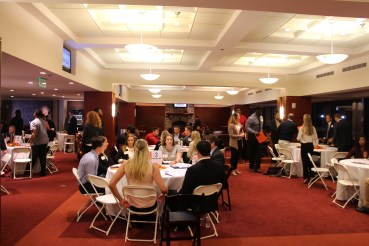
Blacksburg, Va,. Oct. 16–Students gather in the presidential suite in Lane Stadium for Career Jumpstart. Athletes had the opportunity to meet with workers from across the New River Valley to learn about life in the “real world.” Photo: Brady Hess

by Brady Hess–

Scott Morgan writes that in every sport other than baseball, less than two percent of collegiate athletes turn pro. At Virginia Tech, the Office of Student-Athlete Development within the Athletic Department has started Career Jumpstart to show student-athletes their options after their playing days are over.

According to hokiesports.com, the “Career Jumpstart provides opportunities for Hokie student-athletes to enhance career development skills, while interacting with alumni and professionals to make connections, learning about specific career fields, and enhancing their networking skills.”

Whether it is getting a feel for what the path is to become a medical professional or learning to change four tires on a racecar, a wide variety of work was on display in Lane Stadium.

Billy Hardee, a Doctor of Osteopathic Medicine at the Community Health Center of the New River Valley, said it was encouraging to see young athletes seeking out their options in the workforce.
The admiration also came from the student-athletes for their new colleagues.

“Tonight was really awesome,” said Mandy Powers, a senior on the Virginia Tech volleyball team. “We just had a great time meeting so many people from so many different companies.”

Like Hardee, other employers sang high praises of Virginia Tech for hosting an event of this nature for its athletes, but they also sang high praises for the student-athletes inquiring about their futures.

Kim Adams, the director of SOX and accounting policy at Union Bank & Trust, is also an alumnus of Virginia Tech. Adams said that she has always tried to give back to the school in which she attended and that Career Jumpstart provided another way for her to do just that.

“I never had the opportunity to do something like this when I was a student-athlete here,” said Dr. Billy Hardee, a former Virginia Tech student-athlete. “It’s great that this is very much a part of Virginia Tech and their athletic department.”

Hardee discusses his experiences with the event in the audio slideshow below.

Hokies versus Hurricanes

by Harvey Creasey–

IMG_0010
Richmond, Va., Oct. 12 — Accepting Awards     Undergraduate researchers Hisyam Mohsin and Sophia Lee accept an award on behalf of the Flint Water Study Team. Photo courtesy of Sophia Lee.


Virginia Tech’s commitment to research and aid throughout the water crisis in Flint, Michigan, brought national attention to the university and its research team. With civil engineering professor Dr. Marc Edwards at the helm, the Flint study team is expanding its reach to areas affected by recent natural disasters.

In the last two months, the United States has seen Hurricane Harvey rip through Texas, Hurricane Irma ravage Florida, and Hurricane Maria topple much of Puerto Rico. In fact, according to CNN, Puerto Ricans have resorted to knowingly consuming potentially dangerous water in the storm’s aftermath.

But the Hokie team, which helped to blow the whistle on hazardous levels of lead in Flint’s tap water, is now taking samples from wells in Houston and parts of Florida. Already, samples from Houston wells have tested positive for E. coli, as well as fecal indicator bacteria.

“The immediate reaction is to send tons of bottled water so people don’t have to deal with this,” said Sophia Lee, one of the undergraduates on the research team. “At the end of the day, we need a solution.”

The E. coli and other bacteria infiltrating Texas drinking water is a direct result of flooding and runoff, and likely damage and breaking of pipes and wells. According to Texas A&M University, Virginia Tech’s partner in the Hurricane Harvey research, more than one million Texas cattle have died as a result of affected water. While humans have not been affected to the same degree, the chemical change in the water is significant.

In addition to working with Texas A&M, the research team has also partnered with the University of Florida to gather and analyze water samples. Members also still make frequent trips to Flint, which, according to Dr. Edwards, is improving.

“It is difficult to be working on so many places at one time,” said Hisyam Mohsin, another of the undergraduate researchers. Mohsin and Lee received the Community Engagement Award at the University Professional and Continuing Education Association (UPCEA) conference this month.

As was true for residents of Flint, residents of the hurricane-affected areas in Texas and Florida have received national support and resources. Tech’s research team will require another grant to work on Puerto Rico, however. According to Lee and Mohsin, the desire to help is no weaker for the US territory.


UPDATE: As of Tuesday, October 24, the Research Team will start testing samples from Puerto Rico. More details to come.


Screen Shot 2017-10-23 at 10.38.48 AM
Click the photo to view the full infographic on Infogram.com

Boy (Scouts) will be boys?

by Ashley Wills, Humberto Zarco–

Photo credit: brizzle born and bred via Foter.com / CC BY-ND

The Boy Scouts of America announced it will become fully inclusive for girls for the first time in its 107-year history.

To support its decision, the BSA cited surveys of parents whose children are not involved in scouting that said 90 percent of parents surveyed expressed interest in signing their daughters up for a program like Cub Scouts. Eighty-seven percent expressed interest in a program like Eagle Scouts.

The announcement drew mixed reactions from the BSA community and indirect criticism from Girl Scouts USA. “The need for female leadership has never been clearer or more urgent that it is today — and only Girl Scouts has the expertise to give girls and young women the tools they need for success,” Girl Scouts said in a statement.

BSA membership has been declining for years. In 2016, the organization reported they had 2.3 million members, a decrease from 2.8 million in 2012.

For months, Girl Scouts USA felt BSA would try to start recruiting girls. Buzzfeed obtained a letter in August in which Girl Scouts President Kathy Hopinkah Hannah actually accused the BSA of recruiting girls to boost their declining numbers.

Digital News Delivery: We’ve got a Code Red!

Photo credit: Pixel Fantasy via Foter.com / CC BY-NC-ND


by Mary Desmond, Freddy Mesmer–

There are many apps out there for your smartphone. Some are games, others are social media apps, but what many people are missing is an urgent news app.

The Code Red Alert app is a unique way of presenting the user with constant updates of emergency news going on around them. The user-friendly interface makes this an app accessible for all. The news updates range from flood alerts to missing people in your area.

When it comes to apps, users want an easy to use app. This Code Red Alert app is very easy to set up and follow after it is set up. The interface includes a list of alerts as well as an option to look on a map to see where certain alerts are relevant to your location.

This app is unique because it combines all kinds of alerts into one app. Users now do not have to rely on a weather app or other apps to give them separate alerts. Now, they can go to the Code Red Alert app and have all their urgent weather and news based needs there.  

https://www.youtube.com/watch?v=0zFfdi0lLog&feature=youtu.be

Life in the fast lane

IMG_9971
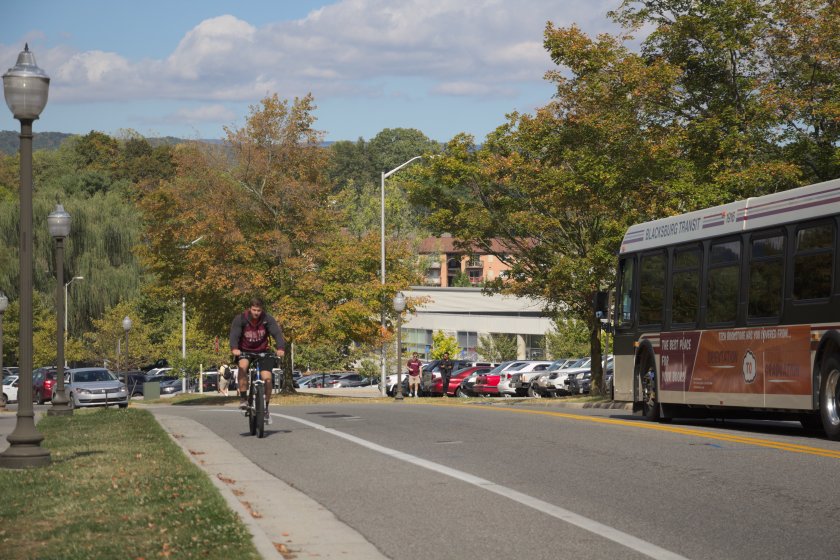
BLACKSBURG, Va., Sept. 29 – Students that choose to bike around and to campus have numerous bike lanes to use which helps create a safer commute around town. Photo: Nathan Loprete

by Nathan Loprete–

Virginia Tech has grown continuously over the years. With an increased student population comes increased revenue. However, that also meant increased traffic and a need for additional transportation methods. Luckily for Virginia Tech, Deborah Freed, who works for the school, recognized this problem in 2000 when she created the Alternative Transportation program.

One of the programs associated with the Alternative Transportation program is the Hokie Bike Hub which is located on Perry Street.

Alternative Transportation Assistant Chitti Raju has seen the biking community increase over the past few years at Virginia Tech.

“I think with more students, the number of bicycles will continue to increase,” he said.  “People are realizing it’s an easier way to get around and to campus.”

Now in 2017, the Bike Hub has helped Virginia Tech become of the better biking campuses in the country. In 2013, Virginia Tech was named as a “Bronze Bicycle Friendly University,” by the League of American Bicyclists which accounts for bike lanes, bike routes and fix-it stations.

Raju contributes the growth in cyclists to the size of the campus and the traffic which makes it safer to bike than in a heavily populated metro area.

The Hokie Bike Hub is one of the contributing factors to Virginia Tech being named a bicycle-friendly campus. Raju says The Bike Hub helps students repair problems with their bikes and according to student intern Mary Frazier it all starts with the willingness to learn.

“Having these tools for free is amazing because these are some very specific tools,” she said. “It empowers you to fix your own bike and learn more. The biggest part is learning how to fix your bike.”

The Bike Hub maintains a consistent flow of customers, especially while the weather is suitable but there are still those that brave the elements.

“Whenever it gets colder there’s less people that come in…but people that come in have more stuff going on,” said Frazier.

Raju talked about the idea of creating a “self-sustaining bicycle culture,” and the mission for the Bike Hub.

“Our goal is to get people and keep people on bicycles,” he said. “The idea of the alternative transportation department is to support and grow the community that takes any form of transportation that isn’t one person in a car.”

“What makes this place so awesome to bike, is the area itself because it’s so beautiful,” said Frazier.

There are other programs in the New River Valley that help promote cycling. The NRV Bike Kitchen is a non-profit organization in Christiansburg, “that distributes bicycles to those that can’t afford other means of transportation,” according to Raju.

With programs such as these and a campus that is focusing on alternative transportation, it’s no wonder why Virginia Tech’s cycling community is continuing to pick up speed.