Virginia Tech students can do more than take group fitness classes. Some are learning what it takes to teach them. Senior and aspiring instructor Sydney Sexton shares her experience with exercise leadership training as she works toward the VT Fitness audition in December.
By Alexandra Guerra, Crime, Safety, and Justice Reporter
Lane Stadium is known for its electric game day atmosphere, especially when thousands of fans jump to “Enter Sandman.” The stadium is designed to handle large crowds and the movement created by these traditions. Engineers monitor the structure and its performance to help ensure Lane Stadium remains safe for fans on game day.
Written by: Nico Aguayo, Arts, Sports, and Culture Reporter
A sport that emerged off the movie screen and eventually to Virginia Tech, jugger is a coed sport that has grown drastically throughout the club’s existence.
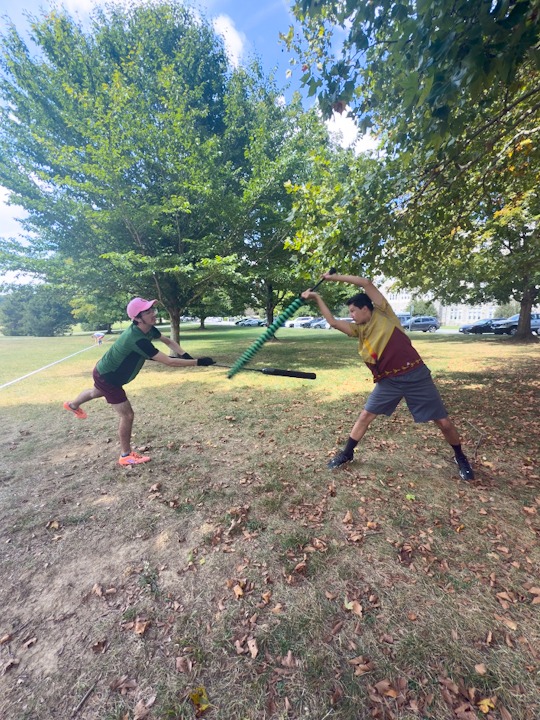
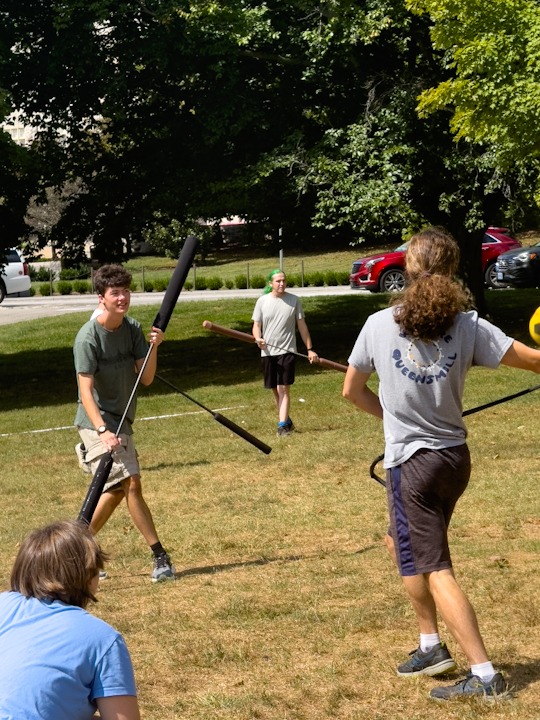
Based on “The Salute of the Jugger,” a 1989 post-apocalyptic film, the sport of jugger is a five-on-five live-action-role-play sport between two teams. Each team consists of a runner. This person is in charge of grabbing a ball and taking it to the opposing team’s base. Once the runner reaches the opposing base with the ball, he or she then scores a point for their team. What do the other four players on a team do, you might ask? Once the whistle is blown, the other four players, either an attacker or defender will enter a “duel” with a player on the opposing team. These players are armed with staffs or chains to try and stop the opposing runner or help their runner score. “To make a staff, you take a PVC pipe, put a foam material around it, and usually a woman’s stocking or other piece of fabric to give it a design,” said Isaiah Suazo, member of the Knights L’Hôpital, the Jugger club at Virginia Tech. In the duels, all it takes is your weapon to hit another player for them to go down for a certain amount of time, this time is called stones. From there, the duels will result in helping their runner get to the opposing base one way or another.
Staff player Isaiah Suazo defending against attacks from a fellow club member in Blacksburg, Va., on Sept. 13, 2026. (Nico Aguayo, The News Feed NRV)
The club began in the spring of 2023 by a group of friends who just enjoyed playing jugger by themselves. They played jugger once that spring semester, before officially starting the club that fall. “When I came to Virginia Tech my freshman year, I was scrolling through gobbler connect to find stuff and I saw them, (Jugger Club) and just showed up one of the first Sundays they had practice,” said Janos Erdelyi, president of the Jugger Club. From what started with fewer than 10 members flourished to over 30 active weekly members of the club. “I joined when I was a freshman and have been here every week since. Genuinely my whole freshman year, I’ve been here and now I am starting my sophomore year and I will be doing the same for the next 2-3 years,” Suazo told me.
The club hosts multiple events throughout the week. On Sundays they have open practice, no matter what the weather might bring. Last semester, there was even a practice with snow on the ground. Erdelyi makes sure to make food for those who show up for winter practices. These practices start with a mini game called zombies. Zombies is a free for all game that helps the members warm up. From there, the members break out into teams to practice. “Practice used to last from noon to 2 p.m., then it became noon to 3 p.m., and now we just play until everyone gets tired,” club officer Zach told me. On Wednesdays, the club also hosts a laid back event that lasts from 8 p.m. to sometimes even 1 am. This practice time is more focused on members spending time with one another and having fun instead of focusing more on just playing the sport.
On Nov. 7, the club is headed to Chapel Hill, North Carolina for the annual Moonshine Cup. This is a tournament between different jugger clubs across the country. Last year, the tournament took place in Arizona. “It was incredible food, incredible company, and two days of running around in a beautiful 70 degrees,” said Suazo. This year, the team aims to bring three different teams from Virginia Tech to compete. “We have started to implement tactics seen from Manchester,” Suazo told me. This year, the team is focused on more of a man-to-man approach rather than chancing it at a random duel. “Each team and club has their own tactics to an extent,” Erdelyi explained. There will always be one runner, players with staffs, and only one chain. Erdelyi, who is a senior now, is a chain player. A chain is made up of a soccer ball attached to a rope. This weapon is thrown and pulled back allowing chain players more range to try and hit opposing team players.
President of the club, Janos Erdelyi, using his chain to attack fellow club member in Blacksburg, Va., on Sept. 13, 2026. (Nico Aguayo, The News Feed NRV)
The club focuses on more than just the tournament aspect of jugger, they focus on being one of the only coed Virginia Tech sports clubs on campus. “I think it’s really important that we have these more physical activities, especially for people that didn’t get to partake in the traditional sports but are nerdy enough to sword fight, it’s cool,” said Suazo. The club is open to anyone, no matter what year, no matter what skill level you have, and most importantly, no matter who you are.
For more information you can visit the club’s Instagram page @juggeratvt.
by Caroline Garcia, arts, culture and sports reporter.
Virginia Tech now has a women’s club golf team for the first time, and now has over 20 girls playing and competing in its first seasons.
As the school year starts ramping up, so are athletics at Virginia Tech. Freshmen and other students alike are trying out for club and rec teams. But not all sports are created equal. Just a year ago, there was no club sports team for women’s golf, despite a flourishing men’s team with over 80 members.
Emma Miller was a student eager to join club golf in college, only to find herself in a large room with only men golfers. Rather than quitting or being the sole woman on the team, Miller thought of the idea to start a club team for women to play golf at Virginia Tech.
In an interview, Miller speaks on her experience starting the women’s club golf team and motivations behind it.
Her comments were edited slightly for length and clarity.
What was the experience like trying out for the men’s team?
I was the only girl on the team that made it, out of, I think, three girls that tried out. There weren’t as many girls anyway in the beginning — there were 85 guys on the team, and I was the only girl. So I was like, this is way too many men. But I went and I made the team.
Women’s club golf president Emma Miller gets ready to hit a fairway shot during a match. Photo courtesy of Emma Miller.
What was the process of creating a women’s team?
I talked to the president of club golf and I talked to the rec sports office. I said, do you think it would be possible if we made a women’s branch of the team so that they can try out and not be intimidated, even playing with guys? They said, “You can start a women’s team. It’ll just be a branch — we’ll have a position for you, women’s captain.” So we went and did that. Then I made the Instagram account, sent out tryout information. We got 25 girls to try out, and then we had 15 to 20 girls make the team. That was a lot of fun, but it took a lot of work.
What does it look like to have a branch off the men’s team?
We’re not fully split, because we’re coed. We have people to run stuff for us, like our Instagram, so that we get more girls. We’re allowed to host our own events and call ourselves the women’s club golf team. We get to do things on our own.
How long did the process take to officially become established?
It took about a year and a half to officially become established. I talked to the sports club advisor, and it’s official as of September 2025. I’m on exec and the board so that the women have more of a say in what they do. For tournaments, it’s actually really easy for us, because the guys still handle all that. We have enough representation that we can send four to six girls to tournaments, when we used to send none. It was a pretty smooth process getting tournaments for the women, but it was a pretty long process to get us situated and set up as an official branch.
In tournaments, do you play against other women, or how does that work?
We usually play against guys, because we’re the only team in our conference that really has any women.
What motivated you to create a team for women to feel comfortable playing on?
Girls were really intimidated because there were 70 guys while claiming to be coed. I was really motivated to get the team started because I want a safe space for girls to be able to play golf and feel like they can play and be competitive at the collegiate level without worrying about how they’re playing because of the guys and what they say.
How has your relationship been with the men’s golf team? Are they accepting or helpful?
Yeah, I like to be close with the president and all of our exec members. We’re trying to get a little more involved with what they’re doing, because their events are a little different than ours. We’re trying to get incorporated into those events a bit more. Now that we have the club set up and situated, the relationships are going to be a little better, because we’ll be closer to them and able to hang out and play golf with them more. I feel like that’s just what we need.
Do you wish other schools had women’s club golf teams? Why do you think they might not yet?
I feel like the reason they don’t really have other teams is because they don’t know the demand for women in golf — there are a lot of girls that play, they’re just intimidated, and schools haven’t taken the steps to be less intimidating. Hopefully, once they see that teams like ours are out there, they’ll be inspired to take steps toward having their own women’s team.
Is there anything else you wish people knew about women’s club golf, or club sports in general?
I would just say it’s very important for women to be involved in sports in college, because not a ton of people go after that. I feel like it’s super important to have people that support you.
What has been your favorite part of being a part of, or leading, the club golf team?
I guess I just really love the community. I love my people — they’re really fun, really awesome. We do a lot of things together, which is really nice. We golf together, and a lot of the time we also get better.
Have you seen growth in the girls since starting?
Yeah, I’ve seen a lot of girls get better. One girl was shooting in the 50s, and then as soon as she and I were playing together, we really challenged each other, and now she’s shooting in the low 40s, which is pretty good.
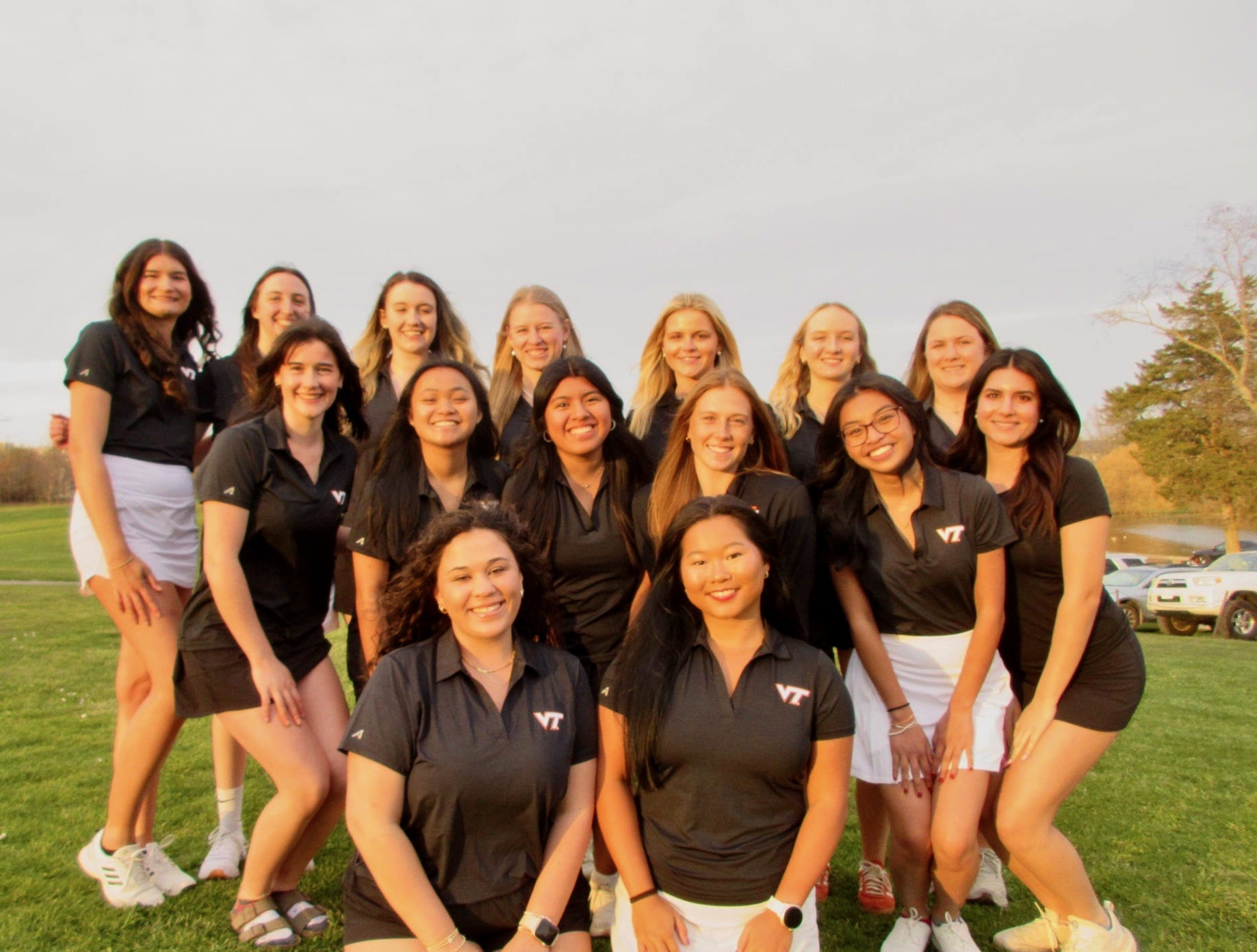
Team photo of the women’s club golf team, Spring 2026. Photo courtesy of Emma Miller.
By Nico Aguayo, Arts, Sports, and Culture Reporter
There has been a lot of change to Virginia Tech’s football program this offseason. To David Cunningham, managing editor for Virginia Tech Sideline, it has been a change he’s never seen before.
Virginia Tech has had one of its most active offseasons in program history. With the addition of head coach James Franklin and more than 50 coaches and players, there’s new territory for everyone. New territory as well for former Virginia Tech student and now managing editor for Tech Sideline, David Cunningham. In an interview with Cunningham, he spoke on the new opportunities, possibilities and future for this new Virginia Tech football program.
David Cunningham, Managing Editor of Tech Sideline. Credit: David Cunningham
Responses were edited slightly for length and clarity.
What does James Franklin bring to Virginia Tech that the program may have been missing in recent years?
I think James Franklin has such a special trait as a CEO-type of coach. He really has his hands on every single facet of a football program, whether that’s construction or what the inside of the training room looks like to the social media posts. He puts so much time and effort into all of the little details. He’s also a big-time recruiter, which Virginia Tech has never had before. The way he goes out and picks up big-time recruits is unlike anything the Hokies have ever had. On top of that, he is a great fundraiser. I think you’ve seen what Virginia Tech has been doing over the last handful of months since he’s arrived. Franklin is a salesman, that’s what he does. He has really elevated Virginia Tech in a lot of areas that the Hokies never thought they could reach because they never had a coach like him. He’s obviously a very good football coach, but he’s so much more than that.
Of all the roster moves Virginia Tech has made this offseason, which one do you believe will have the biggest impact on the Hokies this season?
I think Ethan Grunkemeyer at quarterback. He was a big-time pickup even though he doesn’t have a ton of game reps under his belt. He came from Penn State where he started the final seven games last season for the Lions when their starting quarterback went down with an injury. He’s got multiple years of eligibility ahead, which I think is very exciting for the program. I also would look to the defensive side where they brought in Jaquez White from Troy. He was an All-Sun Belt selection last year. White is very talented, shifty, and you can leave him alone on an island. I think as the Hokies get deeper into the season, they will rely on him a lot more. In the last handful of years, cornerback has been a position that the Hokies felt kind of shaky about. They had Dorian Strong and Mansoor Delane, but since then it’s really teetered off. This year, they brought in Jaquez White along with a couple other transfers, Cam Chadwick and Kenny Woseley. I think the cornerback room is in a much different place than it has been in recent years.
What does hiring Brent Pry say to the team and fans who know him as our former head coach?
Well, first off, I think it takes a lot of guts for Pry to own up to his shortcomings as a head coach. He failed and he’s admitted that openly, but the bottom line is wherever James Franklin was going to go and be a head coach, he was going to take Brent Pry. They worked together for a very long time at Penn State, and I think when you have as long of a relationship and as tight of a relationship as they do, it makes it really easy for them to kind of pick right back up where they left off. James Franklin has referred to him as the best defensive coordinator in the country, which is how highly he thinks of Pry. If Franklin had taken a different job, Franklin was going to take Pry with him. It just so happens that the job was Virginia Tech. It is weird, but I think the dynamic has been accepted by the fans because they look at Brent Pry’s history and see the defense on the field. I think he’s back to his old self again. He’s hands-on with the defense calling blitzes and coverage. That’s the kind of stuff that got him into football in the first place and something he loves doing.
What do these offseason moves tell you about how Virginia Tech’s athletic department views the future of the football program?
I think it all starts back with the invest to win plan that was put together by the board of visitors last fall where Virginia Tech came to the table and said, if we want to be competitive in football, we have to fund the program like other Power 4 schools are. That’s a big reason why James Franklin is here. From a fundraising standpoint, a philanthropy standpoint, and an investor standpoint, they’ve done a much better job of making themselves competitive. For offseason roster additions, Franklin signed a highly rated recruiting class, signed a pretty good transfer portal class, and brought in all of these coaches. This program is going to have its trajectory completely changed simply because of what Franklin has been able to establish in such a short period of time. All of these offseason moves show you where this program can really go if it continues to build up speed and momentum. It might not happen this year, but I think the Hokies have a bright future ahead with Franklin.
Besides the overall record, what would you consider a successful first season for James Franklin at Virginia Tech?
I think him making a bowl game, so winning six games, would be a big step in the right direction for the program. This is also James Franklin we are talking about. He’s won 68% of his career games as a head coach. He’s never coached a team that did not make a bowl game. I think that’s the baseline. The schedule is very difficult in the second half of the season, but I think there are opportunities along the way to really get the fan base to buy into the future plan of what Virginia Tech football is going to look like in these next few years. I think at the end of the season, Virginia Tech fans will look back on this year and see that we are in such a different place than we were at this point last year. I think the future is bright because of how James Franklin has basically built this program up since he took over in November.
Editor’s note: The Hokies play the Old Dominion Monarchs in Lane Stadium Saturday, September 12 at noon.
Your first Virginia Tech game day can be an overwhelming experience. The Virginia Tech Rescue Squad shares advice on staying safe and responsible.
With football season finally here, new students have the chance to experience their first Virginia Tech game day. Whether it’s your first time on Center Street, at the tailgating lots, or at Lane Stadium, it can be a lot for first-timers.
Senior undergraduate student and Virginia Tech Rescue Squad Chief Alec DiLeonardo has been a part of the Rescue Squad since his freshman year. This has given him firsthand experience with health and safety concerns on and around game days.
This interview has been edited for length and clarity.
Virginia Tech Rescue Squad Chief Alec DiLeonardo, courtesy of @vt_rescue on Instagram.
For a freshman experiencing their first game day, what are the biggest safety concerns they should be aware of?
For first game day of the year for freshmen, it’s an exciting time; you’re going out, you get to experience the Lane Stadium experience for the first time.
Some of the safety concerns that we, on a public safety side, want everyone to watch out for is obviously, a lot of people like to consume alcohol. We encourage you to be mindful, be smart, and to not overdo it.
Hokie Wellness actually has a really good web page called Party Positive. It has a whole page of things to consider, such as choosing if and what you drink, pace yourself, it’s not a race, eat before you drink, and make sure you designate a non-drinking driver.
So those are all things that we want people to take into account before they take a sip of alcohol. What could the potential consequences come of this if they are not responsible? This web page also talks about at what point it’s no longer just recreational drinking, and now we’re transitioning to alcohol poisoning, and when medical interventions need to take place.
If someone realizes their friend has had too much to drink, what is the safest next step?
So for us, where EMS and Rescue Squad intervene and where we get called for, on typical game days, weekends… it is a higher level of alcohol intoxication, so alcohol overdoses. Those usually are apparent if, say, your friend is now breathing abnormally. They’re breathing less than 10 times a minute. Those are things that we start to get concerned with, and where the alcohol has now transitioned from no longer just being an intoxicated state to now where medical interventions may need to be taken.
The biggest thing too is checking for pain responses. So give them a nice big old pinch right on the traps, right above your shoulder. Pinch them anywhere. If there’s no pain response, they don’t look up at you or speak to you after that, and they are fully unconscious; that’s when we encourage people to call 911.
Center Street is a big frenzy, and people are always excited to go there. That’s not our territory, but we do partner with Blacksburg Rescue and Blacksburg PD on that. Both of those agencies are staged at Center Street during the festivities. So if there is at any point where you feel a friend is either having a medical emergency or is showing signs of alcohol poisoning, find a police officer, find a rescue member, or just call 911.
Where should a student go if they start feeling sick or overwhelmed in Lane Stadium?
Kind of the same as if you have a friend, or you see someone in the stands or at Center Street, who’s exhibiting signs of unconsciousness, possible alcohol poisoning, or any medical emergencies that can pop up during these times. Find a police officer at any of the portals in the stadium, so the path out into the stands. There are always police officers there.
Come to one of our first-aid stations. They’re displayed on the scoreboard throughout the game. They are also indicated by the big red star or the cross over the doors. Any of our rescue members that are with Virginia Type Rescue will be in a high-vis vest. So either a lime green or a neon orange. That indicates that we’re EMS to people. Or, again, just call 911.
What mistakes do you see people making in their first few game days?
Overindulging or overintoxication is definitely one of the different things that we see. Some of it, too, is that they’re just not familiar with the area. So, getting lost, separating from their friends.
We always encourage you to stick together, whether you’re in a big group or not. Say you are in a group of 10, 15 people. Make sure there’s at least one or two people in there that you are always stuck with. One of the biggest things that we see is people coming to us solo. They don’t have any friends with them. Well, we need to find someone to release them with if they’re still in a certain state. In general, we encourage everyone to stick together. That’s for everyone’s safety as well.
With this new load-in procedure this year as well, when students enter the gates, pretty much whoever they’re standing with during load-in is who they’re going to be sitting next to. So when students are coming in through the portals to be seated into their seats, there’s actually going to be ushers putting them into rows, and whoever you’re sitting next to or standing next to going down the steps or going up the steps to your seat is who you are going to be stuck next to for the first half. Throughout the game, you can get a move around, but this is to help make load-in smoother and a lot safer for everyone as well.
What would you say to a freshman who’s afraid to get themselves or their friend in trouble by calling for medical help?
From an EMS side, this is something we deal with on a weekly, day-to-day basis. People are worried that they’re gonna get in trouble, and they won’t tell us stuff.
If your friend needs medical attention, call. We may ask you questions that may feel like you will get in trouble for. We are just trying to understand the full situation from an EMS side, how we can better treat that patient, your friend, if something has happened to them.
On August 24, 2026, Virginia Tech Athletic Director Brian White announced a plan to improve cellular coverage at Lane Stadium in his first address to the Virginia Tech Board of Visitors.
Cellular signal in Lane Stadium is often impacted on gamedays, with fans experiencing trouble sending text messages or making calls. A temporary solution will be put into place for the 2026 season, with a permanent solution following suit for the 2027 season.
Jeffrey Reed, Willis G. Worcester Professor and co-director of Wireless @ Virginia Tech is a professor in the Bradley Department of Electrical and Computer Engineering. Reed’s areas of research include cognitive radio and smart antennas. In an interview ahead of Virginia Tech’s first gameday on Sept. 5, Reed spoke about the science behind cellular technology and what impacts cellular signals.
What’s your background in cellular technology?
I’ve been here since 1992. I was here during the early days of the wireless revolution. Before that, I worked for a defense company doing military communications and got my PhD at the University of California Davis looking at interference issues. It turns out that the key problem with cellular communications is interference issues. So it was natural for me to get involved within commercial wireless. I’ve been around, and I’ve seen a lot of things.
What is the basic science behind cell signals?
The basic science behind it and the key why cellular works is that signals get attenuated as a function of distance. So the farther you’re away from the cell tower, the lower the signal. Eventually, it reaches a point where the signal has degraded in strength enough where you could have another signal, and that could be from another tower that uses the same frequency. So, unlike a broadcast network, like a TV station or a radio station, it tries to maximize its coverage. The cellular networks take advantage of being able to transmit in a limited region and reuse the frequencies. That gives us the ability to reuse the channels, which allows for a lot more users to be able to use the spectrum, because we reuse the channels.
Is utilizing large cell towers still the norm for cellular networks?
The big cell towers are no longer really being deployed very often. It’s the small systems, the indoor systems that are very small. They may repeat the size of a Wi-Fi access point or a little bit more. Those have become popular, and cell sites that sit on top of a light pole — those are very popular. However, the big giant cell sites that people see from the highway — very few are being deployed.
Is it common for rural areas to have worse signals than urban areas?
That’s very true. There’s still places in the state in which there is very lousy cell phone coverage, if it exists at all. Mostly what’s being deployed now are low power systems that add capacity to the network. So you could have more simultaneous users of the cellular network. That’s the big problem in the stadium. You know, a touchdown happens, and people want to take a picture and send it to their friends and family. Everybody’s using their cell phone at the same time. There’s a capacity limit.
Are there other factors that would impact cell signals on a gameday?
If you’re moving or not, that could make a difference. It depends too on the frequency band that is being used. Lower frequency bands tend to have better propagation characteristics. They can go further. They’re not as likely to be blocked by obstacles. Higher frequencies, on the other hand, you have those issues. They tend to be shorter ranges and blocked by signals. Most of the new spectrum that has been released over the higher frequency, that’s because we ran out of spectrum in the lower frequencies. So now we have to resort to the higher frequencies, and the propagation characteristics aren’t as good.
Theoretically, what would updating the signal in Lane Stadium look like?
I suspect that they’re going to put more cell sites around. Even now, organizations such as Verizon bring in C.O.W.S. during a game. Cells on wheels. It’s a mobile cell site. They set it up to be able to handle the additional demand for the network. So they’ll probably deploy more infrastructure to be able to improve the capacity. They may use additional bands as well.
Does the quality of the cell signal change depending on the provider?
Yeah. Generally speaking, the best provider depends on the area. I’m not gonna go out on a limb and tell you what I think the best provider is, but if you don’t have good cell coverage, you can think about changing providers. It’s a matter of how much infrastructure they have and what frequencies you’re operating on.
What is the future of cellular technology innovation?
We’re in the 5th generation of cellular now, and starting next year, we’ll probably start the standardization for the sixth generation. So, engineers will be working together to come up with what that 6G standard will be. 5G was developed with three things in mind: mobile broadband access, ultra reliable and low latency communications and massive machine to machine communications. Mostly what people have seen, though, is the mobile broadband. We really haven’t seen much of the other applications yet. I suspect we will start to see them in 6G.
This interview was edited for length and clarity.
Jeffrey Reed in his office holding a cell phone. Photo Courtesy of Ben Murphy for Virginia Tech News.
Virginia Tech Men’s Basketball is placing a growing emphasis on hydration, nutrition, and recovery, enabling players to perform at their peak potential
By Owyn Dawyot, Health and Wellness Reporter
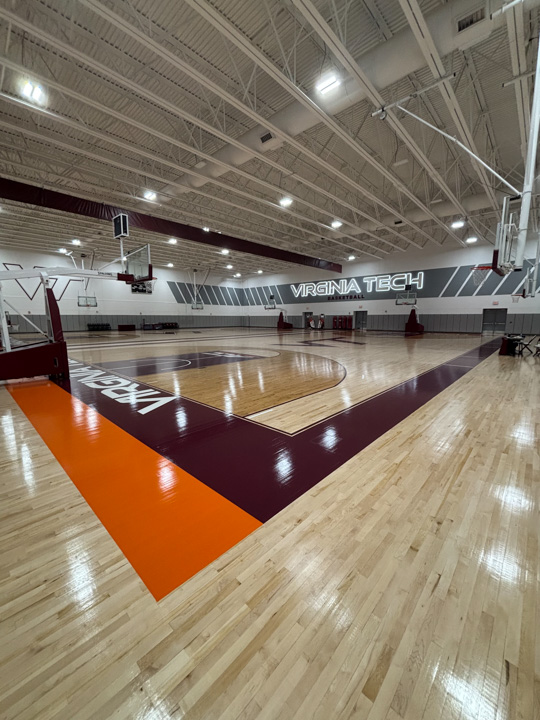
Pictured is the Hahn Hurst Practice facility. Both the men’s and women’s basketball teams train and practice here year-round. By Owyn Dawyot – May 10, 2026
For many college athletes, health and nutrition is often something that gets pushed to the side. Between late-night studying, inconsistent sleep schedules, and having a social life, maintaining healthy habits can feel nearly impossible. However, inside the world of Division I athletics, players and staff are increasingly treating health and recovery not as optional, but as a critical part of success.
For Virginia Tech Men’s basketball player Jaden Schutt, prioritizing health started long before college. Growing up in a household where nutrition and fitness were constantly emphasized, he quickly learned that what he put into his body directly affected how he performed on the court.
“I would say in the last few years, honestly, just making sure I’m hydrated, I have enough sleep, and just eating a lot cleaner,” Schutt said. “I wake up and drink salt water, take hydration mix, and make sure that’s the first thing I’m getting in.”
While many athletes focus primarily on training and skill development, Schutt believes recovery and nutrition are equally important. He explained that his daily routine revolves around whole foods, hydration, and limiting processed ingredients.
“A lot of things I cut out are artificial dyes, sugar in general, and junk food,” he said. “I’m trying to burn fuel as efficiently and as clean as possible.”
Schutt said he began taking nutrition seriously around fifth grade when he started playing competitive sports regularly, claiming that seeing the difference in his own performances made it difficult to ignore how much nutrition mattered.
“I really didn’t want to have a bad game, so I was trying to do everything I could to play to the best of my ability,” Schutt said.
That mindset only intensified as he got older and watched the habits of people around him. Schutt described how observing his older brothers gave him firsthand examples of both healthy and unhealthy lifestyles.
“One brother took things really seriously, and another didn’t,” he said. “I kind of watched their habits and who was getting more success.”
For Schutt, the connection between healthy habits and athletic performance became obvious over time. He said that while athletes can temporarily adapt to unhealthy eating, the long-term effects eventually appear physically and mentally.
“I’ll notice my skin start breaking out, and my joints are hurting a little more. If I really take it seriously and eat the way I want to, I recover faster, feel better, and my joints are less painful,” Schutt admitted.
“If you take care of your body, it takes care of your mind.” – Jayden Schutt
Schutt also believes the benefits extend far beyond basketball. “If you’re feeling good, you’re going to be a nicer person,” he stated. “If your back’s hurting or you’re irritated, you go through life a little cloudy.”
He compared good health to carrying “sunshine” internally, explaining that taking care of your body positively affects your mentality and relationships with others.
The emphasis on health and recovery is not just coming from players themselves. Behind the scenes, sports nutrition staff members are helping athletes understand exactly how nutrition, hydration, and recovery impact performance.
Savannah Gustafson, director of basketball sports nutrition at Virginia Tech, works directly with athletes to optimize their diets and recovery routines throughout the season. According to Gustafson, hydration is one of the most overlooked but important aspects of athletic performance.
“We push hydration really heavily here to make sure we’re preventing injury risk and electrolyte imbalances,” Gustafson stated. She elaborated that this is extremely crucial, considering some players lose almost 10 pounds of fluid per practice from sweat alone.
Gustafson explained that athletes undergo hydration testing regularly so staff members can tailor hydration plans to individual players. Research on dehydrated Division I basketball players, she said, shows noticeable declines in shooting accuracy, focus, and energy output.
“They sent basketball players out already dehydrated, and their shooting percentage was down,” Gustafson said. “Their ability to exert energy was decreased.”
Sleep is another major priority for the program. While many college students stay up late playing video games or scrolling on social media, athletes are encouraged to maintain disciplined sleep schedules during intense training periods.
“They’re 18 to 22 years old, so they want to stay up late, but sleep is so important for recovery and coming in with a clear head each day,” Gustafson stated.
Nutrition before and after workouts is also carefully planned. Gustafson stated that athletes are typically given carbohydrate-heavy foods before workouts to provide energy, while post-workout meals focus heavily on protein and recovery supplements.
“We want them going into practice well fueled with carbohydrates,” she said. “Then, following a workout, we’re pushing heavy protein intake for recovery purposes.”
Among the recovery tools used by athletes is tart cherry juice, which Gustafson said can help reduce inflammation and aid recovery after strenuous practices.
Pictured is the men’s basketball team’s kitchen. This area is regularly stocked with convenient, healthy options for players to grab on the go as they’re making their way in and out of the locker room between practices and team lifts. By Owyn Dawyot – May 10, 2026
Despite having access to elite resources, Gustafson said many athletes still struggle with consistency when it comes to nutrition. Convenience plays a major role in eating habits, especially for busy college athletes balancing practices, travel, and academics.
Due to demanding schedules, athletes often rely on quick meals instead of cooking for themselves. Gustafson explained that while ideal nutrition is important, ensuring athletes simply eat enough during the season is also critical.
“In season, I’d rather them be eating than not eating,” Gustafson said. “If it has to be Chipotle, that’s fine with me.”
She also noted that many incoming freshmen arrive with very limited nutrition knowledge. “A lot of times, they’ve just been tall and strong their whole life, and that got them here. If they know what a carb, protein, and fat are, I’d consider that pretty advanced for a high schooler,” Gustafson stated.
Transfer athletes from smaller schools sometimes possess slightly more practical knowledge because they previously lacked access to nutrition staff and had to learn independently. However, Gustafson said many athletes still do not fully understand the relationship between nutrition, inflammation, immunity, and recovery until they arrive at a Power Five program.
Schutt said watching professional athletes has also reinforced the importance of recovery and health. He specifically mentioned players like LeBron James and Shai Gilgeous-Alexander as examples of athletes who heavily invest in their bodies.
“You’re seeing LeBron getting oxygen tanks and doing all these things for his health,” Schutt said. “You start to realize how much professional athletes spend on their health because it’s their job.”
For Schutt, healthy habits have become less of a temporary in-season routine and more of a lifestyle. He admitted that when he was younger, he would celebrate the end of a season with donuts, cookies, and junk food. However, over time, he realized how difficult it became to regain conditioning after unhealthy stretches.
“It’s so hard to get back into shape,” Schutt claimed. “I’d rather sacrifice the opportunity to cheat on meals than let my body go.”
“Nutrition habits capitalize in a good or bad way.” – Savannah Gustafson
Gustafson emphasized that the effects of nutrition are somewhat of a snowball effect. According to her, the differences between a well-fueled athlete and an under-fueled athlete may not appear immediately, but they become very noticeable over the course of a season.
Beyond basketball performance, Gustafson said one of her goals is to help athletes build habits that will continue after sports end. Transitioning away from athletics can be difficult physically and mentally, especially for athletes whose daily routines have revolved around training for years.
She explained that many former athletes struggle after retirement because they no longer maintain the same level of activity but continue the same eating habits. Helping players understand long-term wellness, she said, is just as important as preparing them for games.
For Schutt, that long-term perspective already shapes the way he approaches health today. Even after basketball, he expects to continue prioritizing exercise, clean eating, and recovery.
“I think especially when I’m getting older, I’ll try to eat as healthy as I can and maintain a nice workout routine,” Schutt stated.
As conversations surrounding mental health, wellness, and performance continue growing in sports, athletes are increasingly recognizing that success depends on more than talent alone. Recovery, sleep, hydration, and nutrition are becoming foundational pieces of athletic performance rather than secondary concerns.
For athletes like Jaden Schutt, the goal is simple – treat the body well now in order to perform better today, and to live healthier tomorrow.
By Andrew Honaker, Arts, Culture and Sports reporter
The structure of college athletics is shifting rapidly, and programs like Virginia Tech are already feeling the impact.
On any given weekend in Blacksburg, the atmosphere around college sports still looks familiar. Fans pack into Lane Stadium, traditions remain intact, and the pageantry that defines college athletics continues to draw attention. But beneath that surface, the system that has long defined college sports is undergoing one of the most significant transformations in its history.
From changes in player movement to the growing influence of name, image and likeness (NIL) deals, the traditional model of college athletics has been replaced by something far less predictable. What was once a system defined by stability, continuity, and clearly defined rules has evolved into one shaped by financial competition, shifting regulations, and constant roster turnover.
Triumph NIL collective supporting Virginia Tech athletes. (Courtesy: Triumph NIL)
Now, with federal involvement entering the conversation, the future of college athletics faces even more uncertainty.
In April 2026, President Donald Trump signed an executive order aimed at stabilizing college athletics amid growing concerns over NIL, transfers and financial imbalance. The White House described the current system as a “chaotic state of affairs,” driven by inconsistent rules and an “out-of-control financial arms race” that threatens both universities and non-revenue sports.
The order represents one of the most direct federal efforts to address the evolving structure of college athletics, a system that many believe has outgrown its traditional governance model. While college sports have historically been governed by organizations like the NCAA, a combination of legal challenges, state-level legislation and financial pressures has weakened centralized control.
Bill Roth, the longtime radio voice of Virginia Tech football and a Sports Media and Analytics professor, said the transformation of college athletics has already been dramatic, even before federal involvement became part of the conversation.
Bill Roth, radio voice of Virginia Tech football and professor. (Courtesy: Bill Roth)
“The guardrails that had been in place for years no longer exist, and the money flowing directly to athletes has increased exponentially“
Bill Roth
Over the past several years, a series of court rulings have reshaped the legal framework surrounding college athletics. Decisions at both the federal and state levels have challenged long-standing NCAA restrictions, particularly in areas related to compensation and eligibility. As a result, schools have been forced to adapt quickly to a system that is still evolving in real time.
Recent policy changes have weakened many of the traditional structures that once governed recruiting, player movement and financial distribution. Without those guardrails, schools are now operating in an environment where competitive advantage is often tied directly to financial resources.
At the same time, the lack of consistent oversight has left the system without a clear governing structure.
“The business of college athletics can’t govern itself, but the role of the federal government isn’t to fix bad business models,” Roth said.
That tension — between a system that lacks internal control and uncertainty around external regulation — is at the center of the current debate surrounding federal involvement in college athletics.
While those changes are happening at a national level, their effects are already being felt at Virginia Tech, where programs are adjusting to new realities in recruiting, roster management and financial planning.
Evan Hughes, the play-by-play broadcaster for multiple Virginia Tech sports, said two developments have driven much of that change: the transfer portal and NIL.
Evan Hughes, play-by-play broadcaster for Virginia Tech athletics. (Courtesy: Virginia Tech Athletics)
“The two biggest changes in college athletics over the last few years have been the transfer portal and NIL,” he said. “It’s been unique to see how both sometimes go together.”
In the past, roster stability was a defining characteristic of college sports. Players typically developed within a program over several years, and coaching staffs could build long-term systems around returning athletes. That model has shifted dramatically.
The transfer portal has created a system where player movement is more fluid than ever before, allowing athletes to change programs with fewer restrictions. At the same time, NIL opportunities have introduced financial considerations into those decisions, adding another layer of complexity.
Those shifts have directly influenced how teams are built and maintained from year to year, creating new challenges for programs trying to balance competitiveness with financial limitations.
“Teams only have a certain amount of money to work with NIL-wise, and that varies by sport,” he said. “That impacts how rosters are built and how teams retain players each offseason.”
As a result, roster continuity — once a cornerstone of college athletics — has become increasingly difficult to maintain. Coaching staff must now navigate not only recruiting and player development, but also retention, financial allocation and external competition for talent.
Financial differences between programs have only intensified that issue, creating a growing divide across the college sports landscape.
“The rich get richer, and smaller programs can’t always keep their best players because it’s essentially free agency every year.”
Evan Hughes
That disparity is particularly significant for programs like Virginia Tech, which must compete against schools with larger financial resources and more established NIL infrastructures. While Virginia Tech remains competitive within its conference, the broader national landscape has shifted in ways that make sustained success more difficult to maintain.
Adjustments are already underway at Virginia Tech, where leadership has begun to respond to the changing environment.
“We’ve already seen it,” Roth said. “The Board of Visitors has enacted major changes in the last few months to adjust how athletics operates at Virginia Tech.”
Those changes reflect a broader shift across college athletics, as schools attempt to adapt to a system that continues to evolve without a clear long-term framework. From restructuring budgets to exploring new revenue streams, athletic departments are being forced to think differently about how they operate.
One of the biggest questions moving forward is sustainability — a challenge that extends beyond individual programs.
“Where the revenue will come from at most schools, including Virginia Tech, is the biggest challenge,” he said.
As expenses increase and competition intensifies, many programs are relying more heavily on external revenue sources. Media rights, in particular, have become a central driver of financial growth in college athletics.
The increasing reliance on media revenue, particularly from television deals, continues to shape the direction of college sports. Expanded playoff formats, conference realignment and increased media exposure have all contributed to a system where financial success is closely tied to visibility and broadcast value.
“Media rights are paying for all of this, and the chase for additional revenue will determine the ‘haves’ and ‘have nots’ of the next generation of college athletics,” he said.
That divide — between programs with access to significant media revenue and those without — is expected to widen in the coming years, further reshaping the competitive landscape.
As financial stakes continue to rise, the potential for federal involvement adds another layer of complexity.
The executive order outlines possible changes to eligibility rules, transfer limits and NIL regulation, all aimed at creating a more standardized system across college athletics. However, questions remain about how those changes would be implemented and whether they will address the underlying issues facing the sport.
Uncertainty surrounding those changes is already influencing how programs operate.
From roster decisions to long-term planning, athletic departments are being forced to adapt in real time while navigating a system that continues to shift beneath them. Without clear, consistent guidelines, schools are left to make decisions in an environment where rules may change at any moment.
At the same time, the way college athletics is covered has also evolved.
“It’s unique now to see college sports covered like professional sports, with deals being negotiated openly and buyouts becoming part of the conversation,” Hughes said.
That shift reflects a broader transformation in how college athletics is perceived. As financial elements become more visible, the line between amateur and professional sports continues to blur, changing both how the games are played and how they are discussed.
For programs like Virginia Tech, the challenge moving forward will be navigating that new reality while maintaining competitiveness and stability in an increasingly complex system.
With federal involvement now part of the conversation, the future of college athletics remains uncertain — shaped by financial pressures, evolving policies and the ongoing search for a sustainable model.
For now, the only certainty is that the system continues to change.