Whether you are a Virginia Tech student, faculty member, or staff, finding a spot on campus can turn out to be one of the most challenging tasks of the day.
Some attribute this to the high number of faculty/staff parking spots versus the low number of spots attributed to students, while others say that it is due to Virginia Tech Parking and Transportation issuing too many parking permits.
According to the commuters we spoke with outside of the Squires Student Center, while the causes of this parking problem differ, the solution is simple – build another parking garage.
According to the Master Plan released by Virginia Tech in 2017, the university hopes to remove the Squires parking lot and the Duck Pond parking lot and add vertical parking solutions, such as parking garages.
Blacksburg, Va., Feb. 26 – A NEW BUSINESS: Foamo opened its doors on February 17 with many customers lining up from the cash register to out the doors in order to try the items offered. Photo: Ricky Lam.
by Ricky Lam–
A new business has surfaced in downtown Blacksburg run completely by an undergraduate student and his brother.
“I was on my way back home and as I’m passing by the Blacksburg roundabout, I see a ‘for rent’ sign. I checked out the place, called my mother and had a serious conversation about potentially opening up a business here. I spent the entire first semester of junior year coming up with a business plan on what I wanted to do,” said Youssef Rhanime.
Rhanime, an undergraduate student at Virginia Tech, is the co-owner of Foamo, a cafe that serves coffee, crepes and rolled ice cream. While some may think Rhanime is young to run a business, according to a Forbes article, the best age to start a business depends on the maturity of the industry as well as the stage of one’s maturity. As both a student and business owner, Rhanime spends his time constantly switching between two worlds.
“It’s been tough because obviously double majoring and trying to build a business from scratch means you have no time for other things. But my family is super supportive and my friends are the best so they’ve eased the process,” Rhanime said. “I definitely have a hard time showing up to class, but I do well enough that I can show up for the exams and still do well at the end of the semester.”
Along with Rhanime, his older brother moved from Orlando to Blacksburg in order to help him construct and run the business. Rhanime’s wife, Hafsa Malik Rhanime, also helped develop the marketing plan and branding for the business.
“How I found out was a surprise. He randomly called me because he wanted to show me something one night. It was pretty late and I remember pulling into the parking lot with my best friend and Youssef like, ‘Where are we going? Mill Mountain is closed,’” Malik Rhanime said. “That’s when he walked us into the empty, destructed space — where Foamo would soon be constructed, and shared his whole vision: floor plans everywhere with lots of questions, excitement and surprise. That’s when all the remarks he made in the past about starting a business clicked in my head.”
While Foamo might seem like a regular cafe, Rhanime hopes the business supports his endeavors in giving back to the community. Eventually, Rhanime wants to donate a percentage of his profits to aiding the Roanoke Refugee Partnership. According to a Roanoke Times article, over 800 refugees have been accepted into Roanoke since 2011 where 21 are Syrian.
“I love Blacksburg and I have a passion for service so the goal is to work for the community and those in need to make sure I’m doing everything I can to share the wealth,” Rhanime said. “A huge part of me not wanting a nine-to-five [job] is so that I have the time to work with impoverished populations without the worry of not being financially secure.”
Blacksburg, Va., Feb. 26 – CREPE IN STYLE: A worker prepares a crepe. While Turner’s place offers crepes, Youssef Rhanime hopes that his focus on quality brings in more customers. Photo: Ricky Lam.
Blacksburg, Va., Feb. 26 – PREPARE THE BATTER: A worker prepares to make rolled ice cream for a customer. Originating from Thailand, the desert consists of a heavy cream, milk, salt and sugar batter. Photo: Ricky Lam.
Blacksburg, Va., Feb. 26 – STUDY AESTHETIC: A group of friends are drinking coffee and eating crepes. With free wifi access, Foamo offers a new spot to do work in the Blacksburg area. Photo: Ricky Lam.
Blacksburg, Va., Feb. 26 – INDUSTRIAL INFLUENCED: Jason Ratliff’s artwork hangs on the walls at the cafe. An industrial aesthetic was implemented because Youssef Rhanime wanted an interior unlike any other business in Blacksburg. Photo: Ricky Lam.
Blacksburg, Va., Feb. 26 – FROZEN: Youssef Rhanime teaches a worker how to properly make rolled ice cream. The below freezing pan flattens and solidifies the batter, creating the same texture as regular ice cream. Photo: Ricky Lam.
Blacksburg, Va., Feb. 26 – CORE INGREDIENTS: Foamo offers a plethora of rolled ice cream toppings. These ingredients are chopped into the batter, blended together and placed onto a below freezing metal pan. Photo: Ricky Lam.
Blacksburg, Va., Feb. 26 – ROLL THEM UP: A worker finishes the rolled ice cream process. Using metal spatulas, the ice cream is scrapped off vertically to form a rolled look. Photo: Ricky Lam.
Blacksburg, Va., Feb. 26 – STIR-FRIED: Foamo offers a variety of different ice cream flavors, including fruity pebbles. Youssef Rhanime hopes that the rolled ice cream trend brings in more customers due to its visible hands-on process and visual presentation. Photo: Ricky Lam.
Blacksburg, Va., Feb. 26 – Over a dozen acupuncture clinics exist in the New River Valley area to provide pain management and strategy for recovering drug addicts, including Blacksburg Acupuncture Clinic pictured above. PHOTO: Aly De Angelus
by Aly De Angelus —
Despite national coverage on opioid drug overuse, officials have been unable to answer the public’s most pressing question — How can we provide an effective, safe and economically sound treatment to everyone that needs help?
If America wants to end the opioid crisis, it’s time to make some decisions. For starters, are the majority of U.S. citizens in agreement that Medication-Assisted Treatment (MAT) is an ethical way to cope with withdrawal and seek recovery under health care professionals? If not, how can non-medicinal treatments such as behavioral therapy, safe injection sites or acupuncture yield successful results?
“I think acupuncture can be more effective than opioids for pain,” said Greg Bryson, acupuncturist and massage therapist at New River Valley Healing Hearts. “In chronic pain patients, the use of opiate medications sometimes require increasing doses for the same relief. Unfortunately, that’s not sustainable forever.”
According to Acupuncture Now Foundation‘s website, two recent scientific studies, published by the NIH, suggest that acupuncture is twice as effective as conventional care for treating chronic back pain. Other benefits of acupuncture include managing stress, controlling chemical levels in the central nervous system, improving quality of sleep and aiding pain management. The goal of acupuncture is to target the body’s natural opioids so that you don’t have to look elsewhere for synthetic results.
Since exploring the ancient Chinese practices of acupuncture in 1996, the World Health Organization (WHO) determined acupuncture to be an acceptable therapy for drug treatment and specified its application for western medicine in 1997.
In the past decade, military and veteran affairs have begun promoting alternative pain treatments including yoga, meditation and acupuncture. Evidence Based Acupuncture, an online database for acupuncture research, is working hard to prove clinical merit and eliminate skepticism in their work. Through these non-medicinal milestones, hundreds of medical facilities have changed their perspective and four states (California, Oregon, Rhode Island and Massachusetts) have granted insurance through Medicaid programs for acupuncture as an alternative to MAT.
The problem, however, is that it’s unclear how many opioid users are actually seeking high-powered drugs for physical pain as opposed to recreational use that likely intertwines with numerous psychological disorders.
“The stories are diverse but two-thirds of people who use substances, their original use, have trauma in their lives,” said Blacksburg native Anne Giles, who specializes in opioid use disorder research. “You ask about prevention? Let’s be kind to our children, let’s be kind to each other, let’s protect each other.”
Giles referred to medications such as methadone, buprenorphine, and naltrexone as the top treatments for opioid users. Last year, STAT News published an article about MAT treatment that highlighted one fundamental gap in modern-day research — all of these drugs on the market have different risks and benefits. If people can overdose and die on methadone and can’t on buprenorphine or naltrexone, is it ethical to consider them all effective based on their success rates alone?
For Victoria Taylor, a clinical acupuncturist in Christiansburg, Va., her involvement in drug recovery programs has taught her that both medication and acupuncture are fundamental in creating a holistic treatment plan that will keep opioid users from relapsing as long as possible.
“When you do acupuncture with people in chemical dependency programs … these are people where some of them haven’t slept in years, people who have experienced a lot of violence in their life and they are all slack-jawed, with their mouths hanging open and just completely relaxed and vulnerable,” Taylor said. “It’s not a substitute for treatment but it part of treatment.”
Part IV of the Virginia Register of Regulations specifically states that Virginian doctors must have a SAMHSA waiver to authorize buprenorphine prescriptions. In addition, federal law limits the number of treatment drugs distributed to patients on an annual basis.
“There is an artificial shortage because of federal policy,” Giles said. “That is why I am passionate and insane because yes, we have identified the problem. There is opioid use disorder. It’s happening so let’s treat it, but we can’t.”
For a better understanding of the opioid crisis in Virginia, click on the infographic below.
Christiansburg, Va,. Feb. 27-Volunteer Papers: The Animal Care and Adoption Center is located on Cinnabar Road in Christiansburg. Photo: Rachel Freeburger
The Virginia Tech motto, Ut Prosim or “That I May Serve,” is lived out every day by students who volunteer to help the people in the Blacksburg and New River Valley Communities. While helping our two-legged friends is important, sometimes we forget that our four-legged friends could use some help too.
Both of which offer numerous opportunities for students to volunteer.
The Humane Society is a no-kill shelter and some of the animals there stay there for months and even years. Volunteers are needed to keep the animals happy and socialized while they wait to be adopted.
Jamie Burton, the Shelter Manager at the Humane Society says, “We are blessed with many fantastic student volunteers from VT and RU. So that everyone can enjoy their time at the shelter, we ask our students to sign up online for a time to visit the shelter.”
Burton emphasizes the importance of signing up online for a time on Fridays and Saturdays for groups to volunteer.
Another opportunity for students to volunteer is through dog walking at the Animal Care and Adoption Center. Volunteering there, however, requires a training session.
Marilyn Wheaton, Volunteer Education Coordinator at the Adoption Center, says, “The training session is easy and well worth it.” She encourages everyone to tell their friends to volunteer and help the animals.
If a student cannot make it out to the shelters, they are encouraged to set up supply drives for the animals. The Humane Society’s website says that the shelters are always in need of dog/cat food, non-clumping cat food, bleach, laundry detergent, paper towels, etc.
Students can also visit the Second Time Around store in Blacksburg. According to their website, the store sells a wide variety of items and all proceeds go directly towards helping the animals at the Humane Society.
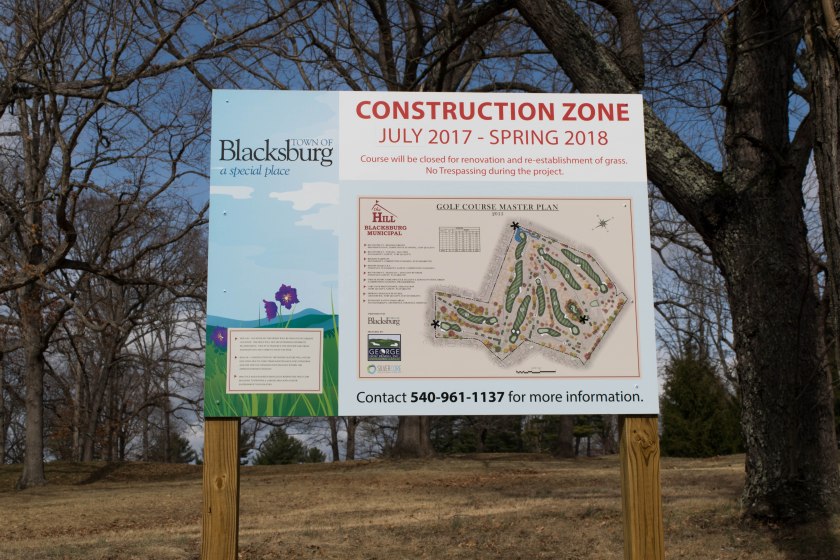
BLACKSBURG, Va., Feb. 15 – Construction to the course began as a result of requests from local residents through an online forum. Photo: Alexis Walsh
by Alexis L. Walsh—
As Spring approaches, Blacksburg Parks and Recreation continues to work towards the grand re-opening of “The Hill”, the town’s municipal golf course. Construction to the course began in August 2017 and is set to be completed within the next couple of months. What can Blacksburg residents expect?
According to Blacksburg Parks and Recreation’s website, Aspen Golf performed the construction that included the re-grassing of greens and fairways. Additionally, in order to accommodate different player levels, all the tee complexes were rebuilt to provide multiple tee decks. Bunkers on the course were also either removed, replaced or renovated.
Jeff Kleppin, The Hill Golf Shop Supervisor, stated, “The updated course should bring in more experienced golfers who might not necessarily think to use a municipal golf course as an elite course.” He added, “We are excited to welcome new and old members after the grand opening in a few short months.”
A two hole, short game practice area was constructed to provide a practice and teaching facility near the professional shop. Kleppin hopes to offer more children’s programs as a result of the new practice area. He explained that in the past children’s classes were not as prevalent due to lack of course variety; however, he hopes the new course will eliminate the prior issue.
Blacksburg Parks and Recreation aims to provide residents with a variety of amenities that encourage community relations through a healthy lifestyle. Upon completion of the course, residents will be able to purchase memberships that range from children’s passes to adult memberships.
Dean Crane, Director of Blacksburg Parks and Recreation Department, stated, “The town bought the course in 1971 and has made very little changes since.” He added, “The grand opening will show years of hard work and planning paying off. We hope our residents will appreciate the efforts we have made for them.”
Crane has been the Director of Blacksburg Parks and Recreation Department for over ten years. He explained that the new course has the potential to bring a lot of revenue into the town. He looks at the updated golf course as a major investment for Blacksburg and expressed major excitement for the future of the town.
According to Blacksburg’s Municipal Golf Course website, residents are asked to remain patient through the construction process. The website stresses the importance of the public’s ability to avoid temptations as far as walking on restricted areas and/or sledding.
The course will remain closed to pedestrian traffic in effort to protect the new grass; Residents are asked to use the adjacent walking trails. For more details regarding daily golf rates, passes, and the announcement of the re-opening, residents can visit “The Hill” facebook page.
BLACKSBURG, Va., Feb. 15 – Willard Drive will remain closed until construction is complete. Photo: Alexis Walsh
BLACKSBURG, Va., Feb. 15 – Fences are used throughout the course to keep pedestrians and animals away from the construction site. Photo: Alexis Walsh
BLACKSBURG, Va., Feb. 15 – The different color flags placed throughout the course represent the grass quality. Photo: Alexis Walsh
BLACKSBURG, Va., Feb. 15 – In order to protect the new grasses, trail users are asked to use the walking trails adjacent to the golf course. Photo: Alexis Walsh
BLACKSBURG, Va., Feb. 15 – Trees are marked throughout the course to represent the different phases of construction. Photo: Alexis Walsh
BLACKSBURG, Va., Feb. 15 – Sand is placed in the holes before grass seeds are planted in order to avoid mud pools after rain or snow. Photo: Alexis Walsh
BLACKSBURG, Va., Feb. 13 – Supply and Demand: A donor gives blood at the VT Sports Club Blood Drive in response to the shortage across the nation. Photo: Kat Schneider
by Kat Schneider–
Though there is almost always a national shortage of donated blood, the winter season sees a dramatic decrease in donation levels.
“It depends on the time of year,” said Daniece Rodrigue, a Collection Specialist with the Red Cross for 12 years. “Recently, it’s been weather and flu season and holidays. People are traveling, and the need rises.”
According to the Community Blood Bank, in America and Canada, more than 4.5 million patients need blood transfusions annually. The number of donations, however, drops significantly during the cold winter season between weather cancellations and cold and flu season.
“A lot of people who are regular donators have a harder time to get out; things get canceled because there’s snow, sleet or rain,” said Jenna Sanders, a senior Human Nutrition, Food and Exercise major at Tech. Sanders, a regular donor, has previously canceled appointments to donate because of these conditions.
The American Red Cross reports that it supplies 40 percent of the blood donated in America. Of that, 80 percent is collected at mobile blood drives set up around the communities in places such as schools and places of worship. When weather causes cancellations of those mobile blood drives, the national donation supply takes a hit. Over 500 Red Cross blood drives have been canceled nationally this year alone, costing the donation service over 16,000 units of blood.
The weather is not the only factor that causes a decrease in blood donations during this time of year. Rodrigue explains that potential donors are unable to donate blood when they are sick or are taking certain over-the-counter medications following their sickness. They are also encouraged not to come in if they are feeling unwell, even if it is just a common cold.
Those considering donations during this season can check the American Red Cross website or the Virginia Blood Services website for eligibility requirements set by the FDA.
Weather and health permitting, Sanders encourages everyone in the Virginia Tech community to consider donation: “Our school’s about service, and this is a really great way to serve others and even to save a life.”
Collection Specialist Daniece Rodrigue
Senior Human Nutrition, Food and Exercise major Jenna Sanders
Akron, Oh., Jan.14 – Cari Champion Interviews James and Durant: This interview spawned controversy when a Fox News Host challenged the validity of the NBA players opinions about the political climate in the United States. Video by Uninterrupted.
by Josh Henry–
Following the 2016 Presidential election, a cloud has hung over the United States. Despite social media rising to new heights, people are scared to air their political opinions more than ever. That said, prominent figures in non-political positions are trying to give people some confidence when it comes to airing grievances or agreements with the way things are going.
Two of those figures are LeBron James and Kevin Durant. Those men are two of the NBA’s brightest stars and took part in a new vodcast with ESPN host Cari Champion on January 14th. Both men spoke not only about experiences in their own lives, but also about what it is like living under the Trump administration.
One day after the vodcast was released earlier in February, Fox News host Laura Ingraham did a segment on her show responding to the players commentary. She criticized many things about both men and specifically ended her commentary telling them and other outspoken athletes to just “shut up and dribble.”
The backlash to Ingraham’s comments was swift from all angles around the country. She took time to make pointed, and possibly racist, comments regarding the two men. But the ending statement is what bothers me the most.
We are guaranteed certain freedoms by our forefathers which we hold dear. One of those freedoms is the freedom of speech. It is very rarely limited, and without it many of the foundations of our nation would crumble.
The Sedition Act was struck down in the late 18th century because it limited our speech. It is dangerous to silence a nation from speaking out against their leaders. If we can’t speak out, we are controlled and therefore no longer free.
So how in the world can anyone be forced to be silent just because of their profession? As a reporter for the News Feed, should I not be entitled to my opinion? Should everyday people who vote in our leaders but work as bankers, teachers, plumbers, etc.… not be allowed to speak up when they feel their leaders are doing the wrong thing?
To expect silence and obedience from people just because they don’t happen to have a political science degree, or more likely the case with Ingraham: don’t agree with your side, isn’t a sign of democracy. It is a sign that she would rather have an oligarchy or dictator rule with no one opposing.
No, athletes will not shut up and dribble, or stick to sports, and they shouldn’t. After all, before he was President, Donald Trump was a reality TV show host and businessman. I guess he didn’t stick to that.
Blacksburg, Va., Feb. 5, 2018 – Norris Hall was the location of the tragedy of April 16, 2007 took place. 30 people lost their lives in the building on that day. Today, the Virginia Tech community works with the Virginia Tech Police Department to keep the campus safe. Photo – Josh Henry
by Josh Henry —
In Blacksburg, Virginia everyone recognizes the pain and horror that so many communities have felt in recent years following shootings on college campuses. It has been almost 11 years since the tragedy of April 16, 2007, and in that time shootings have risen exponentially across the U.S. on college campuses.
From 2011 to 2016, 101 shootings on or near college campuses took place, which was a 153 percent increase from the prior 5 years, according to a study by the Citizens Crime Commission of New York City. There is no definable reason for the rise in shootings, but no matter the location the effect on the community is the same.
“It felt like there was a shadow over everything after [April 16] happened,” VT graduate Henry Chang said. “There was no way to properly recover. I just remember constantly being sad. It ended up bringing us all together, but it was all incredibly hard to handle.”
Chang, the brother of current VT student Stanley Chang, was a freshman in 2007. Before April 16 he never had a reason to worry about his own security. But afterward, that changed in a hurry.
“It was hard to feel safe going to class,” Chang said. “Of course we all had to keep our normal routine to get away from it all, but like I said there was just this shadow. We all had our guard up.”
After the April 16 tragedy, multiple security changes were made on Virginia Tech’s campus and across the U.S. in an effort to prevent more shootings in the future. According to Virginia Tech Police Chief and Director of Security Kevin Foust, Virginia Tech has doubled up on most security measures.
“We [increased] the number of officers from 24 to 50 [since 2007],” Foust said. “We’ve added more Blue Light emergency phones [both indoors and outdoors]. There are more security cameras, the LiveSafe app, and the Personal Emergency Preparedness joint presentation with [Virginia Tech’s] Office of Emergency Management.”
Changes like this became more common on campuses around the country after the tragedy at Virginia Tech. Some have even been adjustments to things that have already been around for years, like the siren on the University of Texas A&M’s campus.
Nationally, there hasn’t been one discernible solution to the issue of preventing Campus shootings in the United States. Even Foust suggests there is no “correct” way to handle everything, but overall safety starts at the community level.
“Security is a personal responsibility,” Foust said. “I cannot guarantee your safety here on this campus, as I cannot guarantee my own. What we do is educate our community as best we can so that when a crisis occurs, each person can make the best decision based upon the facts and circumstances in front of them at that time. [This] community has embraced personal responsibility and remains very vigilant.”
BLACKSBURG, Va., Feb. 6 – The Virginia Tech community experiences heavy traffic on U.S. Route 460, especially during spring break and football season. Photo: Cody Davis
by Cody Davis–-
Seventeen Virginia state legislators requested federal assistance to improve Interstate 81 on Thursday, Jan. 25. According to Virginia Businessmagazine, the legislators sent a letter to U.S. Senators Tim Kaine and Mark Warner to address the “dire need of improvements to increase safety” in the Shenandoah Valley.
“The letter… asks that the congressional delegation works with President Trump to address longstanding transportation and safety needs,” Del. Christopher Head (R – 17th District) said. “In Richmond, we will continue to debate and negotiate our budget and transportation spending.”
Head and Del. Chris Hurst (D – 12th District) are two of the 17 legislators who signed the letter to Virginia’s congressional delegation.
According to WSLS.com and WDBJ7.com, Hurst held a town hall in Blacksburg on Saturday, Jan. 27 to give citizens an update from Richmond. He discussed traffic congestion, driver habits and the need to change the transportation narrative from “being solely focused on northern Virginia.”
“Transportation needs… and policy discussions shouldn’t begin and end with Interstate 66 and the Beltway,” Hurst said. “We want attention to be first placed on Interstate 81.”
In addition to the legislators’ letter to the congressional delegation, the Senate of Virginia has introduced two bills that seek to improve Interstate 81. According to Virginia’s Legislative Information System, Senate Bill No. 561 aims to impose left-lane restrictions on tractor trucks, while Senate Bill No. 971 establishes a corridor improvement plan.
As of Wednesday, Feb. 7, Senate Bill No. 561 has been continued to the 2019 session and Senate Bill No. 971 has been referred to the Senate Committee on Rules.
“Currently, we are working with different VDOT administrative districts to identify specific projects on Interstate 81,” Head said. “I’m hoping that included in those projects, are plans to widen to three lanes in certain areas of the Roanoke Valley along I-81 to relieve congestion and address safety concerns.”
Regarding plans to improve public safety on the interstate, Head and Hurst stressed the importance of research.
“I think we need to study this issue more in-depth than ever studied before,” Hurst said. “It’s great that Virginia Tech has the transportation institute, so I think we should definitely be working with them.”
Hurst is referring to the Virginia Tech Transportation Institute (VTTI), a research organization that seeks to “save lives, time and money” in transportation. VTTI is home to the I-81 Corridor Coalition, an association dedicated to improving public safety along Interstate 81.
“We see ourselves as, eventually, becoming the best resource for information on the corridor,” Andy Alden said.
Alden is the I-81 Corridor Coalition’s executive director. He gave his thoughts on how transportation in Virginia can be improved.
“We definitely need a new funding structure,” Alden said. “We need a new way to fund the improvements that are needed.”
Alden claims that VTTI does not get too involved in the “policy side of things” regarding legislation. Instead, the organization seeks to inform lawmakers with research reports.
BLACKSBURG, V.a., Feb. 6 – Andy Alden works in his office at VTTI. Photo: Cody Davis
BLACKSBURG, V.a., Feb. 6 – The Virginia Tech Transportation Institute is located near the Corporate Research Center. Photo: Cody Davis
BLACKSBURG, V.a., Feb. 6 – Many Virginia Tech students and faculty take Interstate 81 to get to and from their hometown. Photo: Cody Davis
BLACKSBURG, V.a., Feb. 6 – Exits such as this one are subject to traffic congestion and accidents. Senate Bill No. 971 aims to reduce said accidents with its proposed corridor improvement plan. Photo: Cody Davis
BLACKSBURG, V.a., Feb. 6 – Under Senate Bill No. 561, tractor trucks such as this one would be mandated to travel in the right-hand lane in designated areas. Photo: Cody Davis
BLACKSBURG, V.a., Feb. 6 – Merging tractor trucks can cause severe accidents on the interstate. Legislators and researchers are working to minimize tractor truck incidents. Photo: Cody Davis
BLACKSBURG, V.a., Feb. 6 – The I-81 Corridor Coalition focuses on specific causes of traffic accidents, such as the small number of truck stops along the interstate.
BLACKSBURG, V.a., Feb. 6 – Senate Bill No. 971 seeks to make construction areas safer under its proposed corridor improvement plan.
According to Facebook CEO Mark Zuckerberg, Facebook is taking action to help benefit and promote local news media with an update on users’ home news feed. Facebook page and post boosts have become extremely popular with businesses around the globe. Page admins are able to boost their posts or page by paying Facebook to increase their reach. Leaning on this idea, Zuckerberg plans to boost local news organizations posts for free.
For example, if a user follows their local news station or newspaper, these posts will be higher on the news feed and more prominent over other shared posts and stories. The new algorithm will be implemented in hopes to promote community involvement and spread local information rather than national .






 > THE NEWS FEED <