Virginia-Maryland College of Veterinary Medicine at Virginia Tech seeks dogs for clinical trials of new cancer treatment 

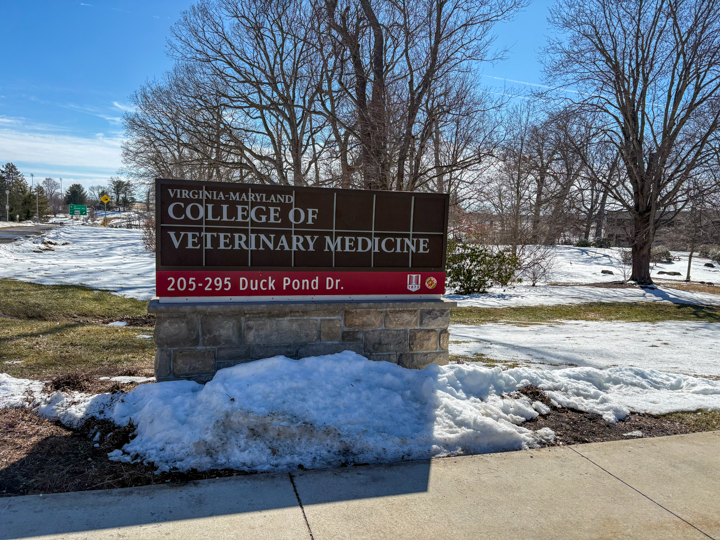
Sign outside the Virginia-Maryland College of Veterinary Medicine (Josie Sellers, TheNewsFeedNRV.com)

By: Josie Sellers, health and wellness reporter

BLACKSBURG, Va. (Feb. 13, 2026)- Researchers at the Virginia-Maryland College of Veterinary Medicine at Virginia Tech are testing a new approach to treating brain tumors using the drug verteporfin in combination with photodynamic therapy. 

Dr. John Rossmeisl working at the Virginia-Maryland College of Veterinary Medicine. Photo by @vamdvetmet

Led by Dr. and Mrs. Dorsey Taylor Mahin Professor of Neurology and Neurosurgery at Virginia Tech, Dr. John Rossmeisl, the study will test three dogs diagnosed with brain tumors over 180 days to determine a safe and effective dose of the photosensitive verteporfin, “NanoVP.” 

The trial specifically targets glioblastomas, which are extremely aggressive and infiltrative. In the United States, about 12,000 people are diagnosed each year, and they account for 14% of brain tumors. They are especially hard to remove because they lack a clear border. 

Hopefully, the findings from the trial will aid in research on tumors in humans, once again giving reason to believe dog is a man’s best friend.

Cancerous cells in brain tumors, especially glioblastomas, can travel from the tumor that is visible using diagnostic techniques, such as magnetic resonance imaging (MRI). Because it is difficult to see the invasive cells, it is a challenge to remove the entire mass. As a result, it often recurs. 

Rossmeisl is collaborating with the University of Maryland Associate Professor Dr. Joe Huang, who developed NanoVP. He compares it to an eraser at the end of surgery, where cells that are not removed by hand are eradicated. 

“The goal of this particular study will be to administer the drug and then shine the light into the resection cavity after the main tumor mass is removed, with the goal of the drug in the photodynamic therapy killing any remaining cancer cells that remain behind that we can’t see,” said Rossmeisl. 

NanoVP differs from other photosensitizing drugs because it crosses the blood-brain barrier. This barrier is a wall of cells that defends the brain from harmful substances, preventing about 98% of small-molecule drugs from entering. 

Because of the relatively small size of the drug, it can cross the barrier to reach tumors.

Already, data from previous trials on mice show that the drug effectively kills tumor cells. In preclinical trials, it extended the life of the mice beyond other treatments. The current study will determine effective doses with limited side effects for the dogs. 

The target doses will be based on the data they already have from the mice. Because dogs are much bigger than mice, they will likely need more.

However, because of the photosensitization, the patient may have complications when they are exposed to light. This study aims to research the ideal amount of injection.

While the dogs are under anesthesia, as much of the tumor as possible will be removed through surgery. Then, NanoVP will be injected through a vein. Once the tumor is removed, a laser will shine to activate the drug, killing the remaining tumor cells. 

Within the next two hours, five blood samples from each dog will be collected for research. 

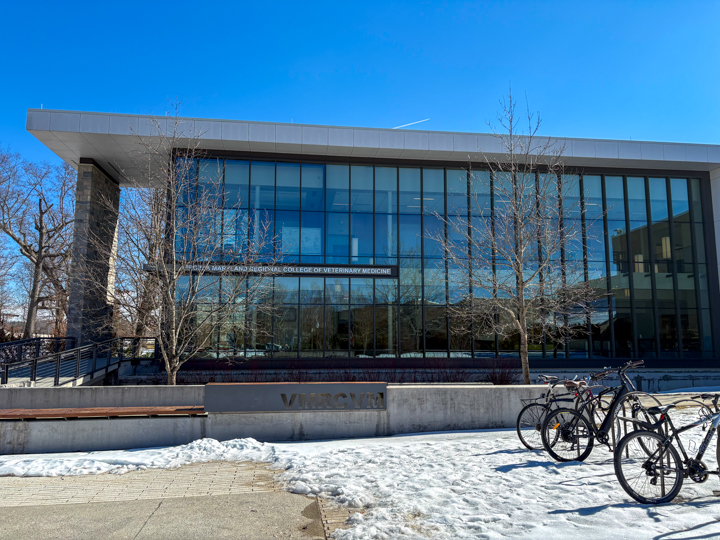
Virginia-Maryland College of Veterinary Medicine building (Josie Sellers, JMC 4814)

For the next six months, they will have follow-up visits, and owners may withdraw them at any point. 

This trial differs from conventional animal testing, which involves generating a disease. Instead, his study focuses on dogs who already have brain tumors, which Huang says is a more ethical approach. 

“If we give the drug with no drug-associated side effects in this trial, we’ll consider the trial successful,” said Rossmeisl. “It’s a very early-stage trial, so we’re not trying to prove that it’s going to totally eliminate cancer. That’ll be later on down the road.” 

Rossmeisl hopes that in the future, this treatment will be used more frequently in combination with other forms of more traditional cancer treatment, such as chemotherapy or radiation.

While this trial specifically works with brain cancer, the drug is effective against any kind of tumor. 

In fact, Dr. Huang has already used the drug for various kinds of tumors. 

“You might need certain doses for certain types,” said Rossmeisl. “You might have to tweak the dosage or the exposures to light for certain types of tumors. But then again, those are details that would be answered in a different study.” 

Researchers also want to utilize findings from the trial to improve treatment for humans, giving hope to those who may benefit.

“As a patient who has a brain tumor- and actually has had a couple- and has undergone two surgical interventions for it, I am really glad that they are doing this experiment, and it’s going through the phases of clinical trials before it approaches the patient,” said Virginia Tech student Sydney Hill. “It seems like a really good therapy, and I hope that it has some promising results.” 

This trial is working with a European glioblastoma study using the same photodynamic therapy approach in people. Both trials are funded by the same company, Modulight, using a translational approach where the data from the trials are shared to improve both studies. 

As of now, there are no dogs enrolled in the study. Those interested in the trial can find more information here

Simple Truth and America’s protein obsession: When wellness gets complicated 

By Sarah Shrader, health & wellness reporter

Protein is the latest health craze in the U.S. However, the exponential rise in protein-marketed products and consumption has experts warning that this may have gone too far. 

“Now, protein is part of the marketing environment,” stated Vivica Kraak, who holds a doctorate and is an associate professor of food and nutrition policy at Virginia Tech University. “It’s the new gluten-free.”

CBS news reports that last year, 61% of Americans increased their protein intake. Industries took notice, as protein-centered products popped up in the forms of Starbucks’ Protein Cold Foam, Dunkin Donuts’ Protein Refreshers, and Kroger’s Simple Truth Protein Line. 

Hyper protein consumption is a predominantly younger facing health trend. Younger generations, such as Millennials and Generation Z, on average, spend $71 on protein items (meat, dairy, powders, chips, etc.) per week, whereas older generations tend to spend about $27, according to Empower’s recent “The Protein is Extra” study

Additionally, 43% of Americans reported that they are willing to pay higher prices for protein-enhanced items. That percentage is higher among Generation Z, 56% of whom reported splurging on protein goods. The study further affirms Americans’ protein preference; it found that 50% of respondents check protein content first when reading nutrition labels, and that 45% consciously look for protein-labeled items. 

The muscle-building macro further solidifies itself as a health stamp of approval as 72% of study respondents reported that if a product is labeled as protein-enhanced, they are more likely to pay extra. A majority of respondents also stated that they are looking to increase their protein intake – enter Simple Truth Protein Line. 

Launched on September 17, 2025, and marketed as an affordable and “free from unwanted ingredients” protein option, Kroger’s Simple Truth brand offers more than 110 protein-enhanced grocery items. 

The line boasts everyday products enhanced with whey, pea, and various concentrated protein sources. Additionally, products that are already protein-rich are featured, like Simple Truth’s protein cottage cheese. Their version sports 15 grams per ½ cup serving, in juxtaposition to Good Culture’s 14 grams for the same serving size.  

Other merchandise includes, but is not limited to: 

Simple Truth Protein’s grain free berry flavored cereal on grocery store shelf. (photo by Sarah Shrader TheNewsFeedNRV.com)

The Simple Truth Protein Line appeals to health-conscious consumers, looking to eat right. While it may be grocery supplies, the line is marketed as health products and an investment in one’s overall well-being. 

“We’re just talking about wellness more like a product or a service, but not comprehensively,” Kraak stated. “We live in a very saturated environment with commercial messages. That’s just the nature of American society.”

The U.S. is by far the largest health economy in the world. Valued at $2 trillion, it represents one-third of the global wellness economy according to the Global Wellness Institute

“I think the opposite of mindful living and mindful eating is this optimization culture that’s being driven by marketers and advertisers,” Kraak stated. “There’s a whole monetary economy behind it. I think it’s going to have detrimental impacts if you can never reach perfection.” 

As wellness is packaged and sold to American consumers, health fads often present themselves as a capitalist opportunity to gain market share. Spanning from ketogenic diets, Whole30, juice cleanses, gluten-free and now to protein-centric diets, Kraak noted that pervasive health claims and marketing have oversaturated the market and led to confusion surrounding nutrition.

Woman compares yogurt brands at Kroger in Blacksburg, VA. (photo by Sarah Shrader TheNewsFeedNRV.com)

“We don’t yet know how much ultra-processed food can be consumed without having health risks,” stated Brenda Davvy, who holds a doctorate and is a professor in the department of human nutrition, foods and exercise at Virginia Tech University. 

Kroger’s push for protein is also a symptom of a larger trend in the U.S., according to Kraak. While American protein intake increased in recent years, the new federal dietary guidelines encourage greater protein intake across the board. 

“For decades, the recommended daily intake of protein has been 0.8 grams of protein per kilogram of body weight,” Davvy stated. “The latest version of our dietary guidelines, which were just released, increase this a bit to about 1.2 grams protein per kilogram of body weight.”

Kraak addressed the change in nutrition guidance, asserting that, today, most Americans are not underconsuming protein, but more likely overconsuming it. She noted that without proper movement, excess protein stores as fat in the body. Further, Kraak added that protein diversity, specifically consuming plant-based proteins, is more crucial than eating it in large quantities. 

Experts, like Davvy and Kraak, endorse the Mediterranean diet, which is ranked as the healthiest diet in 2025 by U.S.News. The diet focuses on whole foods with an emphasis on diverse plant consumption. Intuitive eating is also promoted, in contrast to other diets, which tend to suggest restriction of calories or elimination of food groups. 

Kraak also emphasized the importance of integrating movement into daily life, such as ditching the car and walking, using public transport, engaging in frequent exercise and overall simplifying wellness in a media landscape that is designed to complicate it. 

Rural Virginia could see growth in data centers

By Savannah May, Politics & Government reporter


As Northern Virginia fills with massive data centers, tech companies are increasingly turning to rural counties for land. Places like Montgomery County, Va., may not have proposals yet, but experts warn that land-use decisions like these can affect communities for generations.

Nearly every Google search, social media post or online purchase passes through a data center somewhere. Companies rely on these facilities to store information, run websites and apps and manage internal operations like payroll, human resources and sales.

Data centers operate at different capacities. Hyperscale facilities differ from traditional data centers in their ability to host and operate at least 5,000 servers and cover at least 10,000 square feet of physical area.

“The number of operational hyperscale data centers continues to grow inexorably, having doubled over the past five years,” according to John Dinsdale, a chief analyst at Synergy Research Group. Not only will numbers increase, but so will their size. Advances in AI (artificial intelligence)-focused, GPU (graphics processing unit)-powered infrastructure are expected to roughly double the computing capacity of the next generation of hyperscale centers.

Companies like Google build at such a massive scale due to the demand for AI, data storage and other big-data computing pursuits. Hyperscale facilities are expanding rapidly across the United States. The number of hyperscale data centers doubled between 2019 and 2024, with more than 135 coming online in 2024 alone.

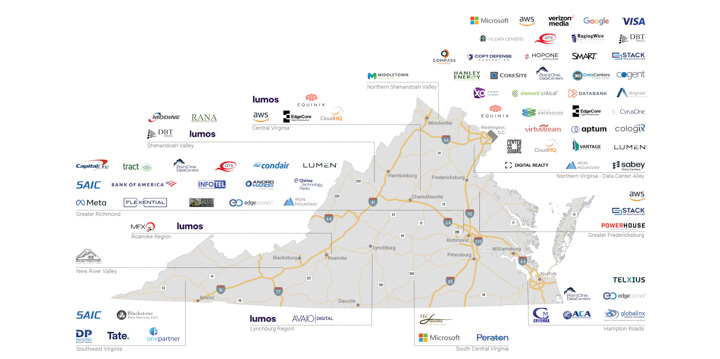
A map depicting the locations of major data centers across Virginia. (Map courtesy of Virginia Economic Development Partnership, vedp.org)

Virginia has the largest concentration of data centers in the world, hosting 35 percent of known hyperscale data centers worldwide. Northern Virginia, known as “Data Center Alley,” is at the forefront of this market.

Today, local constituents in these communities are pushing back against projects once considered “guaranteed approvals,” due to economic and political resistance.

For residents like Carlos Balvin, a cinema major at Virginia Tech, the impact is visible. “They’re a real eyesore and a stain on what would often otherwise be a beautiful day,” he says.

With this ongoing growth, companies are shifting to locations that offer large tracts of cheap land compared to dense urban areas.

Jurisdictions in Northern Virginia heavily invested in fiber-optic and network infrastructure to build a higher network capacity, which has helped attract data center development. Many companies in the region overlap with the defense and logistics industry. By developing near Washington D.C., a strategic decision, companies are closer to that infrastructure.

“In many ways, data centers are probably taking advantage of the fact that the infrastructure was prioritized here and developed here,” says Margaret Cowell, associate professor of Urban Affairs and Planning at Virginia Tech.

Rural communities offer reliable grid connections for resource adequacy and open terrain, making line-of-sight transmission easier. Areas with less development become easy targets, potentially swayed by financial incentives.

“In the past, there were debates about whether it was fair to site landfills in poor, rural communities that didn’t have much economic opportunity,” says Cowell. “Waste management companies would approach them and say, ‘You’ve got land, you could make money off it.’” While landfills and data centers are quite different, weighing their strategic approaches may offer insight into the industry’s next moves.

For Montgomery County, the primary operating data center facility is located in Blacksburg. Brush Mountain Data Center, located within the Corporate Research Center at Virginia Tech, is a subsidiary of Advanced Logic Industries, a Virginia-based company. Brush Mountain is a smaller-scale data center compared to the majority of facilities located in Northern Virginia.

Planning commissions approve development for several reasons. Developments could be seen as a way to increase the tax base or improve the economic conditions within your community.

“If you’re doing smart economic development, you’re concerned with the workforce. If you’re going to say yes to one of these companies, ideally, there would be a guarantee of a certain number of jobs being created,” says Cowell.

Michael Cary, research assistant professor in the Department of Agricultural and Applied Economics at Virginia Tech, wrote in an email, “The one area of research that does have some preliminary results that I am aware of is labor markets. There is no evidence of job creation beyond temporary spikes in construction jobs.”

This means that as research further develops, local politicians will still consider these impacts in making economic decisions for their constituents. As data centers continue to grow across the United States, including Virginia, it’s important to remember that if constituents are loud enough, they can have a real influence on what does or does not develop in their communities.

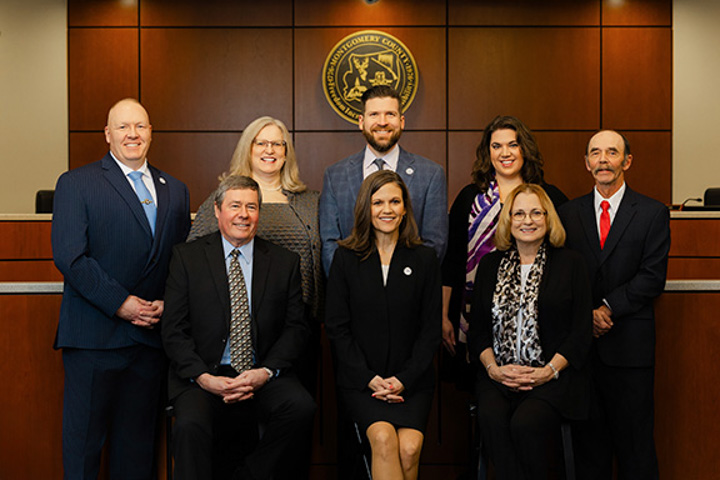
Montgomery County Board of Supervisors pose for a group photo. (Photo courtesy of BoardDocs)

The Montgomery County Planning Commission said there are currently no proposals or zoning changes under consideration for data centers, and the Board of Supervisors has only discussed the issue. Planning staff said no formal action has been taken beyond preliminary discussion.

“Montgomery County probably doesn’t draw much benefit from a data center, but it could be persuaded by promises of revenue,” says Cowell. “There’s a real tension about whether we should allow this in our backyards, because, in some ways, it feels exploitative.”

How ICE intersects with Virginia Tech campus policing 

Michaela Scott, crime, safety and justice reporter 

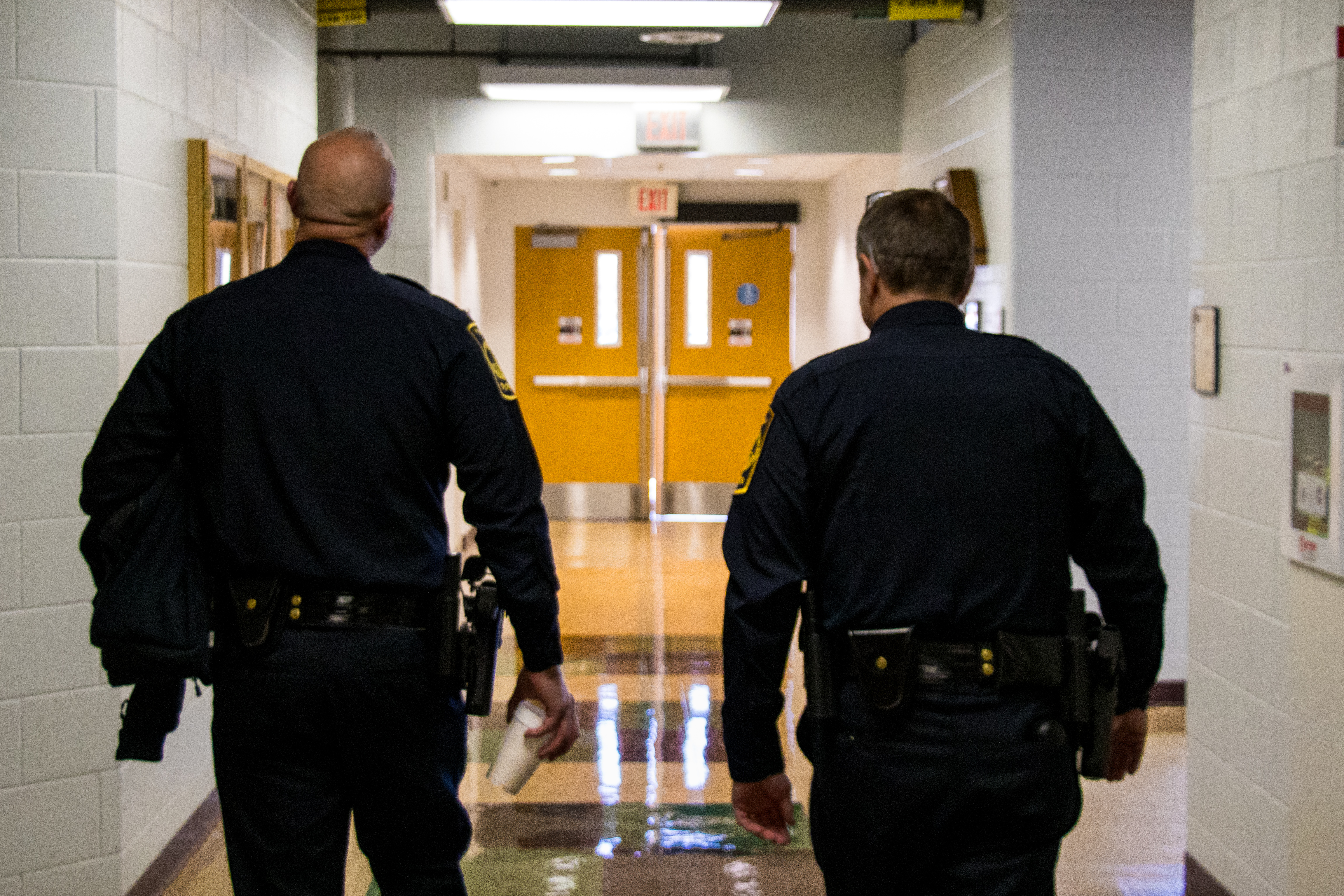
Virginia Tech Police Department Chief Deputy Tony Haga and Chief Mac Babb leave a meeting in the campus Public Safety Building on Feb. 12, 2026. (Michaela Scott/TheNewsFeedNRV.com) 

Federal immigration detentions have surged nationwide this year, and the detention of a Virginia Tech student early last July continues to raise questions in the New River Valley about how federal immigration policy intersects with local policing.  

As of Dec. 26, 2025, there are 212 active detention centers operated by U.S. Immigration and Customs Enforcement, which is roughly double the number in operation at the start of the year. Some local law enforcement agencies across the country have participated in what are known as 287(g) agreements, which are federal partnerships that allow trained officers to perform certain immigration enforcement functions. Similarly, at some universities, campus police departments have entered agreements with the federal government authorizing officers to assist in immigration enforcement.  

According to ABC News, the Trump Administration’s surge in law enforcement has created a chilling effect on student attendance in districts nationwide. Thousands of students in counties across the U.S. are being reported absent from school daily in fear of ICE agents.  

In Virginia, however, state policy shifted earlier this year. 

On her first day in office, Gov. Abigail Spanberger rescinded Executive Order 47 (2025). It had originally required state law enforcement agencies to cooperate directly with federal immigration authorities and encouraged participation in federal deputization programs. 

In essence, the order removes the initial mandate, allowing state law enforcement to refocus on their core responsibilities, such as keeping Virginians safe.  

The move marked a shift in state policy and offered reassurance for students. The Virginia Tech Police Department says their mission has always remained the same.  

“Nothing changed from the day before to the day after the new executive order,” said Mac Babb, VTPD chief of police. “We’ve been the consistent agency all along in our focus on supporting the community.” 

However, social media and conversations across campus have raised questions regarding whether VTPD would honor a criminal ICE detainer.  

Anonymous posts warning of ICE sightings have continuously circulated on Yik Yak, a location-based social media, amplifying uncertainty among some students about what authority campus police hold in immigration matters. Babb emphasized that the department encourages students to contact campus police if federal agents are reported nearby, in order to verify legitimacy and to prevent unnecessary escalation.  

Babb added that none of these claims have been proven to be true.  

Virginia Tech Police Department officer responds in a patrol vehicle with emergency lights activated on campus on Feb. 12, 2026. (Michaela Scott/TheNewsFeedNRV.com) 

“A lot of what VTPD would do is more for the community than it would be for ICE, but it would be perceived as, oh, you’re helping ICE.” Babb said. “If ICE was on campus, our purpose there would be to deescalate the situation, so we don’t expose more people to investigations by ICE and potentially subject additional people to arrest, which doesn’t need to happen.”  

In regard to the Virginia Tech student detained in July 2025, Babb explained that VTPD was not a part of the enforcement action but later conducted an internal review to assess preparedness and potential implications.  

“I think it’s important that everybody understands that the detention last July occurred after an actual criminal event, and unfortunately, it triggered an inspection during the arrest process,” Babb said. “So those are the types of things that we try to watch out for, and to make sure that we don’t have more people end up in situations where they’re under review as well.” 

With international students making up 12% of the total student population at Virginia Tech, Deputy Chief Tony Haga explained that his team has devoted time to connect with the student population to build assurance in students. 

“Some of those students are coming from places of origin where there is no relationship with the police department at all,” Haga said. “So already stepping into our community, we are somebody they’re not going to trust.”  

To bridge that gap, VTPD has partnered with the Cranwell International Center to provide presentations and informational sessions outlining students’ rights and campus procedures.  

 University leaders say that those efforts reflect a broader institutional commitment to international students.  

“If we’re going to save the environment, cure cancer, and develop the hottest technology in AI, we need to know how the world interacts with it,” said Mark Owczarski, VT university spokesperson. “From the very beginning, we truly welcome and seek out individual international folks from all over the world to come here.” 

Babb reiterated that immigration enforcement is a federal responsibility, and that VTPD’s role remains focused strictly on criminal matters and campus safety. 

While state policy shifts and national enforcement trends continue to evolve, university officials maintain that their role remains focused on campus safety rather than immigration enforcement. For some students, however, broader national debate means concerns about immigration policy are unlikely to fade.  

“In light of current events, say what you will, but the values and the approach that Virginia Tech takes haven’t changed,” Owczarski said. 

Virginia Tech Board of Visitors approves on-campus residential housing and athletic facility improvements

By Megan Reese, politics and government reporter

On Thursday, Feb. 5, the Virginia Tech Board of Visitors met virtually for a special meeting to discuss improvement and funding plans made to the Beamer-Lawson indoor practice facility and on-campus residential facilities. 

During the special meeting, two resolutions were discussed. The first was authorizing Virginia Tech to move forward with an $800,000 planning authorization, which is to make improvements to the Beamer-Lawson indoor practice facility. The second was authorizing planning funds and target timelines for several on-campus residential housing renovations, such as Slusher Hall, Pritchard Hall and Hoge Hall. Both plans were approved by the 13 board members in attendance unanimously.

“As a freshman I lived in Pritchard, and I think renovating should definitely be a priority for this school. Not only is there no air conditioning, but the bathrooms need a little love and the carpet in Pritchard needs to go,” said junior Virginia Tech student Leila Sarkarzadeh.

An entryway to Pritchard Hall, a residence hall on Virginia Tech’s campus.

 Photo taken by Megan Reese.

A full view of Slusher Hall, a residence hall on Virginia Tech’s campus. Photo taken by Megan Reese.

Many students complain of the lack of air conditioning in those residential halls during the hotter months, and the university is prioritizing that in the renovations. The renovation goals include heating, ventilation and air conditioning, as well as environmental quality, addressing modern program needs and safety needs. 

Virginia Tech made an effort to better understand students’ needs and priorities by bringing in Brailsford and Dunleavy, a consulting company, to meet with students. The board also has an undergraduate student representative that conveys those needs. This person is a non-voting member, but still contributes to conversations, giving students a voice. There are four other non-voting members, the staff, faculty, administrative/professional faculty, and graduate student representatives. 

“I sat in on one of [the Brailsford and Dunleavy] meetings as an RA, and I sat in on it as a student leader, and then I met with them in my capacity as the representative,” said Thomas Feely, the undergraduate student representative. “So I think they tried to cover their bases quite well. Emails went out to all of the residents saying, if you want to be part of a focus group, they’re meeting today for this.”

Amy Sebring, Virginia Tech’s vice president and chief operating officer, explained the plans in immense detail during her presentation. There was a refresher on all of the plans that were previously discussed, the renovations’ financial impact and a preliminary housing framework scenario discussing enrollment growth. 

Slusher Hall was built in 1972 and the target construction start date will be summer of 2028. The proposed planning authorization is $6.5 million. Hoge Hall is the next building to start construction, with a target start date of the summer of 2030. It was built in 1966 and the proposed planning authorization is $9 million. The last building in this plan is Pritchard Hall, built in 1967, with the first phase of construction planning to begin in summer of 2032 and phase two in summer of 2034. The proposed planning authorization is $12 million. 

The plan also noted that residential rates will increase with inflation and the renovations. The plan states “by 2032, to cover project costs, residential rates would need to increase by 4.2% per annum. By 2032 this would equate to 25.2% or $2,326, which equals a bed rate of $11,576.”

Annual increase needed to cover project costs is 4.2% and the annual increase projected to cover inflation is 3%, which combines to 7.2%. However bed rates are different based on the category. There is non air-conditioned multiple occupancy, air-conditioned multiple occupancy, and air-conditioned single occupancy. The new bed rate will apply based on the category. 

“That 7% is being applied per category. The reason why I think this is reasonable is because we’re behind. We have a lot of deferred maintenance on these facilities,” said Feely. “3% goes to inflation and then the 4% is for the cost of renovations, which it’s tough to argue with 4%. To me it seems like a pretty good deal.” 

Although the on-campus residential resolution was the bigger proposition of the meeting, the indoor practice plans were approved as well. The plan notes, “a conditioned interior practice environment is critical to remain competitive with other Atlantic Coast Conference and NCAA Division I athletics programs.” 

Beamer-Lawson indoor practice facility. Photo taken by Megan Reese.

The board recently made headlines for approving a $229 million plan to invest in athletics for the next four years. This plan aligns with the need to be competitive with other Division I athletic programs. 

Feely noted that although there may be concern about more money going towards athletics, that this plan is funded by athletics auxiliary revenues, like ticket sales, which is money that the athletics department already has. 

The next board of Visitors meeting is planned for April 13-14. 

How Tarzan Lifts balances college and the dream of becoming a full-time fitness influencer

By Owyn Dawyot, Health and Wellness Reporter

Caleb Grider, also known as Tarzan Lifts, practices bodybuilding poses after finishing a lift – Shot with iPhone 15

Caleb Grider, better known as “Tarzan Lifts”, is a bodybuilding YouTuber known for throwing around monstrous weights and making fun, educational videos for those interested in fitness. However, something most don’t know about Grider is that he is also a junior at Virginia Tech, studying Marketing, something he hopes will aid the development of his social media presence while promoting his own personal brand.

Grider’s journey of becoming an influencer began as a young teen. “I started going to the gym at 13 and would watch all these YouTube videos of different influencers, getting all the information I could,” Grider stated, referring to what first piqued his interest in creating content.

Years later, during his senior year of high school, Grider’s physique had grown considerably, similar to his dark, jet-black hair, catching the attention of many friends and family members. “It was all these external forces that were pushing me to do it (start posting), and I finally bought a camera my freshman year of college,” Grider said when describing what eventually pushed him to start posting.

What struggles or “roadblocks” have you hit along the way since first starting to post on YouTube?

Grider talked about a big struggle he’s faced since first posting on YouTube: how his peers perceive him. “People do perceive you differently if you post online,” Grider stated.

Grider followed by saying he tries focusing on only valuing the opinions of his “inner circle”, which are the people closest to him who originally told him to start posting in the first place and who know his true, genuine character.

“Is it out of the ordinary, yes”, Grider acknowledged, “but at the end of the day, it’s something that I want to do, so it doesn’t really matter,” Grider said regarding posting videos online. This is a very positive mindset that’s kept him equally motivated and confident, and helps him combat the fear of judgment, something he admittedly is still in the process of perfecting.

Do you feel like your time at Virginia Tech as a Marketing Major has contributed to the success you’ve had posting videos on YouTube and social media? If so, how?

“I’m more aware of algorithms and statistical click-through rates, and it’s opened my eyes to different analytics; it’s just taught in a different way,” Grider said. “Then I take it and apply it to the business that I have (Tarzan Lifts).”

Grider went on to reference a Digital Marketing class that he is currently enrolled in at Virginia Tech and really enjoys.

What life lessons have posting fitness content online helped you learn?

Grider described the biggest life lesson he’s taken away from posting fitness content is delayed gratitude, stating that many online creators expect instant results when they first start posting and get discouraged when their content doesn’t perform well immediately.

Admittedly, Grider said that his videos when he first started making online content weren’t the best quality, and it wasn’t until recently that he felt the content he was making was genuinely good. Grider further elaborated, stating that he has failed many times while attempting to create content viewers will find engaging, but when he fails, he fails forward.

“I use my YouTube videos like compound interest,” Grider stated. “Every single good video that I produce could just get 100 views, but once one pops, I’ll have 20 or 30 good videos for people to watch.”

Do you ever struggle finding the right balance between schoolwork and posting on social media?

Grider stated that this has been a constant struggle every semester throughout his college career. “Whether it is school or YouTube, trying to always find the time to get everything done is definitely difficult,” Grider stated, claiming that sometimes school will have to take a back seat to YouTube, and vice versa.

Grider expanded on this by saying that time management is something he is actively working on, and sometimes he will take what he calls a “personal day”, away from school and YouTube, because both require a lot of creativity, which can be immensely draining at times.

What are some things, or people, that motivate you to keep improving and growing your platform each day?

Grider described his older brother Tim, a 25-year-old airline captain, as the person who has most motivated him to continue growing and improving each day by modeling the values of discipline and consistency, which Grider has adopted in his own life.

“If you want your dream, go out and get it,” Grider said. “It’s not a dream if it’s not crazy, and if people don’t literally say, ‘What are you doing?’”

Grider attested that Tim has been someone whom he has looked up to because he followed his dream of becoming an airline captain and has been fully supportive of Grider while pursuing his dream of becoming a full-time influencer.

What is the most rewarding thing for you personally that has come from posting on YouTube?

“The personal interactions I’ve had when people have told me that I’ve made a positive impact on their lives,” Grider said.

“I want to have an impact on this world in a positive way, and if I can impact one person from one video, then I’ve won,” Grider said, referencing that the interactions he’s had with supporters have been the most rewarding thing to come from posting.

Grider followed, stating that his “why” behind posting content was having an impact on this world in a positive way, either through education from his videos or entertainment.

As job uncertainty grows, Virginia Tech Advisor helps students find direction

By Diego Canales, education reporter

Students who are graduating college are marked with economic uncertainty and increasing competition within multiple career paths. 

At Virginia Tech, students are navigating a competitive job market while trying to apply their experiences and skills into careers with purpose. The challenge is not lacking skills, but understanding how to apply those skills. 

The work field has shifted into making hiring decisions more selective which starts questioning if students’ coursework, experiences, and involvement with the campus gets them the job they want. It has been widely known that students are not getting jobs lately in this economy.

Academic advisors play an important role in helping students find the right place to fit. In an interview with Chelsey Hancock, an academic advisor at Virginia Tech’s School of Communication, Hancock discussed the challenges students face and how her advising helps students’ better position themselves after college.

Her comments were edited for length and clarity.

What challenges do students face when preparing for careers during their college?

One of the biggest challenges I see is that students often feel unqualified for jobs they are interested in. Many students underestimate the skills they gain through their coursework. 

For example, a student with a communication degree is a versatile degree, which means it can apply to many different career paths; however, this flexibility can also make it harder for students to see a clear direction. 

I frequently remind students that writing, public speaking, teamwork, and critical thinking are valuable skills across industries, even if a job title does not explicitly mention “communication.” Still try to apply for that job even if it is not your strong suit, everything in the workforce relates to Communication. 

How do advisors help students recognize their transferable skills?

Encouraging students to reflect on what they are already doing in their classes. 

Presentations, group projects, research assignments, and written work all help students build professional communication skills. Even with the least experience the work done in coursework goes a long way for students.  

Advisors work with students to identify these strengths and show them how to describe those skills in resumes, cover letters, and interviews. Understanding how classroom experiences translate to workplace expectations is a major part of advising students.

How has the economy changed the way advisors guide students?

The current economy has made the job search more competitive in many fields.

Instead of relying on a single job board, students are encouraged to research specific companies, attend career fairs, and explore multiple platforms. 

I stress that in today’s market, opportunities often require persistence and proactive searching rather than waiting for postings to appear.

Why are communication skills important in the current economic job market?

Communication skills are essential in nearly every profession. Employers want to know that candidates can write professional emails, speak clearly, and collaborate with others. 

Even in positions that do not involve public-facing communication, employees must still work with teammates and supervisors. I emphasize that strong communication skills are not optional—they are foundational to workplace success.

How should students approach job postings when they don’t meet every qualification?

I often tell students not to disqualify themselves too quickly. Job postings frequently describe an ideal candidate rather than a required one. 

If a student lacks experience in one area, they should be honest about it while highlighting the skills they do have. I would recommend focusing on strengths, related experience, and a willingness to learn rather than fixating on missing qualifications.

What networking strategies do advisors recommend for students?

Networking begins with simply putting yourself out there. We encourage students to attend career fairs, networking events, and information sessions, even if they feel nervous. 

Introducing yourself, asking questions, and engaging in conversation are all forms of networking. I also recommend meeting with career professionals on campus who can help students prepare for these interactions.

How should students handle career fairs when recruiters seem disengaged?

I suggest that students take the initiative by asking specific questions. Instead of ending the conversation when a recruiter mentions an online application, students can ask what skills the company values most or what makes a candidate stand out. These questions can help students gain insight into employer expectations and leave a stronger impression.

What role do campus resources play in career preparation?

Campus resources are essential for career development. Career and professional development offices assist students with resume writing, interview preparation, and identifying internships and job opportunities. 

I encourage communication students to use these services early and often, rather than waiting until senior year. Utilizing these resources can help students feel more prepared and confident throughout their academic journey.

What habits do employers value most in communication with students?

In addition to communication skills, employers highly value time management. Being able to balance responsibilities, meet deadlines, and stay organized is critical in most workplaces. 

It’s understandable that students develop these habits throughout college as they juggle coursework, jobs, and extracurricular activities. Demonstrating strong time-management skills can help students stand out to employers.

How should students deal with rejection during the job search?

Rejection is a normal part of the job search process. The constant reminder to students is that not receiving an offer does not mean they are incapable or unqualified. 

Sometimes another candidate is simply a better fit for the role. Each interview provides experience that students can apply to future opportunities. I encourage students to view rejection as a learning experience rather than a setback.

Do you have anything you would like to add?

One resource I would encourage students to explore is Steppingblocks, a career tool that shows where alumni have gone, what industries they are working in, and how students’ majors connect to different career paths. It is still fairly new, but it provides useful data on job outcomes and career trends that students often ask about. I am beginning to introduce it more by Career and Professional Development at Virginia Tech because it helps answer questions about where graduates are going and what the job market looks like, especially for students who are unsure of their next steps. 

How RAs Raise Awareness of Sexual Assault Resources at Virginia Tech 

By Alexis Edwards, crime, safety & justice reporter

Resident advisors (RA’s) are many times the first people students talk to when they have concerns about sexual assault, or personal safety on Virginia Tech’s campus. Throughout the school year, RAs live in residence halls with the students.

At Virginia Tech, sexual assault awareness can be seen in multiple campus organizations including the Virginia Tech Police Department, Title IX, The Women’s Center, and residential life staff. Resident advisors play a huge role in these situations because of their close connection to the students. Since they live in the dorms, RAs can have more comfortable conversations about safety, consent, and reporting sexual assault with the students. So, if a student is not okay with talking to police, their first option can be their resident advisor, someone who is closer to their age, and more familiar. 

Brendan Roeting, a resident advisor at Virginia Tech, has been in the role for the past three years and is now a well-being RA in East Ambler Johnston Hall. As a well-being RA, he is mainly focused on student safety, education, and support. In this interview, Roeting talked about how RAs are trained to spread awareness about sexual assault resources, how students usually reach out for help, and some of the most common misunderstandings students have about reporting and support services. 

Brendan Roeting, a resident advisor at Virginia Tech, making his rounds in East Ambler Johnston Hall 

Can you describe your role as an RA and the training that you receive related to late-night safety and sexual assault awareness in the dorms? 

Every resident advisor goes through training on sexual assault awareness and Title IX policies at the beginning of the academic year, said Roeting.  

Before the fall semester starts, RAs go through a full week of training, and have multiple days focused on Title IX and how to respond to sexual assault situations and support students if they report a sexual assault. 

Roeting said this training has many different exercises that help RAs practice how to handle situations that happen in the dorms a lot, especially when a student comes to them looking for help regarding a sexual assault. 

“We go through scenarios of how we’re supposed to react as RAs and what we can do for the person who asks for help,” Roeting said. “It’s really about knowing how to respond in a way that supports the student and puts them in contact with the right resources.” 

How do RAs help spread awareness about sexual assault resources within residence halls and on campus? 

Roeting said that well-being RAs play a huge role in spreading awareness through holding events that make it easy for students to participate in, rather than giving them a presentation that is intimidating. These events are designed to create comfortable environments where students can talk about safety topics without feeling overwhelmed by the subject they’re talking about. 

“The events we host can be anything. Sometimes we play video games, watch a movie, cook something, but they always have a well-being and awareness theme that goes with them,” Roeting said. “One of those themes is Title IX protection and speaking out.” 

Some events focus on sexual health resources, such as where students are educated where to get condoms on campus, and learn about consent, while also teaching what steps to take if an experience was not consensual. Roeting said the goal is to mix safety awareness into everyday life rather than showing it as something negative or something to be scared of. 

“Just making the entire college experience safe for them is really important to us,” he said. 

What kinds of questions or concerns do students most often bring to you regarding safety or reporting? 

According to Roeting, the most common concern students express when approaching an RA is fear of getting in trouble. 

“The biggest question is usually, ‘Am I going to get in trouble?’ or ‘What’s going to happen to me if I tell you this?” he said. 

Roeting reassured that RAs are very transparent about their role as mandatory reporters. When conversations begin to involve sensitive information, RAs explain what mandatory reporting means to the student and what information may need to be shared with higher officials. 

“We tell our students that we don’t go around telling everyone their story or business,” Roeting said. “We only share information with our direct supervisors and the people who need to know in order to help if it’s needed in that moment.” 

In most situations, Roeting said students have full control over whether they want to pursue additional resources or legal action unless the situation is life-threatening or involves serious physical harm. Having these options, he said, reassures students who are scared to speak up for themselves that there’s multiple approaches to finding help. 

“It’s more voluntary than forcing someone to do something,” he said. 

How do RAs connect students with campus resources like VT Police, Title IX, or The Women’s Center? 

Roeting said RAs connect students with campus resources both through educational programming and individual support when needed. One example he highlighted was self-defense training events hosted with a campus partner. 

“I’ve done self-defense training events where students could practice techniques and also ask questions,” Roeting said. “They were able to ask things like what’s legal and what’s not legal in terms of self-defense. Which in my opinion is very helpful” 

These events also allow students to interact directly with campus resources in a setting that isn’t scary or demanding. It makes the services feel more approachable for students. In addition to programming, RAs also turn to a resource binder that outlines available support services for a variety of situations, not just sexual assault. 

“If a student comes to me and says, ‘I need help with this situation’, we can walk through together which resources can help them,” Roeting said. “It gives us the opportunity to help their situation without overwhelming them and scaring them out of reporting what happened to them.” 

What do you wish more students understood about the resources available to them on campus? 

Roeting said one of the most common misconceptions within the students is that sexual assault resources are only available to women. 

“Title IX applies to everyone,” he said. “It doesn’t matter if you’re male or female. Everyone has equal protections and equal access to help.” 

He talked about CARE a program housed within the Women’s Center, as an example of a resource that serves all students, despite its name only saying “Women”. 

“The name can be misleading for some students, I even tried to get it changed,” Roeting said. “But the resources are always there for anyone who needs them.” 

Roeting really pushed that sexual assault, and Title IX-related concerns can affect anyone and that no student should feel excluded from seeking help because of their gender and identity. 

“If someone wants help, they should be able to seek the help they need,” he said. “Everyone deserves support.” 

Helping good music live on: Geoff White on music of the Civil War

By Kailey Watson, Arts, Culture and Sports reporter

Geoff White, musician and historian. (Courtesy of Geoff White)

Geoff White is a lifelong musician whose talents found their calling in Civil War-era music. Through reenactment events and lectures, White shares tunes of the time with all who will come to listen.

After moving to Virginia in 2007, he and his wife began participating in civil war reenactments. White brought his fiddle, and his journey began by wanting to have more songs to play around the campfire. He would later receive a Bachelor’s in History in 2013 from Radford University, where he was employed, and worked on studies dealing with music from the Civil War. From there, White began performing combined concerts and lectures from battlefields to retirement homes. 

The following questions and answers were edited slightly for length and clarity.

How do you find the Civil War-era songs that you’re playing?

The Civil War was a unique period in history because so many of the people who fought it from the bottom up, the privates and the rankers, were literate. So we had this explosion of literacy, people being able to write letters and diaries and accounts, but you also have that same thing with musical literacy. Music was much more for the masses, and not just passed down through the oral tradition. 

As far as what we call Parlor Music, a lot of that is readily available. Another avenue would be the music that was printed and distributed to the musicians who were in the army. You also had people going around documenting and recording what musicians were playing. In some cases, it can be very difficult to find just how old this tune is or how new this tune is. 

There’s also another avenue, which would be during the Depression. The Works Progress Administration went around to people who were former slaves and said, we need to document what these people have to say about the lives they led before nobody is alive who remembers it at all. They’re what we call the slave narratives. 

In some cases, they also had people singing songs that they actually recorded with a tape recorder. They were very, very young when these things were happening. But at least they have primary sources.

Have you noticed any difference in being able to find music from one side or the other? 

No, I don’t think there’s any sort of difficulty on one side or the other. There’s plenty available on both sides, or neutral. Just songs that both sides enjoyed, because when it comes down to it, it’s Americans fighting Americans.

As far as picking and choosing, I try to present songs from both sides of the war. Not to express any sort of bias or sentiment towards one side or the other, but to put it in a historical context. 

What were these songs typically about?

It could be about anything, because these soldiers were people. They were normal, common people. 

Sometimes they’re singing about battles. There was an old song called “The Mockingbird,” where the soldiers repurposed it to be about the siege of Vicksburg, and they’re talking about the parrot shells whistling through the air. 

There are a lot of songs about food. I mean, it’s fundamental for existence, right? So why not sing about food? You had songs about the beans that they ate, or about goober peas.

There’s love, like Lorena, a song about a lost love.

I thought about this a lot when the pandemic happened. There was this sentiment that I heard over and over again. It was, “when this is over.” When the pandemic’s over. There was a refrain and a civil war song, “when this cruel war is over, when this war is over,” there’s always this, let’s just get past this. So there was a sentiment that I’ve seen and sort of experienced when we went through this life-changing, traumatic event of the pandemic.  

They were looking back or saying, this sucks. We want to look ahead. You know, to win, so all this crap is done. 

It was a very hyperbolic time. It was a time when people spoke and wrote very passionately about what they were experiencing. So you see that reflected in a lot of the media and in the books and the literature and, of course, the music. You know, they were wax poetic in a way that we don’t do exactly right now about anything and everything under the sun.

For your lectures and events, do you speak solely about the history of the songs, or do you also include general history?

I’m talking about the history of the song, but in some cases, the song has a story to tell beyond just who wrote it, when it was about and what was happening in the world. 

I do a tune called the Spanish Waltz, which you might have heard at West Point. The education for these up-and-coming officers was not just to be an officer. These men were expected to move through the higher echelons of society without embarrassing themselves, their unit and the US Army. They were trained how to eat properly at a formal dinner. How to dance properly. 

There might be a problem that you foresee when you have a single sex school. How do you teach the men to dance? Well, half the men have to wear an armband, so they learned the ladies’ part of the dance. And so that’s an interesting way of thinking about what it would have looked like then at the US Military Academy. I use the Spanish Waltz as a way of talking about that. Now I’m going to play the Spanish Waltz, and you can let your imagination run wild.

What is the importance of keeping the music of this time alive?

My first response is, just because it’s good music. I don’t want to see that die on the vine. These songs and these musicians deserve to be remembered in some way. 

Another thing is that when we learn about the Civil War in a very immersive environment, like a reenactment, one of the things that helps contribute is hearing the music. That can help transport you back in time, just like going to the symphony and hearing Beethoven’s Ninth Symphony can transport you back to when people were listening to that kind of music. 

It’s one thing to read about history. It’s another thing to smell history right at a reenactment, and holy cow, well, you smell history. You can taste history. You can hear history when talking about the music. So that’s my stock and trade, hearing history. 

How data quietly shapes decisions across Virginia Tech athletics

By Andrew Honaker, Arts, Culture and Sports reporter

Scott Wise, Manager of Data and Analytics for Virginia Tech athletics

Data analytics has become a behind the scenes driver of decision making within Virginia Tech Athletics, influencing everything from ticket pricing to in game strategy as the department navigates a rapidly changing college sports landscape.

As financial pressures increase and competitive margins shrink, athletic departments across the country are turning to analytics for clarity. At Virginia Tech, that shift has expanded the role of data beyond performance metrics, embedding it into business strategy, fan engagement, and long term planning.

Scott Wise, who works with athletic leadership on data and analytics initiatives, helps translate complex information into practical decisions for administrators and coaches. In an interview, Wise explained how analytics is currently used across the department, the misconceptions surrounding sports data, and where he sees its future impact. His responses were edited for clarity and length.


How would you describe your role in data and analytics within Virginia Tech Athletics?

We’re fortunate to have leadership that genuinely wants to use data to make better decisions. Whether it’s data science or analytics, they want information that helps them choose the best path forward rather than relying solely on instinct.

A large part of my role focuses on pricing studies, revenue projections, and budgeting. Those areas are where analytics can have immediate impact. We’ve been able to evaluate pricing across all sports to better understand demand, maximize revenue, and still consider the fan experience.

What’s made this effective is trust. Leadership wants to make informed decisions, and they’re willing to act on the data we provide. That allows analytics to actually shape outcomes instead of just supporting decisions that have already been made.


How is data analytics currently being used within Virginia Tech athletic programs?

On the team side, softball is a strong example. They have a very forward thinking staff that constantly looks for ways to improve, even by small margins. When you’re one game away from the College World Series, those details matter.

We’ve analyzed several years of historical data to identify what has led to success and what hasn’t. From there, we model potential outcomes to help guide in game strategy. That includes decisions like whether to steal, bunt, adjust the batting order, or choose a specific pitcher in a given situation.

What makes that partnership effective is buy in. Not every program is willing to adapt based on analytics, but softball has embraced it, which allows data to become a competitive advantage rather than just background information.


What is one way analytics influences decisions that fans would never expect?

Pricing decisions are a big one. Fans sometimes think prices are raised randomly or without regard for their experience, but that’s rarely the case.

We analyze household income, discretionary spending, demand trends, and how different segments of fans behave. The goal is to balance financial sustainability with accessibility. While we do need to generate revenue to operate, we also can’t ignore how fans respond to pricing changes.

It’s never as simple as increasing prices because a game sold out the previous year. Every decision requires weighing multiple variables and understanding the potential consequences.


How do you make analytics useful for coaches instead of overwhelming them?

Coaches can get overwhelmed quickly if they’re given too much information. The key is simplifying the output while maintaining strong analysis behind the scenes.

Some staffs are excellent at blending analytics with qualitative insight, like how a player looks physically or how an opponent is reacting in real time. Others struggle if they’re presented with too many numbers.

What’s been most effective is narrowing things down to one or two metrics that resonate with them and presenting those visually, often through dashboards. That allows coaches to make decisions without feeling buried by data.


What types of data are most valuable to the department right now?

Consumer analysis is one of the most valuable areas right now. We’re focused on understanding who attends games, who doesn’t, and why.

With changes in college athletics and new leadership in football, there’s excitement, but excitement alone doesn’t guarantee attendance. Data helps identify fans who haven’t traditionally come out and determine how to re-engage them.

Understanding fan behavior has become just as important as understanding what happens on the field.


How has the role of analytics in college athletics changed in recent years?

It’s changed dramatically. When I first started, only a handful of schools had dedicated analytics roles. Now, departments across the country are creating positions focused on data science and analytics.

That shift is driven by necessity. Every dollar is under more scrutiny than ever before, and departments need to justify decisions with evidence. Analytics helps ensure resources are allocated responsibly and strategically.

Data driven decision making is no longer optional, it’s becoming standard.


What misconceptions about sports analytics do you encounter most often?

A common misconception is that probability equals certainty. If a model shows a 51 percent chance of something happening, people assume that outcome is guaranteed, which isn’t true.

Analytics doesn’t predict the future. It provides information about what is likely to happen. The value comes from using that information to adjust strategy and reduce risk, not from assuming outcomes are predetermined.

Understanding that difference is critical for applying analytics correctly.


How do you measure whether analytics is actually making a difference?

Tracking impact is essential. Financially, that can be straightforward. If we conduct a pricing study, implement recommendations, and see increased revenue the following year, that’s a clear indicator.

The same approach applies to attendance or performance metrics. It’s about defining expected outcomes and comparing them to actual results. Being able to show that connection helps demonstrate the value of analytics.


What challenges come with implementing analytics at the Power Four level?

Buying in remains the biggest challenge. Some people in college athletics don’t trust data or believe it can’t account for real world situations.

That’s not accurate. We can incorporate both quantitative and qualitative factors into models. The challenge is getting people comfortable using analytics as part of their decision making process.

Fortunately, Virginia Tech’s leadership is forward thinking, which puts us in a strong position compared to many programs.


Looking ahead, where do you see analytics having the biggest impact at Virginia Tech?

The biggest opportunity is integrating business data with performance data. That alignment is rare in college athletics, but it’s where analytics can be most powerful.

If we can evaluate everything from ticket sales and fundraising to on field performance within a unified framework, we can make smarter decisions across the entire department. That’s where I see Virginia Tech continuing to grow.