By Alexis Edwards, crime, safety & justice reporter
Thousands of fans packed into Lane Stadium on April 18 for Virginia Tech’s spring football game when a planned pregame parachute entrance suddenly took a dangerous turn. During the jump into the stadium, one of the parachutists, decorated U.S. Army special operations veteran Pasha Palanker, was caught by powerful wind gusts and slammed into the scoreboard. The impact left him tangled and dangling more than 60 feet above the field as nearly 40,000 fans watched in shock. Within minutes, firefighters from the Blacksburg Fire Department rushed toward the structure, launching a complex technical rescue operation that would soon gain national attention across social media and news outlets.
What many spectators saw as a shocking viral moment was, for emergency responders, a carefully coordinated rescue involving quick decisions, specialized equipment, and years of training. Behind the hundreds of videos circulating online was firefighter Kyle Guinn, who was in the basket of the 100-foot ladder truck to reach the stranded parachuter suspended high above the field.
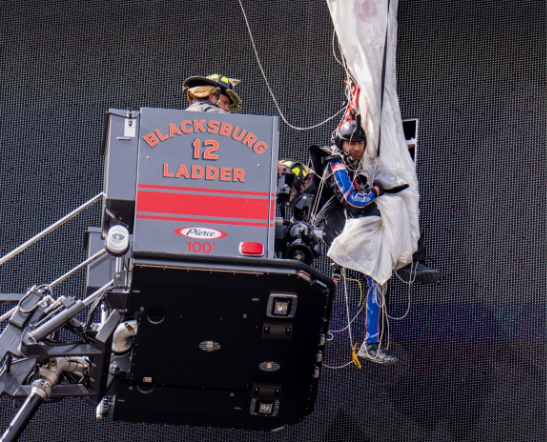
Firefighter Kyle Guinn was one of the first responders tasked with reaching the stranded parachuter above Lane Stadium.
Photo by Alexis Edwards
The incident quickly spread online after videos posted to social media showed the parachuter tangled near the scoreboard while emergency personnel gathered below. News outlets across the
country picked up the story, including coverage from ESPN and NBC News, as viewers questioned how the rescue would unfold.
For Guinn, however, the focus never shifted toward publicity.
“We are helping people every single day,” Guinn said. “So it was just more of us doing our job.”
At the time of the incident, Guinn was not initially stationed inside Lane Stadium. Instead, he and the department chief were responding to a fire alarm near Oak Lane while separate personnel worked the football game itself.
The Blacksburg Fire Department divides emergency responsibilities during game days, assigning some crews directly to Lane Stadium while others remain available to respond throughout town.
While investigating the fire alarm, Guinn received a radio update from dispatchers covering the game.
“We get a phone call from the officer who was dispatching for the game saying that there was a parachuter stuck on the board,” Guinn said.
After clearing the fire alarm, Guinn and the chief immediately responded toward Lane Stadium. By the time they arrived, emergency crews had already attempted to use one ladder truck to reach the parachuter, but it was not tall enough.
The scoreboard towered above the field, leaving the stranded parachuter suspended beyond the reach of the first truck.
“So we had to improvise and get the second ladder out,” Guinn said.
Dispatchers called for Ladder 12, the department’s 100-foot ladder truck. While firefighters waited for the truck to arrive, rescue personnel discussed alternate plans, including the possibility of rappelling from the top of the scoreboard if the ladder could not safely reach the parachuter.
“Rescue wanted to rappel from the top,” Guinn said. “That would have taken a lot longer to get set up.”
Instead, crews focused on positioning the taller ladder truck beneath the scoreboard while command personnel coordinated the scene below.
From the stands, fans watched emergency officials coordinate plans while the parachuter remained suspended above the stadium. On social media, videos and speculation spread rapidly before many people fully understood what was happening.
For firefighters below the scoreboard, however, the attention from the crowd became background noise.
“There wasn’t too much debate on who was going up there,” Guinn said.
Although no formal certification was required to operate inside the basket, Guinn had extensive experience working with the ladder truck during emergency calls and training exercises.
“I had more experience in the basket,” he said.
Many of the department’s senior ladder operators were either not present yet or were serving in command positions on the ground, where they coordinated operations instead of participating directly in the rescue.
As the ladder slowly rose toward the scoreboard, Guinn focused less on the crowd surrounding him and more on the technical details of safely reaching the parachuter.
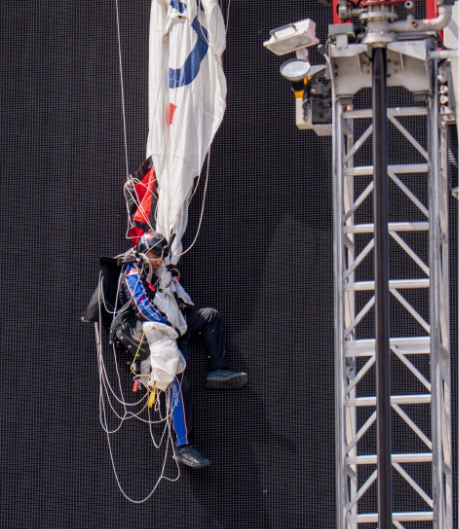
Emergency responders maneuver Ladder 12 toward the Lane Stadium scoreboard during the parachuter rescue operation.
Photo by Alexis Edwards.
“I was more focused on just getting the ladder to him,” Guinn said.
The plan required careful positioning. The parachuter needed enough space to step safely onto the ledge outside the basket before firefighters could help him inside and begin untangling the parachute cords.
When Guinn finally reached him, the parachuter remained surprisingly calm despite hanging above thousands of people.
“He was really calm, really chill,” Guinn said. “He was doing everything he could to just basically stay on the board.”
Additional rescue personnel worked simultaneously inside the scoreboard structure itself. A supervisor from Blacksburg Rescue communicated with Guinn through a small opening while helping move tangled cords away from the ladder basket.
Then, responders identified another potentially dangerous problem.
A smaller chute responsible for deploying the parachuter’s reserve parachute had become caught dangerously close to the basket. If the cord accidentally snagged while firefighters worked, the reserve parachute could deploy directly into the basket itself.
“That would have been really bad for us,” Guinn said.
With assistance from the rescue supervisor inside the scoreboard, Guinn located the cord and secured it before the reserve chute could accidentally deploy.
At the same time, additional technical rescue crews moved inside the structure, preparing backup rescue systems in case firefighters needed to transition into a rappelling operation.
Most of that coordination happened completely out of public view.
“There’s definitely a lot more that goes into it than what people see,” Guinn said.
The viral clips posted online captured only brief moments of the rescue, often without context about the planning and communication occurring behind the scenes.
“The biggest thing that I kind of took away was that you can’t judge too much based on a 30-second clip,” Guinn said. “There’s a lot more happening behind the scenes.”
Emergency responders communicated constantly over radios while managing equipment, personnel, and crowd safety below. Guinn said one of the biggest challenges was not necessarily the rescue itself, but managing the overwhelming number of people surrounding the operation.
“We were pretty coordinated on who was doing what,” he said. “The biggest challenge was just keeping people back and managing personnel.”
The department also worked to limit unnecessary involvement from individuals not directly connected to the rescue operation. While some members of the parachute team assisted firefighters by identifying equipment concerns, responders intentionally restricted access around the scene to avoid additional risks.
“We try to keep anyone who’s not directly operational involved in the rescue effort as blocked off as possible,” Guinn said.
Although the rescue became one of the most widely viewed moments connected to Virginia Tech athletics that season, Guinn said firefighters approached it no differently than any other emergency call.
One reason, he explained, was the department’s extensive training schedule.
“One of the things that the Blacksburg Fire Department does really well is training its members beyond just what the basic fire standard is,” Guinn said.
In addition to standard firefighter certifications, crews regularly train on ladder operations, technical rescues, and emergency scenarios involving specialized equipment.
According to the National Fire Protection Association, technical rescue incidents require advanced operational coordination and extensive equipment familiarization because of the unpredictable nature of rescue environments.
Guinn said his station trains several times each week in addition to department-wide training sessions held monthly.
“Part of our truck checks is also raising the ladder, climbing it, and making sure everything works,” Guinn said.
That constant repetition ultimately helped firefighters remain calm while operating in front of a packed football stadium and a national audience.
Even after videos of the rescue spread online, Guinn said he never viewed the situation as extraordinary compared to the work firefighters routinely perform.
“I didn’t expect it was going to be national news or anything,” he said.
Instead, he viewed the rescue as another example of firefighters relying on preparation and teamwork under pressure.
“It’s just nice to be part of a department that trains enough to do our job and get stuff done,” Guinn said.
By the end of the rescue, the parachuter had been safely removed from the scoreboard, and the crowd inside Lane Stadium erupted in applause. Within minutes, attention shifted back toward football.
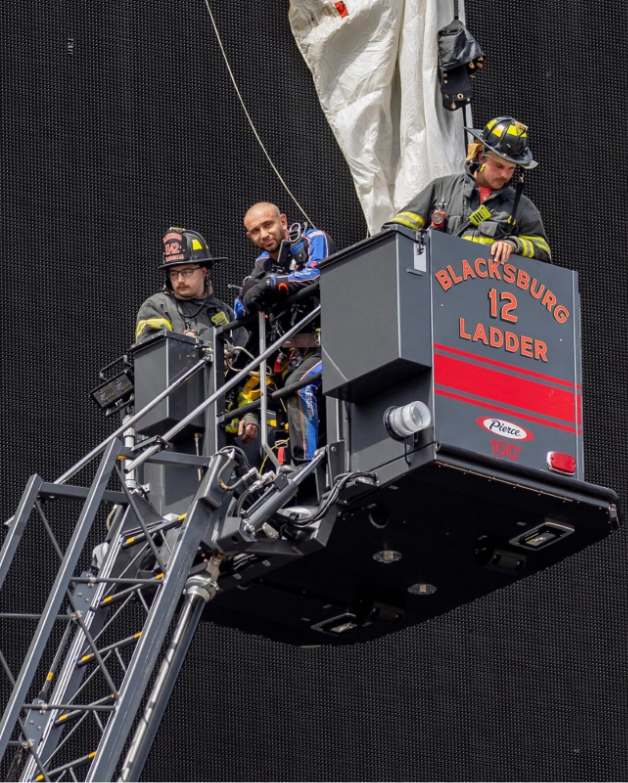
Fans watched as emergency crews safely completed the rescue operation above Lane Stadium.
Photo by Tech Sideline.
For Guinn and the firefighters below the scoreboard, however, the moment ended much more quietly.
After the equipment was packed away and the field cleared, they returned to work, just as they do after every other call.