More Than Basketball: How Virginia Tech Athletes Prioritize Health Beyond the Court

Virginia Tech Men’s Basketball is placing a growing emphasis on hydration, nutrition, and recovery, enabling players to perform at their peak potential

By Owyn Dawyot, Health and Wellness Reporter
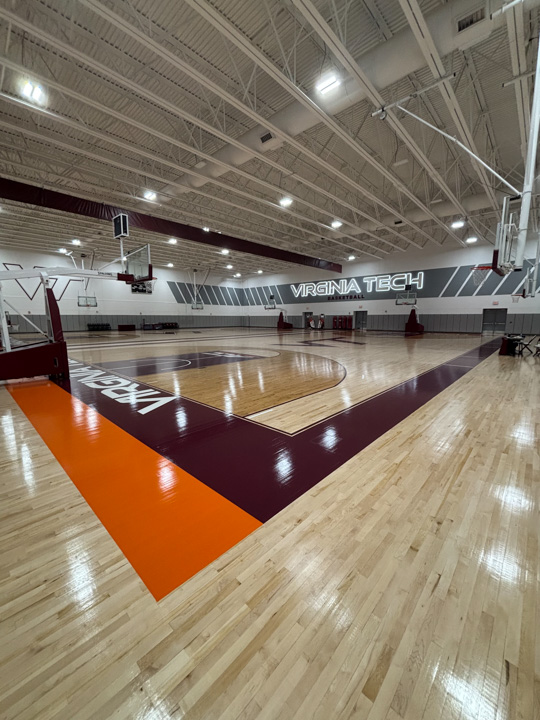
Pictured is the Hahn Hurst Practice facility. Both the men’s and women’s basketball teams train and practice here year-round. By Owyn Dawyot – May 10, 2026

For many college athletes, health and nutrition is often something that gets pushed to the side. Between late-night studying, inconsistent sleep schedules, and having a social life, maintaining healthy habits can feel nearly impossible. However, inside the world of Division I athletics, players and staff are increasingly treating health and recovery not as optional, but as a critical part of success.

For Virginia Tech Men’s basketball player Jaden Schutt, prioritizing health started long before college. Growing up in a household where nutrition and fitness were constantly emphasized, he quickly learned that what he put into his body directly affected how he performed on the court.

“I would say in the last few years, honestly, just making sure I’m hydrated, I have enough sleep, and just eating a lot cleaner,” Schutt said. “I wake up and drink salt water, take hydration mix, and make sure that’s the first thing I’m getting in.”

While many athletes focus primarily on training and skill development, Schutt believes recovery and nutrition are equally important. He explained that his daily routine revolves around whole foods, hydration, and limiting processed ingredients.

“A lot of things I cut out are artificial dyes, sugar in general, and junk food,” he said. “I’m trying to burn fuel as efficiently and as clean as possible.”

Schutt said he began taking nutrition seriously around fifth grade when he started playing competitive sports regularly, claiming that seeing the difference in his own performances made it difficult to ignore how much nutrition mattered.

“I really didn’t want to have a bad game, so I was trying to do everything I could to play to the best of my ability,” Schutt said.

That mindset only intensified as he got older and watched the habits of people around him. Schutt described how observing his older brothers gave him firsthand examples of both healthy and unhealthy lifestyles.

“One brother took things really seriously, and another didn’t,” he said. “I kind of watched their habits and who was getting more success.”

For Schutt, the connection between healthy habits and athletic performance became obvious over time. He said that while athletes can temporarily adapt to unhealthy eating, the long-term effects eventually appear physically and mentally.

“I’ll notice my skin start breaking out, and my joints are hurting a little more. If I really take it seriously and eat the way I want to, I recover faster, feel better, and my joints are less painful,” Schutt admitted.

“If you take care of your body, it takes care of your mind.” – Jayden Schutt

Schutt also believes the benefits extend far beyond basketball. “If you’re feeling good, you’re going to be a nicer person,” he stated. “If your back’s hurting or you’re irritated, you go through life a little cloudy.”

He compared good health to carrying “sunshine” internally, explaining that taking care of your body positively affects your mentality and relationships with others.

The emphasis on health and recovery is not just coming from players themselves. Behind the scenes, sports nutrition staff members are helping athletes understand exactly how nutrition, hydration, and recovery impact performance.

Savannah Gustafson, director of basketball sports nutrition at Virginia Tech, works directly with athletes to optimize their diets and recovery routines throughout the season. According to Gustafson, hydration is one of the most overlooked but important aspects of athletic performance.

“We push hydration really heavily here to make sure we’re preventing injury risk and electrolyte imbalances,” Gustafson stated. She elaborated that this is extremely crucial, considering some players lose almost 10 pounds of fluid per practice from sweat alone.

Gustafson explained that athletes undergo hydration testing regularly so staff members can tailor hydration plans to individual players. Research on dehydrated Division I basketball players, she said, shows noticeable declines in shooting accuracy, focus, and energy output.

“They sent basketball players out already dehydrated, and their shooting percentage was down,” Gustafson said. “Their ability to exert energy was decreased.”

Sleep is another major priority for the program. While many college students stay up late playing video games or scrolling on social media, athletes are encouraged to maintain disciplined sleep schedules during intense training periods.

“They’re 18 to 22 years old, so they want to stay up late, but sleep is so important for recovery and coming in with a clear head each day,” Gustafson stated.

Nutrition before and after workouts is also carefully planned. Gustafson stated that athletes are typically given carbohydrate-heavy foods before workouts to provide energy, while post-workout meals focus heavily on protein and recovery supplements.

“We want them going into practice well fueled with carbohydrates,” she said. “Then, following a workout, we’re pushing heavy protein intake for recovery purposes.”

Among the recovery tools used by athletes is tart cherry juice, which Gustafson said can help reduce inflammation and aid recovery after strenuous practices.
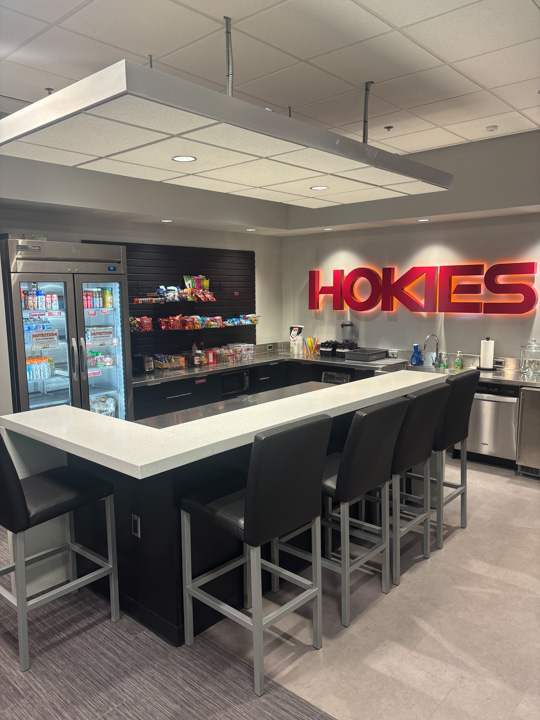
Pictured is the men’s basketball team’s kitchen. This area is regularly stocked with convenient, healthy options for players to grab on the go as they’re making their way in and out of the locker room between practices and team lifts. By Owyn Dawyot – May 10, 2026

Despite having access to elite resources, Gustafson said many athletes still struggle with consistency when it comes to nutrition. Convenience plays a major role in eating habits, especially for busy college athletes balancing practices, travel, and academics.

Due to demanding schedules, athletes often rely on quick meals instead of cooking for themselves. Gustafson explained that while ideal nutrition is important, ensuring athletes simply eat enough during the season is also critical.

“In season, I’d rather them be eating than not eating,” Gustafson said. “If it has to be Chipotle, that’s fine with me.”

She also noted that many incoming freshmen arrive with very limited nutrition knowledge. “A lot of times, they’ve just been tall and strong their whole life, and that got them here. If they know what a carb, protein, and fat are, I’d consider that pretty advanced for a high schooler,” Gustafson stated.

Transfer athletes from smaller schools sometimes possess slightly more practical knowledge because they previously lacked access to nutrition staff and had to learn independently. However, Gustafson said many athletes still do not fully understand the relationship between nutrition, inflammation, immunity, and recovery until they arrive at a Power Five program.

Schutt said watching professional athletes has also reinforced the importance of recovery and health. He specifically mentioned players like LeBron James and Shai Gilgeous-Alexander as examples of athletes who heavily invest in their bodies.

“You’re seeing LeBron getting oxygen tanks and doing all these things for his health,” Schutt said. “You start to realize how much professional athletes spend on their health because it’s their job.”

For Schutt, healthy habits have become less of a temporary in-season routine and more of a lifestyle. He admitted that when he was younger, he would celebrate the end of a season with donuts, cookies, and junk food. However, over time, he realized how difficult it became to regain conditioning after unhealthy stretches.

“It’s so hard to get back into shape,” Schutt claimed. “I’d rather sacrifice the opportunity to cheat on meals than let my body go.”

“Nutrition habits capitalize in a good or bad way.” – Savannah Gustafson

Gustafson emphasized that the effects of nutrition are somewhat of a snowball effect. According to her, the differences between a well-fueled athlete and an under-fueled athlete may not appear immediately, but they become very noticeable over the course of a season.

Beyond basketball performance, Gustafson said one of her goals is to help athletes build habits that will continue after sports end. Transitioning away from athletics can be difficult physically and mentally, especially for athletes whose daily routines have revolved around training for years.

She explained that many former athletes struggle after retirement because they no longer maintain the same level of activity but continue the same eating habits. Helping players understand long-term wellness, she said, is just as important as preparing them for games.

For Schutt, that long-term perspective already shapes the way he approaches health today. Even after basketball, he expects to continue prioritizing exercise, clean eating, and recovery.

“I think especially when I’m getting older, I’ll try to eat as healthy as I can and maintain a nice workout routine,” Schutt stated.

As conversations surrounding mental health, wellness, and performance continue growing in sports, athletes are increasingly recognizing that success depends on more than talent alone. Recovery, sleep, hydration, and nutrition are becoming foundational pieces of athletic performance rather than secondary concerns.

For athletes like Jaden Schutt, the goal is simple – treat the body well now in order to perform better today, and to live healthier tomorrow.
The cost of living a healthy lifestyle as a college student

By Owyn Dawyot, Health and Wellness Reporter

The demands of living as a college student who prioritizes their health and fitness are almost as challenging as getting through the school itself.

College is a crucial time in a person’s life when they’re making decisions that will affect their future. Coincidentally, something that often gets neglected during the busy life of a student is their health, both physical and mental, which directly affects how the rest of their lives will play out.

Many of these young adults don’t want to think about taking the extra time to work out or spending the extra money on healthier groceries, but those two factors are more important for your well-being than you think.

While in college, students are bombarded with strenuous class schedules, spending time with clubs and organizations they’re involved in, and looking for jobs and internships over the summer, all while attempting to maintain a social life. It’s an extremely draining time, so why would it make sense to add something else to your plate, like going to the gym?

“I think your mental and physical health go together, so you have to prioritize one to work on both,” Nick Owen, a senior at Virginia Tech, said when describing why going to the gym is important for him. Owen believes that if you work on your physical health, then your mental health will follow. He’s also a believer that if you have a healthy, balanced diet, then you will see significantly more progress in each of these areas.

Owen regularly trains at The Weight Club, an off-campus gym located in Blacksburg, Va., which raises the question: Why spend the money to train at a gym off campus when Virginia Tech offers three fully-functional facilities on campus, intended for the use of students enrolled at the university – McComas Hall, War Memorial Hall, and the VT Rec Sports Field House (also known as “The Bubble”)?

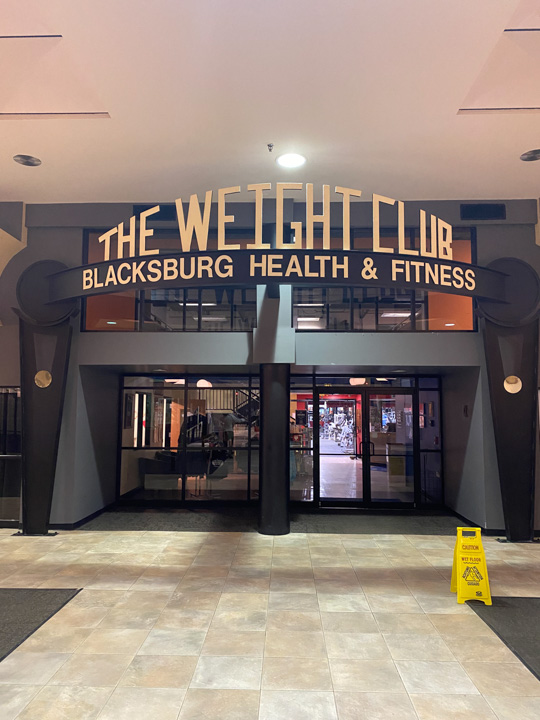
Blacksburg, Va., Feb. 10, 2026 – Pictured above is The Weight Club, a popular off-campus gym among Virginia Tech students. Photo: Owyn Dawyot – TheNewsFeedNRV.com

“The on-campus gyms don’t have a sauna, and Weight Club is less crowded,” Owen stated, expressing that he believes it is crucial for his health and well-being, and that he would make the sacrifice to pay $414 for the year to have the luxury of using a sauna.

Another student, Mathew Hale, a sophomore at Virginia Tech, also purchased an off-campus gym membership at Very Good Gym in Christiansburg, Va. Hale pays for the semester plan that Very Good Gym offers, which is $180 for four months, and describes the membership he pays for as a “quality of life” purchase.

“I feel like I’m almost saving money by not having to worry about parking on campus or getting a parking pass to go to an on-campus gym,” Hale stated. “It’s never busy, and it’s a 24-hour gym, so while I’m there, I don’t have to worry about hours or anything like that.”

While both Owen and Hale seem to have their reasons for spending the extra money on exercising each month, healthy eating is a completely different animal and needs to be done with strategic planning, as described by Maddie Reis, another senior at Virginia Tech, who believes that living a healthy lifestyle as a college student is much more than just working out.

“I shop in Christiansburg, and I have my groceries listed for when I go to Aldi and when I go to Walmart, depending on the prices,” Reis stated. “I know each item that I have to get at each store to get the lowest price point.”

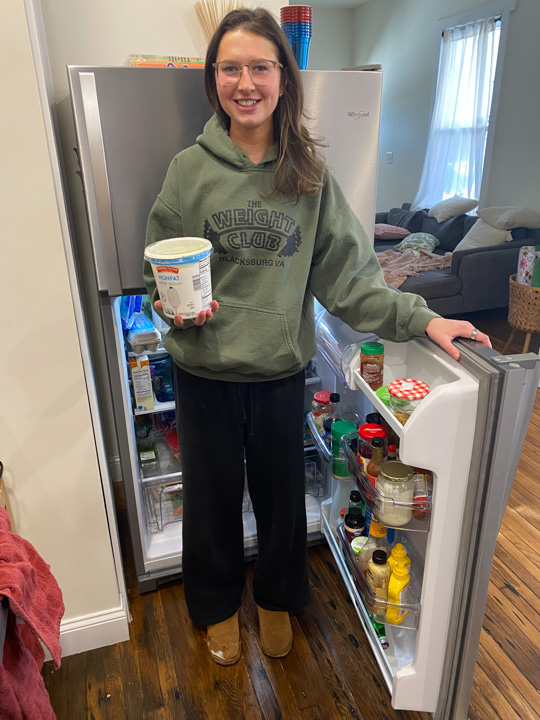
Blacksburg, Va., Feb. 9, 2026 – Maddie Reis poses in front of her fridge filled with healthy food while holding her favorite snack, plain Greek yogurt. Photo: Owyn Dawyot – TheNewsFeedNRV.com

Reis also said that she is constantly browsing the internet searching for deals on healthy food and drink items. She claimed that Olli Pop is her favorite healthy drink. She knows the exact date they go on sale each month at Food Lion and is ready to stock up.

However, it doesn’t stop there. Reis strategically plans out her grocery list for every week, down to the serving size of each dish she’s preparing the following week.

Reis said that she also has suffered from insomnia throughout college and purchases around $40 of various supplements per week to help ensure that she gets adequate rest for recovery.

Owen and Hale both stated that they also purchase supplements, creatine, and protein powder. Owen doesn’t stop there, also taking ashwagandha, magnesium, and fish oil. Both claim this excess supplementation doesn’t just help their performance in the gym, it also plays a huge role in their energy levels throughout the day, during classes, and long study sessions.

All three students stated that they rarely eat out, as the healthier restaurants in Blacksburg, such as Greens, Roots, and Chipotle, are typically their go-to options when they do, expressing that they are very costly on their tight budgets.

Although college is a very stressful time, and it may not make much sense to some to spend the extra time and money on worrying about prioritizing their health, many students, including these three, would disagree, arguing that it may be worth the effort.

How Tarzan Lifts balances college and the dream of becoming a full-time fitness influencer

By Owyn Dawyot, Health and Wellness Reporter

Caleb Grider, also known as Tarzan Lifts, practices bodybuilding poses after finishing a lift – Shot with iPhone 15

Caleb Grider, better known as “Tarzan Lifts”, is a bodybuilding YouTuber known for throwing around monstrous weights and making fun, educational videos for those interested in fitness. However, something most don’t know about Grider is that he is also a junior at Virginia Tech, studying Marketing, something he hopes will aid the development of his social media presence while promoting his own personal brand.

Grider’s journey of becoming an influencer began as a young teen. “I started going to the gym at 13 and would watch all these YouTube videos of different influencers, getting all the information I could,” Grider stated, referring to what first piqued his interest in creating content.

Years later, during his senior year of high school, Grider’s physique had grown considerably, similar to his dark, jet-black hair, catching the attention of many friends and family members. “It was all these external forces that were pushing me to do it (start posting), and I finally bought a camera my freshman year of college,” Grider said when describing what eventually pushed him to start posting.

What struggles or “roadblocks” have you hit along the way since first starting to post on YouTube?

Grider talked about a big struggle he’s faced since first posting on YouTube: how his peers perceive him. “People do perceive you differently if you post online,” Grider stated.

Grider followed by saying he tries focusing on only valuing the opinions of his “inner circle”, which are the people closest to him who originally told him to start posting in the first place and who know his true, genuine character.

“Is it out of the ordinary, yes”, Grider acknowledged, “but at the end of the day, it’s something that I want to do, so it doesn’t really matter,” Grider said regarding posting videos online. This is a very positive mindset that’s kept him equally motivated and confident, and helps him combat the fear of judgment, something he admittedly is still in the process of perfecting.

Do you feel like your time at Virginia Tech as a Marketing Major has contributed to the success you’ve had posting videos on YouTube and social media? If so, how?

“I’m more aware of algorithms and statistical click-through rates, and it’s opened my eyes to different analytics; it’s just taught in a different way,” Grider said. “Then I take it and apply it to the business that I have (Tarzan Lifts).”

Grider went on to reference a Digital Marketing class that he is currently enrolled in at Virginia Tech and really enjoys.

What life lessons have posting fitness content online helped you learn?

Grider described the biggest life lesson he’s taken away from posting fitness content is delayed gratitude, stating that many online creators expect instant results when they first start posting and get discouraged when their content doesn’t perform well immediately.

Admittedly, Grider said that his videos when he first started making online content weren’t the best quality, and it wasn’t until recently that he felt the content he was making was genuinely good. Grider further elaborated, stating that he has failed many times while attempting to create content viewers will find engaging, but when he fails, he fails forward.

“I use my YouTube videos like compound interest,” Grider stated. “Every single good video that I produce could just get 100 views, but once one pops, I’ll have 20 or 30 good videos for people to watch.”

Do you ever struggle finding the right balance between schoolwork and posting on social media?

Grider stated that this has been a constant struggle every semester throughout his college career. “Whether it is school or YouTube, trying to always find the time to get everything done is definitely difficult,” Grider stated, claiming that sometimes school will have to take a back seat to YouTube, and vice versa.

Grider expanded on this by saying that time management is something he is actively working on, and sometimes he will take what he calls a “personal day”, away from school and YouTube, because both require a lot of creativity, which can be immensely draining at times.

What are some things, or people, that motivate you to keep improving and growing your platform each day?

Grider described his older brother Tim, a 25-year-old airline captain, as the person who has most motivated him to continue growing and improving each day by modeling the values of discipline and consistency, which Grider has adopted in his own life.

“If you want your dream, go out and get it,” Grider said. “It’s not a dream if it’s not crazy, and if people don’t literally say, ‘What are you doing?’”

Grider attested that Tim has been someone whom he has looked up to because he followed his dream of becoming an airline captain and has been fully supportive of Grider while pursuing his dream of becoming a full-time influencer.

What is the most rewarding thing for you personally that has come from posting on YouTube?

“The personal interactions I’ve had when people have told me that I’ve made a positive impact on their lives,” Grider said.

“I want to have an impact on this world in a positive way, and if I can impact one person from one video, then I’ve won,” Grider said, referencing that the interactions he’s had with supporters have been the most rewarding thing to come from posting.

Grider followed, stating that his “why” behind posting content was having an impact on this world in a positive way, either through education from his videos or entertainment.