The price of remembering: Virginia Tech’s growing graduation photo industry

By Aaliyah Kinsler | Arts, Culture and Sports Reporter
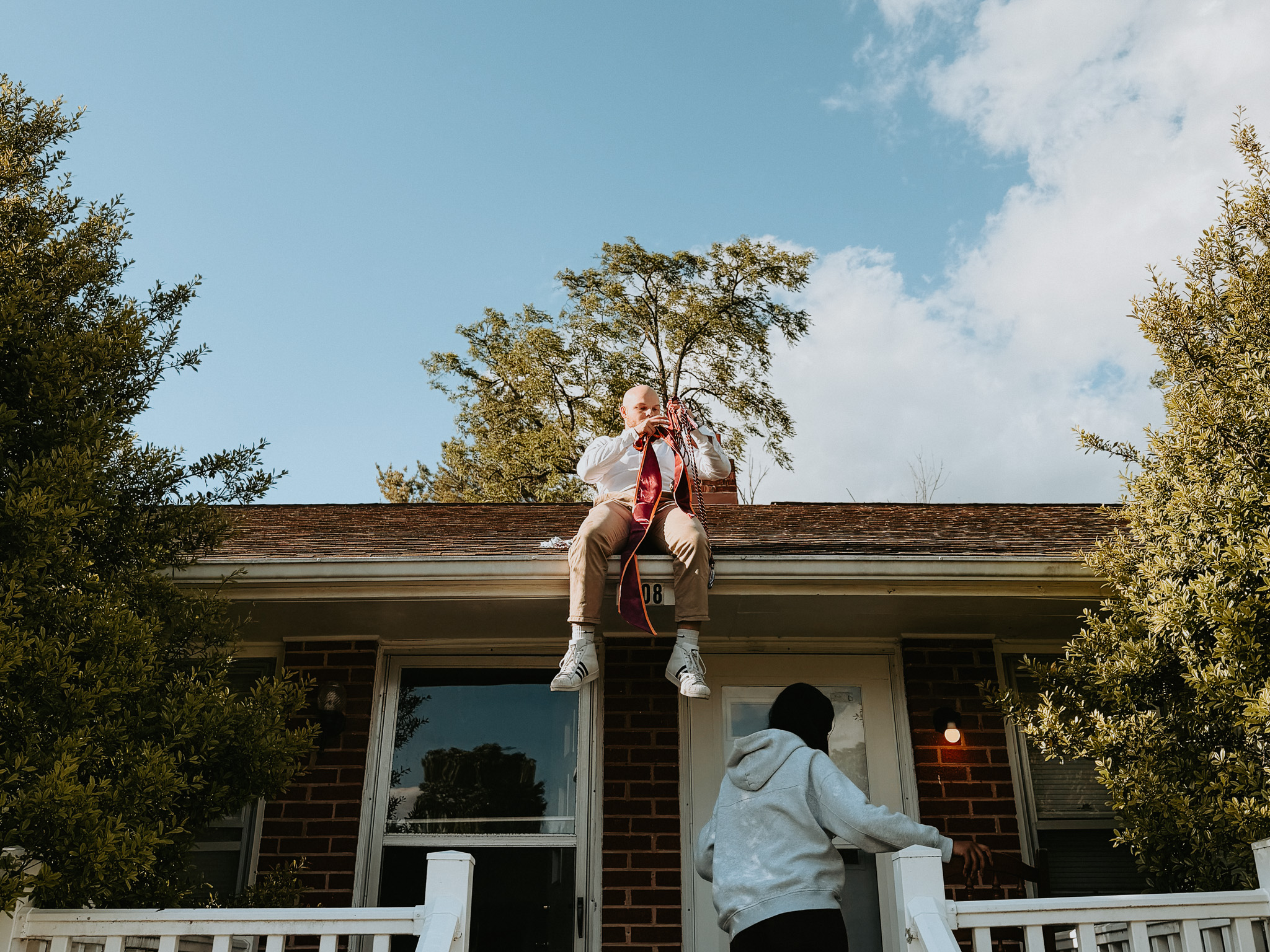
A Virginia Tech graduate prepares for a graduation photo session outside an off-campus home in Blacksburg, Virginia, during spring commencement season. (Aaliyah Kinsler, The Newsfeed NRV)

As graduation season settles over Virginia Tech, groups of seniors dressed in white dresses, maroon stoles and graduation caps crowd iconic campus landmarks from Burruss Hall to Lane Stadium. Nearly every evening in April and May, students wait in lines for their turn beneath the Pylons or outside Burruss Hall while photographers maneuver around packed sidewalks and golden-hour lighting. 

For many students, graduation photos have become as much a part of the college experience as commencement itself. 

But as the popularity of graduation photography has surged alongside social media culture, so has the pressure surrounding it. What was once a smaller tradition centered on family announcements and framed keepsakes has evolved into a booming industry tied closely to Instagram aesthetics and social expectations. For some Virginia Tech students, professional graduation photos have become increasingly difficult to afford. 

Photographer Jackson Sirbaugh, who has photographed Virginia Tech graduates for six years, said demand for sessions has grown dramatically during his time of photographing students. 

“I feel like even just a few years ago, or even before Instagram was really popular, it wasn’t as big of a deal,” Sirbaugh said. “Now you see all the iconic poses and outfits at every single different spot, and everyone wants that glorified, amazing thing.” 

Sirbaugh said his booking process now begins nearly a year in advance. By August, students already begin reserving spring graduation sessions, and by the time April arrives, many photographers’ schedules are completely filled. 

“Honestly, the most frustrating part about grad photos is that there are so many people that need to graduate and take photos,” Sirbaugh said. “Some evenings it’s endless people.” 

For photographers, graduation season has become both emotionally rewarding and financially significant. Sirbaugh described graduation photography as “the bread and butter” of his business while he was a student. 

“It’s business, it’s photography, it’s money,” Sirbaugh said. “But then it’s also been so special to do photos for friends because it kind of started off as people I didn’t know as much, and now it’s peers and roommates and best friends.” 

Sirbaugh said the culture surrounding graduation photography at Virginia Tech has also become increasingly crowded and competitive in recent years as more students purchase cameras and begin offering sessions. 

“I would say it’s definitely way more oversaturated than even before,” Sirbaugh said. “But because there are so many graduates, there’s room for a lot of people.” 
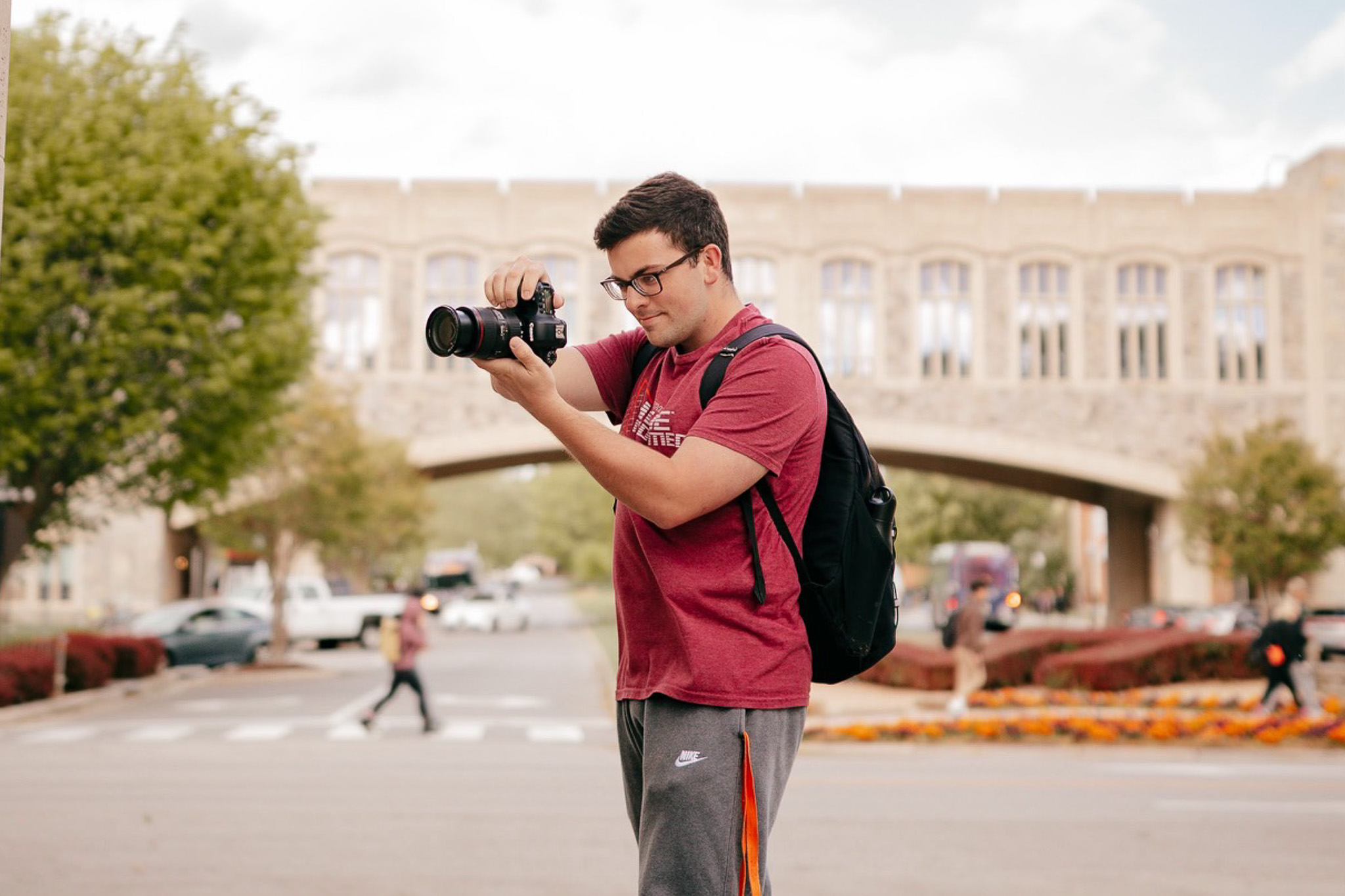
Jackson Sirbaugh photographs Virginia Tech graduates near the War Memorial Pylons during spring commencement season in Blacksburg, Virginia. Photo courtesy of Jackson Sirbaugh.

Despite the competition, Sirbaugh said many photographers at Virginia Tech operate more like a community than rivals. When his schedule fills, he often sends students to other photographers through a recommendation list he maintains. 

“There are literally endless grads to take photos with,” Sirbaugh said. 

Still, the increasingly polished culture surrounding graduation photography can create pressure for students who cannot justify the expense. 

“I think social media definitely makes it feel less optional.” 

Anna Eaton, a Virginia Tech Class of 2025 graduate, originally planned to book professional graduation photos during her senior year. But after comparing pricing packages and balancing other graduation expenses, she ultimately decided against it. 

“I definitely wanted grad photos,” Eaton said. “It felt like everybody around me was doing them, especially once people started posting their photos on Instagram.” 

Eaton said the cost became difficult to rationalize while preparing for graduation and post-college expenses. 

“At that point I was already thinking about moving expenses, graduation costs and trying to save money after college,” Eaton said. “Grad photos just stopped feeling practical for me.” 

Like many seniors preparing to graduate, Eaton said she was already balancing application fees, apartment deposits, graduation attire and plans for relocating after college. 

“When you start adding everything up at the end of senior year, it gets expensive really quickly,” Eaton said. “Grad photos were something I wanted, but they weren’t something I absolutely needed.” 

Instead, one of Eaton’s friends borrowed a camera and photographed her around campus near the Drillfield and Burruss Hall. 

“One of my friends ended up taking mine for me, and honestly it turned into a really fun memory,” Eaton said. “They weren’t professionally done, but I still love them because they feel personal to me.” 

Still, she admitted there was a sense of pressure surrounding the experience. 

“I think social media definitely makes it feel less optional,” Eaton said. “Even if nobody directly says you need grad photos, it kind of feels expected.” 

Even so, Eaton said taking photos with a friend ultimately reminded her that graduation memories do not have to look perfect online to feel meaningful. 

“At the end of the day, I cared more about remembering the moment than making everything look perfect online,” Eaton said. 

That pressure is something photographer Travis Carr said he thinks about often. 

Carr, who has photographed graduation sessions at multiple universities including Virginia Tech, New York University and Fordham University, said social media has dramatically reshaped photography culture over the last decade. 

“When I was a freshman, the seniors took grad photos, but social media was a very different environment,” Carr said. “The further along we get, definitely the more influence social media has on grad photos and the presence of them online.” 

Carr said the growth of social media has increased demand for photographers but also complicated the meaning behind graduation photography itself. 

“Selfishly, yeah, I want more of the market,” Carr said. “But also, do we all need $300 grad photos? I don’t know.” 

“Do we all need $300 grad photos? I don’t know.” 

Carr said many students feel pressure to present polished versions of themselves online, and graduation photography can sometimes contribute to those insecurities. 

“The counterweight to the social media thing tells us we’re not good enough all the time,” Carr said. “It tells us you have to look like this and be this way and pay this amount for photos.” 

Carr said his own experiences in front of the camera shaped how he approaches photographing students. 

“Photography is a vulnerable thing,” Carr said. “You’re holding up a mirror to somebody and saying, ‘Here’s all the flaws you think about all the time.’” 

Because of that, Carr said much of his process focuses on helping students feel comfortable rather than simply creating technically perfect photos. 

“If people have a good time and they feel good, that’s going to be the memory associated with it,” Carr said. 

Ironically, Carr himself never took professional graduation photos while in college because he could not afford them. 

“I didn’t have grad photos taken because I couldn’t afford it,” Carr said. 

He said that experience has influenced the way he thinks about the industry now, describing graduation as a rare moment when students pause to recognize how much their lives have changed over four years. 

“You’re sitting in Lane Stadium surrounded by this community that you’ll never be around again in the same way,” Carr said. “It’s four years of your life that hopefully launches the rest of your life.” 

He said his goal as a photographer is not simply creating technically perfect photos but creating an experience where students feel comfortable and celebrated. 

“My goal with most of the work I do is to say, ‘Hey, you are enough while you’re in front of this lens,’” Carr said. 

Sirbaugh echoed similar feelings, saying many of his favorite sessions are memorable not because of the photos themselves but because of the people attached to them. 

The Virginia Tech Class of 2024, Sirbaugh said, felt especially personal because many of the graduates were longtime friends. 

“I can look back now and think, wow, that’s what we looked like when we were graduating college,” Sirbaugh said. “This is what campus looked like, this is how we smiled, this is how we were.” 

He said some of his favorite sessions happen outside the traditional graduation locations because they allow students to express more of their personalities. 

“There are so many cool spots around campus,” Sirbaugh said. “Sometimes it can get really monotonous doing the same locations over and over, but then you go somewhere like Hahn Horticulture Garden, and it completely changes the feel of the photos.” 

Sirbaugh said the emotional aspect of graduation photography becomes more apparent as time passes. 

“A lot of those moments grow value over time,” Sirbaugh said. “At the moment, they’re just really cool photos, but years later you realize that was such a specific moment in your life.” 

As graduation season continues across Virginia Tech’s campus, students carrying bouquets and champagne bottles will continue lining up across familiar campus landmarks in pursuit of the perfect graduation photo. 

Whether captured through a professional lens, a borrowed camera or a friend’s phone, the meaning behind those photos often remains the same: preserving a fleeting moment before an entire community moves on. 
Genesis Film Festival returns to Virginia Tech, spotlighting student filmmakers

By Aaliyah Kinsler, arts, culture, and sports reporter

BLACKSBURG, Va. — The Genesis Film Festival is returning to Virginia Tech on April 27, offering students the opportunity to showcase their films on the big screen. Hosted by the Cinema Club, the festival highlights student creativity and provides a space for filmmakers of all experience levels to share their work with a live audience.

Local libraries report few book challenges despite national trends 

By Aaliyah Kinsler, arts, culture & sports reporter

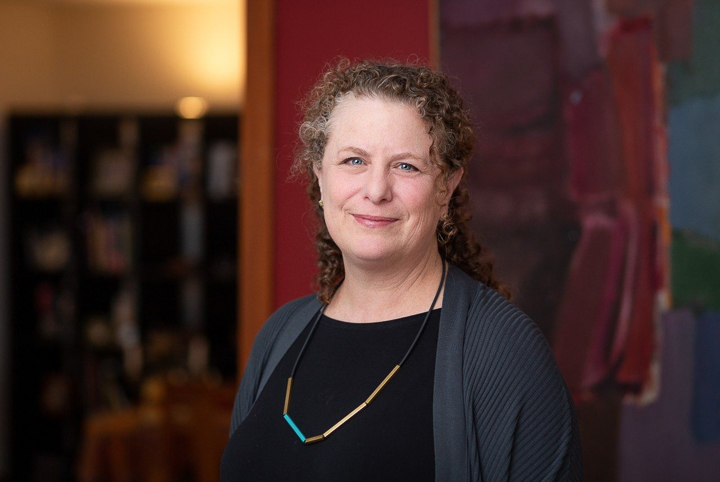
CHRISTIANSBURG, Va. (Feb. 11, 2026)– Salena Sullivan, Christiansburg Library branch manager, stands between book stacks inside the Christiansburg branch of the Montgomery-Floyd Regional Library. (Aaliyah Kinsler, Newsfeed NRV) 

Book challenges and removal requests at public libraries across the New River Valley remain infrequent, even as debates over library collections continue nationally, according to officials with the Montgomery-Floyd Regional Library system. 

Library officials say formal requests to reconsider books or materials have been rare locally and have not increased in recent years. This comes despite a growing public attention to book challenges across the country and high-profile cases reported in other parts of Virginia and the United States. 

“I’ve been here since 2017, and there have been challenges to the collection, but we certainly haven’t seen an increase over the past few years,” said Montgomery-Floyd Regional Library Director Karim Khan. “It’s infrequent, not something that happens every week or every month.” 

Public libraries operate under formal policies and legal standards when evaluating materials rather than responding to individual complaints alone. The Montgomery-Floyd Regional Library system uses a written request for reconsideration process tied to collection development policy, state law and professional library standards that guide how materials are selected, and when necessary, reevaluated. 

Library officials say these policies help create consistency and transparency when requests do occur. The system’s collection development policy outlines how materials are selected, how these requests are reviewed, and how final decisions are made. The process usually involves reviewing professional evaluations, collection criteria and community need while making sure decisions remain aligned with legal standards and library ethics principles. 

“It’s not a big deal because we’re prepared,” Khan said. “A public library should have policies in place approved by its governing authority. We give our full attention every time somebody puts in a request for reconsideration.” 

The library system serves Montgomery and Floyd counties through four branches located in Blacksburg, Christiansburg, Floyd, and Shawsville. Requests must come from people eligible for library cards tied to the service area, which includes local residents, students, and others with qualifying ties to the community. Library officials say this structure ensures the reconsideration process reflects the communities that directly support and fund the library system. 

While public discussion often frames book challenges through political or ideological lenses, library leadership in the New River Valley says that the local experiences have been more varied. They say concerns most often focus on perceived content suitability for children or accuracy of factual information rather than a single political viewpoint. 

“I think what tends to unify a significant chunk of them is people trying to make sure children are ‘safe,’” Khan said. “It’s either that or, ‘This is scientifically inaccurate.’” 

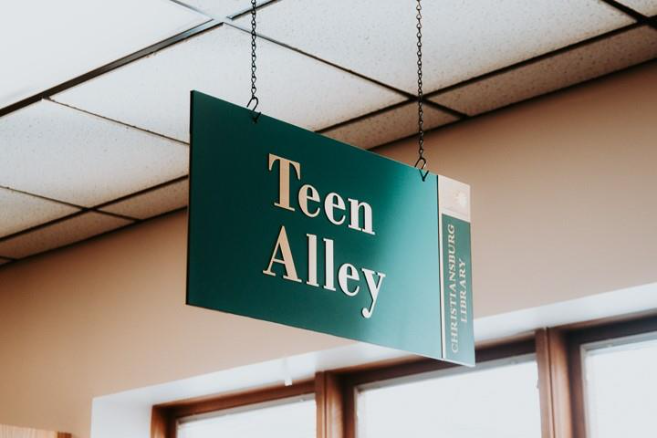
CHRISTIANSBURG, Va. (Feb. 11, 2026)– A “Teen Alley” sign marks the teen section inside a public library, where materials are organized by age groups and audiences. (Aaliyah Kinsler, Newsfeed NRV) 

Library officials say many concerns begin as conversations between patrons and staff rather than formal written requests. Front-line employees are often the first point of contact when patrons have questions or concerns about materials, allowing libraries to explain how collections are built and why certain materials are included. 

At the branch level, staff say public libraries serve broader roles beyond book circulation, including acting as information centers, study spaces and community gathering spaces for people of all backgrounds. 

“Libraries play a very important role in our community as a place where people have access, access to information, access to leisure and access to community,” said Christiansburg Library Branch Manager Salena Sullivan. “It’s one of the only places where you don’t have to pay to be here.” 

Sullivan said strong library systems often reflect overall community health, noting that library access often supports education and lifelong learning across age groups. 

“Having a robust library in your community is a really good indicator of a healthy community,” Sullivan said. 

Library management say public trust plays a significant role in how collections are built and maintained. Officials say collections and programming are designed to meet the needs of different populations across the New River Valley, including families, students, working adults and rural residents with varying information needs and interests. 

CHRISTIANSBURG, Va. (Feb. 11, 2026)– Books sit on display shelves inside a Montgomery-Floyd Regional Library branch in the New River Valley. (Aaliyah Kinsler, Newsfeed NRV) 

“Libraries’ collections and programming should reflect the needs of the community,” Sullivan said. “We’re here to serve as an information resource.” 

Library officials say individuals and families ultimately decide what materials are appropriate for themselves or their children. While libraries organize materials by age group and intended audience, officials say they are not responsible for making individual reading decisions for patrons. 

They say legal definitions, particularly around obscenity, are determined by courts rather than library staff. Libraries rely on legal standards and established review processes when evaluating materials rather than subjective personal standards. 

“If it’s not obscene according to the law, then it’s not obscene,” Khan said. “It’s a legal term and we are no judge of that.” 

Library officials say their goal is to maintain broad access to materials while following professional standards and legal requirements. Officials say public libraries are designed to serve entire communities, even when individual patrons may disagree with certain materials or viewpoints represented in a collection. 

Across the New River Valley, library leaders say community relationships and open communication have helped to keep reconsideration requests relatively rare compared to trends reported in some other parts of the country. Officials say continuing conversations with patrons and maintaining transparent processes remain the biggest priorities moving forward.

How Virginia Tech curates the voices that take the stage 

By Aaliyah Kinsler, arts, culture, and sports reporter 

Margaret Lawrence, Director of Programming for the Center for the Arts at Virginia Tech. Photo Courtesy of Rob Strong and Virginia Tech

As universities face increasing questions about representation, audience engagement and institutional responsibility, arts programming has become a large reflection of broader cultural values. 

At Virginia Tech, the Center for the Arts brings professional performers from around the world to campus stages and shapes how students and the New River Valley community encounter the arts. 

In an interview, Margaret Lawrence, director of programming for the Center for the Arts, discussed how those decisions are made, how audiences influence programming and why representation matters. 

Her comments were edited slightly for length and clarity. 

How does Virginia Tech and the Center for the Arts decide which artists and performers are featured on campus? 

I can only speak for the Center for the Arts, because of course there’s lots of other stuff happening in the arts on this vast campus. We are really the center for bringing professional American and international touring performing artists, and top-notch professional visual artists. 

I’m the person involved with performing artists specifically. We produce a series of between 25 and 30 performances each year, kind of balanced between the two semesters. We don’t really present much in the summer when the students aren’t here. 

Our mission is to really bring the most extraordinary arts experiences here and to celebrate the diversity of kinds of art forms, of kinds of artists, of individuals. This might be the only chance a student at Virginia Tech has to see a full philharmonic orchestra, or a contemporary American dance company, or a very famous jazz artist they’ve heard of but never saw in person. This is a really formative time for students here. 

What goes into deciding which artists make it into a season? 

I’ve been a curator for more than 40 years. I have a lot of knowledge of the artists who are out there, not only in the U.S. but across the globe, and a lot of networks in the field with other performing arts centers. 

What we try to bring together are some artists who are at the top of their game and very well known, and then artists who are emerging, who you may never have heard about. That proximity to those artists and their work is really exciting. 

We’re just as interested in presenting really important music of the past as we are in premiering brand-new compositions. We even helped commission a brand-new piece that premiered here by a living composer. 

Do artists reach out to you, or do you reach out to them? 

All of the above. Almost all professional artists are represented by agents and management companies. They know who I am. I often pursue somebody for years before it finally comes true. 

I might be in New York and have a whole bunch of meetings. We had a trio here recently that was a new project. Those artists thought of it and put it together. The minute I heard about it; I was pursuing it. 

Some artists are incredibly expensive to bring, and it might take years and really creative thinking to raise the funds. When we brought Yo-Yo Ma here, the cellist, that didn’t happen overnight. 

How much influence do students and community members have in programming decisions? 

I’m working for at least a year and a half in advance. Right now, I’m almost done programming 2026–27, and I’m starting to work on 2027–28. That automatically changes how we approach things. 

If I only brought artists that I personally love, some of those things are really esoteric. That doesn’t mean I’m going to bring it to Blacksburg. So, I try to create a real balance. 

We do national touring Broadway shows because people want to see them. We see people there we might not see at any other kind of performance. That’s really important to us. 

Do engagement and education factor into programming choices? 

We’re not only presenting performances. We’re creating what we call engagement activities. We ask artists to do workshops, come into classes, teach master classes and do school-time matinee. 

For some kids, it might be the first time they’ve ever been to a theater. Those experiences are incredibly important for showing people what the world around them is. 

Have you noticed shifts in audiences over time? 

We’ve built a very strong subscription base from the community. Many of them will sign up for the entire season and trust us to have a great experience. 

The student percentage of attendees is very healthy. It tends to be around 23% of the audience, which is quite high. I think that’s partly because we do so much engagement with the artists. 

Have any performances sparked reflection about whose voices are being elevated? 

Several years ago, we brought a trans theater artist from London who did a piece about their identity. People told me, “You never would have seen a piece like this when I was a student here.” 

For students and community members, it creates a sense of belonging. For everybody else, it’s about learning about the people we share this globe with. 

We also brought a dance company from India collaborating with a company from Sri Lanka. A student told me it was the first year they were able to form a Sri Lankan student organization. The artists were from her hometown. Seeing that on the stage here was incredibly powerful. 

Looking ahead, how should Virginia Tech continue evolving in how it presents artistic voices? 

The arts are about entertainment, but they’re also about truth and self-expression. College is when people are figuring out what they stand for and what’s important to them. 

The more arts we have on campus, whether through the Center for the Arts or elsewhere, the better.