
By Aaliyah Kinsler | Arts, Culture and Sports Reporter
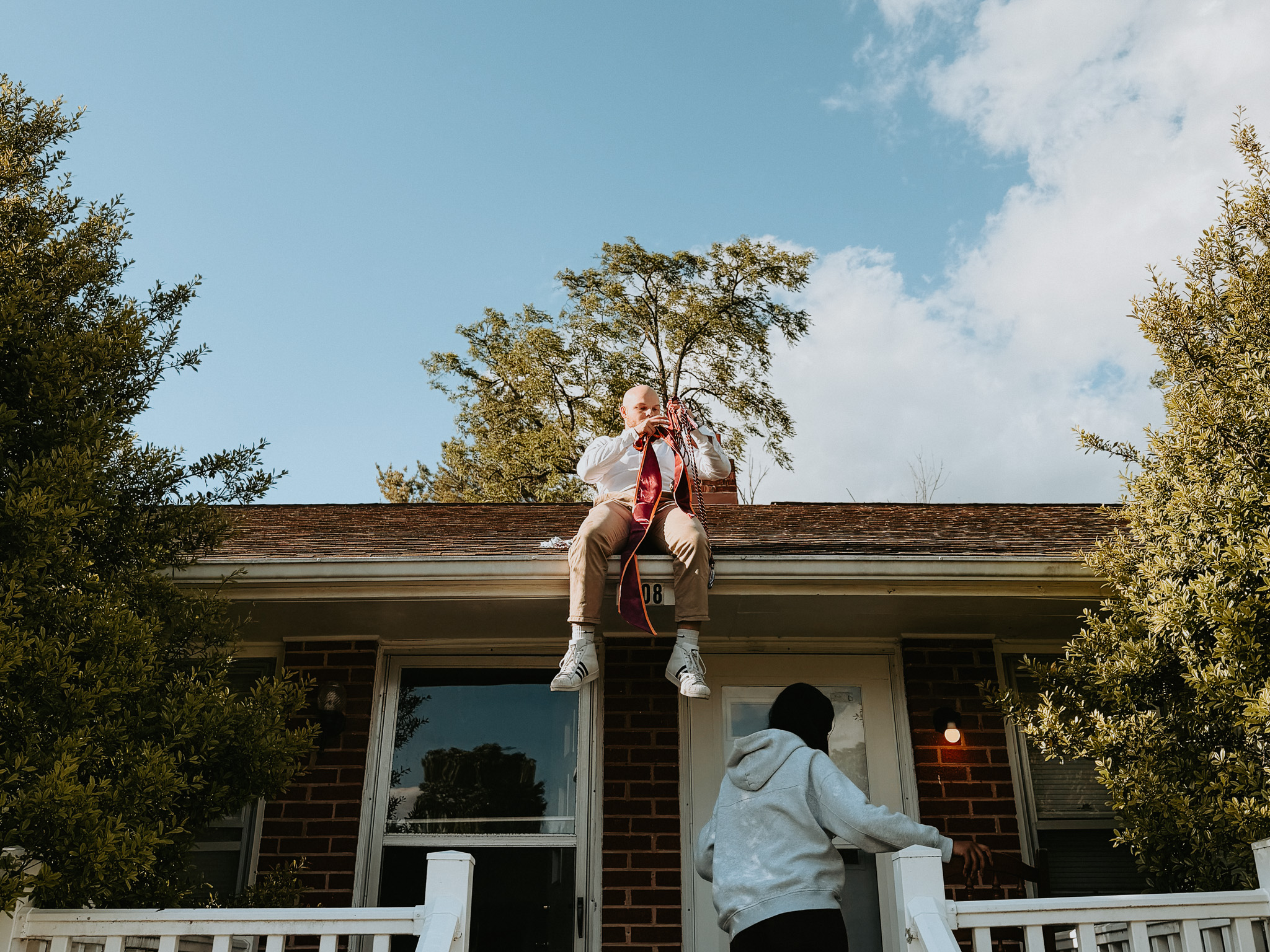
A Virginia Tech graduate prepares for a graduation photo session outside an off-campus home in Blacksburg, Virginia, during spring commencement season. (Aaliyah Kinsler, The Newsfeed NRV)
As graduation season settles over Virginia Tech, groups of seniors dressed in white dresses, maroon stoles and graduation caps crowd iconic campus landmarks from Burruss Hall to Lane Stadium. Nearly every evening in April and May, students wait in lines for their turn beneath the Pylons or outside Burruss Hall while photographers maneuver around packed sidewalks and golden-hour lighting.
For many students, graduation photos have become as much a part of the college experience as commencement itself.
But as the popularity of graduation photography has surged alongside social media culture, so has the pressure surrounding it. What was once a smaller tradition centered on family announcements and framed keepsakes has evolved into a booming industry tied closely to Instagram aesthetics and social expectations. For some Virginia Tech students, professional graduation photos have become increasingly difficult to afford.
Photographer Jackson Sirbaugh, who has photographed Virginia Tech graduates for six years, said demand for sessions has grown dramatically during his time of photographing students.
“I feel like even just a few years ago, or even before Instagram was really popular, it wasn’t as big of a deal,” Sirbaugh said. “Now you see all the iconic poses and outfits at every single different spot, and everyone wants that glorified, amazing thing.”
Sirbaugh said his booking process now begins nearly a year in advance. By August, students already begin reserving spring graduation sessions, and by the time April arrives, many photographers’ schedules are completely filled.
“Honestly, the most frustrating part about grad photos is that there are so many people that need to graduate and take photos,” Sirbaugh said. “Some evenings it’s endless people.”
For photographers, graduation season has become both emotionally rewarding and financially significant. Sirbaugh described graduation photography as “the bread and butter” of his business while he was a student.
“It’s business, it’s photography, it’s money,” Sirbaugh said. “But then it’s also been so special to do photos for friends because it kind of started off as people I didn’t know as much, and now it’s peers and roommates and best friends.”
Sirbaugh said the culture surrounding graduation photography at Virginia Tech has also become increasingly crowded and competitive in recent years as more students purchase cameras and begin offering sessions.
“I would say it’s definitely way more oversaturated than even before,” Sirbaugh said. “But because there are so many graduates, there’s room for a lot of people.”
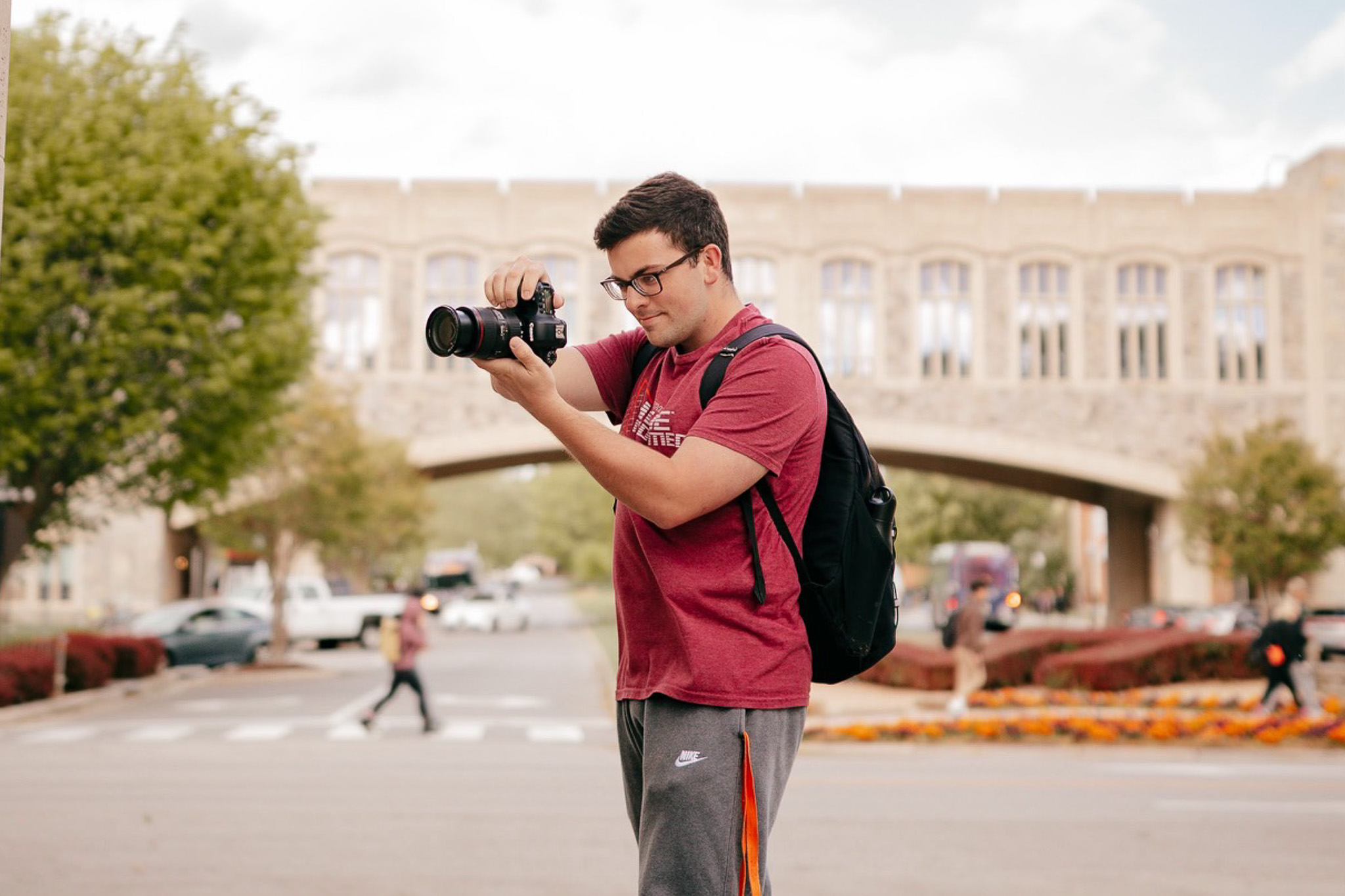
Jackson Sirbaugh photographs Virginia Tech graduates near the War Memorial Pylons during spring commencement season in Blacksburg, Virginia. Photo courtesy of Jackson Sirbaugh.
Despite the competition, Sirbaugh said many photographers at Virginia Tech operate more like a community than rivals. When his schedule fills, he often sends students to other photographers through a recommendation list he maintains.
“There are literally endless grads to take photos with,” Sirbaugh said.
Still, the increasingly polished culture surrounding graduation photography can create pressure for students who cannot justify the expense.
“I think social media definitely makes it feel less optional.”
Anna Eaton, a Virginia Tech Class of 2025 graduate, originally planned to book professional graduation photos during her senior year. But after comparing pricing packages and balancing other graduation expenses, she ultimately decided against it.
“I definitely wanted grad photos,” Eaton said. “It felt like everybody around me was doing them, especially once people started posting their photos on Instagram.”
Eaton said the cost became difficult to rationalize while preparing for graduation and post-college expenses.
“At that point I was already thinking about moving expenses, graduation costs and trying to save money after college,” Eaton said. “Grad photos just stopped feeling practical for me.”
Like many seniors preparing to graduate, Eaton said she was already balancing application fees, apartment deposits, graduation attire and plans for relocating after college.
“When you start adding everything up at the end of senior year, it gets expensive really quickly,” Eaton said. “Grad photos were something I wanted, but they weren’t something I absolutely needed.”
Instead, one of Eaton’s friends borrowed a camera and photographed her around campus near the Drillfield and Burruss Hall.
“One of my friends ended up taking mine for me, and honestly it turned into a really fun memory,” Eaton said. “They weren’t professionally done, but I still love them because they feel personal to me.”
Still, she admitted there was a sense of pressure surrounding the experience.
“I think social media definitely makes it feel less optional,” Eaton said. “Even if nobody directly says you need grad photos, it kind of feels expected.”
Even so, Eaton said taking photos with a friend ultimately reminded her that graduation memories do not have to look perfect online to feel meaningful.
“At the end of the day, I cared more about remembering the moment than making everything look perfect online,” Eaton said.
That pressure is something photographer Travis Carr said he thinks about often.
Carr, who has photographed graduation sessions at multiple universities including Virginia Tech, New York University and Fordham University, said social media has dramatically reshaped photography culture over the last decade.
“When I was a freshman, the seniors took grad photos, but social media was a very different environment,” Carr said. “The further along we get, definitely the more influence social media has on grad photos and the presence of them online.”
Carr said the growth of social media has increased demand for photographers but also complicated the meaning behind graduation photography itself.
“Selfishly, yeah, I want more of the market,” Carr said. “But also, do we all need $300 grad photos? I don’t know.”
“Do we all need $300 grad photos? I don’t know.”
Carr said many students feel pressure to present polished versions of themselves online, and graduation photography can sometimes contribute to those insecurities.
“The counterweight to the social media thing tells us we’re not good enough all the time,” Carr said. “It tells us you have to look like this and be this way and pay this amount for photos.”
Carr said his own experiences in front of the camera shaped how he approaches photographing students.
“Photography is a vulnerable thing,” Carr said. “You’re holding up a mirror to somebody and saying, ‘Here’s all the flaws you think about all the time.’”
Because of that, Carr said much of his process focuses on helping students feel comfortable rather than simply creating technically perfect photos.
“If people have a good time and they feel good, that’s going to be the memory associated with it,” Carr said.
Ironically, Carr himself never took professional graduation photos while in college because he could not afford them.
“I didn’t have grad photos taken because I couldn’t afford it,” Carr said.
He said that experience has influenced the way he thinks about the industry now, describing graduation as a rare moment when students pause to recognize how much their lives have changed over four years.
“You’re sitting in Lane Stadium surrounded by this community that you’ll never be around again in the same way,” Carr said. “It’s four years of your life that hopefully launches the rest of your life.”
He said his goal as a photographer is not simply creating technically perfect photos but creating an experience where students feel comfortable and celebrated.
“My goal with most of the work I do is to say, ‘Hey, you are enough while you’re in front of this lens,’” Carr said.
Sirbaugh echoed similar feelings, saying many of his favorite sessions are memorable not because of the photos themselves but because of the people attached to them.
The Virginia Tech Class of 2024, Sirbaugh said, felt especially personal because many of the graduates were longtime friends.
“I can look back now and think, wow, that’s what we looked like when we were graduating college,” Sirbaugh said. “This is what campus looked like, this is how we smiled, this is how we were.”
He said some of his favorite sessions happen outside the traditional graduation locations because they allow students to express more of their personalities.
“There are so many cool spots around campus,” Sirbaugh said. “Sometimes it can get really monotonous doing the same locations over and over, but then you go somewhere like Hahn Horticulture Garden, and it completely changes the feel of the photos.”
Sirbaugh said the emotional aspect of graduation photography becomes more apparent as time passes.
“A lot of those moments grow value over time,” Sirbaugh said. “At the moment, they’re just really cool photos, but years later you realize that was such a specific moment in your life.”
As graduation season continues across Virginia Tech’s campus, students carrying bouquets and champagne bottles will continue lining up across familiar campus landmarks in pursuit of the perfect graduation photo.
Whether captured through a professional lens, a borrowed camera or a friend’s phone, the meaning behind those photos often remains the same: preserving a fleeting moment before an entire community moves on.

