
By Nichelly Lysy, Politics & Government reporter.
Montgomery County officials ended a joint meeting without changing the county’s zoning ordinance, but several participants favored retaining case-by-case control over large data centers instead of allowing them automatically in an industrial district.
The Board of Supervisors and Planning Commission spent more than an hour discussing electric demand, cooling systems, noise, tax revenue and the long-term fate of the buildings. County staff said the Board of Supervisors will need a dedicated work session to tell planners what kind of ordinance to study. No date for that session was announced.
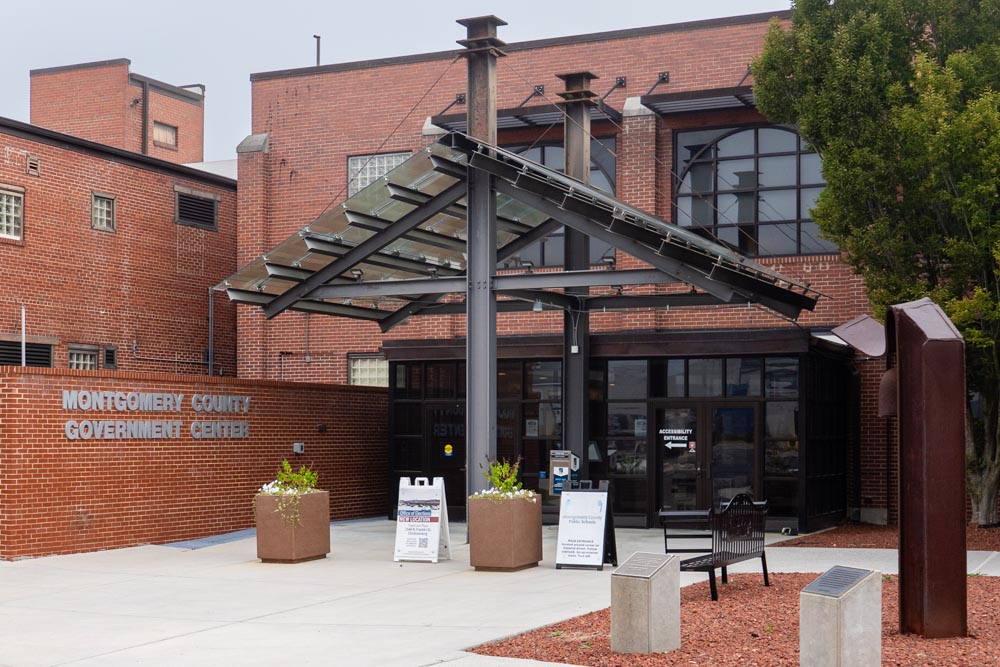
The informational meeting was the county’s latest step in a process that began in December 2025, when supervisors directed planning staff and the Planning Commission to study data centers as a land use. Officials said Thursday that the current ordinance contains no provision allowing a data center in the county’s unincorporated areas. No development application was considered at the meeting.
Brea Hopkins, Montgomery County’s director of Planning and GIS Services, said staff needs a clearer destination before it can develop recommendations.
“What we’re looking for is direction on what you want us to study, what you want us to look at, what specifically our end goal is,” Hopkins said. Staff would then work through those questions with the Planning Commission before bringing a proposal forward, she said.
The News Feed reported in February that Montgomery County had no data-center proposal or zoning change under consideration. September 17’s meeting did not introduce a project, but it moved the county’s policy discussion toward possible rules for one.
That discussion comes as Virginia’s data-center industry expands beyond its concentration in Northern Virginia. Northern Virginia contains 13% of reported operational data-center capacity worldwide and 25% of capacity in the Americas, according to a 2024 study by the Joint Legislative Audit and Review Commission. The commission found that future growth is expected in other parts of Virginia, although limited flat land and access to power can make Southwest Virginia sites harder to develop.
Representatives from the engineering firm Hurt & Proffitt explained that data centers range from rooms serving one institution to hyperscale campuses drawing hundreds of megawatts. Board and commission members questioned whether Montgomery County should distinguish projects by electric demand rather than square footage. They also discussed conditional-use permits, setbacks, cooling technology, construction traffic and requirements for removing or repurposing a facility after it closes.
The distinctions matter because the approval path determines how much discretion local officials retain. Todd Schenk, chair and associate professor of Urban Affairs and Planning at Virginia Tech, said before the meeting that the absence of a stand-alone definition does not automatically prevent development in every locality.
“If a developer wants to put up a data center in an area zoned industrially and it meets all of the zoning and building requirements, the path to permitting is fairly straightforward,” said Schenk when asked about what a zoning district already permits.
Montgomery County officials clarified at the September 17 meeting that its present code does not provide that path. If the county adds data centers to the ordinance, it will have to decide whether any category should be permitted by right or whether proposals should require conditional approval. Several participants supported conditional review for larger facilities, while leaving open whether smaller enterprise facilities could follow different rules.
District F Supervisor Mary Biggs said she favored retaining the authority to review individual proposals. “We want to be able to put conditions on a potential project, and personally, I would,” Biggs said.
Schenk said unclear standards can turn discretionary reviews into legal and political disputes. “Ambiguities are a key source of disagreements around what should be permitted and where, and those disagreements often spill over into the courts and the courts of public opinion,” he said.
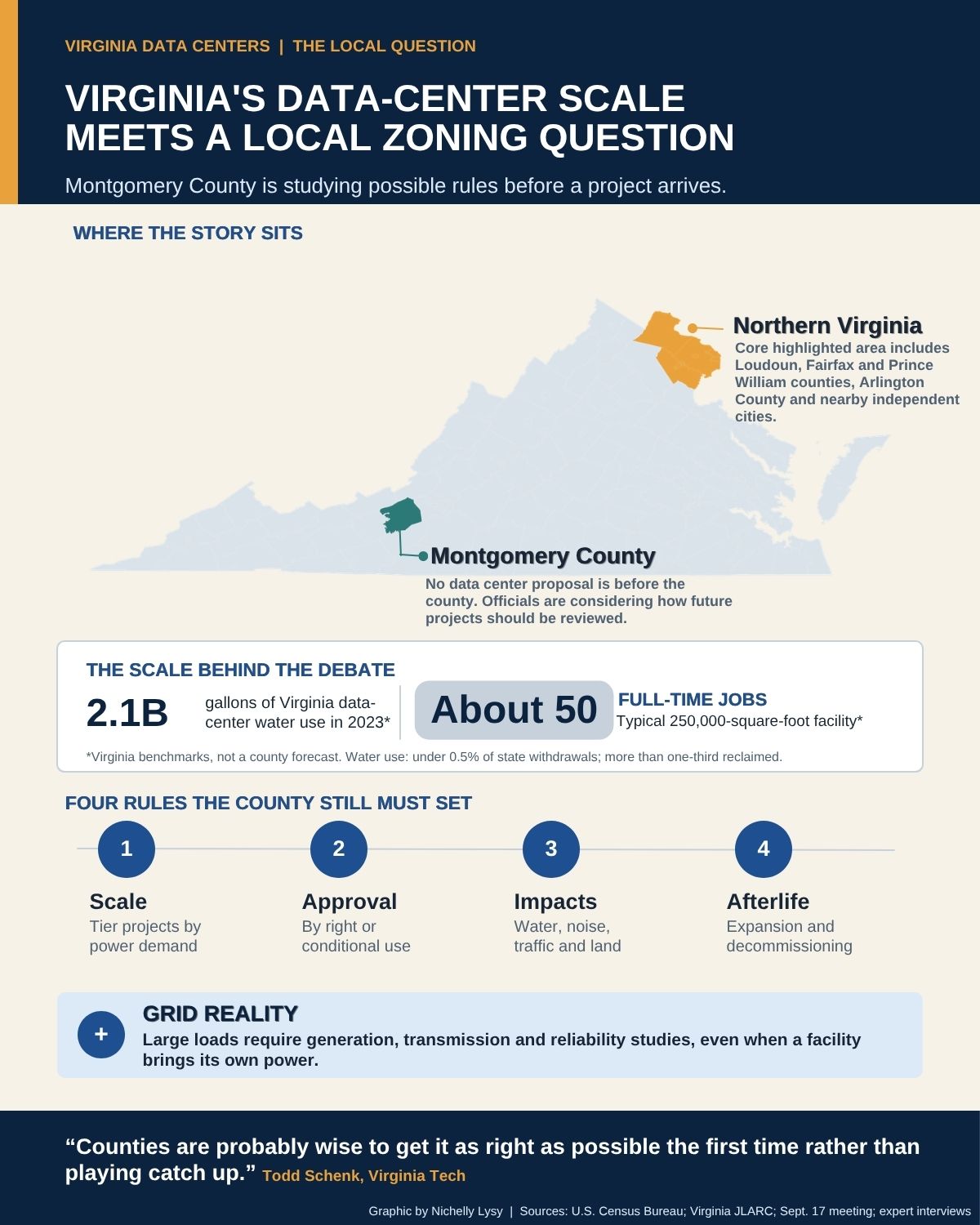
Water and land-use effects depend heavily on a facility’s design and location. JLARC estimated that Virginia data centers used 2.1 billion gallons of water in 2023. More than one-third came from reclaimed water, and the total represented less than 0.5% of statewide withdrawals. The same report said a typical 250,000-square-foot facility may employ about 50 full-time workers, while approximately 1,500 workers may be on site at the height of construction.
Schenk said county officials should evaluate fresh water, wastewater, stormwater runoff and backup generators alongside noise and setbacks. He also said residents should be involved before positions harden. “Engaging folks via well-designed outreach and participatory processes can build trust and lead to better, fairer, and more stable outcomes,” Schenk said.
When it comes to electricity, it involves decisions beyond county zoning. Ali Mehrizi-Sani, a Virginia Tech professor of Electrical and Computer Engineering and director of the university’s Power and Energy Center, said utilities must study whether generation and transmission systems can serve any proposed large load during normal operations and equipment failures, “Additional studies are done also to ensure the load variations and disturbances do not adversely impact the reliability of the grid,” Mehrizi-Sani said.
He said on-site generation would not make those studies unnecessary because the facility’s load and its generation could disconnect at different times during a disturbance. Mehrizi-Sani said current discussions indicate that upgrade costs would be borne by developers and that larger electricity purchases could create economies of scale. JLARC offered a more cautious statewide assessment: current rates appropriately assign existing costs, but rapid growth could still raise costs for other customers as utilities add generation and transmission infrastructure.
For Montgomery County, those statewide questions now return to a local one: what kind of development the county would accept and under what conditions. Hopkins said staff needs the Board of Supervisors to identify the subjects it should study and the outcome it should pursue. Until that direction comes, the county’s data-center rules remain unwritten.

