

Kyle Reeder, Politics and Local Government Reporter
The topic of automated license plate readers (ALPRs), made popular by the Flock camera brand, has come under fire in Virginia as cities begin to pause, remove, and rethink the automated cameras. However, Virginia Tech and the Town of Blacksburg continue to use nearly 27 Flock cameras for crime reduction and student safety, despite a recent pause by other nearby jurisdictions.
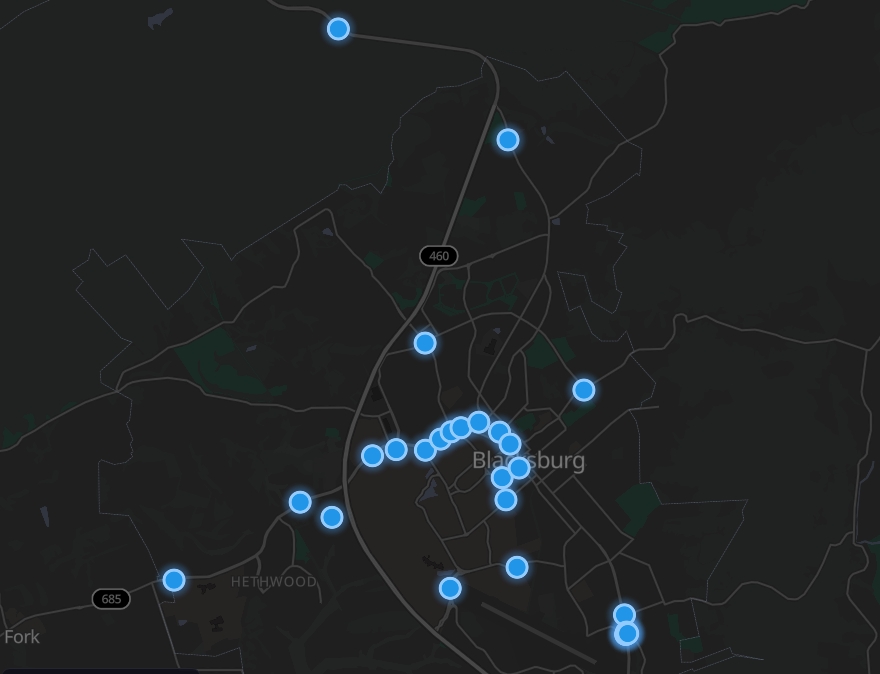
27 ALPR cameras are visible in Blacksburg through the Deflock.org site. Other ALPR cameras include brands like Motorola and Axon.
The issue remains an ethical debate as to whether the cameras infringe on constitutional rights, or if they prove beneficial to local law enforcement.
The ALPR technology first arrived at Virginia Tech’s campus in 2023, and in Christiansburg, one year later. The complex camera network proved useful, according to Virginia Tech’s Chief of Police, Mac Babb.
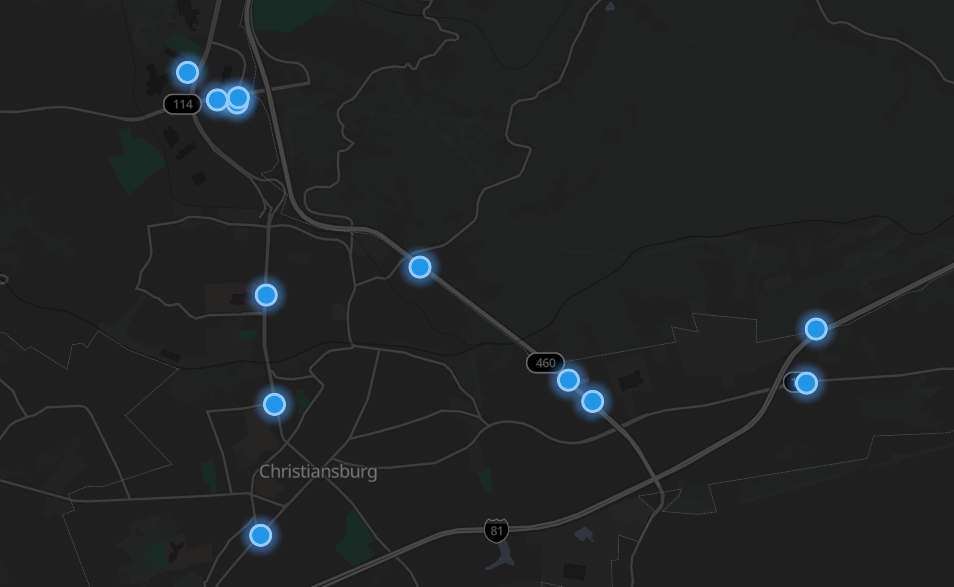
13 ALPR cameras in Christiansburg, now offline after the town council’s decision.
“Within two weeks of the cameras going up nearly three years ago,” Chief Babb said, “investigators were able to track down a man who had been stalking a university employee. We would have never known it without the cameras.”
The cameras work by photographing passing license plates and checking it against police databases of stolen vehicles, missing persons, and Amber alerts. The pictures create a sketch of the car, marking notable features like roof racks and bumper stickers, according to Chief Babb. A match will signal an alert directly to an officer’s phone within seconds.
Two years later, the technology had become more publicized, and concerns grew over citizen’s personal privacy. Across the country, Flock came into the headlines after police officers started to misuse the technology, most infamously a Texas officer who used ALPR cameras to stalk his ex-girlfriend.
DeFlock Virginia Tech, a student-run group who lobbies for the removal of Flock cameras on-campus, has collected 855 signatures toward a 1,000-signature goal. They work in collaboration with the Student Senate and the Board of Visitors. The representative from DeFlock VT said the group isn’t opposed to license plate readers themselves “which have existed for decades,” but to the nationwide data sharing.
“It violates the Fourth Amendment,” the DeFlock VT representative stated. “It constitutes a search, and it should require a warrant.”
When discussions arise of the constitutionality of Flock cameras, and what Harvard Professor Shoshanna Zuboff coins as “Surveillance capitalism,” three cases are brought to light:
Carpenter v. United States (2018): A Supreme Court case that expanded the Fourth Amendment protections in a digital era, stating that citizen’s online data is private and requires a warrant for probable cause to access it.
Schmidt v. City of Norfolk (2024): A U.S. District Court Case on whether ALPRs violate the Fourth Amendment privacy rights with warrantless “dragnet” tracking of vehicles on public roads, was eventually ruled not in violation of the Fourth amendment.
Chatrie v. United States (2026): A Supreme Court ruling on cellphone location data and geofencing in the case of a criminal action, was ruled a reasonable Fourth amendment search and does not violate the constitution.
“Chief Justice Roberts said in Chatrie, ‘If travel activity reveals intimate details of a person’s life, it requires a warrant,’” DeFlock VT quoted. “And I think anybody would tell you that when you search a license plate or a vehicle description on Flock, it’s going to give you a comprehensive record of their movements.”
The Virginia Tech Police Department sees it differently.
“In the Schmidt case, the individual’s picture was tracked like 500 times by 176 cameras,” Chief Babb said. “It wasn’t a small number, but even then, these cameras are 3 ½ miles apart. Some of the images are captured an hour away. You could turn left, you could turn right. None of that creates a picture of a person’s life. So, from a constitutional standpoint, until the Supreme Court looks at it, everything that we see very much says it’s not a Fourth Amendment violation.”
As tensions grew between city surveillance and citizen concern, Christiansburg decided to remove all Flock cameras entirely.
“It was a unanimous council decision and there seemed to be a lot of citizen concern about it,” said Mayor of Christiansburg, Michael Barber. “We had a public hearing on it and we had 13 people speak about it.”
Emotions toward ALPR cameras continued to be mixed.
“I think there’s a lot of misconceptions and disinformation about how our particular Flock cameras operated,” Mayor Barber said. “First of all, they are license plate readers – that’s all it is. We don’t have cameras for facial recognition, or anything along those lines. It was purely a law enforcement tool that would help identify cars and license plates.”
After a 2025 privacy law was passed by Governor Glenn Youngkin, Flock cameras in Virginia are not able to share data across state lines unless issued a warrant. Camera data can only be stored for 21 days.
“I understand that people don’t want to be tracked and want their privacy,” Mayor Barber said. “But honestly, if you don’t want your privacy invaded…then you need to put your cell phone away. Those things track you worse than what Flock cameras ever did.”
“Over the two years we have had them, we have no record of any misuse by any of our officers,” said Mayor Barber. “In that period of time, we were able to solve 89 cases of missing persons, stolen cars, stolen license plates, and so forth. So, it has its advantages, and it certainly helps speed the process of solving crimes.”
Following Christiansburg’s decision to remove over 10 ALPR cameras, Montgomery County Sheriff Robert Page went public with his decision to pause Flock cameras county-wide on September 3. His concerns over public safety were “not only about preventing and solving crime” but also maintaining the resident’s trust in the Sheriff’s Office.
The county-wide Flock pause only applies to the Sheriff’s Office’s own cameras, which means that ALPR cameras within Blacksburg Police and Virginia Tech continue to operate around the town. Concerns, debates, and the petition to “de-Flock” Virginia Tech remain open.

