
By Erin Bailey, education reporter
A quarter century after the Sept. 11, 2001, terrorist attacks on the World Trade Center located in lower Manhattan, New York City, the day remains prevalent in the nation’s memory. Remembered both for its tragedy and for the heroes who saved countless lives, 9/11 continues to be taught in schools as a life-changing moment in American history.
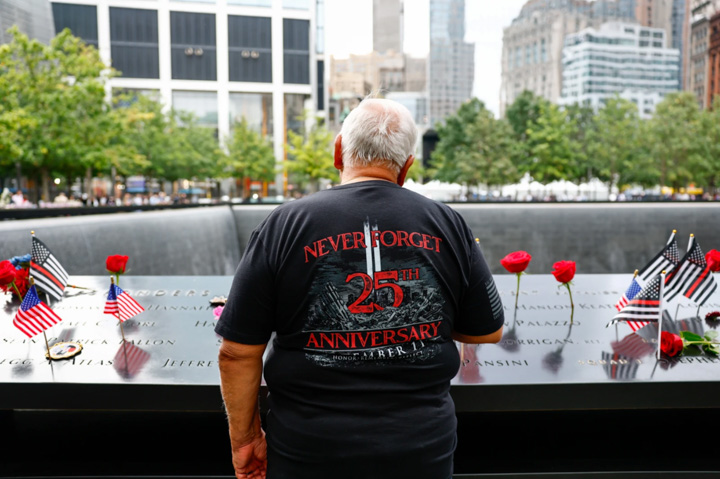
Man overlooks the Sept. 11, 2001 memorial during the 25th anniversary ceremony on Friday, Sept. 2026 in New York City. Photo Courtesy (Associated Press)
On the morning of Sept. 11, 2001, four commercial planes were hijacked by members of the al-Qaeda Islamic terrorist group. Two planes, American Airlines Flight 11 and United Airlines Flight 175, crashed into the north and south towers of the World Trade Center, killing all passengers on impact and trapping individuals in the towers. After the collision, both towers collapsed only giving some individuals the opportunity to escape. American Airlines Flight 77 crashed into the Pentagon, and United Flight 93 crashed in an empty field in Shanksville, Pennsylvania, which was thought to be headed to the White House for another attack.
The terrorist attack took the lives of 2,977 individuals and injured thousands located in the towers, the Pentagon and Shanksville. As the years pass, educating the importance of the attacks and how the tragedy brought the nation together stays relevant in school systems.
According to Stephanie Miller, a fifth grade teacher at Christiansburg Elementary School, a moment of silence to honor the victims the day of 9/11 starts the conversation amongst her students in the classroom.
“We have a conversation about the significance of the day,” Miller said. “A lot of times, my students will have stories that their parents have told them, they’ll share their parents’ stories. We talk about how it’s something that more united the country instead of tore us apart, and how they learned to adapt, build, overcome and recover from it to make us stronger together.”
While elementary school students weren’t alive during the time of the attacks, Miller works her lesson around how the event affects her students today, explaining to her students that security and flying drastically changed following the attack. Miller’s students can often connect their experiences with flying to grasp an understanding of new laws put into place.
Although teachers continue to educate students on the attack, a set curriculum covering the event varies from state to state based on their standards.
“Most of what we teach in elementary social studies is going to be directly to whatever the state standards are, and if there’s not a standard about 9/11, that makes it hard to bring it into your curriculum,” said Amy Allen, an associate professor of history and social science in the elementary education program in the School of Education at Virginia Tech.
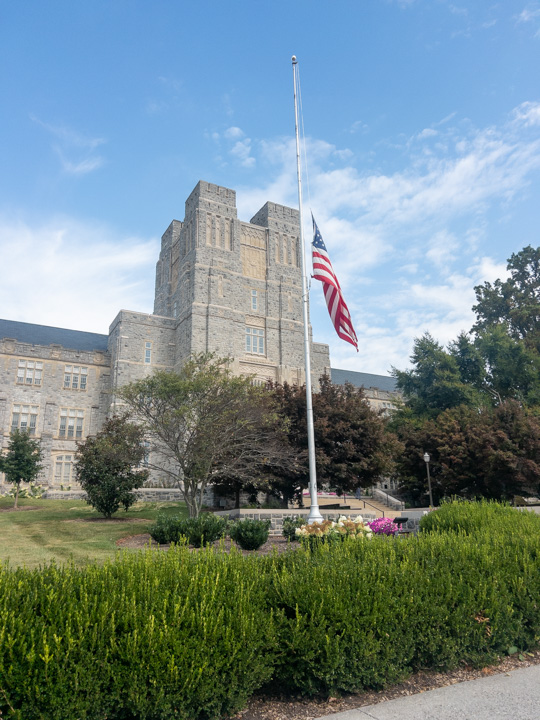
Virginia Tech lowers the American flag to half-staff in front of Burruss Hall on Sept. 11, 2026, to honor the lives lost 25 years ago in the terrorist attack. Photo Courtesy (Erin Bailey, The News Feed NRV)
While standards may vary, Allen elaborates that patriotism holds importance in elementary education.
“A lot of standards are about patriotism,” Allen said. “The thing that happened after 9/11 is there was a huge surge of patriotism in the U.S and people were thinking differently about what it meant to be an American, what it meant to support a cause.”
The tragedy is often taught to younger students through a series of picture books that focus on both the individuals that lost their lives and first responders who helped at the scene.
“There are books about 9/11 that are really great books to use,” Allen said. “There’s a book about firefighters that when I was teaching that I would often use to teach about 9/11, and it wasn’t a 9/11 specific book. It was just about firefighters, but that introduced that idea. It is called “September 12: We Knew Everything Would Be Alright” and it was created by students; it taught that basically after a really tragic event, the world goes on.”
The 9/11 Memorial and Museum offers a virtual view of the memorial located in New York. The “interactive video experience” gives individuals the opportunity to walk through different exhibitions that are present at the museum without having to be in person.
“There’s a website and it’s like a Google Maps street view where the students can kind of virtually walk through the museum and it’s like a scavenger hunt,” Miller said. “They have questions on a paper that they need to answer, so they’re going through the museum and reading the plaques, information and filling in a note sheet to educate themselves more about it.”
As 2026 marks the 25th anniversary of 9/11, families and friends of the victims gathered for a ceremony in Memorial Plaza. The ceremony read aloud the names of the men, women and children who passed due to the attacks. A total of six moments of silence were given to mark each tragedy. An additional moment of silence was given to those who lost their lives due to 9/11 health effects.
According to Andrew Webb, the administrator of communications, public relations and marketing for Montgomery County Public Schools, the Junior Reserve Officer Training Corps performed a flag ceremony this year at Christiansburg High School marking the times that the planes would’ve hit the buildings.
“It’s definitely on the forefront of our minds, making sure that our students are educated and know what happened 25 years ago,” Webb said.
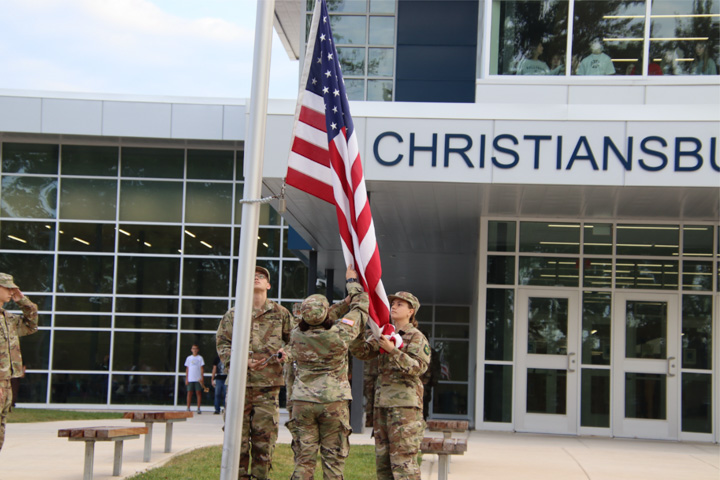
Junior ROTC at Christiansburg High School performs flag ceremony in remembrance of the 9/11 attacks on Sept. 11, 2026. Photo Courtesy (Montgomery County Public Schools)

