
By Erin Bailey, education reporter
This video explores how social media is prevalent in education. Classroom learning can contribute to both career and individual success, shaping the future of job opportunities.
By Erin Bailey, education reporter
This video explores how social media is prevalent in education. Classroom learning can contribute to both career and individual success, shaping the future of job opportunities.
By Erin Bailey, education reporter
A quarter century after the Sept. 11, 2001, terrorist attacks on the World Trade Center located in lower Manhattan, New York City, the day remains prevalent in the nation’s memory. Remembered both for its tragedy and for the heroes who saved countless lives, 9/11 continues to be taught in schools as a life-changing moment in American history.
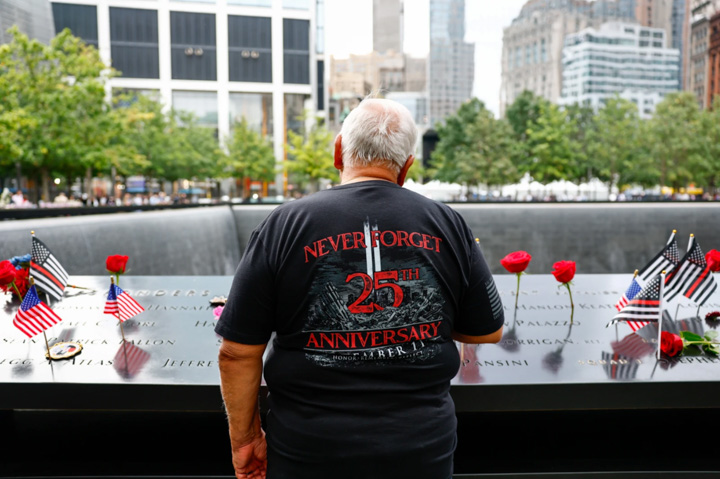
Man overlooks the Sept. 11, 2001 memorial during the 25th anniversary ceremony on Friday, Sept. 2026 in New York City. Photo Courtesy (Associated Press)
On the morning of Sept. 11, 2001, four commercial planes were hijacked by members of the al-Qaeda Islamic terrorist group. Two planes, American Airlines Flight 11 and United Airlines Flight 175, crashed into the north and south towers of the World Trade Center, killing all passengers on impact and trapping individuals in the towers. After the collision, both towers collapsed only giving some individuals the opportunity to escape. American Airlines Flight 77 crashed into the Pentagon, and United Flight 93 crashed in an empty field in Shanksville, Pennsylvania, which was thought to be headed to the White House for another attack.
The terrorist attack took the lives of 2,977 individuals and injured thousands located in the towers, the Pentagon and Shanksville. As the years pass, educating the importance of the attacks and how the tragedy brought the nation together stays relevant in school systems.
According to Stephanie Miller, a fifth grade teacher at Christiansburg Elementary School, a moment of silence to honor the victims the day of 9/11 starts the conversation amongst her students in the classroom.
“We have a conversation about the significance of the day,” Miller said. “A lot of times, my students will have stories that their parents have told them, they’ll share their parents’ stories. We talk about how it’s something that more united the country instead of tore us apart, and how they learned to adapt, build, overcome and recover from it to make us stronger together.”
While elementary school students weren’t alive during the time of the attacks, Miller works her lesson around how the event affects her students today, explaining to her students that security and flying drastically changed following the attack. Miller’s students can often connect their experiences with flying to grasp an understanding of new laws put into place.
Although teachers continue to educate students on the attack, a set curriculum covering the event varies from state to state based on their standards.
“Most of what we teach in elementary social studies is going to be directly to whatever the state standards are, and if there’s not a standard about 9/11, that makes it hard to bring it into your curriculum,” said Amy Allen, an associate professor of history and social science in the elementary education program in the School of Education at Virginia Tech.
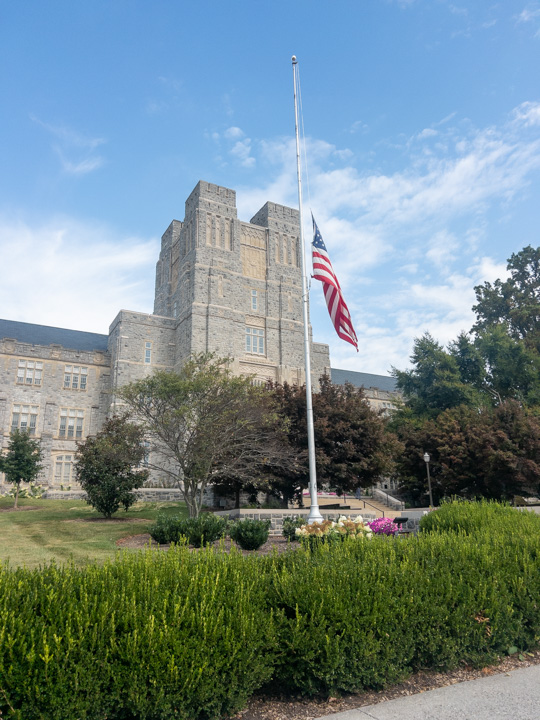
Virginia Tech lowers the American flag to half-staff in front of Burruss Hall on Sept. 11, 2026, to honor the lives lost 25 years ago in the terrorist attack. Photo Courtesy (Erin Bailey, The News Feed NRV)
While standards may vary, Allen elaborates that patriotism holds importance in elementary education.
“A lot of standards are about patriotism,” Allen said. “The thing that happened after 9/11 is there was a huge surge of patriotism in the U.S and people were thinking differently about what it meant to be an American, what it meant to support a cause.”
The tragedy is often taught to younger students through a series of picture books that focus on both the individuals that lost their lives and first responders who helped at the scene.
“There are books about 9/11 that are really great books to use,” Allen said. “There’s a book about firefighters that when I was teaching that I would often use to teach about 9/11, and it wasn’t a 9/11 specific book. It was just about firefighters, but that introduced that idea. It is called “September 12: We Knew Everything Would Be Alright” and it was created by students; it taught that basically after a really tragic event, the world goes on.”
The 9/11 Memorial and Museum offers a virtual view of the memorial located in New York. The “interactive video experience” gives individuals the opportunity to walk through different exhibitions that are present at the museum without having to be in person.
“There’s a website and it’s like a Google Maps street view where the students can kind of virtually walk through the museum and it’s like a scavenger hunt,” Miller said. “They have questions on a paper that they need to answer, so they’re going through the museum and reading the plaques, information and filling in a note sheet to educate themselves more about it.”
As 2026 marks the 25th anniversary of 9/11, families and friends of the victims gathered for a ceremony in Memorial Plaza. The ceremony read aloud the names of the men, women and children who passed due to the attacks. A total of six moments of silence were given to mark each tragedy. An additional moment of silence was given to those who lost their lives due to 9/11 health effects.
According to Andrew Webb, the administrator of communications, public relations and marketing for Montgomery County Public Schools, the Junior Reserve Officer Training Corps performed a flag ceremony this year at Christiansburg High School marking the times that the planes would’ve hit the buildings.
“It’s definitely on the forefront of our minds, making sure that our students are educated and know what happened 25 years ago,” Webb said.
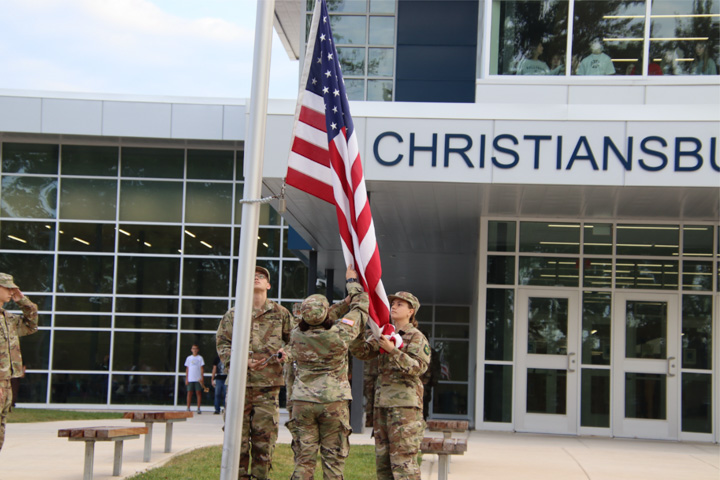
Junior ROTC at Christiansburg High School performs flag ceremony in remembrance of the 9/11 attacks on Sept. 11, 2026. Photo Courtesy (Montgomery County Public Schools)
By Erin Bailey, education reporter
On Aug. 23, 2026, Virginia Tech News announced the launch of HokieAI, a university-supported platform designed to give students, faculty and staff access to vetted artificial intelligence tools. HokieAI aims to provide users with innovation while focusing on security and ethical use.
Features available through HokieAI range from drafting and revising content to coding support and image creation. The platform is designed to handle all levels of data, including high-risk information.
Virginia Tech urges interested individuals to complete a training course called AI at Virginia Tech: A Primer for HokieAI. The module supports AI literacy and responsible use.
In an interview, Carl Harris the Chief Technology Architect at Virginia Tech elaborates on how HokieAI will change higher education in the foreseeable future.
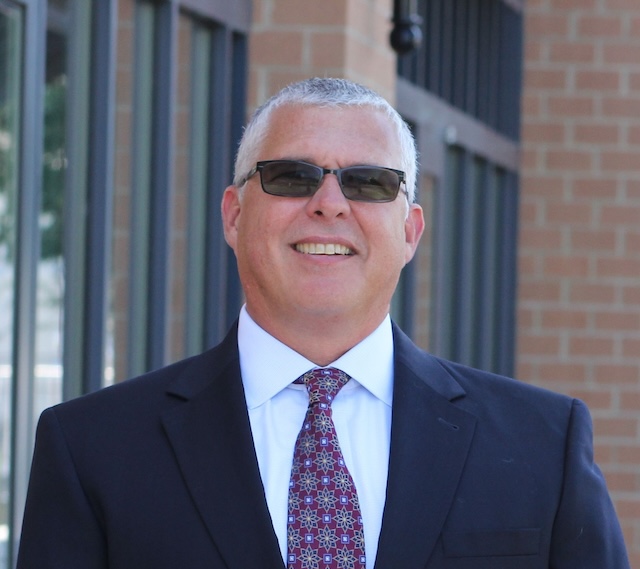
Carl Harris is the Chief Technology Architect at Virginia Tech. (Courtesy of Virginia Tech, Division of Information Technology)
His comments were edited slightly for length and clarity.
What did the process of creating HokieAI look like?
When we decided we wanted a platform like HokieAI, we looked to see what was in the market, and we decided to do competitive procurement for it, something through a request for proposals, and that process is time-consuming. Ultimately, we started in November, maybe even as early as late October, and we had responses in, reviewed and evaluated by the committee associated with that procurement, and forwarded the contract in April of this past year.
How do you envision HokieAI changing the way students approach learning, research and creative work?
I teach a course in electrical and computer engineering. My syllabus includes details about where you can and can’t use AI. The thing I always tell my students about with respect to this affecting the experience that you’re getting is, if you’re not having to think about what you’re doing, if it’s really just asking questions and then regurgitating responses, you’re getting no benefit from that. Part of our statements around literacy for AI is this notion that you still need to be the expert in whatever domain that is. In my course, it’s an electrical engineering topic, but you still need to be providing that expertise to ground what the AI is telling you. You still need to be applying your own judgment. AI doesn’t have a sense of judgment, humans do, and you need to be thinking critically about what it’s telling you.
How does HokieAI’s secure, university‑managed environment change the way students and faculty can safely use AI?
Students are already using things like ChatGPT, Claude and Gemini for their learning and for their research. One of our goals with this was to create a space where students could do that, where whatever they’re putting into that tool, we know isn’t being used to train models. We know it’s not being retained for any sort of purpose by the provider. We’re the provider. While we do retain some of that data, it’s mostly because we need to from a legal perspective, not so that we use different models or share with anyone. When students need to use AI in their coursework, we’re ensuring through having this tool that all students have equal access, really regardless of their ability to pay or spend more money out of pocket.
How do you see HokieAI reshaping the way faculty design courses, assignments or assessments?
One of the things that we hope is if we’re providing a tool and everyone has access to it, that those universities providing solutions will inspire faculty to get more engaged, especially those that are either still on the fence, but maybe some of them are actually behind the fence.
I can have much higher expectations for what I want students to gain out of projects, or how many projects they do, if I know a lot of the grunt work of doing those projects can be assisted with AI. It’s really rethinking higher education, thinking about what does higher education look like in the face of this very powerful tool.
How does HokieAI position Virginia Tech among peer institutions in terms of AI leadership?
Even though there are other schools doing this, we’re still among the early adopters. Not every school out there has this capability, although it’s becoming more common because I think it’s a good decision that’s relatively affordable in the concept of universal access for everyone at the university that solves a lot of the has and have nots challenges.
How do you imagine HokieAI influencing the skills students graduate with?
The opportunities for students to ask the hard questions about what are the impacts of AI societally, environmentally, what should this mean in the course of my career? I think providing the space and the opportunities to explore and have really the academic discourse about these things is key to us. Not just grappling with it, but getting through solutions and answers to some of those questions.
Is there anything else you’d like to add?
We had some students asking what happens to my prompts that go into HokieAI, and will my professors be able to get access to that? Asking those questions and thinking really about the implications of this is going to be a commitment that your generation is going to have to carry forward. Getting a deeper understanding of what are the implications, where could this go, where do we not want it to go and where would we like to see it go? I think it’s really important for people in their university experience to be asking those questions.

