
By Hafsa Ayubi, Politics and Government Reporter
Virginia Tech and the Town of Blacksburg used the first town-gown meeting of the fall semester Sept. 10 to answer a deceptively simple question: When an issue affects both campus and town, who is actually in charge? The public meeting at the Creativity and Innovation District brought town officials, university representatives and students together to explain where their responsibilities differ and how they work together.
The meeting, titled “Town and University Governance,” focused on how Blacksburg and Virginia Tech are led, organized and responsible for decision-making. The distinction matters in a college town where issues such as housing, transportation, development and student behavior can affect both students and permanent residents. Blacksburg and Virginia Tech share one community, but they do not share one government.
The official meeting description said the discussion would highlight the distinct responsibilities of local government and university administration, as well as how the two institutions collaborate on issues affecting the broader Blacksburg community.
For Blacksburg, authority begins with the Town Council. Blacksburg has operated under a council-manager form of government since 1952. The council adopts ordinances and resolutions, approves the town budget, sets tax rates, makes land-use and zoning decisions and establishes long-range policies. It appoints a town manager, who carries out those policies and oversees town operations.
Virginia Tech has a separate structure. The university’s Board of Visitors serves as its overall governing body, while University Council, senates, commissions and committees participate in a shared governance system that reviews issues and makes policy recommendations. That means an issue involving an off-campus development within the town, for example, can involve Blacksburg’s land-use authority, while decisions about university policies or operations move through Virginia Tech’s own administrative and governance structure.
The two systems may be separate on paper, but life in Blacksburg rarely stays neatly inside those lines.
Steve Ross, a Blacksburg deputy town manager, compared the relationship between the town and university to a family. Ross is one of two current deputy town managers listed by the town.
“We are codependent of each other like siblings we get along most of the time, but we always come together.”
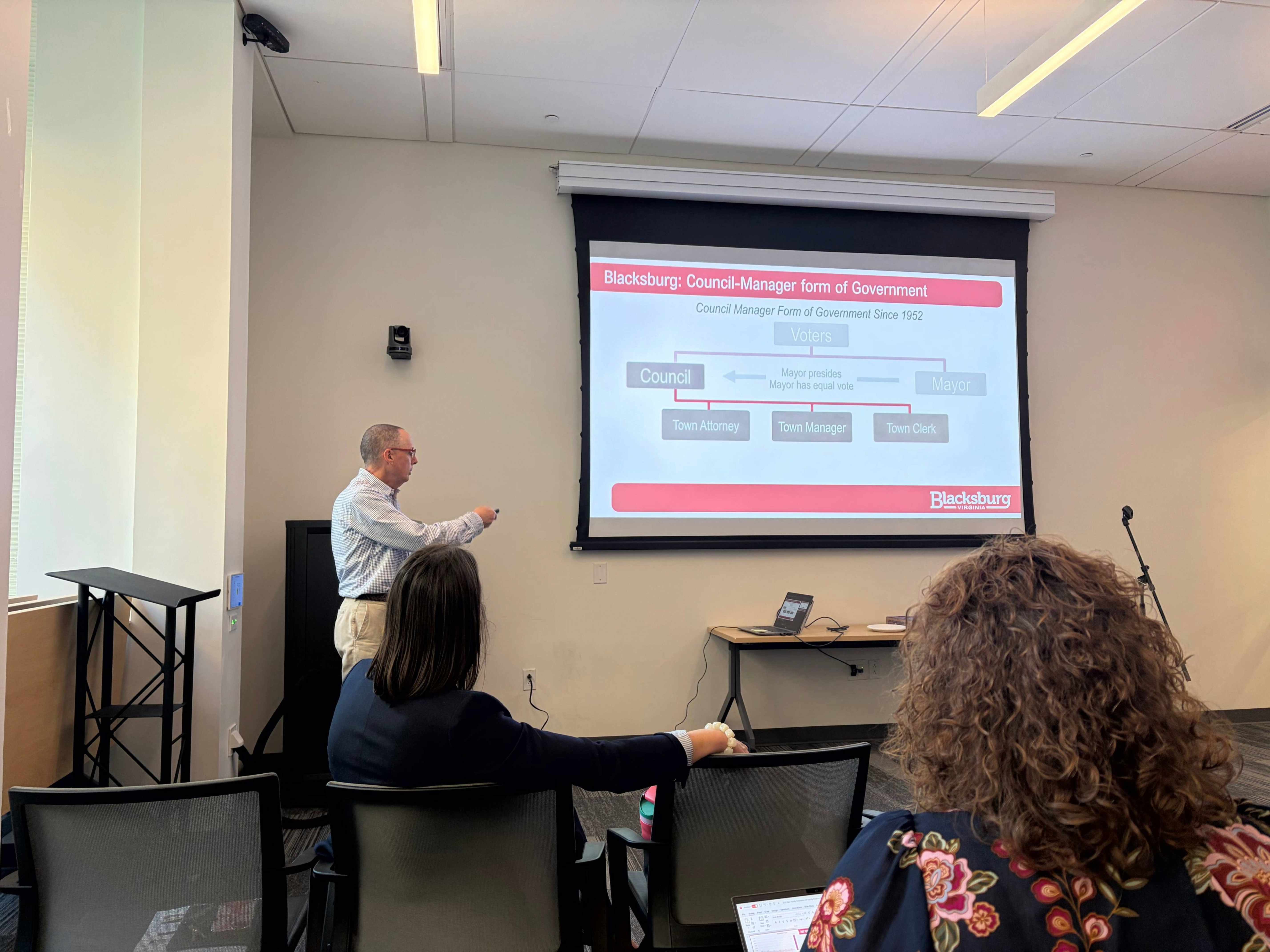
Steve Ross, Blacksburg deputy town manager, explains the town’s council-manager form of government during the Sept. 10 Town Gown meeting on town and university governance.
Photo by Hafsa Ayubi, TheNewsFeedNRV.com.
That relationship is part of the reason Town Gown exists. The group brings together town and Virginia Tech staff, students and residents six times a year for conversations about issues affecting the broader community. Town Gown is co-chaired by a Blacksburg deputy town manager and Virginia Tech’s vice president for Student Affairs, with topics selected each year based on the interests and feedback of participants.
Previous Town Gown discussions show how often the two institutions’ responsibilities intersect. Meetings have addressed off-campus housing, policing, university housing, campus planning and construction, and issues where decisions made on one side of the community can have consequences on the other.
The Sept. 10 meeting also highlighted that university governance is not limited to administrators. Virginia Tech’s shared governance system includes senates representing undergraduate students, graduate and professional students, faculty, staff and administrative and professional faculty. These groups participate in a process that can send policy recommendations through University Council to university leadership.
Undergraduate Student Senate President Lindsay Ricci said understanding that system is important because many students do not realize they have representation within it. Virginia Tech lists Ricci as the Undergraduate Student Senate president for the 2026-27 academic year.
“I think it’s really important just to know what community you’re involved in, what’s going on in the community, and how to support the community just by spreading information and getting to know, getting together, to know one another, and also just hearing from the town side, and also the university side.”
For students, knowing which institution controls an issue can determine where they take a concern. A question about town zoning or an ordinance follows a different path than a concern about university policy. Other issues, including transportation and housing, can involve both institutions because their effects cross the campus boundary.
Ricci said students can also have a more direct role in university decision-making than they may realize.
“I think it’s really helpful, because I think the first thing is students knowing about us and about student governance, because they don’t know how they’re represented and how we’re directly a part of the university system, in which we get a vote on university policy recommendations.”
The Undergraduate Student Senate maintains representation on University Council and other university-level governance bodies. Four USS officials serve as representatives on University Council, where they can discuss or present issues affecting undergraduate students. University Council reviews and makes recommendations on university policy, while final authority rests with the university president and Board of Visitors.
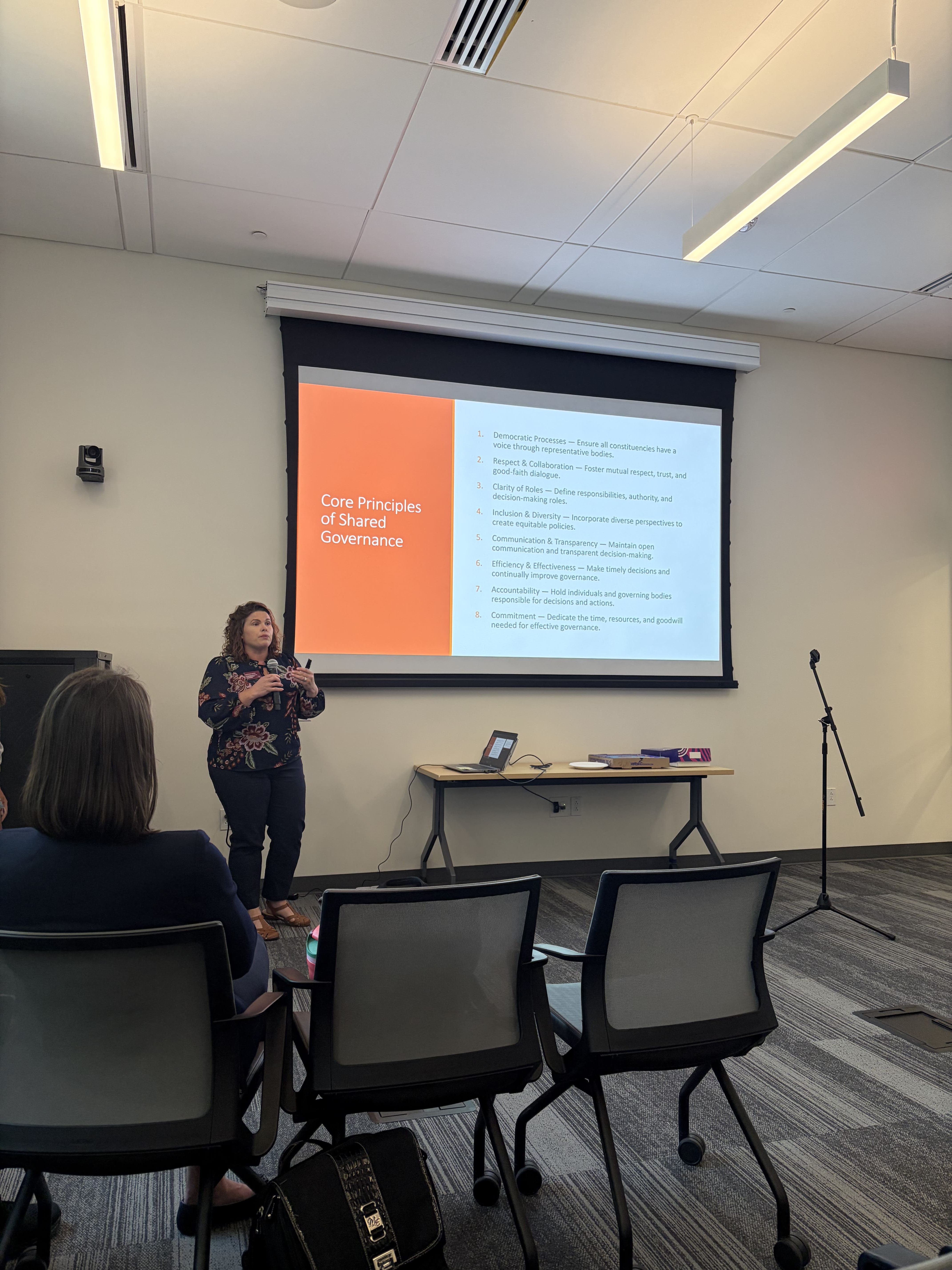
Marlena Lester, a representative of Virginia Tech’s Administrative and Professional Faculty Senate, discusses the principles of shared governance during the Sept. 10 Town Gown meeting.
Photo by Hafsa Ayubi, TheNewsFeedNRV.com.
That structure gives student representatives a place to bring the student experience into university policy discussions.
“And so they just don’t know, that we can help change that and sway the vote as well, of just, putting our opinion out there there, not everyone knows about the student experience unless you’re a student,” Ricci said.
For Ricci, awareness is the first step toward participation.
“So I think it’s important for them to get involved.”
Town Gown’s purpose is not to merge the two governments, but to create a place where the people working within them can better understand how their decisions connect. The Town of Blacksburg describes the group as working toward “strengthening, nurturing and sustaining relationships” across all sections of the community.
The Sept. 10 discussion showed why knowing the difference matters. There is not always one person or institution with authority over every problem that touches Blacksburg and Virginia Tech. Sometimes the answer starts with Town Council. Sometimes it starts with university governance. And for issues that cross the edges of campus, the answer can require both sides to come to the same table.

