Apple has recently created a news application that comes already installed on the latest versions of Apple iPhones and iPads. Since the application is already installed on the device, set up is very easy.
The application allows users to customize their newsfeed with the sources of their choice. Once the sources are chosen, users have to option to receive notifications from these sites on their device or via email.
Top stories from these sources are then organized within the application for easy navigation through the most relevant stories. The news application is also connected to the newsfeed on the device itself. By swiping left on the home screen, the news application provides four stories it thinks the user would be interested in.
This application creates an easy, convenient way for people to access the news they want to read without having to search for it.
Blacksburg, Va., Feb. 14 – High Lunge Pose: Nicole Boyle, owner of InBalance Yoga, practices a high lunge pose in a hot yoga class. Boyle says she practices yoga because it makes her happy.
by Haven Lewis–
It’s 4 p.m. on a Tuesday. Clients come in, one by one, with yoga mats, towels, and water bottles in hand, ready to enter the sauna that has consumed the studio at InBalance Yoga.
“My favorite is the hot yoga vinyasa classes,” says Keala Mason, manager and instructor at the studio.
Mason first became an instructor during her undergraduate years at James Madison University. She was later appointed as Coordinator of Sport Clubs and Youth Programs at the university’s recreation center. As the coordinator, Mason noticed a steady increase in the availability and popularity of yoga classes.
“I think one reason is because we’ve got celebrity endorsements and it’s become something that’s trendy to try, but then people stay with it because they see that it’s not just a trend,” Mason speculates. “It’s been around thousands of years so there’s gotta be something to it.”
According to David Gordon White’s “Yoga, Brief History of an Idea”, the earliest account of yoga is found in the Hindu Kathaka Upanisad, a scripture dating from about the third century B.C.
Yoga Alliance reports that the number of American practitioners has grown 50 percent in the past four years. Why are Americans now turning to this age-old practice as a form of exercise?
Nicole Boyle, owner of InBalance, has been practicing yoga for 11 years.
“I’m 38 now and it feels like I’m aging in reverse. I can do things now that I couldn’t do in my 20s,” Boyle says assuredly.
She believes that yoga has given her the confidence, and strength, to do triathlons, marathons, go on extended hiking and camping trips, and even try Crossfit.
“I think people are attracted to it because of some of the physical benefits, but then they see how well they feel mentally, emotionally, spiritually,” says Boyle. “Yoga can do more than just be a physical exercise.”
Boyle may be right. Yoga Alliance reveals that practitioners have a stronger sense of mental clarity, are more likely to give back to their communities, and have more agile bodies than non-practitioners and the public at large.
Boyle says that her clients typically range from ages 18 to 80. Her business offers chair yoga and community pool yoga for those who have trouble with mobility.
“There’s so many different types and so many different paces. As long as you can breathe, you can do yoga.”
Blacksburg, Va., Feb. 14 – Crescent Variation: Students at InBalance Yoga practice their High Lunge, Crescent Variation poses. This pose opens the hips and strengthens the legs, knees, ankles, and waist. Photo: Haven Lewis
Blacksburg, Va., Feb. 14 – Standing Split: Students practice the Standing Split pose. This pose is challenging, but will improve one’s balance over time. Photo: Haven Lewis
Blacksburg, Va., Feb. 14 – Upward Salute: Yoga instructor, Keala Mason, demonstrates the Upward Salute pose. This pose stretches the sides of the body, shoulders, spine, armpits, and belly. Photo: Haven Lewis
Blacksburg, Va., Feb. 14 – Lunge Variation: Students practice a lunge variation. For practitioners who have trouble touching the floor with these poses, blocks may be used to modify and assist. Photo: Haven Lewis
Blacksburg, Va., Feb. 14 – High Plank: A student practices the high plank pose, otherwise known as “Utthita Chaturanga Dandasana”. It is one of the Sun Salutation poses. Photo: Haven Lewis
Blacksburg, Va., Feb. 14 – High Lunge: A student focuses while practicing her High Lunge. Photo: Haven Lewis
Blacksburg, Va., Feb. 14 – Hot, Hot, Hot: Hot Vinyasa yoga is performed in a room typically heated from 85 to 90 degrees. Photo: Haven Lewis
Blacksburg, Va., Feb. 14 – Mats on Mats: Yoga mats are specially fabricated to prevent hands and feet from slipping while practicing yoga. Photo: Haven Lewis
Blacksburg, Va., Feb. 15 – LOCAL IMPACT: Blacksburg High School is just one of four high schools in the Montgomery County Public Schools district that could be affected by new policies. According to U.S. News, Blacksburg High has a math proficiency rating of 84 percent, which is higher than the district and state average. Photo: Ashley Cimino
Betsy DeVos was confirmed as the eleventh United States Secretary of Education after an unprecedented tie-breaking vote cast by Vice President Mike Pence. Much controversy surrounding DeVos’ devotion to private school education has caused widespread public concern both leading up to and following her confirmation.
Concerns were initially revealed during her senate confirmation hearing. Professor Nicholas Goedert of the Department of Political Science of Virginia Tech explained that the controversy surrounding her nomination was partly due to the ideological conflicts that are common with cabinet nominees.
“There were [questions], largely revealed in her confirmation hearings, related to her competence to do the job, as she had almost no work experience in education and seemed unaware of broad principles and terms commonly used in the state administration of education.” said Goedert.
Clips of Virginia Senator and former Vice President Candidate Tim Kaine’s questioning of DeVos’ during her senate hearing was shared on social media and many became concerned about DeVos’ inability to agree that public and private schools should be held equally accountable if receiving federal funds.
WASHINGTON, Jan. 17 – HEATED HEARING – Betsy DeVos with Sen. Joe Lieberman and Sen. Tim Scott at her confirmation hearing before testifying for Senate committees. Photo: AP Photo/Carolyn Kaster
No Child Left Behind, now replaced by the Every Students Succeeds Act (ESSA)Every Students Succeeds Act (ESSA), introduced higher accountability for schools and school districts receiving funding. ESSA, signed in 2015 by President Obama, shifts for power over education to the states and moves away from the “one size fits all” approach to education in schools. Still, DeVos would be reviewing each state’s ESSA plans outlining their education goals and plans to reach them.
Montgomery County Public School teachers and administrators are very concerned that DeVos doesn’t have the expertise to handle the one trillion dollar budget of the United States Department of Education or fix the current state of the public education system. In a survey of 99 MCPS faculty, nearly all respondents agreed that Ms. DeVos seems unfit for the job.
The image above is a link to the public infographic published via Piktochart.
In regards to accountability, one teacher said, “[I don’t] see her lack of experience bringing any of the accountability issues to the forefront.”
However, most of their concerns were regarding money and where it was going to go. When asked to describe a way that DeVos’ policies could impact their work and their students, one respondent said, “Her policies and desires to take money from public schools and put it towards private schools (which are not held to the same standards) will greatly impact the already hurting public school system.”
Amongst the many negative responses to the survey lay tiny glimmers of hope within the MCPS community.
One faculty member said, “I work for a fantastic public school. We offer a huge amount of programs for our students and the administration works hard to not leave any student behind. Public schools are not disasters.”
Blacksburg, Va., Feb. 15-Career Center: Many students, especially upperclassman, come to the Career Center seeking advice on resume building, job seeking, and future employment opportunities. Photo: David Jones
by David Jones–
At colleges across the country, there seems to be a common trend among undergraduate students regarding their personal finances. While the stresses of student loans are not unheard of, young men and women seek financial opportunities at their respective colleges and institutions.
From odd jobs to strong budgeting practices, students try to find a way to treat themselves in other areas of their life. While that is the case, there are other students whose lifestyles outside of the classroom that financially benefits them and on their own terms.
In the world of entrepreneurship, money flows based on what you put into it. If you sell well, then you can make good money from time to time. Some people are fixed on their creativity, hard work, and passions to the extent that they’re willing to bet everything on what could possibly lead to a better life.
Many students today have adopted this mindset, and are exploring new ways to build their businesses and to seek better financial gains than they ever did while working for somebody. More than just for the money, a lot of them do it because it’s in an area that they know and love.
Aside from being a well-known DJ at Virginia Tech Marcus Finney aka DJ Finesse is a senior studying human development at Virginia Tech. He is also the main talent of a group he started back in 2016 known as Finesses Entertainment. While the group’s ultimate goal is to run the night-life scene someday, at the same time Marcus and his colleagues enjoy making money for what they love to do.
Finesse Entertainment is just one of many business ventures that were started by a group of college students. There’s also Savage Entertainment (based in Radford, VA), Randolph Photography, The Gold Coast Warriors (fitness group), and GloFleaux (beauty products and services). Each with a distinct characteristic, these young business leaders make it seem easy to do what they do.
BLACKSBURG, Va., Feb. 6 – Training Day: Dakota, a seven-month old white Golden Retriever, is part of the SDWR training program.
by Kameron Kopecky–
If you have been on the Virginia Tech campus recently you have more than likely seen a handful of students accompanied by dogs with colored vests on. These dogs are part of the SDWR and the Saint Francis Service Dogs training program and the students are their trainers.
The trainers are with the dogs throughout the duration of the 12 to 18 month program where the dogs are required to learn over 50 commands in order to one day aid a child or other individual in need. Once their training is complete, the dogs graduate to service dog school where they are further trained for specific disorders, which include autism, epilepsy, PTSD (post-traumatic stress disorder), and diabetes, also known as invisible disabilities.
According to the Americans with Disabilities Act of 1990, “an individual with a disability is a person who has a physical or mental impairment that substantially limits one or more major life activities, has a record of such impairment, or is regarded as having such an impairment.”
After the dogs complete service dog school, they are assigned to an individual with an invisible disability. Most of the time, this individual is a child, but under no circumstances is there an age restriction to qualify for a service dog.
Unfortunately, qualifying and obtaining a service dog is not as easy as signing a few papers and bringing the dog home like it is for adopting a regular pet. A trained service dog can cost upwards of $25,000. Many recipients start GoFundMe pages and other similar forms of funding to help pay for the cost of the service dog. If a recipient does have the money to pay for the service dog, they still have some time to go before the entirety of the training process is complete.
“The training continues with the family until the dog is three years of age and can test for their official title of a service dog,” said Carey Johnson, an SDWR trainer at Virginia Tech who has been training her service dog, Dakota, for the past two months.
When the service dog has completed all of its training it officially belongs to the recipient and remains with them throughout the remainder of the dog’s lifetime.
If for any reason the service dog is unable to complete its training, the service dog trainer is first-in-line to adopt the dog.
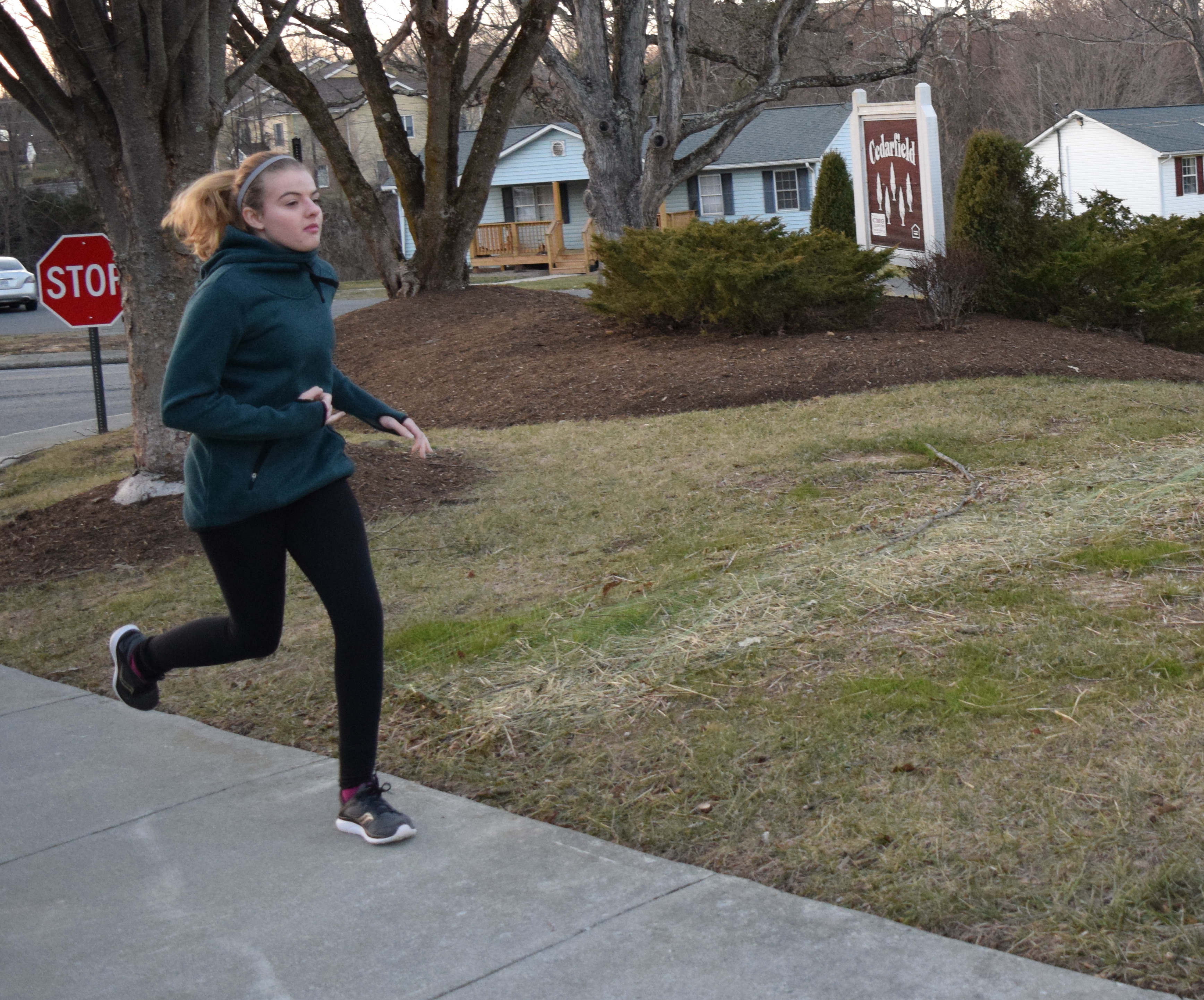
Blacksburg, Va., Feb. 5- Running despite the cold: Erin Newman runs in her neighborhood on a chilly afternoon. She is wearing running tights and a jacket in the windy 45 degree weather. Photo: Becky Shumar
January and February seem to be the coldest months in the New River Valley, and for many people this means it is time to hunker down until the warmth returns. But experts say the change in temperature is no excuse to put on winter weight.
Triathlon runner Sam Forsyth claims the cold weather improves his race performance.
“You don’t sweat as easy and you feel more energized,” said Forsyth. “I always have my fastest times in the 50s and the slight rain.”
For many runners the first sign of frost means it is time to start running inside. But Forsyth says he will do all he can to avoid running on the treadmill. Not only does it hurt his knees, but he says it takes away from the experience.
“Part of the enjoyment of running is exploring, finding new places and seeing what’s around the corner,” said Forsyth. “There’s no scenery inside.”
The graphic above gives runners a guide on what to wear based off the temperature outside.
But running in the cold is not the same as running in warmer temperatures. Runners have to dress properly to avoid frostbite, hypothermia and joint injuries. Athletes also should not anticipate the same run times as they have had during the fall season.
“Expect to go slow the first mile or so,” said Forsyth.
How athletes dress could significantly improve or worsen their running experience. A decent pair of wind resistant gloves improves comfort tremendously.
“My hands are the first things to get cold. Hands are a part of your extremities hard for them to heat up.”
Forsyth says dry-fit gloves are not necessary because if his hands get sweaty, he will want to take them off anyways. As for feet, it is important to have a warm pair of socks that can wick away sweat. Running shoes should have decent traction to prevent falling on slippery ice.
The graphic above shows the benefits of running.
Forsyth says layers are the best way to stay comfortable throughout the whole workout. It gives runners the ability to manage their temperature while warming up during the run. According to runnersworld.com, you should dress as though it is 10 to 20 degrees warmer outside. Wearing too much clothing can cause overheating and discomfort.
But it is not just about how you dress. Experts say those who run in the winter are at a greater risk for dehydration. According to running.competitor.com, runners do not sweat as much and feel less thirsty when they are cold. This leads to a decrease in water consumption during the winter months. It is imperative that athletes drink half their body weight in fluid ounces to avoid dehydration.
Blacksburg, Va., Feb. 2 – Lane Stadium Video Scoreboard: Virginia Tech’s 2017 recruiting class came to Blacksburg to play at historic Lane Stadium, the home of the Hokies. Lane Stadium’s atmosphere is one of the many reasons players want to play at Virginia Tech. Photo: Johnny Kraft
by Johnny Kraft–
Coach Justin Fuente and his staff made a statement with Virginia Tech’s 2017 recruiting class. The 2016 ACC coach of the year welcomes 27 new players following his first full recruiting cycle as leader of the Hokies.
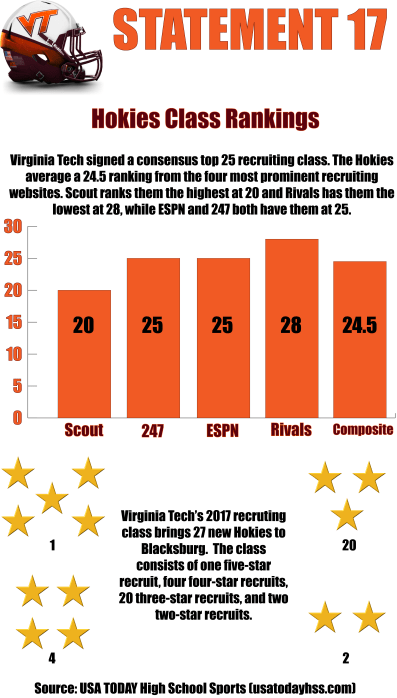
Fuente built off his impressive debut season in Blacksburg by signing Virginia Tech’s highest-ranked class in four years. According to USA TODAY High School Sports, the Hokies’ inked a consensus top 25 recruiting class. The full year made a huge difference for Fuente’s staff.
“Last year was speed dating trying to get to know people. This is much more calculated. I probably shouldn’t use that term. I’m much more comfortable because I been around these guys and their families a lot more,” said Fuente at his National Signing Day press conference. “As a class, I have been able to spend a lot more time with these kids and their families. I was able to teach them about Virginia Tech and what Virginia Tech can do for them.”
Virginia Tech prioritizes in-state recruits by keeping them home. This recruiting class is highlighted by three recruits ranked in the state’s top 10 led by prized defensive back Devon Hunter. The other two top in-state recruits are defensive end TyJuan Garbutt and linebacker Dylan Rivers, who flipped his commitment from Penn State in January. This is the first time since 2012 Virginia Tech has signed more than two of Virginia’s top 10 players.
“It’s extremely important. We want the rest of the country to know they’re in for a battle if they’re coming into the state of Virginia,” said Director of Recruiting Operations, Thomas Guerry about in-state recruiting. “This state is our top priority and we’re going after the in-state guys first and foremost.”
Click the image to view the full version of the infographic breaking down Virginia Tech’s 2017 recruiting class
“I think the most important detail about this class is the fact that we were able to early enroll nine of these guys. This day in age, it’s so crucial to get these young guys in a semester early and have them develop in the weight room, at the training table with their meals and obviously on the field during spring ball,” said Guerry about the early enrollees. “At the quarterback position, for example, we are going to get to watch all of our quarterbacks compete for 15 practices, which will largely determine where we are headed into fall camp.”
Fuente’s biggest challenge is replacing the offense’s best weapons with receivers Isaiah Ford and Bucky Hodges as well as quarterback Jerod Evans all leaving for the NFL. However, Fuente is well equipped with many young weapons.
While Virginia Tech welcomes one of the most talented recruiting classes in school history, the Hokies know all of this is meaningless unless they prove it on the field with wins.
“I don’t think it says anything until we produce on the field. There are highs and lows in this industry, especially in recruiting. And it carries over to wins and losses,” said Guerry. “The key is to never get too high and never get too low, always take each challenge as it comes and we’ll be the best we can be. We need to win and keep the momentum going.”
Blacksburg, Va., Feb. 6- LOOKING ON: Redshirt-junior wide receiver C.J. Carroll looks on at his teammates during their Monday afternoon lift. The Maryland native is a preferred walk-on for the Virginia Tech Hokies football team. Photo: Blayne Fink
by Blayne Fink–
John Engelberger, Cody Grimm, Will Montgomery, Sam Rogers—for some, those names are just that, names, but for Hokie fans, these are some of the most successful and impactful players to ever come through the Virginia Tech football program. However, what links these players is not just their success on the gridiron, but that they were all preferred walk-ons for the Hokies.
According to Recruiting-101, a preferred walk-on is a student athlete who has been noticed by a coach and are then offered a spot on a university’s athletic team, but who does not receive an athletic scholarship. With the glitz and glam of the recent National Signing Day still fresh in the minds of football fans, it begs the question: What is National Signing Day like for those preferred walk-ons?
“I kind of took part in it, but I just signed a blank piece of paper and got the pictures, that’s it,” said redshirt-junior wide receiver C.J. Carroll, a preferred walk-on for the Virginia Tech Hokies football team.
However, that’s not just it, it’s also the start of a long and trying process to ultimately earn that coveted scholarship and cement their name on the aforementioned list. Carroll, who was given a preferred walk-on spot in a signing class that featured highly touted players like Isaiah Ford and Travon McMillian, explains that his walk-on position requires playing with a different edge than that of scholarship athletes.
“You have to [play with an edge], there are very few of us out there that actually play, so once you get your opportunity, you have to make the most of it to try and earn a scholarship,” said Carroll. “As well as, to get the respect of other people who do have scholarships.”
Since joining the Hokies in the summer of 2014, Carroll has used that edge to work his way up in the team ranks, first, starting with the scout team and eventually becoming a key part of the Hokies offense and kick return game.
Carroll was also given the privilege of wearing the jersey number 25, awarded to the special team’s player of the week in honor of former head coach Frank Beamer, in the team’s game against Notre Dame. For Carroll, the opportunity had an even deeper meaning, as coach Beamer was always so giving to walk-ons like himself.
“It was crazy, that whole day was unbelievable,” said Carroll. “Notre Dame is a historic program and to wear that number 25 and play on national television…it was something that I won’t forget.”
As for the advice he would give to other players given a preferred walk-on spot?
“Work hard, earn the respect of players and coaches, and the rest will take care of itself,” said Carroll.
And that it did, just one day after the 2017 National Signing Day, Carroll was finally given his own, real, signing day when was awarded a scholarship by head football coach Justin Fuente.
Blacksburg, Va., Sept. 6- WATCHFUL EYES: C.J. Carroll watches on as his teammates complete their sets of benchpress for the day. Photo: Blayne Fink
Blacksburg, Va., Sept. 6- PUSHING TEAMMATES: A key expectation of preferred walk-ons is the job of pushing starters. Here, Carroll cheers on his teammates completing a set of benchpress. Photo: Blayne Fink
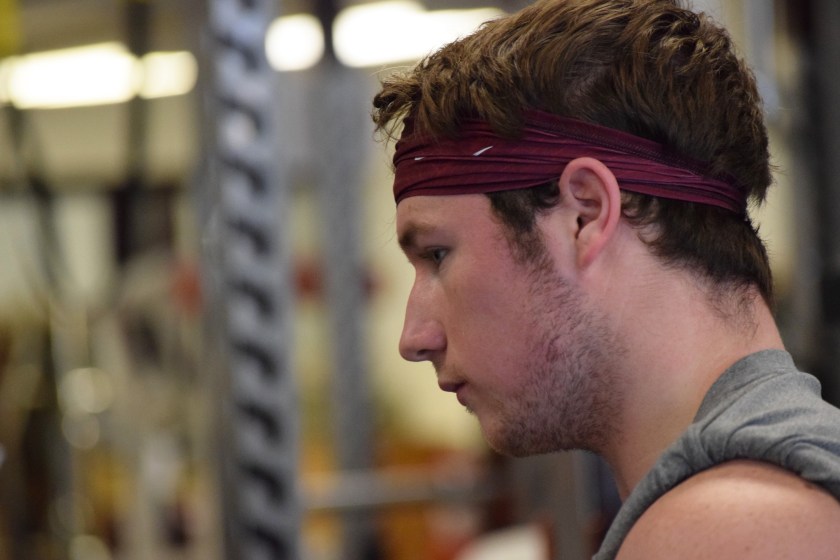
Blacksburg, Va., Feb. 6- GEAR: Preferred walk-on players are given the same gear as that of scholarship players, such as the w1n-0 training tops Carroll sports here. Photo: Blayne Fink
Blacksburg, Va., Feb. 6- GOOD TIMES: Laughing along with teammates during an off-season workout, Carroll was quick to note that preferred walk-ons are treated no differently among the team. Photo: Blayne Fink
Blacksburg, Va., Sept. 6- FROM NO TO PRO: Cody Grimm, a preferred walk-on turned NFL draft pick, is among the many Virginia Tech walk-ons to don a spot on the “Hokies in the NFL” wall. Photo: Blayne Fink
Blacksburg, Va., Feb. 6- SPECIAL PLACES: Cody Grimm even grabbed a spot in legendary coach Frank Beamer’s book “Let Me Be Frank.” Beamer was well known for his work with special teams, a job taken very seriously, especially by walk-ons. Photo: Blayne Fink
Blacksburg, Va., Feb. 6- CAPTAIN: Former Hokie walk-on Jack Tyler earned a position as captain for the 2013 Virginia Tech football season. Former walk-ons such as Will Montgomery and Willie Byrn were also given the honor. Photo: Blayne Fink
Blacksburg, Va., Feb. 1 – Barber Shop: The Brownstone Barber Shop, on South Main Street, officially opened its doors to customers with a ribbon cutting ceremony on February 1. Photo: Stephen Dixon
On Feb. 1, 2017, a new business officially opened on South Main Street in downtown Blacksburg. Brownstone Barber Shop, which technically opened its doors to customers in late December 2016, held a ribbon cutting ceremony to celebrate their success thus far and announce themselves to the public.
Co-owner Patti Schrantz, a master barber for 34 years, and her three coworkers left Sports Clips to start Brownstone and get out of the corporate world. “We got really tired of the corporate setting. So we decided to make this LLC and formed the barber shop from there,” Schrantz said.
Being something new and different is not the only reason that Schrantz founded Brownstone. She wanted to help the local economy by keeping the tax dollars in Blacksburg as well as helping residents participate in the downtown Blacksburg loyalty card program. According to the downtown Blacksburg website, the card program encourages customers to shop local by rewarding them with a five dollar gift card to a local business, when they make purchases at five different local businesses.
Adam Workman, assistant vice president at First Citizens Bank and ambassador for the Montgomery County Chamber of Commerce, agreed that local businesses like this are crucial for the local economy. “It creates a community atmosphere. The more diversity we have in our community, the better we’re going to be. So having a business, like the barber shop here, in downtown Blacksburg, makes it more attractive.”
Brownstone Barber Shop is located at 301 S. Main Street next to Mellow Mushroom.
Blacksburg, Va., Feb. 1 – Walk Ins Welcome: Appointmens for hair cuts can be made online or over the phone, but Brownstone invites customers to walk in for an unscheduled appointment as well. Photo: Stephen Dixon
Blacksburg, Va., Feb. 1 – Patti Schrantz, co-owner of Brownstone, finishes cutting a customer’s hair before the ribbon cutting ceremony. Photo: Stephen Dixon
Blacksburg, Va., Feb. 1 – Manly Atmosphere: In place of the typical countertops used in most barber shops, the barbers at Brownstone prefer toolboxes, which provide a more masculine feel for their customers. Photo: Stephen Dixon
Blacksburg, Va., Feb. 1 – Eat Up: After the ribbon cutting ceremony, guests were invited to enjoy a smorgasbord of homemade food prepared by the employees. Photo: Stephen Dixon
Blacksburg, Va., Feb. 1 – Mayor Fun: The Mayor of Blacksburg Ron Rordam has a little fun with the ceremonial big scizzors as he pretends to cut a customer’s hair. Photo: Stephen Dixon
Blacksburg, Va., Feb. 1 – It’s Official: Brownstone Barber Shop officially announces it’s opening as Mayor Ron Rordam cuts the ribbon in front of the business. Photo: Stephen Dixon
Blacksburg, Va., Feb. 1 – Small Talk: Co-owner Patti Schrantz and Mayor Ron Rordam chat in front of the shop after the ceremony. Photo: Stephen Dixon
Blacksburg, Va., Feb. 1 – All Smiles: Adam Workman, an abassador for the Montgomery County Chamber of Commerce, cannot contain his excitement for a new business to be opened in downtown Blacksburg. Photo: Stephen Dixon














 > THE NEWS FEED <