Alcohol abuse prevention: a wasted effort?

relay2
Blacksburg, Va., April 26, 2017 – Top of the Stairs: Tots is one of Blacksburg’s most popular bar hangouts and home to TOTS Tuesday, where students and residents can come together to sing and listen to karaoke, as well as drink alcohol every Tuesday night.  Photo: Kameron Kopecky

by Kameron Kopecky–

Underage drinking is one of the biggest problems on college campuses throughout the country. According to the Centers for Disease Control and Prevention, “Excessive drinking is responsible for more than 4,300 deaths among underage youth each year, and cost the U.S. $24 billion in economic costs in 2010.”

Virginia Tech has groups for students whose main goal is to combat underage drinking, as well as classes to teach incoming students about alcohol before they arrive on campus. They, along with other colleges are taking initiative and coming up with ways to try to combat underage drinking.

Universities, including Virginia Tech, are testing out various methods, such as Hokie Wellness and AlcoholEdu, to try and educate and prevent underage drinking by addressing it early on. At the beginning of each student’s freshman year, they are required to take the online AlcoholEdu course.  Their main goal “…is to create a welcoming and inclusive campus, and to reduce the negative consequences of alcohol misuse and abuse on campus as well as the incidents of unwanted sexual behavior.”

Virginia Tech junior Evan Burton said he recalls his experience with AlcoholEdu as a time that he rushed through the online course and called the course a joke.

If most students are like Burton, the effectiveness of the online course is clearly in question and it seems Virginia Tech may need to look for alternative methods to educate students on the dangers of alcohol abuse.

While college can be rigorous, stressful, and overwhelming at times, some students may search for ways to help them relieve their stresses through the consumption of alcohol.

For some it becomes more than simply a way to alleviate stress.

“I feel like it’s out there [alcohol] and I’m doing it. I am not going to stop [drinking],” Burton said.


Tap and go

by Erik Van Pelt, Rachel Hale–

Virginia Tech recently launched a new mobile food ordering application. Students now have the ability to order food from specific shops in Turner Place dining hall using their smartphones. Dining Services at Virginia Tech have partnered with Tapingo, a smartphone app designed to offer mobile payment at college style dining halls.

The innovative new systems have been adopted at Turner Place as a small-scale launch for the service, which will have widespread availability on the majority of on-campus dining halls in Fall of 2017.

Launching the app early allows both Dining Services and students a grace period to become familiar with the process and ensure that it will run smoothly in the future.

“There was definitely a learning curve when we first started using it,” said Olivia Jansce, an employee at Bruegger’s Bagels. Jansce was part of the first group of employees who had to learn the process of using a phone application for payment rather than a card. She explained they had to learn not only the technicalities of using the app but also the demands of it in terms of labor.

Employees have to service their in-store customers while also keeping up with orders coming in digitally. This process involves adapting new methods of prioritization and efficiency, for employees.

The purpose of the new program is to streamline dining services, offering patrons the same high-quality product with a much shorter waiting time.

“I’ve used it a few times to order from Bruegger’s and it’s saved me a lot of time,” said Virginia Tech senior Josh Wallis.

Students at Virginia Tech frequent the dining halls in large crowds during the time windows in between classes. These rushes can overwhelm dining facilities causing backups and delays; the institution of mobile ordering is aimed at mitigating these backups and providing a more convenient experience for diners.

The introduction of the app is not designed to generate a larger customer base, just a more efficient experience for current customers.

According to the Princeton Review, an independent college ranking service, Virginia Tech ranks fourth in the nation for best dining services. The ranking system is based on comprehensive criteria that include things like quality of food, service, range of choice and health standards.

Virginia Tech is ahead of the curve with the introduction of the app. Only a handful of other schools afford the same luxury to their students.

Students at Virginia Tech can download the app online or in any major smartphone app store. Dining Services expects a seamless transition in the Fall when the service goes full-scale, and hope to continue their high standards of service to students.

LIFE/STYLE: Enjoying summer on a budget

E
Photo via Foter.com


by Courtney Snukis, Carson Bartlett, Haven Lewis–

Attending college can be incredibly expensive and the demand of coursework often leave students with little time to get a job. According to a study from Ohio State University, 70 percent of students feel stressed about finances.

Additionally, the average debt for college students in the United States has increased. According to a report from the Institute for College Access and Success, the average borrower owes more than $30,000.

With mounting debt and inconsistent incomes, frugality is essential for college students during the summer. There are plenty of activities, indoor and outdoor, that can keep students entertained.

Low funds don’t have to mean no fun for college student during the summer, especially if you’re willing to take advantage of free events and low-cost activities.

Happier animals, happier community

Screen Shot 2017-04-30 at 5.58.37 PM
Christiansburg, Va., April 25- New and Improved: The new Montgomery County Animal Care and Adoption Center has increased space for animals and volunteers. Photo: Becca Tedesco

by Becca Tedesco, Hayley Olivenbaum, J.B. Wright–

According to the ASPCA (American Society for the Prevention of Cruelty to Animals), approximately 6.5 million animals enter U.S animal shelters every year. One shelter in the New River Valley area is working to make the lives of those animals happier and healthier.

The grand opening of the new Montgomery County Animal Care and Adoption Center was April 29, 2017. The new shelter is over 16,000 square feet, a 288 percent increase in space compared to the previous shelter. With this increase in space, there is obviously much more room for animals to be housed. Due to the larger facility, the center is moving towards a no kill policy and focusing more on making sure the animals are either adopted or sent to a rescue.

“It’s so much brighter and there’s so much more room. The animals are going to be more adoptable because they are so much happier,” said Director Eileen Mahan.

The staff and volunteers are proud of their new center and hope that it will be a place that adds more community involvement. Not only will the center be a place that houses animals, but it also includes a community room to hold meetings,  paint nights and other community events.

Mahan has already seen the impact the new facility has had on the volunteers and animals. The center has a greater ability to keep the shelter clean and this has a direct effect on everyone that comes in contact with it.

The shelter can now hold 68 dogs and 64 cats, a 310 percent increase in the number of animals housed. Not only that, but the shelter stays open much longer during the week.

The new shelter includes a shower for staff to wash off in after working with animals, a laundry room to wash animals blankets and dishes, a surgical room for vets to come and perform minor surgeries on animals and an indoor food room, all things the previous center didn’t include.

There are many ways that people can help at the new center – from walking and bathing dogs, to doing laundry and caring for recently abandoned or adopted pets. Even Montgomery County inmates are able to come in and help around the center.

This shelter is one of many that is working towards helping to lower the average of euthanized animals each year. It is also hoping that it can teach the community the importance of making sure that stray animals are taken care of properly.


The New Newman Library

IMG_9664.jpg
Blacksburg, Va., April 20-Newman Library: Virginia Tech’s flagship library has seen the removal of nearly a quarter of its books. University officials hope to build new study spaces in their absence.

by Richard Chumney–

Veterans of Virginia Tech’s Newman Library may have noticed some stark changes in the past weeks. Dozens of shelves, on multiple floors, have been stripped empty of books to make room for new study spaces.

From Newman’s first to fifth floor nearly a quarter of all books and various collections have been moved to two Virginia Tech operated off-site storage facilities. According to Mark Kucask, assistant dean and chief of staff of Virginia Tech libraries, the decision to remove certain materials was based on the frequency of use. Books that were checked out less frequently were more likely to be relocated.

Patrons will still have access to the relocated collections, however, they will have to submit a request to the library prior to viewing their desired material.

According to the University Libraries’ website, the reorganization effort is a part of the larger Beyond Boundaries initiative.

Newman Library’s fourth floor will be the focus of most of the changes, including a complete renovation.

Virginia Tech’s library is a popular place for students to study or to complete groundwork, however many struggle to find free seating. University officials hope the recently cleared space will allow the creation of new study spaces and students labs, helping to alleviate Newman Library’s congestion.

As libraries continue to transition to digital collections the physical space required to hold collections declines. In the meantime, much of the floors within Newman Library remain dominated by shelving. No specific date for their removal has been set, however, the renovation is scheduled to last through 2017 and into 2018.

Digital News Delivery: Audio technologies for journalists

microphone-with-screen-with-chart
Photo credit: Foter.com

by Sara Joy-Hogg, Stephen Dixon–

Mobile technology is quickly changing the ways in which journalists record interviews and audio. Instead of using heavy and expensive high-tech equipment, journalists are using their smartphones and switching to mobile journalism.

A large reason for the switch to mobile technology is how cheap and easy it is to use. According to a poll by Pew Research Center, 77 percent of Americans had a smartphone in 2016. Since many journalists already have the smartphones, downloading a voice recording app is convenient and either free or very cost efficient.

However, a key issue with cheaper, mobile technology is the lack of quality. These mobile apps are free for a reason, resulting in many people questioning if journalists should be using them instead of standard, high-tech equipment.

In the vodcast below, we compare mobile apps such as Voice Recorder and Voice Memos, a digital audio recorder, and a lavalier mic.

https://www.youtube.com/watch?v=s1zmj-IW0Mc&feature=youtu.be

Algorithm to fight cyberbullying

IMG_0111
Blacksburg, Va., April 20 – Professor Bert Huang: Huang continues his research on algorithms to detect cyberbullying. His tool is only about halfway complete as he looks to take it to the next level of preventing cyberbullying. Photo: Johnny Kraft

by Johnny Kraft–

Cyberbullying is quickly developing into one of the most popular forms of bullying as social media and technology can be used as a weapon 24 hours a day, seven days a week. However, an assistant professor at Virginia Tech has built his own weapon in the battle against cyberbullying.

Professor Bert Huang has developed an algorithm to detect traces of cyberbullying. Huang is an assistant professor in the Virginia Tech Department of Computer Science, where he is using his knowledge of machine learning to develop algorithms to combat cyberbullying.

According to bullying statistics, about half of adolescents experience some form of cyberbullying, and 10 to 20 percent experience it regularly. However, Huang has found in his research that adults experience cyberbullying more frequently than people realize, and that men experience about the same amount of cyberbullying as women, although they are much different forms of cyberbullying.

Huang developed computer algorithms to identify cyberbullying automatically by using machine learning, which is a type of artificial intelligence that provides computers with the ability to learn without being explicitly programmed.

“We have to provide information as human experts for the machine-learning algorithm to learn from where these are explicit examples of here’s something that I am looking and here’s something that I’m not looking for,” said Huang. “So in this case, it would be here’s an example of cyberbullying and here’s an example of not cyberbullying. Doing that is really expensive and takes a lot of human effort, and is really tricky for humans to do.”

According to DoSomething.org, 81 percent of teens believe cyberbullying is easier to get away with than bullying in person. Right now, the algorithm can only detect traces of cyberbullying, but Huang’s challenge is to eventually find a way to prevent cyberbullying after detection. Huang acknowledged this as the biggest obstacle and focus of his research.

“That’s the goal. There’s a big open problem beyond the detection task. So once you detect it, what do you do?” said Huang.

The algorithm is still developing, as it is not completely accurate yet. Huang hopes to keep evolving his weapon, as a practical tool for social media and other Internet users in the future, but the next step is not completely clear.

“There’s a big question of what you do if you actually detect cyberbullying. This is a problem that we as humans have not solved,” said Huang. “How you intervene and how you fix that problem is not obvious, so getting a computer to do that is an even harder problem.”

Bert Huang
Blacksburg, Va., Virginia Tech Assistant Professor Bert Huang built an algorithm to detect traces of cyberbullying. Photo: berthuang.com

RLRO Radio: Community policing one Monday at a time

IMG_6003.JPG
Blacksburg, Va., April 24 – Officer Arkeif Robinson cues up his next track during the Monday broadcast of the RLRO Nation radio show. Photo: Ashley Cimino

by Ashley Cimino —

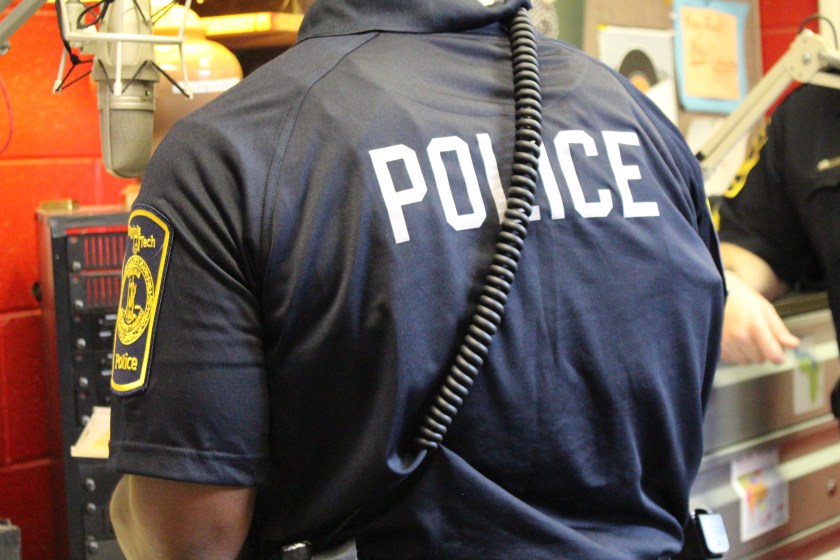
RLRO (pronounced rolo) Nation is the group of three Virginia Tech Police Department officers that are designated as Residence Life Resource Officers. Officers Arkeif Robinson, John Tarter, and Kenny Ball come together every Monday from 2 to 3:30 p.m. to host a radio show on WUVT FM, Virginia Tech’s student-run radio station.

The purpose of this weekly radio show is to connect with the community that they serve. On the show, the officers highlight special programs that the RLROs host or attend. Popular events from the semester include Relay for Life, Friday wallyball games in War Memorial Gym, and the RLRO Fried Bologna and Cheese Night.

Each Monday, several guests, often times people who work in residence life at Virginia Tech or other VTPD officers, fill the small WUVT studio. The RLROs host small interviews with the guests and include them in the typical layout of their show, like having them read sections of a prepared script.

“I catch the show every Monday while I’m working. I’m glad that it’s on WUVT because I would never have found it normally, or even thought I’d be interested in it really,” said Katie Pierce, a junior at Virginia Tech.

The officers started the show back in 2013 and haven’t missed a semester since, and they’ve built a following. While it’s a common joke on the show that only 20 people are listening in, the RLRO Nation Facebook page has over 1,000 likes.

“I never would’ve imagined that a show by cops exists on WUVT, but it does. It just goes to show how much WUVT sticks to their ‘radio for everyone’ motto and I know the RLROs are a good part of the WUVT community,” said a current DJ at the station.

Some listeners and community members wonder why the Virginia Tech Police Department would dedicate officers specifically to the on-campus residents as resource officers, and the answer is simple. According to Bureau of Justice Assistance, community policing is a way for the community and law enforcement to engage in a trusting, mutually beneficial relationship that can be used to solve problems within the community. For the RLROs, WUVT is just one way that they can reach the people they are aiming to help.

You can listen to RLRO Radio every Monday from 2 to 3 p.m.  from anywhere at www.wuvt.vt.edu/listenlive or locally at 90.7 on your radio dial.

RLRO Radio from Ashley Cimino on Vimeo.

Efforts to honor cadet

FullSizeRender (8)
Blacksburg, Va., April 20- Capital Projects: Donors are a big reason building construction is possible at Virginia Tech. Photo: Katie Lukens

by Katie Lukens–

Virginia Tech is continuously building and expanding the university to accommodate the growth of the student body. Although Virginia Tech is a state university, only about 23% of funds for the school come from the state, according to Andy King, a Virginia Tech student. This means that the other 77% of funds comes from donors. These donations support students, faculty, academic initiatives, university programs, athletics and capital projects.

These capital projects include the new buildings across campus. “Private support is an essential component of the funding for important projects across the university” states Virginia Tech. It has been a tradition that if someone makes a large enough donation to a capital project they can have the new building named after them.
Three students had an idea to break the norm of how buildings were named and wanted to honor someone who lived out Virginia Tech’s core value, Ut Prosim. Although they saw how vitally important donors are to the university, Andy King, Nicholas Oberle, Tristan Nguyen wanted to recognize the sacrifice of Matthew La Porte, who was killed defending the lives of others on April 16, 2007.

King, Oberle and Nguyen began a petition to rename a new cadet hall after La Porte. The petition began with hopes of acquiring 5,000 signatures but it quickly grew to over 43,000 signatures.

The university took notice to the large response but has decided not to rename the new building.

King shared his frustration with the university, not because they denied the request to rename the building, but because he felt the request was not taken seriously by the officials.
The efforts of these students have not gone unseen and the memory of La Porte will continue to live on.

Students create awareness of sex trafficking

18057874_1236010589851351_3164487243509909214_n
Blacksburg, Va., April 21 – Campus Fundraiser: Members of “It Happens Here” raise money to furnish rooms in a safe house outside of Squires Student Center. Photo: Jordan White

by Whitney Turner–

Three Virginia Tech students have created an organization on campus to raise awareness of sex trafficking in Virginia called “It Happens Here.”

After working with victims of sex trafficking while on a mission trip together last spring break, Jordan White and Caroline Omland decided to use this issue as a platform for White’s homecoming campaign. When the homecoming campaign ended, White, Omland and their friend Kirsten Mitchell decided they didn’t want to stop educating people on this issue.

“We didn’t really see that people knew fully what it was or even that it existed in America or even that it existed at all,” said Mitchell. “So we really want to see people become more aware.”

In 2016, the National Human Trafficking Hotline reported that out of 148 cases of human trafficking in Virginia, 105 of them were sex trafficking cases.

In addition to education, “It Happens Here” seeks to fundraise and change legislation to combat this issue.

Having not had a haircut for over two and a half years, White used his mane to create a fundraiser to benefit Street Ransom, a safe house for victims of sex trafficking located in Roanoke, Va. By donating money to furnish rooms in the safe house, participants could vote on whether White should dread his hair, wear it as a fro, let it keep growing or get a buzz cut.

“Our initial goal was to furnish one room, $700 to $730 a room and we passed that in the first six hours,” said White. “Then we raised it to three rooms and we passed that a little over halfway through the campaign. So then we upped it to $5,000, which would furnish all of the rooms in the safe home.”

By the end of the fundraiser, White’s hair had raised $4,570 and won him a buzz cut.

White, Omland and Mitchell were surprised by the overwhelming interest and support their organization has received so far and they are hopeful that they can make a difference.

“I think people automatically assume that awareness isn’t really doing anything, that it’s not actually fighting against sex trafficking, but it is,” said Mitchell. “Because when you learn about it you’re stirred to action, you’re stirred to talk about it, you’re stirred to make other people realize this is happening.”

18058050_1646790835335644_758413815777497056_n
Blacksburg, Va., April 25 – Raising Awareness: Kirsten Mitchell hopes to raise awareness of sex trafficking on Virginia Tech’s campus. Photo: Jun Yu