
By Savannah May, Politics & Government reporter
As Northern Virginia fills with massive data centers, tech companies are increasingly turning to rural counties for land. Places like Montgomery County, Va., may not have proposals yet, but experts warn that land-use decisions like these can affect communities for generations.
Nearly every Google search, social media post or online purchase passes through a data center somewhere. Companies rely on these facilities to store information, run websites and apps and manage internal operations like payroll, human resources and sales.
Data centers operate at different capacities. Hyperscale facilities differ from traditional data centers in their ability to host and operate at least 5,000 servers and cover at least 10,000 square feet of physical area.
“The number of operational hyperscale data centers continues to grow inexorably, having doubled over the past five years,” according to John Dinsdale, a chief analyst at Synergy Research Group. Not only will numbers increase, but so will their size. Advances in AI (artificial intelligence)-focused, GPU (graphics processing unit)-powered infrastructure are expected to roughly double the computing capacity of the next generation of hyperscale centers.
Companies like Google build at such a massive scale due to the demand for AI, data storage and other big-data computing pursuits. Hyperscale facilities are expanding rapidly across the United States. The number of hyperscale data centers doubled between 2019 and 2024, with more than 135 coming online in 2024 alone.
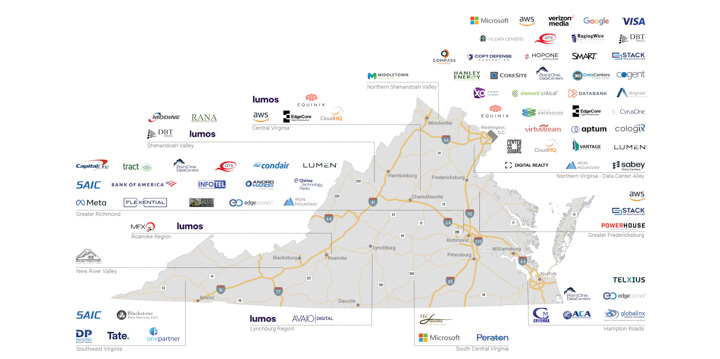
Virginia has the largest concentration of data centers in the world, hosting 35 percent of known hyperscale data centers worldwide. Northern Virginia, known as “Data Center Alley,” is at the forefront of this market.
Today, local constituents in these communities are pushing back against projects once considered “guaranteed approvals,” due to economic and political resistance.
For residents like Carlos Balvin, a cinema major at Virginia Tech, the impact is visible. “They’re a real eyesore and a stain on what would often otherwise be a beautiful day,” he says.
With this ongoing growth, companies are shifting to locations that offer large tracts of cheap land compared to dense urban areas.
Jurisdictions in Northern Virginia heavily invested in fiber-optic and network infrastructure to build a higher network capacity, which has helped attract data center development. Many companies in the region overlap with the defense and logistics industry. By developing near Washington D.C., a strategic decision, companies are closer to that infrastructure.
“In many ways, data centers are probably taking advantage of the fact that the infrastructure was prioritized here and developed here,” says Margaret Cowell, associate professor of Urban Affairs and Planning at Virginia Tech.
Rural communities offer reliable grid connections for resource adequacy and open terrain, making line-of-sight transmission easier. Areas with less development become easy targets, potentially swayed by financial incentives.
“In the past, there were debates about whether it was fair to site landfills in poor, rural communities that didn’t have much economic opportunity,” says Cowell. “Waste management companies would approach them and say, ‘You’ve got land, you could make money off it.’” While landfills and data centers are quite different, weighing their strategic approaches may offer insight into the industry’s next moves.
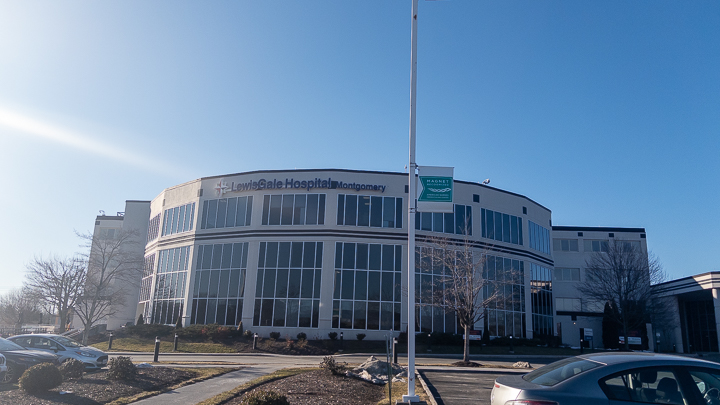
For Montgomery County, the primary operating data center facility is located in Blacksburg. Brush Mountain Data Center, located within the Corporate Research Center at Virginia Tech, is a subsidiary of Advanced Logic Industries, a Virginia-based company. Brush Mountain is a smaller-scale data center compared to the majority of facilities located in Northern Virginia.
Planning commissions approve development for several reasons. Developments could be seen as a way to increase the tax base or improve the economic conditions within your community.
“If you’re doing smart economic development, you’re concerned with the workforce. If you’re going to say yes to one of these companies, ideally, there would be a guarantee of a certain number of jobs being created,” says Cowell.
Michael Cary, research assistant professor in the Department of Agricultural and Applied Economics at Virginia Tech, wrote in an email, “The one area of research that does have some preliminary results that I am aware of is labor markets. There is no evidence of job creation beyond temporary spikes in construction jobs.”
This means that as research further develops, local politicians will still consider these impacts in making economic decisions for their constituents. As data centers continue to grow across the United States, including Virginia, it’s important to remember that if constituents are loud enough, they can have a real influence on what does or does not develop in their communities.
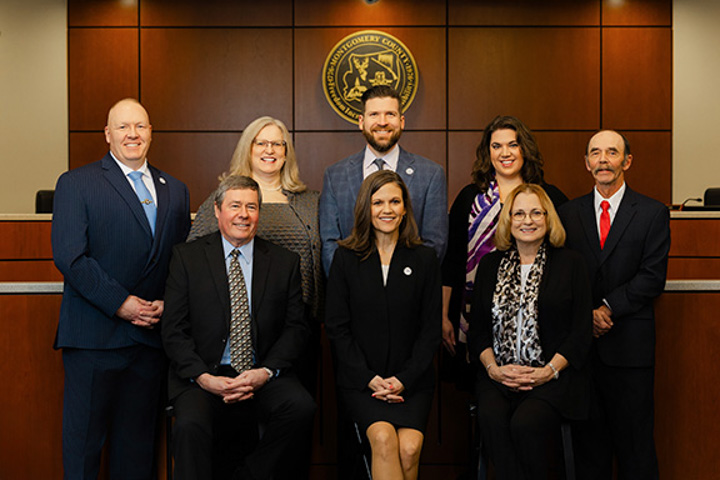
The Montgomery County Planning Commission said there are currently no proposals or zoning changes under consideration for data centers, and the Board of Supervisors has only discussed the issue. Planning staff said no formal action has been taken beyond preliminary discussion.
“Montgomery County probably doesn’t draw much benefit from a data center, but it could be persuaded by promises of revenue,” says Cowell. “There’s a real tension about whether we should allow this in our backyards, because, in some ways, it feels exploitative.”










 > THE NEWS FEED <