
Category: News
TOP STORIES: VT advancing self-driving cars, Hunting: Public vs. Private, Tree-farming business
Gobblers (laid to) Rest
by Harvey Creasey–

Blacksburg, Va. — Virginia Tech recently found itself back in the spotlight in our nation’s capital on Thanksgiving morning. President Trump participated in the annual turkey pardoning ceremony, and officially sent Drumstick and Wishbone to Gobbler’s Rest — a secluded spot of Virginia Tech’s campus.
This marks the second consecutive year that the White House turkeys have moved to Blacksburg. In 2016, President Barack Obama granted clemency for Tater and Tot, the inaugural residents of Gobbler’s Rest.
As Wishbone and Drumstick become the new centers of attention, Tater and Tot have taken a back seat — so much so that Tot, according to sources familiar with the matter, has passed away.
Wildlife conservation major and member of the National Wildlife Society Tristan Jilson said he saw Tater and Tot at Gobbler’s Rest just days before the new turkeys were set to arrive.
“When I last saw Tot he was slumped over against the wall barely moving,” said Jilson. “He looked miserable.”
Two weeks later, Tater alone occupies the space previously inhabited by the duo. Tot’s nameplate had been removed.
According to National Turkey Federation President Joel Brandenberger, the turkeys reside at Virginia Tech because of its respected Animal and Poultry Sciences department.
Turkeys have an average lifespan of 10 years, according to PETA. So what happened to Tot just 18 months after his birth?
At Gobbler’s Rest, a farmhand who wished to remain unnamed said he thought Tot “passed away due to natural causes.”
Jilson remains skeptical.
“Virginia Tech has portrayed Gobbler’s Rest as this safe haven for the pardoned turkeys but now it’s starting to look less like a refuge and more like a graveyard,” he said.
This news has been kept relatively quiet; as of Dec. 3 no university statement had been issued. Perhaps a poultry fatality at one of the nation’s best Animal and Poultry Sciences schools would tarnish its reputation.
At this Thanksgiving’s ceremony, in the White House Rose Garden, President Trump joked about reversing the pardons of Tater and Tot, as he has reversed many Obama-era policies.
Tater and Tot drew many visitors to Gobbler’s Rest over the course of the last year.
According to President Obama’s speech, Tater was technically the “vice turkey,” and would step in if Tot could not fulfill his duties.
Wishbone and Drumstick declined to comment on the matter.

Blacksburg, Va., Nov. 30 — Cold Turkey: A chalk drawing inquiring as to Tot’s whereabouts. Photo by Harvey Creasey.

Blacksburg, Va., Nov. 30 — Devas-Tater-ed: Missing his companion, Tater’s two bedroom is now a studio. Photo by Harvey Creasey.


Blacksburg, Va., Nov. 30 — Retracing Steps: Tristan Jilson walks through his final encounter with Tot. Photo by Harvey Creasey.

Blacksburg, Va., Nov. 30 — Party Lines: Tater is currently separated from Trump’s Wishbone and Drumstick. Photo by Harvey Creasey.

Blacksburg, Va., Nov. 30 — Gobbler’s Rest: It’s not the White House, but the turkeys’ residence is decorated in Washington paraphernalia. Photo by Harvey Creasey.


News Feed Special: Tradition and Change

In this special edition of The News Feed a look at embracing change at Virginia Tech while preserving the university’s time-honored traditions.
TOP STORIES: Students protest, Dogs and brain cancer cure, ‘Get On The Bus’ initiative
Veterans Day at Virginia Tech

by Alexis Johnson–
For most Veterans Day is a time to honor the men and women who have served in the U.S. military, but for others Veterans Day at Virginia Tech takes on a whole new meaning.
According to the History of the Corps of Cadets, Virginia Tech started as a military school in 1872. Now the Corp makes up about 4 percent of the student body according to Virginia Tech Student Affairs.
Each year the Virginia Tech Corps of Cadets organizes and plans several events including remembrance ceremonies, the lowering of the flag, and the firing of Skipper, the Corps of Cadets’ cannon to recognize those that have served, specifically those from Virginia Tech. One event, in particular, is the annual guarding of The Rock hosted by the Robert Femoyer Service Squadron (RFSS), a leadership organization within the Virginia Tech Air Force ROTC program.
Located on the Upper Quad just outside of New Cadets Hall, The Rock is the Corps of Cadets memorial dedicated to Hokies who fought in World War I.
This year, two members of the RFSS, were selected to plan, organize, and coordinate 96 cadets and officers to participate in the guarding of The Rock. Cadets Sakdithep Phongpitakvises and Nyaima Brackner have been planning this event for months and say that it “provides excellent leadership and organizational skills.”
The event was held over a 24 hour period, beginning midnight Friday, Nov. 10, and ending midnight Saturday. Each cadet had the opportunity to sign-up for 30-minute time slots. In groups of two, cadets stood at attention guarding the memorial making a switch every 30 minutes.
“It’s a very small sacrifice compared to what all the veterans have sacrificed for us,” said Cadet Brackner. “It’s honestly just thirty minutes of our lives,” added Cadet Phongpitakvises, “you get a little taste of what they (veterans) go through and get a little taste of why you want to serve.”
According to Cadets Brackner and Phongpitakvises, standing at the rock is “a time for self-reflection.” In fact, their goal for this year was that each cadet who volunteered would reflect on the sacrifices that each veteran has made before them and the sacrifices that they themselves will make in the future.
“Part of the reason I stand in front of the rock and I guard it is to go back on self-reflection and I ask myself why am I in the core? Why do I want to serve?” said Phongpitakvises. “That’s the stuff that goes through my head as I’m standing at the rock and that’s what I want others to think about.”
“Why are you here? There must be a purpose to what you’re doing. If there is no purpose, then why are you doing it?” added Phongpitakvises.
The memorial also has a special stone in memory of Cadet Matthew La Porte who was killed in the April 16 shooting.


Blacksburg, Va., Nov. 10- The Rock Memorial— Featured is a symbolic war cannon representing World War I. There are two cannons on each side of The Rock. Photo: Alexis Johnson.

Blacksburg, Va., Nov. 10- The Rock Memorial— The names listed are of Hokies lost during World War I. These veterans fought in France between 1917 and 1919. Photo: Alexis Johnson.

Blacksburg, Va., Nov. 10- The Rock Memorial— Two cadets stand around the perimeter of The Rock. No one is to walk inside the diamond shape in honor of the fallen Hokies. Photo: Alexis Johnson.

Blacksburg, Va., Nov. 10- The Rock Memorial— Two cadets change positions as one cadet completes his time guarding the rock while the other prepares to stand guard. Photo: Alexis Johnson.

Blacksburg, Va., Nov. 10- The Rock Memorial—The darker gray stone is in memory of Cadet Matthew La Porte who was killed during the April 16 shooting. La Porte was a drummer in the Highty Tighties. Photo: Alexis Johnson.

News Feed Special: Buildings honoring Confederate vets on college campuses

In this special edition of The News Feed, we explore the racial tensions on some U.S. college campuses in the context of memorializing Confederate veterans.
Hokies versus Hurricanes
by Harvey Creasey–
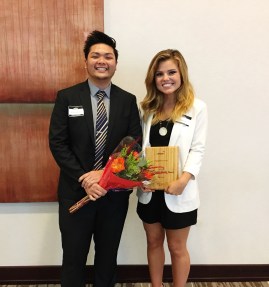
Virginia Tech’s commitment to research and aid throughout the water crisis in Flint, Michigan, brought national attention to the university and its research team. With civil engineering professor Dr. Marc Edwards at the helm, the Flint study team is expanding its reach to areas affected by recent natural disasters.
In the last two months, the United States has seen Hurricane Harvey rip through Texas, Hurricane Irma ravage Florida, and Hurricane Maria topple much of Puerto Rico. In fact, according to CNN, Puerto Ricans have resorted to knowingly consuming potentially dangerous water in the storm’s aftermath.
But the Hokie team, which helped to blow the whistle on hazardous levels of lead in Flint’s tap water, is now taking samples from wells in Houston and parts of Florida. Already, samples from Houston wells have tested positive for E. coli, as well as fecal indicator bacteria.
“The immediate reaction is to send tons of bottled water so people don’t have to deal with this,” said Sophia Lee, one of the undergraduates on the research team. “At the end of the day, we need a solution.”
The E. coli and other bacteria infiltrating Texas drinking water is a direct result of flooding and runoff, and likely damage and breaking of pipes and wells. According to Texas A&M University, Virginia Tech’s partner in the Hurricane Harvey research, more than one million Texas cattle have died as a result of affected water. While humans have not been affected to the same degree, the chemical change in the water is significant.
In addition to working with Texas A&M, the research team has also partnered with the University of Florida to gather and analyze water samples. Members also still make frequent trips to Flint, which, according to Dr. Edwards, is improving.
“It is difficult to be working on so many places at one time,” said Hisyam Mohsin, another of the undergraduate researchers. Mohsin and Lee received the Community Engagement Award at the University Professional and Continuing Education Association (UPCEA) conference this month.
As was true for residents of Flint, residents of the hurricane-affected areas in Texas and Florida have received national support and resources. Tech’s research team will require another grant to work on Puerto Rico, however. According to Lee and Mohsin, the desire to help is no weaker for the US territory.
UPDATE: As of Tuesday, October 24, the Research Team will start testing samples from Puerto Rico. More details to come.

TOP STORIES: Registering voters, Mental health care, Student food pantry
Goat Yoga! Blacksburg’s new fitness trend
By Virginia Pellington

Blacksburg, Va., Sept. 28— Goat Yoga: The new fitness trend Goat Yoga is taking on Blacksburg. Hoof Hearted Farm has over 25 goats ready to interact with their yoga guests. Photo: Virginia Pellington
by Virginia Pellington–
The art form of yoga has been around for centuries, but recently, it’s taken a new twist. Goat Yoga is the new craze in the fitness community, and residents of Blacksburg are jumping on board.
After a Facebook video went viral, Goat Yoga events began popping up in yoga studios around the country. In April 2017, the Blacksburg Yoga Collective (BYC) decided to give it a try; what they thought was going to be a one-time event, has turned into a weekly occurrence.
Kacy McAllister, a BYC yoga instructor, mentioned that they started Goat Yoga after someone posted the viral video to their Facebook page.
“We did it once and the turn out was so huge that we knew we had to make it a regular thing,” McAllister explained.
Goat Yoga is essentially a regular yoga class with goats roaming around the studio and interacting with the guests. The inspiration comes from Lainey Morse, who started the trend on her farm in Oregon. Currently, her classes are so popular that there’s a waiting list of 1,200 people that grows every day. According to Morse, Goat Yoga is no different than taking your dog on a walk; the combination of exercise and interacting with animals is apparently very therapeutic.
CiCi Sobin, a regular BYC yoga attendee, said her favorite part about Goat Yoga is that it gets people who aren’t normally into yoga outside and active.
“Yoga is so great for the mind and body, and I really enjoy seeing people get into it—even if they are just here for the goats,” Sobin said.
What Sobin says about its health benefits is true according to research. One study conducted by Harvard Health found that participants who spent three months doing yoga experienced a 30 percent decrease in anxiety and depression. In addition, GoatYoga.net, Morse’s website, explains that Goat Yoga is not actually curing any diseases, but offering a necessary distraction from day-to-day stress.
Morse and the Blacksburg Yoga Collective are taking advantage of this fitness trend while it’s still relevant. Morse quit her job in marketing and photography to devote her full attention to this new idea; she currently works full-time developing her new Goat Yoga business. McAllister from the BYC says she is just excited to see more people get into yoga.
“My goal is to see at least one new face at every event,” McAllister said.

Blacksburg, Va., Sept. 28—The Farm: Hoof Hearted Farm, located off of Meadowbrook Drive, hosts these Goat Yoga events. Both the farm and the BYC offer these services for free in order to get more people involved. Photo: Virginia Pellington

Blacksburg, Va., Sept. 28—The Regulars: Rebecca Coughman attends the BYC yoga events every single week. She focuses less on the goats and more on the mind-body connection that yoga enhances. Photo: Virginia Pellington


Blacksburg, Va., Sept. 28—Namaste: Cici Sobin takes a moment when the goats have wandered off to other people. Photo: Virginia Pellington


Blacksburg, Va., Sept. 28—Instructing: Kacy McAllister leads a deep breathing exercise at the end of the session. She encourages her students to reflect on how the body feels after an hour of yoga. Photo: Virginia Pellington

Blacksburg, Va., Sept. 28—Closing: The class winds down after a vigorous class with some stretching. Photo: Virginia Pellington

Blacksburg, Va., Sept. 28—Greetings: Virginia Tech students, Brendan and Lisa, greet the goats before their class beings. Photo: Virginia Pellington
 > THE NEWS FEED <