The Southwest Virginia Wildlife Center in Roanoke, Virginia, nurses injured and orphaned animals back to health and returns them to the wild. Each year, staff and volunteers treat hundreds of animals, from birds to bobcats. For many of them, rehab means a second shot at life.
BLACKSBURG, Va. — A $4.2 million GO Virginia grant awarded in May 2026 is funding an effort to expand advanced manufacturing across the New River Valley and Southern Virginia, create jobs and keep engineering talent in the region.
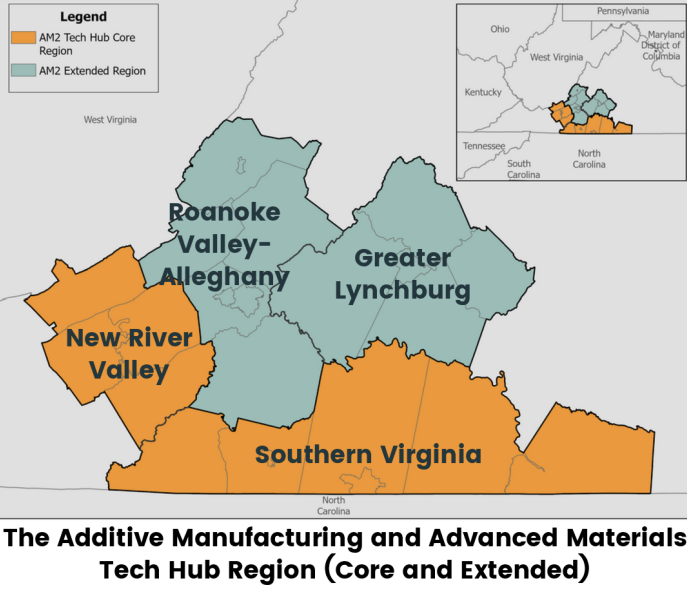
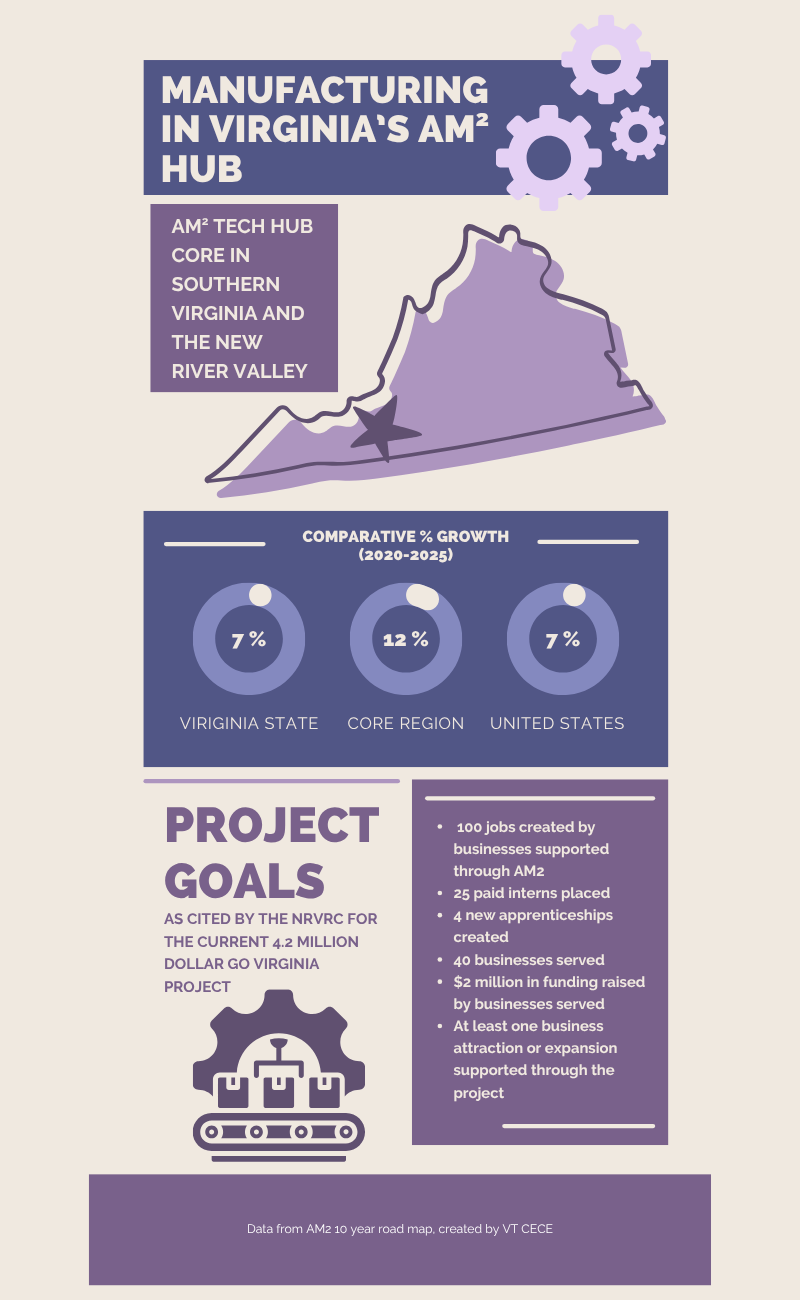
The New River Valley Regional Commission (NRVRC) and a coalition of regional partners are leading the initiative, known as AM2. Its service area spans Southwest and Southern Virginia, with the New River Valley and Danville forming its core. AM2 follows a 2023-25 planning phase that produced a 10-year roadmap for the region. That planning work was funded by a $500,000 U.S. Economic Development Administration grant, matched with $100,000 from GO Virginia. The roadmap also sets goals to create 100 jobs, place 25 paid internships, establish four new apprenticeships, serve 40 businesses and help those companies raise $2 million in outside funding.
Photo from AM2 10 year roadmap prepared by VT CECE.
Chip Bobbert, director of innovation at the Roanoke Blacksburg Innovation Alliance, said the region has a history in manufacturing and transportation. “You don’t have to go very far, especially on the Roanoke side to see it. We drive over a lot of railroad tracks just getting back and forth between here and Blacksburg…that’s in our DNA.” He pointed to Virginia Tech’s engineering program as another built-in advantage the region can lean on.
Manufacturing already supports 65,000 jobs at 1,330 firms across AM2’s full service area, according to the roadmap produced by Virginia Tech’s Center for Economic and Community Engagement. In the core region, manufacturing employment has grown 12% since 2020, nearly double the national growth rate, and the sector accounts for 14% of all core-region jobs, trailing only government as an employer.
“We want people to see this region as the place to start, build and grow an advanced manufacturing business,” said Leo Priddy, economic development planning specialist at the New River Valley Regional Commission.
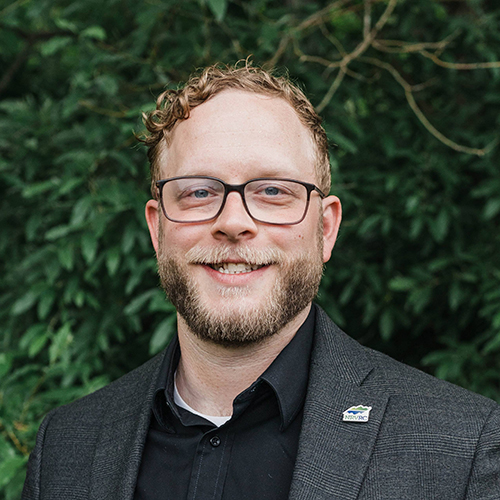
Photo courtesy Leo Priddy.
Part of what makes the initiative credible, Priddy said, is what the New River Valley and Danville, the Southern Virginia hub of the core region, each bring to the table. The New River Valley offers the engineering and research capacity of Virginia Tech, he said, while Danville has the Institute for Advanced Learning and Research, or IALR. These strengths, he said, made the two areas a natural fit when they were paired together for AM2’s original planning grant.
To carry out AM2’s goals, the initiative’s support breaks down into four main pieces: the consortium, which helps coordinate services and projects; studios, which provide technical assistance to help manufacturers adopt new technology; fellows, which pair subject-matter experts with companies; and the career network, which builds the workforce pipeline through education, internships and apprenticeships.
“The fellows side of this is trying to get people that are already working in this space, that have subject matter expertise in this to share that with folks that are starting to engage with these industries,” said Bobbert.
Of the $4.2 million award, $1.25 million is set aside as what Priddy called an “innovation fund” that will provide project-specific support for companies, such as hiring interns.
Keeping talent in the region is as much the point as bringing in new talent. “We have a talented group of young engineers that come out of Virginia Tech every year,” Bobbert said. “The opportunities to keep them in the region and designing and working here in the region is part of this too.”
That talent, Bobbert added, could be put toward work that extends well past the factory floor. “Not only can we manufacture advanced things, we can build things custom-sized for your body,” he said. “So why should the same pin that was designed for me be given to you, when a biomedical engineer could take the CT scans from our bodies and be able to produce the perfect-sized object for our individual repair.”
The initiative also reaches into middle and high schools. GO TEC, an existing middle school program Priddy pointed to, has helped establish hands-on labs and curriculum. AM2 is aimed at closing what Priddy called a “gap in ninth and 10th grade,” building coursework that bridges GO TEC to career and technical education classes in 11th and 12th grade.
Priddy said AM2 is also chasing harder-to-measure wins: manufacturers adopting new technology, improving productivity and strengthening regional supply chains. The initiative isn’t meant to replace groups like Onward NRV or the Roanoke Regional Partnership that handle business recruitment directly, he said, but to give them research, workforce and commercialization resources to bring into those conversations.
The consortium has also applied for an additional $40 million in federal EDA funding to scale up the broader roadmap, though that application hasn’t been decided. In the meantime, the region’s Emerging Tech Conference will include a dedicated AM2 track this fall, giving companies and researchers an early chance to connect.
As AI companies buy used and antiquarian books in bulk to scan and then destroy, one Blacksburg bookseller is asking them to stop.
An internal Anthropic document, unsealed in Bartz v. Anthropic, describes the effort bluntly: “Project Panama is our effort to destructively scan all the books in the world.”
Ellen Woodall, manager of Blacksburg Books, says the practice threatens more than physical inventory. It risks erasing history and altering what is truth. Without the original source material, there is no way to verify whether the information those models produce is accurate, or whether it has been altered along the way.
In an interview, Woodall discussed the threat and urged AI companies, “Please don’t destroy our books.”
Her comments were slightly edited for length and clarity.
AI is shaping how people access and receive information. How do you think training AI models on older texts, or AI more broadly, is reshaping the way information and truth get constructed?
That’s interesting, because if history is written by the victors, that’s a shaping of the truth as well. We’re seeing possibly not catastrophic failures yet, but if you’ve ever used a recipe you found off the internet and realized it was AI generated, you know it’s not always accurate information. So I think we should all be concerned about where we’re getting our information and whether it’s a source we can trust.
Is there a difference between scanning for preservation and scanning to train AI models?
I think that there are multiple differences. For example, Project Gutenberg is with the express intent to preserve the material. Whereas, for Project Panama, books are being scanned to teach AI models and then to be destroyed. There are multiple problems with that. It’s unclear to me whether the source material is being preserved. It’s unclear to everyone whether what AI models are learning is truly useful, and whether it’s ethical in the sense that some AI companies use this to skirt copyright infringement laws. That seems like a legal and moral gray area to me right now.
How do you see this impacting copyright?
Well, I don’t know a whole lot about it. I think a lot of people don’t know a whole lot about it. I think that some AI companies have argued that if they purchase the books and then scan them, that it’s fair use because they purchased the books. It’s unclear to me. But it seems like this is an ever evolving legal landscape that until we have some real answers, maybe we should be a little more critical about what’s happening and a lot more cautious.
Do you worry about the possibility of AI companies changing wording or meaning in books?
That’s certainly something that can be done, and everyone should worry about that when the source material is destroyed. Whether you’re a historian or a scholar or just a regular person that wants to have a real sense of history, we should all be worried about history being changed. That seems pretty common sense.
Do you see the mass purchase of books to train AI models and then be destroyed as a threat to your business?
Things are changing literally minute to minute with AI. I don’t see it affecting us that much in the near future because we’re not a huge dealer of antiquarian books. Our friends over in Christiansburg, Old New River Books, will probably have to deal with it, and they’ll have to deal with it sooner than we do. I have talked to a lot of my colleagues in other cities and states that are dealing with it, and it’s scary. I certainly have a very visceral reaction to the idea of books being destroyed. I don’t necessarily think that every copy of every book needs to be preserved. I used the example of James Patterson. We don’t need 50,000 copies of his 95th bestseller floating around, I think. But when we talk about things like antiquarian books where there’s one copy left, yeah, we probably don’t want to shred that.
Why is it important to preserve physical books?
I think there are a lot of factors there. I’m biased, but for me, there’s a real aesthetic factor to it. Old books are beautiful. They’re artifacts that we can learn a lot from, not just from the text, but we can look at the binding and the script and the typeset and the materials used. These are all little bits of history that are important. You know, it’s the same reason you preserve a Mesopotamian clay tablet, even though we can just take a picture of it. I think that there is a real concern when we’re depending on duplications of information, and information that can be so easily altered. It’s nice to always have source material to go back to.
What’s your first reaction when you hear of books being destroyed?
Certainly it’s alarming, and it’s something we keep an eye on. Like Anthropic’s Project Panama, I mean, it just sounds horrifying as a bookseller, and we haven’t been affected by it yet, but I have heard from many of my bookseller colleagues that people have been buying older books in bulk. It’s very alarming. The idea of books, particularly irreplaceable ones, being destroyed is kind of the antithesis of what we do.
How would you react if a buyer bought books from your store with the intention of destroying them?
We haven’t had anyone approach us yet. We do have people approach us fairly regularly to buy old books. Often when people buy books in bulk, they’re either interior decorators or Instagram influencers that want something like these right behind you in the background of their shots. Because we haven’t had to deal with it yet, we haven’t consolidated a policy around it. We’re taking everything as it comes. I might feel a little odd asking somebody, what do you want the books for? Usually people will tell me. I would have serious second thoughts if someone is buying them to destroy them. That said, it depends on the books, right? Like if it’s a bunch of James Patterson books, they can have them. There are billions of those books, you know. If they’re older antiquarian books, then it would be a tough call.
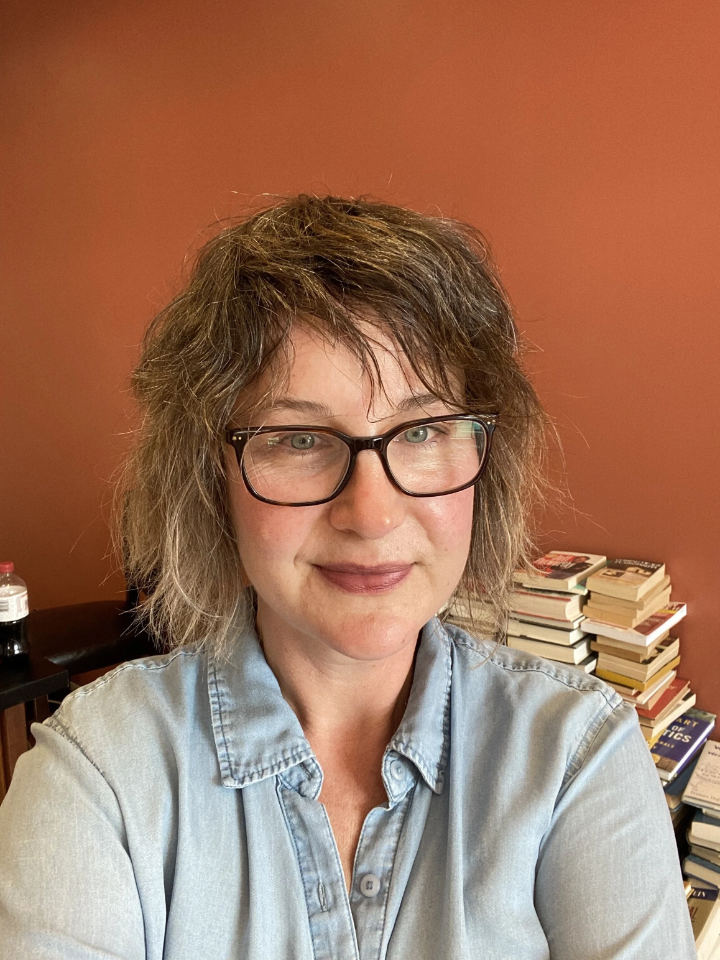
Ellen Woodall, manager of Blacksburg Books. Photo provided by Ellen Woodall.