
By Nick Carlson, science and technology reporter
BLACKSBURG, Va. — A $4.2 million GO Virginia grant awarded in May 2026 is funding an effort to expand advanced manufacturing across the New River Valley and Southern Virginia, create jobs and keep engineering talent in the region.
The New River Valley Regional Commission (NRVRC) and a coalition of regional partners are leading the initiative, known as AM2. Its service area spans Southwest and Southern Virginia, with the New River Valley and Danville forming its core. AM2 follows a 2023-25 planning phase that produced a 10-year roadmap for the region. That planning work was funded by a $500,000 U.S. Economic Development Administration grant, matched with $100,000 from GO Virginia. The roadmap also sets goals to create 100 jobs, place 25 paid internships, establish four new apprenticeships, serve 40 businesses and help those companies raise $2 million in outside funding.
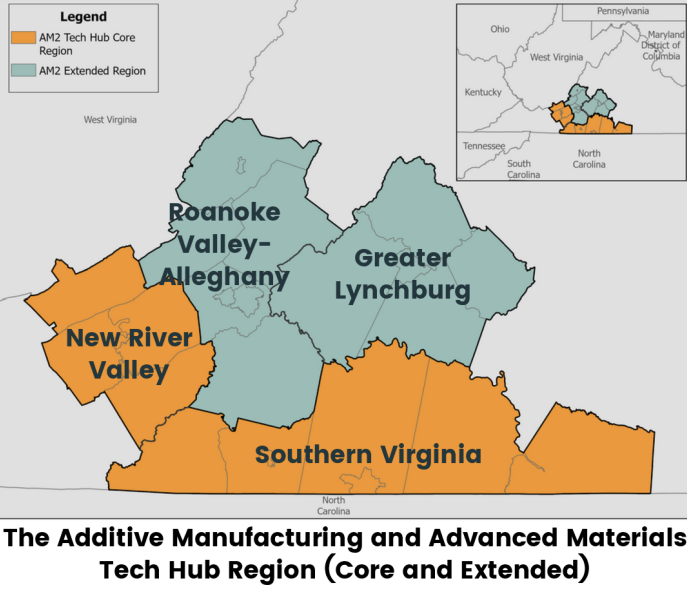
Photo from AM2 10 year roadmap prepared by VT CECE.
Chip Bobbert, director of innovation at the Roanoke Blacksburg Innovation Alliance, said the region has a history in manufacturing and transportation. “You don’t have to go very far, especially on the Roanoke side to see it. We drive over a lot of railroad tracks just getting back and forth between here and Blacksburg…that’s in our DNA.” He pointed to Virginia Tech’s engineering program as another built-in advantage the region can lean on.
Manufacturing already supports 65,000 jobs at 1,330 firms across AM2’s full service area, according to the roadmap produced by Virginia Tech’s Center for Economic and Community Engagement. In the core region, manufacturing employment has grown 12% since 2020, nearly double the national growth rate, and the sector accounts for 14% of all core-region jobs, trailing only government as an employer.
“We want people to see this region as the place to start, build and grow an advanced manufacturing business,” said Leo Priddy, economic development planning specialist at the New River Valley Regional Commission.

Photo courtesy Leo Priddy.
Part of what makes the initiative credible, Priddy said, is what the New River Valley and Danville, the Southern Virginia hub of the core region, each bring to the table. The New River Valley offers the engineering and research capacity of Virginia Tech, he said, while Danville has the Institute for Advanced Learning and Research, or IALR. These strengths, he said, made the two areas a natural fit when they were paired together for AM2’s original planning grant.
To carry out AM2’s goals, the initiative’s support breaks down into four main pieces: the consortium, which helps coordinate services and projects; studios, which provide technical assistance to help manufacturers adopt new technology; fellows, which pair subject-matter experts with companies; and the career network, which builds the workforce pipeline through education, internships and apprenticeships.
“The fellows side of this is trying to get people that are already working in this space, that have subject matter expertise in this to share that with folks that are starting to engage with these industries,” said Bobbert.
Of the $4.2 million award, $1.25 million is set aside as what Priddy called an “innovation fund” that will provide project-specific support for companies, such as hiring interns.
Keeping talent in the region is as much the point as bringing in new talent. “We have a talented group of young engineers that come out of Virginia Tech every year,” Bobbert said. “The opportunities to keep them in the region and designing and working here in the region is part of this too.”
That talent, Bobbert added, could be put toward work that extends well past the factory floor. “Not only can we manufacture advanced things, we can build things custom-sized for your body,” he said. “So why should the same pin that was designed for me be given to you, when a biomedical engineer could take the CT scans from our bodies and be able to produce the perfect-sized object for our individual repair.”
The initiative also reaches into middle and high schools. GO TEC, an existing middle school program Priddy pointed to, has helped establish hands-on labs and curriculum. AM2 is aimed at closing what Priddy called a “gap in ninth and 10th grade,” building coursework that bridges GO TEC to career and technical education classes in 11th and 12th grade.
Priddy said AM2 is also chasing harder-to-measure wins: manufacturers adopting new technology, improving productivity and strengthening regional supply chains. The initiative isn’t meant to replace groups like Onward NRV or the Roanoke Regional Partnership that handle business recruitment directly, he said, but to give them research, workforce and commercialization resources to bring into those conversations.
The consortium has also applied for an additional $40 million in federal EDA funding to scale up the broader roadmap, though that application hasn’t been decided. In the meantime, the region’s Emerging Tech Conference will include a dedicated AM2 track this fall, giving companies and researchers an early chance to connect.
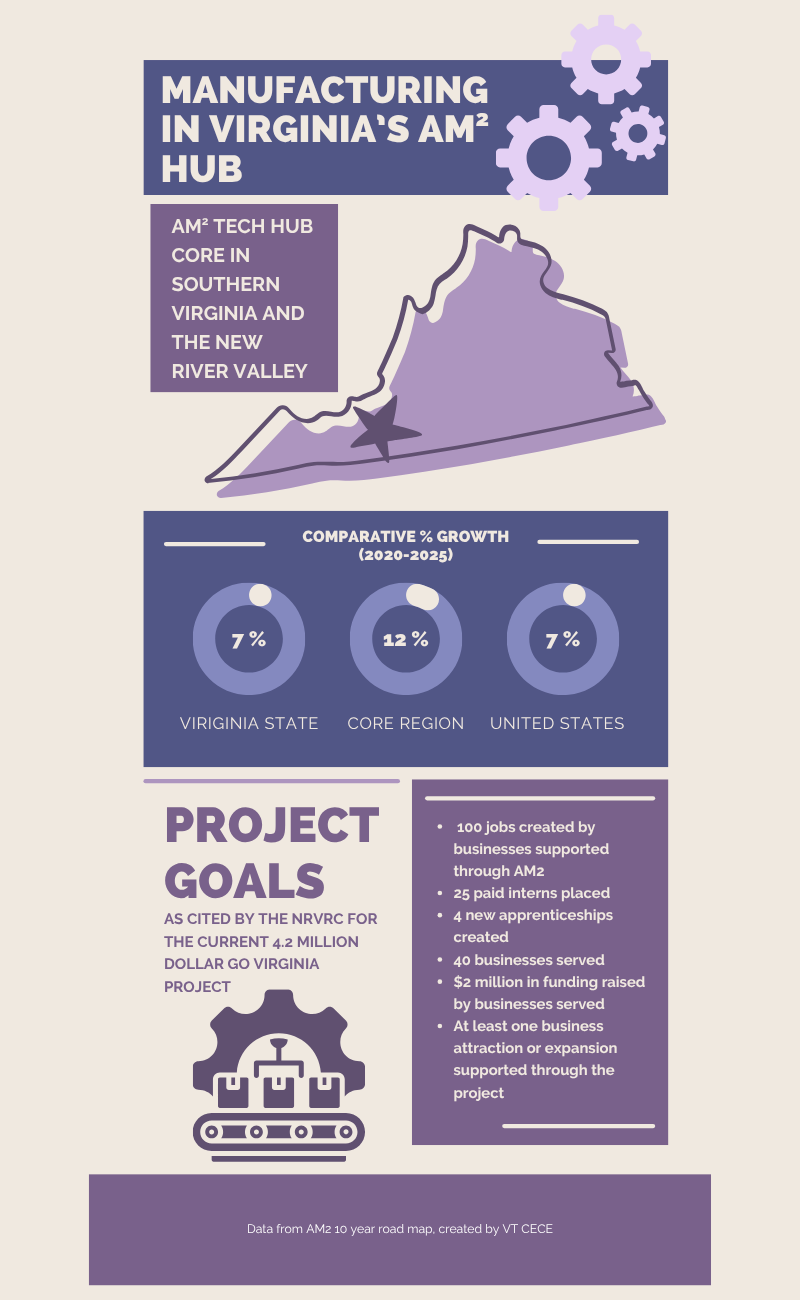
Infographic created by Nick Carlson.

