
By Anastasia Simonenko, arts, culture and sports reporter
A women’s resource center is opening up conversation on topics women have been told to avoid. They bring the community together through outreach and education.
By Anastasia Simonenko, arts, culture and sports reporter
A women’s resource center is opening up conversation on topics women have been told to avoid. They bring the community together through outreach and education.
By Anastasia Simonenko, arts, culture and sports reporter
A place for more than just a daily workout — a studio with opportunities beyond the classroom. See how students at Virginia Tech are turning a job into something more.
By Anastasia Simonenko, arts, culture and sports reporter
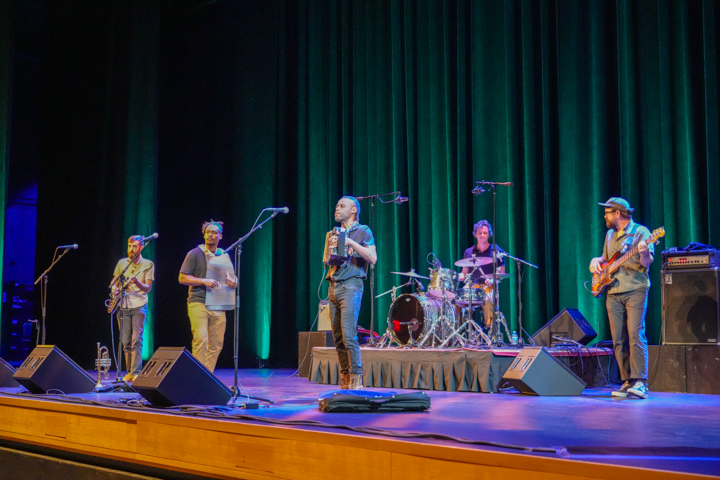
Cedric Watson and Bijou Creole perform native Creole music for the community at the Center for the Arts in Blacksburg, Va. on Sept. 11, 2026. (Anastasia Simonenko, The News Feed NRV)
The Center for the Arts in Blacksburg, Va., hosted its annual free-to-the-public event featuring South Louisiana music by four-time Grammy nominee Cedric Watson and Bijou Creole.
The Center for the Arts is a leading hub for all artistic performances in Blacksburg. It hosts a variety of events from art galleries, professional presentations and touring musical performances.
According to their mission statement, the center seeks to “transform lives through exploration and engagement with the arts and creative process.”
While art galleries are always free, most of the center’s events require a paid ticket, varying in price depending on the event.
Once a year, the center hosts one outdoor event that is free to the public to encourage community bonding.
This year, it was a musical performance by Cedric Watson and Bijou Creole for a night of music on Sept. 11.
Cedric Watson is a four-time Grammy nominee and one of the most prominent musicians in Cajun, Creole and zydeco (a traditional Louisiana Creole music genre) music today. His musical talent is seen in a variety of forms — he is known as a fiddler, singer, accordionist and songwriter.
This distinctive style of music traveled from South Louisiana to Blacksburg to give the town a performance it had never seen before.
The performance was a high-energy dance style with a unique touch of accordion to the traditional band.
Katie Gehrt, director of Marketing and Communications for the center, works to reach community members and leads engagement.
Preparing for large events at the center is a process involving a team of directors, with bookings of musical acts starting months in advance.
Once a performance is booked, Gehrt takes over by getting the word out to the community.
“We’re in a unique position to be able to bring the campus and community together, and this event is the perfect kind of place to do that,” Gehrt said.
The performance center has hosted anyone from the Royal Philharmonic Orchestra to notable touring Broadway shows such as “Chicago” and “TINA – The Tina Turner Musical.”
According to Gehrt, close to 48,000 people attended some type of activity presented by the center.
“We want to bring in artists that show people things they may not have been able to experience to allow them to see things in new ways,” Gehrt said.
Originally the event was planned to be held outside, but with rain in the forecast, the center made an executive decision to move it inside the Anne and Ellen Fife Theater.
Concertgoers of all ages from the Blacksburg community gathered to enjoy a night of music and dance.
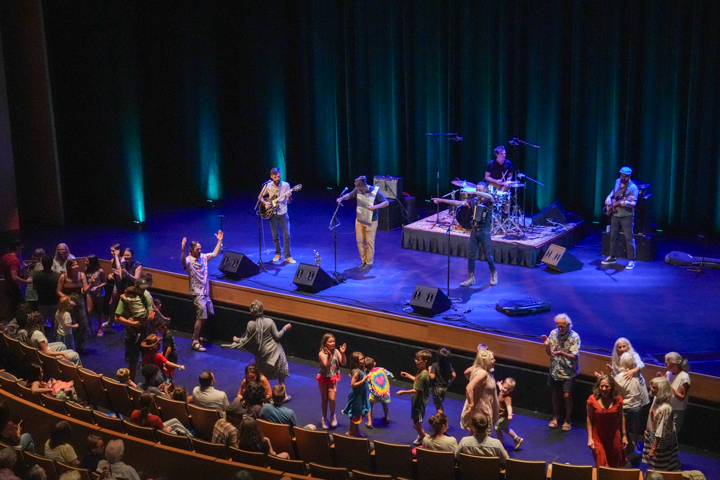
Families gather to dance to southern Louisiana music by Cedric Watson and Bijou Creole at the Center for the Arts in Blacksburg, Va. on Sept. 11, 2026. (Anastasia Simonenko, NewsfeedNRV)
Kacy McAllister, professor of communication at Virginia Tech and a Blacksburg mom, brought her four-year-old son to the performance. She mentioned that seeing new instruments like the accordion was a first for him.
“I’m thrilled that he has an experience to be exposed to things that might otherwise only be available in a more urban setting, it enriches our culture and our exposure to music,” McAllister said.
McAllister formerly worked for the center and mentioned that it continues to make an impact in her life as she now gets to bring her students to exhibitions for class.
The center offered an opportunity for the audience to feel the music by leaving the front of the theater as a dance floor. Children held hands with their grandparents to dance right in front of the band.
“I’m pleased to see people across all different generations be able to get up and dance to the music, it’s heartwarming,” McAllister said.
Dozens of students also attended the performance on their Friday night, dancing their way into the theater once the music was heard from the open doors.
Virginia Tech graduate student Lainey Bradley attended the concert with her roommates.
“Getting to hear a new, different type of music and take the time to learn a little bit more about the history afterwards was so exciting,” Bradley said. “I think the event was a total success.”
Bradley makes a point to attend events when she is available, and she wishes students knew about the events happening on campus more often.
“I think students don’t take advantage of the Center for the Arts enough, it is here to give us the opportunity to see something new, something different,” Bradley said.
This year, the center is hoping to pique more student interest in attending events through advertising and better communication to student organizations.
They have been testing new marketing strategies and reorganizing their website to make information more accessible, Gehrt said.
“I want students on this campus to be aware of the one time in life that you are going to have access to these kinds of experiences,” Gehrt said. “You have an opportunity to see performances that you may not be familiar with, and that’s what college is all about.”
By Anastasia Simonenko, arts, culture and sports reporter
The expansion of the “She Leads Tomorrow” volunteer program is making an impact for Afghan women seeking education.
Every year, Virginia Tech’s Center for Refugee and Migrant Displacement Studies offers a variety of volunteer programs that connect students with refugees across the globe, from Kenya to the Middle East to Southwest Virginia.
One of these programs focuses on providing equal educational opportunities to women from Afghanistan, a country where girls are banned from attending secondary school.
Tech students develop direct relationships with mentees by helping them apply to college, prepare for interviews and put together resumes.
Virginia Tech junior Abigail Lee has helped pilot the program since it first came to campus last year. This year, alongside her fellow student leaders, Lee has worked to expand the program by recruiting more volunteers and giving more women a chance to receive support.
In an interview about her experience leading the program, Lee shared how she got involved, the impact she has seen from the work and how growing the program will open more doors.
Her comments were slightly edited for length and clarity.
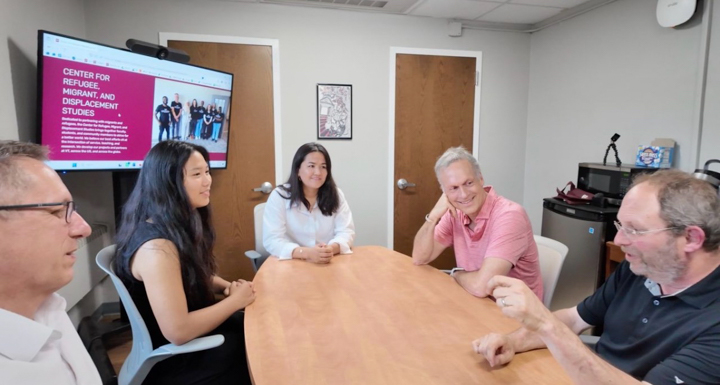
Abigail Lee, student leader with “She Leads Tomorrow,” meeting with representatives of the Center for Refugee, Migrant, and Displacement Studies at Virginia Tech.
How did you first get involved with the program?
At the beginning of last school year, I got an email from the Center for Refugee and Migrant Displacement Studies (CRMDS). They had a few volunteer opportunities to help the local refugee population.
One of them stood out to me, which was “She Leads Tomorrow,” which was aimed at helping Afghan women pursue education. I had known that there’s a lot of oppression in Afghanistan and barriers to women pursuing their education.
I think it’s just always been a topic that I was passionate about. I care a lot about access to education because my mom is a teacher and my brother was a teacher. Access to education equally across the world is very important to me, as is equality across genders.
I didn’t really know much about what it was going to be about or what my role was going to be before I started.
Since it was the first year of the organization, I really played a larger role than I expected. I had to help get other volunteers or help make the curriculum, and I ended up having about 20 mentees.
What is different about this year’s program structure?
Last year, we had three mentors with about 20 mentees each, and we just thought that was pretty overwhelming for all of us. I think meeting with 20 students one-on-one is a lot.
This year, we were able to recruit a lot of new volunteers from GobblerFest, and we have about a dozen volunteers joining us, which will be great. So how we’re going to restructure it is two other program leaders and I are going to lead a large class session every week.
So all the mentees are going to get a class session each week, and then each mentor will have about three to five mentees instead of 20, and they’ll be able to meet with them one-on-one, so it’ll be much easier.
What has the experience been like?
It’s just been great. Getting to learn more about each of these women, their stories, how they got to where they are, I think it’s really inspirational.
Taking into account all the barriers that they face every day and how steadfast and determined they still are in pursuing their education, honestly, it inspires me because how am I going to skip class when there are people on the other side of the world whose literal dream is to be able to go to college?
It’s been inspirational for me, and it’s been great seeing the impact that I’ve been able to have.
I think sometimes when you’re in the nitty-gritty of daily work, and you’re like, “Oh, I have to meet with 20 mentees this week,” it can be overwhelming.
But at the end, having various messages from my mentees thanking me for my help or telling me they got into college and received scholarships has been really rewarding, to just be able to be part of their journey as well.
A lot of these women don’t have access to laptops or very reliable Wi-Fi, so they’re typing out these essays on their phones in the middle of the night, and they’re taking online classes when they can.
A lot of these women were able to go to school until about middle school. They go to high school either online or in very limited circumstances.
I think a commonality between their stories is just how resilient they are and how many hoops they’re willing to jump through to keep learning and keep pushing toward their goals.
Where do you see this program in a couple years? What do you hope to gain out of it?
I think even between last year and this year, it’s been able to expand a lot already. Last year, there was way more demand. There were hundreds and hundreds of students who wanted to be matched up, and unfortunately, there just weren’t enough student volunteers to be able to meet that load.
My hope for the future is that every student who wants a mentor can get one and that the mentors are really able to help them along their journey and be able to be a very helpful resource. I hope that it continues to grow into something that is impactful, not just for a couple of students here and there, but on a more structural level.
I mainly just hope to leave a structural impact. When I graduate, I hope that this program will continue to be in place in future years because it’s very beneficial to both the mentors and the mentees to have this system in place.
I hope that it continues beyond my graduation.
I hope to keep in touch with the women that I’ve mentored and hopefully see them go to their dream colleges, get scholarships or pursue their careers.

