A look ahead at the 164th Virginia General Assembly

by Jonathan Mususa, politics and government reporter

In the November 2025 elections, Democrats won all three statewide races – Abigail Spanberger for governor, Ghazala Hashmi for lieutenant-governor, and Jay Jones for attorney general. In the race for control of the House of Delegates, Democrats extended their majority from 51 to 64, coming three seats short of a supermajority.

More than a month later, Democrats are preparing to assume undivided control of state government for the first time since 2020, before Spanberger gets sworn in on January 17th and the sitting of the 164th General Assembly begins.

With Democrats now having the ability to enact legislative priorities without fear of a veto from outgoing Republican governor Glenn Youngkin, what can Virginians expect from Richmond in 2026?

Constitutional amendments

On November 17, Virginia House Democratic leadership announced that they had pre-filed a series of bills to be debated once the session starts. The first three bills on the Democratic agenda are constitutional amendments. Approved by the General Assembly during the last session, Democrats will have to approve them again this session in order to put these proposals before voters in a statewide referendum. 

This upcoming session, Democrats will attempt to pass proposals to enshrine access to abortion, automatic restoration of voting rights for ex-felons, and the right to same-sex marriage in the Virginia Constitution which would then be subject to referendums on or before November 3, 2026.

“To me, it seems as though we are clearly stating we are with where the American people are,” Sam Rasoul, the Democratic Delegate for the 38th district, said.

Rasoul’s district contains most of Roanoke, save for the southwest corner of the city located in the 40th district. First elected in 2014, his strongly Democratic district re-elected him for a sixth term. Of the proposed amendments, he is especially excited about the restoration of voting rights for ex-felons.

“This amendment, to me, actually only goes halfway,” Rasoul said. “It says, once you’ve served your time, your ability is automatically restored. I think we should even go further, but that is for another time. I am excited to, at least, take this significant step.”

Wren Williams, the Republican Delegate for the 47th district, who is especially opposed to the abortion rights initiative, hopes that “the people in Virginia will stand up and realize that, ‘no, this isn’t what we do here’ and step up and be strong and say, ‘we the people, we give the guidance to our representatives and this is beyond what we said we wanted in November.’”

Williams’ strongly Republican district contains Carroll, Floyd, and Patrick counties, as well as the city of Galax and parts of Henry County, and re-elected him to serve his third term in office.

The redistricting question

Democrats are also proposing another constitutional amendment: changing the redistricting process in Virginia so that the General Assembly can redraw congressional district lines between decennial censuses if other states do the same. This comes as states across the country are redrawing their congressional maps ahead of the 2026 midterms, in response to President Donald Trump calling for legislatures in Republican-controlled states to redraw districts to help Republicans hold onto control of the U.S. House of Representatives.

Currently, Virginia has a bipartisan redistricting commission composed of legislators and citizens from both parties. In the last redistricting cycle in 2020, however, gridlock on the commission caused the state Supreme Court to appoint two special masters from both parties to draw the current maps for the U.S. House and the General Assembly.

Del. Rasoul describes himself as “very passionate about redistricting reform” and supported the bipartisan commission. However, amid the nationwide pattern of partisan redistricting, he feels that Virginia Democrats are merely doing what they have to do.

“I think it would behoove us to do something to be able to say, ‘We know this is a sad moment, but what can we be doing to protect the fabric of the republic?’” Rasoul said.

Nicholas Goedert, a professor of political science at Virginia Tech with a research interest in the redistricting process, sees few short-term drawbacks to pursuing this strategy for Democrats in 2026, but believes that there would be potential adverse effects further into the future. 

“It does have more medium term potential drawbacks for Democrats in that, if they try to win as many seats as possible, they probably have to draw some of these seats to be only slightly Democratic,” Goedert said. “If we were to see a Republican wave election, perhaps, in 2030, which would be the last year that such a map would be in effect, you could see a lot of those seats won by Republicans because they will be only marginally Democratic and they could swing back to the Republicans’ direction.”

“To me, it seems as though we are clearly stating we are with where the American people are.”

– Del. Sam Rasoul (D–Roanoke)

(Saturday, December 13, 2025) An Appalachian Power utility pole near the Shawnee Swim Club in Blacksburg, Va., at the corner of University City Blvd. and Toms Creek Rd. – Jonathan Mususa, for The News Feed NRV.

Affordability, energy policy, and Virginia’s economy

Affordability has been an important plank in the Democrats’ platform, with pre-filed bills aimed at raising the minimum wage to $15 by 2028, mandating an hour of paid sick leave for every 30 hours worked in 2027, and authorizing localities to exercise a right of first refusal on property sales to the end of creating affordable housing.

Also on Democrats’ mind is energy policy, with legislation promising energy cost reductions for low-income families, efficiency mandates for Dominion Energy and Appalachian Power, and weatherization and retrofitting for low-income families’ homes by 2031. Del. Rasoul hopes that measures like these will help lower energy costs for Virginia families.

“I would venture to say that the largest tax increase in Virginia history has been the increase in our utility costs over the past decade, and people are getting hit from so many different angles, and, in this past year, we had, in AEP territory, not just people talking about $1,000 electric bills but even some cases of $2,000 electric bills for an average-sized home,” Rasoul said. “It’s really gotten out of control and it’s just for the wealth of a few.”

Del. Williams, on the other hand, finds Democratic proposals unfeasible and could lead to energy bills becoming more expensive and life in the Commonwealth becoming more unaffordable.

“The idea that the Democrats can legislate their way into a better economy is absolutely insane,” he said. “They need to back off. We need to cut regulations. We need to let the free enterprise market control, and we need to see small businesses thrive so that we can continue to be an economic and business leader in the nation.”

Governor–General Assembly relations

Some of the pre-filed bills had already passed the Democrat-controlled General Assembly, but were vetoed by Republican Governor Youngkin. Now, with a governor from the same party, Democrats in the General Assembly have a smoother path to delivering on campaign promises, with Virginia Tech political science professor Karen Hult calling it “somewhat less of a fraught-with-conflict situation than we’ve seen in the past.”

However, Spanberger’s background as a moderate Democratic Congresswoman could possibly lead to friction between the Governor’s Mansion and the General Assembly when it comes to the details of exactly how to implement their shared priorities.

“There may be some differences in priority and detail on a whole range of issues that Governor-elect Spanberger is going to be trying to push in the General Assembly, but many of those match the same kinds of matters and issues that members of the House of Delegates ran on as well,” Hult said.

To Del. Williams, Governor Spanberger might find herself out of step with her fellow Democrats in the General Assembly.

“Abigail Spanberger is going to want to paint herself as a moderate and she does not have a moderate backing when it comes to the General Assembly and their majority – their expanded majority,” Williams said. “She is really going to have a hard time keeping any kind of control or say over those legislative bodies because they’re going to do whatever they want and then they’re going to hand it to her and say, ‘your move.’”

“I hope … that the people in Virginia will stand up and realize that, ‘no, this isn’t what we do here’ and step up and be strong and say, ‘we the people, we give the guidance to our representatives and this is beyond what we said we wanted in November.’” 

– Del. Wren Williams (R–Patrick County)

The Republican minority

The road to the Democrats’ expanded majority in the House of Delegates ran through 13 Republican-held districts. For Williams, these losses were indicative of a failure on the part of Republicans to put forward an appealing message to voters in the face of a wave of anti-Trump sentiment.

“I don’t think that we brought a real cohesive message of how we were going to make life better for the constituents of the Commonwealth,” Williams said. “We just had an absolute failure to attract those independents, to give them the motivation to turn out, because I’m not sure that they could articulate what we were going to bring to the table if we had been handed those reins.”

Williams will be part of a 36-member Republican House caucus. Republicans will find themselves in the minority in the State Senate as well, with Democrats controlling the upper chamber 21–19 since 2024. Despite being in the minority, he said that he is looking forward to working with his House colleagues of both parties.

“We have to make sure that we are doing our duty by looking after the constituents that sent us to Richmond, which means advocating for smart policies that best benefit our communities,” he said, adding that he hoped that “the Democrats, rather than steal our legislation and slap their name on top of it, will join us in those bipartisan efforts to pass good-sense legislation and policy.”

(Monday, December 8, 2025) A faded poster promoting a get-out-the-vote rally featuring now-Delegate-elect Lily Franklin, by the Newman Library at Virginia Tech. – Jonathan Mususa, for The News Feed NRV.

Virginia Tech growth and and town housing development converge in Blacksburg, Va

The Town of Blacksburg considers the increasing enrollment at Virginia Tech with recent ordinance decisions regarding off-campus housing. (Photo by Emily Dorsey, TheNewsFeedNRV.com)

By Emily Dorsey, politics and government reporter

_______________________________________________
“It’s really the destruction of the place … [Blacksburg is] unrecognizable anymore,” said Kimberley Homer in an interview regarding recent housing developments, sustainable living and quality of life in Blacksburg, Virginia. Homer has lived in Blacksburg since 1980, first as a student and later as a Virginia Tech  employee, working with Technology-Enhanced Learning and Online Strategies (TLOS). Throughout her years as a Blacksburg resident she has seen more large-scale student housing developments, increasing student presence in residential neighborhoods and growing town-gown tension. 

“Town-gown” refers to the relationship or tension between a university and local residents which is a popular concept talked about in Blacksburg, Virginia. Town-gown housing issues can be dated back to 1996 when Virginia Tech’s off-campus housing was in a shortage. The university has seen a 7.3 percent increase in first-year enrollment from 2020 to 2025, now enrolling over 7,000 freshmen undergraduate students. This leaves roughly 2,000 beds for upperclassmen, transfer or graduate students if they choose to live on campus.

In Fall of 2022, Virginia Tech’s Student Life Village was proposed by Virginia Tech Board of Visitors (BOV). The board comprises a range of representatives and experts appointed by the Governor of Virginia including the President of CMG Leasing, CEO of Clark Construction, Virginia’s executive vice president of Dominion Energy and more. The Student Life Village presented a new residential district that involved dining, recreation, housing and enrichment opportunities for up to 5,000 students. In March of 2025, the BOV rescinded the proposal and stopped all action in reference to the project. The BOV affects campus housing by deciding master plans, funding renovations and determining strategies. In tandem, limited on-campus housing options impacts the off-campus housing market

The proposed Student Life Village. Photo courtesy of Virginia Tech News/Sasaki

Mayor Leslie Hager-Smith commented on Virginia Tech’s part in Blacksburg’s housing crisis at the Town Council meeting on Dec 9. 

“The university will always have the upperhand. Virginia Tech can purchase any property it wishes,” said Hager-Smith. “The situation is confounded by the compounding conflict of interest that certain members of the politically appointed board of visitors have. They are crafting university policy on housing and enrollment while also profiting on the private side – building student housing.”

The off-campus student housing complexes vary based on price, availability and accessibility to campus. The Edge, Union and Hub are closer to campus with good walkability but nears $1,000/month for rent. Complexes like Foxridge and The Mill are slightly more affordable but are on the outskirts of town. The median price for off-campus student housing options fall between $700-$1,000 a month depending on how many bedrooms and bathrooms. If a student worked 20 hours a week at the median wage, they would earn around $1,000/month. With this take home pay, about half of the off-campus housing options are not affordable. This is one factor contributing to Blacksburg’s housing crisis. 

Blacksburg is unique to other Virginian universities and surrounding towns based on student population ratio. Compared to University of Virginia, James Madison University and Virginia Commonwealth University, Virginia Tech has the smallest city population to student population ratio. For every 100 permanent residents in Blacksburg, there are about 86 students at Virginia Tech. With roughly 9,000 campus beds and nearly 39,000 students, this creates a very high housing demand and affordability issues for both students and locals. 

“I’ve seen the amount of housing available continue to decline. We have more people who want to live in Blacksburg or move to the area who simply cannot find a house or afford the few houses that are available,” said Blacksburg town council member, Susan Anderson, in an interview regarding housing development growth she’s seen over the years.  

With apartment and townhome rent in Blacksburg being out of range for students’ budgets, many turn to residential neighborhoods in town or in Christiansburg which range from $400-$700/month per person. With more undergraduates filling up existing residential neighborhoods, this pushes out families, couples and graduate students looking for long-term housing options. 

If Virginia Tech continues to increase enrollment without developing more on-campus housing and if the Town of Blacksburg continually supports projects that are not realistically affordable, students and Blacksburg residents will be met with increasing rent, neighborhood displacement and tension between the town and university.

“It’s really the destruction of the place … [Blacksburg is] unrecognizable anymore.”

In the last decade, Blacksburg’s Town Council has added 5,400 beds in off-campus student housing. The Edge and Brexx at Blacksburg, formerly known as The Retreat, were built in this time frame alongside other complexes’ renovations. In 2016, a Collegiate Times article questioned if Blacksburg has too many off-campus options which now is contradicted by a handful of current developments occurring throughout town. 

Two developments close to South Main Street, Midtown and Legacy on Main, have been under construction for a couple years. Midtown will “offer civic, commercial and residential mixed-use public space for all to enjoy” according to their Facebook profile.. In essence, it is a multi-purpose buildout which offers four-story townhomes, two-level condos and other recreation and dining experiences near Downtown Blacksburg. These townhomes and condos are listed from 600,000 to over one million dollars on Eagle Construction of Virginia website and are geared towards teachers, police officers and other full-time workers in Blacksburg.

Dec. 13, 2025, Blacksburg, Va – Construction for Midtown happening along Church St and Midtown Way. (Photo by Emily Dorsey, TheNewsFeedNRV.com)

Legacy on Main is a three-story apartment complex with 56 units which prioritize Blacksburg residents, not undergraduates, who need affordable living options. The future residents will have to qualify and earn up to 80 percent of Blacksburg’s Area Median Income (AMI) which was $63,000 in 2021.

Ordinances 2090 and 2094 were voted down on Tuesday, Dec 9 by the Town Council. They proposed housing developments on Webb Street and University City Boulevard respectively. Both ordinances proffered multi-story, luxury apartment complexes with limited parking and high increase in pedestrian, biker and vehicle safety concerns. While these ordinances were cut, various opportunities for developers remain. Ordinance 2095, was recently approved which will add a handful of townhomes next to an existing apartment complex on Whipple Drive.

Dec. 13, 2025, Blacksburg, Va – Whipple Drive Townhomes will back up to existing student housing, Uptown Village. (Photo by Emily Dorsey, TheNewsFeedNRV.com)

The proposed Whipple Drive Townhomes plan. Image courtesy from the Town of Blacksburg website. 

Lastly, a close 4-3 Town Council vote approved a controversial development on North Main Street in March 2025. This development includes an eight-story, 700+ bedroom apartment complex being constructed near the well-known Downtown round-a-bout. Many citizens raised concerns at the public hearing regarding population density, traffic, pedestrian concerns, parking availability and the effect it will have on Blacksburg’s overall character. 

The proposed 801 North Main Street development. Image courtesy from the Town of Blacksburg website.

“We can’t say no more student housing, no more other people housing,” said Anderson. “That’s just ridiculous. We have to try to balance everybody’s housing needs. That’s a really hard struggle.”

Anderson shared that the Town and Council are working in various committees to mediate these issues. First, the Blacksburg-Virginia Tech Liaison Committee which includes the Mayor, Vice-Mayor, Town Manager and the two Deputy Town Managers who meet with six vice presidents from Virginia Tech monthly to discuss needs and topics that affect both the town and university. Second, is the Montgomery County Liaison Committee. The members include Blacksburg’s Mayor and Vice-Mayor who meet with others from Christiansburg and Radford to discuss and collaborate their shared issues and concerns.

“The university will always have the upperhand. Virginia Tech can purchase any property it wishes.”

The housing crisis Blacksburg is facing affects both students and long-term residents, deciding who can afford to live in town and the change in character. As off-campus developments increase rental prices, students turn to other options like residential neighborhoods or find housing in Christiansburg which intensifies competition for limited space. As a result, families, couples and full-time workers are consistently priced out, unable to find housing that fits their needs and budgets. Virginia Tech and the Town of Blacksburg are urged by its citizens to take a more collaborative approach that prioritizes affordability, sustainable growth and values community concerns. Without more change, the divide between students and residents will deepen, further straining the town-gown relationship that defines life in Blacksburg, Virginia. 

On The Chopping Block: Where DEI Stands During Black History Month 

By Janae Neely, Education reporter 

Universities and higher education are left with uncertainty after President Trump’s executive order, calling for the elimination of diversity, equity, and inclusion in all spaces of the federal government. The executive order conveniently dropped less than two weeks before Black History Month. 

Virginia Tech’s Black History Month post Photo Credits: Virginia Tech Instagram

Why it matters: President Trump has yet to clearly define what is viewed as DEI programs which leaves heritage months like Black History Month hanging in question of whether that violates the executive order. 

  • Virginia Tech has several organizations dedicated to diversity and inclusion. One is the Student Opportunity & Achievement Resources Program, more commonly known as SOAR. This support program is “dedicated to welcoming and retaining underrepresented minority students at Virginia Tech and promoting their success through campus collaborations.” 

The big picture: The Virginia Tech campus has been left in a state of confusion as the state of its DEI programs has been threatened. Zora Dancy a student intern with SOAR noted that diversity, equity, and inclusion span much broader than people realize. 

  • “A lot of people are realizing that DEI isn’t just about race. It’s about people with disabilities, it’s about veterans, and a lot of aspects of this presidency that we’ve seen in the last few weeks, you’ve seen a lot of people say “Oh well I didn’t know’ yeah because you didn’t do your research, you’re just going based off of what you think and what you hear.” Dancy said. 
  • When speaking about the misconceptions regarding DEI, Dancy noted, “…DEI is more than just a ‘Black vs. White’ issue. There’s so many layers to the people who are affected by DEI.” 
  • “This idea that DEI is somehow saying that it’s not allowed or open to white people is really interesting to me because a lot of these spaces did have to start and be developed because Black people and other people of color were not welcomed into white spaces,” Dancy concluded. 

The push for answers: Virginia Tech President Tim Sands, officially addressed Trump’s executive orders at his State of the University Address this past week. 

  • “I would like to acknowledge the challenges that many of you are facing as we interpret and respond to a flurry of executive orders that impact higher education.” Sands continued, “We will follow the law, but we’ll do so once we fully understand the directives and the applications to Virginia Tech. 
  • Sands concluded his statement, “We do not yet have many of those answers, but we are collecting information and providing guidance where we can.
President Tim Sands at the 2025 State of the University Address

Zoom in: Mark Owczarski, Interim Vice President of Communications and Marketing provided insight on the future of inclusion at Virginia Tech and the institution’s stance. 

  • “We believe that in order to do our very best teaching, research, and engagement which is our three missions, it’s why we exist, we need to be able to attract the very best talent. Everybody and anybody who wishes to engage, regardless of who or what they are and what they believe in…” Owczarski stated when asked about the state of DEI at Virginia Tech. 
  • The university’s biggest challenge is that a clear definition of what is classified as DEI has yet to be stated by the Trump administration, “It’s interesting because, the fundamental response is ‘Okay, so we have these orders, what are we doing?’ and really at this point we’re at the stage, we’re trying to understand what they mean.”

What we’re watching for: The town of Blacksburg is going to hold upcoming meetings to further address the executive orders made by President Trump once more details are released. 

  • “I think when you start to take away Black people and people of color when you start to take them out of whatever space, they’re gonna realize how necessary they were in that space. Any person of color, especially Black people, have to work twice as hard, three times as hard to get to where you wanna go. So you put in all that work and make it to that position, you get your degree, and then they’re pulling you out of these spaces, obviously, it’s frustrating but just wait and see because they will quickly realize how much you are needed.” said Dancy.

Trump’s Tariffs: The Cost of America First on Your Grocery Bill

Blacksburg locals check out at Kroger. Photo by Julia Lagano.

By Julia Lagano, Politics reporter

February 1, President Trump announced a 25% tariff on imports from Canada and Mexico. He also stated a 10% tariff will be applied on imports from China. Although these haven’t come into effect yet, the impact on the American consumer has already begun.

Why it matters: The economy is always a main concern for voters when it comes to the Presidential election. How will this candidate improve the economy? Many Americans felt that now-President Trump was the best fit for the job. One of President Trump’s main talking points during his campaign was to lower grocery store prices. He promised to do this on his first day in office.

Flashback: In 1992, the U.S., Canada, and Mexico signed the North American Free Trade Agreement (NAFTA). The trade pact was inspired by the European Economic Community. It eliminated most tariffs and other trade barriers between the three countries. The act provided mixed results; Mexico increased its exports. However, there was little economic growth for the United States and Canada. In 2020, a new trade agreement was enacted, the United-States-Mexico-Canada-Agreement (USMCA).

Zoom in: The average price for a dozen eggs in 2019 was $1.55. In 2025, it has soared to $4.95, a 219% increase. With this spike in prices, consumers nationwide are waiting to see the impact. They want to know how this will affect their community, like the New River Valley. There is concern for lower-income families. Will Supplemental Nutrition Assistance Programs (SNAP) adjust the allotted balances in response to these increases?

  • “The estimated poverty rate in the NRV is about 19%, almost double the rate for Virginia as a whole.  Poor people spend about 33% of after-tax incomes on food (compared to about 14% for the median household), explains Jeffrey Alwang, Agricultural and Applied Economics Professor at Virginia Tech
  • “We do have a fairly good proportions of customers that come in with EBT,” Ella White, Assistant Store Manager at the local grocery store, Earth Fare, shares, “If they see a decrease in what their benefits are, then we will probably lose customers to stores that offer more economical choices.”
Eggs are one of the food products that have increased in price the most. Photo by Julia Lagano

Zoom out: The United States relies on both Mexico and Canada for popular food and beverage products. These include fresh fruits, vegetables, and beer.

  • “About 17% of food consumed in the U.S. is imported and Canada and Mexico are first and third in terms of value of exports to the U.S. (the E.U. is second),” says Alwang.

To be specific, fresh fruits are the biggest import from Mexico. Last year, that was about $9 billion worth. Avocados made up one-third of that total.

Yes, but: A tariff is a tax on imported goods. These taxes are paid by companies that import the goods in question. Advantages of tariffs are that they protect American industries, increasing federal revenue, and encourage domestic manufacturing. President Trump is using these tariffs to put “Americans’ safety and our national security first.” His approach of an isolationism is also a way to promote American companies.

  • “It’s a bleak period right now,” White states. “I am trying to have a positive outlook on the whole thing. I would like to see that [the tariffs] will drive up the country’s economy by encouraging consumers to buy from within the United States.”

What we’re watching for: This was originally supposed to go into effect on February 4. Trump postponed the starting date to March 4. These tariffs could lead to a trade war with Canada and Mexico. The two countries have begun to retaliate in response. If the tariffs are implemented, only time will tell those effects, positive or negative, on groceries and Americans.

The Impact of Hate Speech in Schools: What Montgomery County Public Schools Incoming Policy Could Mean for Students and Staff 

By: Nyles Stone, Politics Reporter

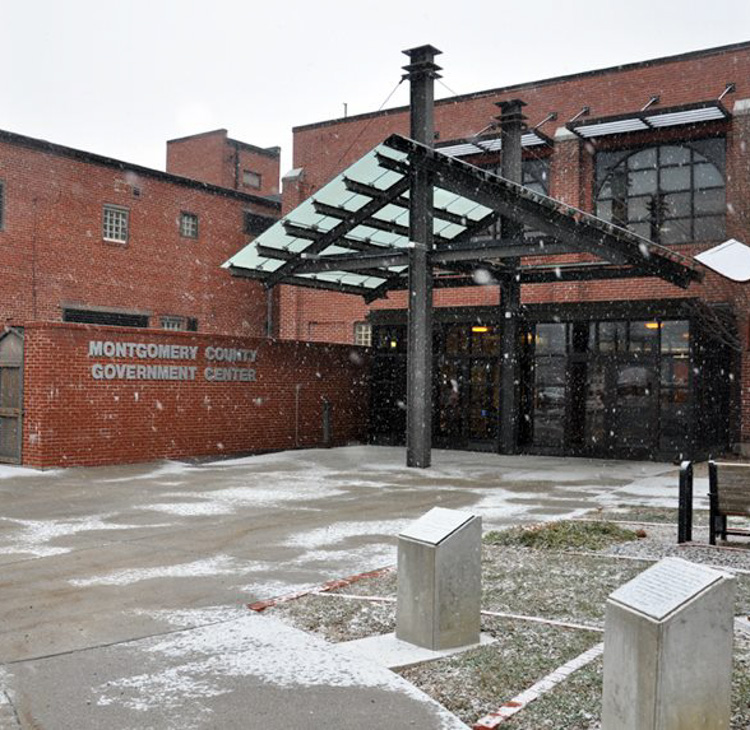
1/5/2025 – Montgomery County Government Center – Photo Credit, Montgomery County, VA Facebook Page

What will the new policy look like: While there is no current update on policies on the MCPS website, multiple sources including Cardinal News and News Messenger have been able to provide information regarding the new policy. 

  • The new policy will outline hate speech, structuring ways for reporting and investigating instances of hate speech;  
  • Elementary students could face up to three days of in-school suspension, while middle schoolers and high schoolers could face detention or in-school suspension on the first offense and 10-days of out-of-school suspension on the third offense. This could bring a longer punishment if student has persistent behavioral issues regarding the policy. 
  • The policy is said to not address staff related issues, having staff related issues investigated by human resources. 
Blacksburg High School Hallways, Photo Credit, Branch Builds

How does hate speech impact students and staff: James Hawdon, a sociology professor at Virginia Tech advises that exposure to hate speech can have serious psychological consequences. 

  • These include mood swings, fear, feelings of anger, and feelings of loneliness. Long term exposure can lead to lower levels of trust in individuals as well as social institutions. It can also lead to perpetuation of stereotypes and intergenerational transmission of prejudices.” said Professor Hawdon. 
  • Teachers and staff could not only be affected by being targeted by hate speech, but they can also witness and emotional strain, “if they see children they work with every day and who they have come to really care about use hate speech or be targeted by someone using hate speech, that is likely to be hard to watch.” 

But where does it start: For many students, hate speech is something that isn’t fully understood, being something that is repeated after hearing it from their parents, siblings, or peers. 

  • “Much of this is likely simply children parroting what they hear parents, other adults, or older siblings say. People often hate that which is different and unknown, but we have to learn that many characteristics that are often targeted for hate are “worthy” of being considered different and feared,” Hawdon explained. 
  • “So why hate some differences and not others?  We have to be told that this difference is somehow “so different” that it is deserving of being targeted for hate, and, more often than not, it is the people closest to us who tell us that.” 

Challenges: Hate speech falls into a gray area in U.S. law, with schools needing to find a balance enforcing students first amendment rights while also implementing a policy to stop hate speech in classrooms. 

  • “Speech, even that professing hate, is considered free speech that is protected by the First Amendment unless it meets very specific criteria about the imminent threat of violence,” Said by Hawdon. 
  • MCPS could follow a similar framework to that of other districts, an example of a policy that tackles harassment and discrimination while protecting first amendment rights is Richmond Public Schools’ Title IX procedures. 

Next Steps: As the district plans to move forward with the hate speech policy, we could possibly see staff training to ensure adequate enforcement of the policies. With multiple hate speech polices in place all around Virginia, MCPS possesses the resources to combat hate speech. 

Federal funding cuts may threaten the breadth of research conducted at Virginia Tech 

The Virginia Tech Corporate Research Center houses laboratories and workspaces for a diversity of research initiatives at Virginia Tech.  

by: Kyndall Hanson, education reporter 

On Feb. 7, the National Institute of Health (NIH) issued a policy outlining a standardized 15% cap on indirect costs incurred through research funded by grants, including maintenance, operational, and administrative expenses. While the NIH’s policy is questioned in federal courts, universities like Virginia Tech are left to weigh the potential impacts of reduced federal support on research initiatives. 

Why it matters: The NIH is one of the first governmental agencies to outline research funding restrictions following the Trump administration’s now-rescinded memo outlining a federal funding freeze. According to a statement by Virginia Tech President Timothy Sands, the NIH’s decision to cut the reimbursements of indirect costs could have a $13 million impact on the university’s annual research budget and over $55 million if the policy was extended across all federal agencies.  

  • “Lives will be lost,” said Sands, describing the potential “debilitating effects” of funding cuts on biomedical research at the university, among other impacts across research disciplines.   
  • “Research is an integral part of who we are and what we do,” said Mark Owczarski, interim vice president of communications and marketing at Virginia Tech. “It’s going to take us time to figure this stuff out.” 

The big picture: As an R1 university, Virginia Tech undergoes significant research activity. In 2024, Virginia Tech’s sponsored research expenditures were $453.4 million. According to Sands, over $308 million of these research expenditures were federally sponsored. As the university works to understand the mandates of federal agencies, the long-term impact on research is unclear, described Owczarski. 

  • According to Sands, of the over $308 million in federally sponsored research, $73 million was attributed to indirect cost reimbursements, or facilities and administrative research costs – with an additional $18 million in indirect expenses subsidized by alternative university funding sources.  
  • “It requires us to ask a lot of questions, do a lot of analysis, figure out what we are doing and [what] each of these executive orders really mean,” said Owczarski. “In the long term, there could be significant impacts, or there could be very little impacts – we don’t know.”  
A graphic by Virginia Tech displays the growing sponsored research expenditures at the university.  

Zoom in: The Virginia Tech Office of Research and Innovation has established a ‘Federal Agency Update’ webpage to notify the university community of updates surrounding university compliance with executive orders and additional impacted federal guidelines. 

  • According to Owczarski, as of early February, Virginia Tech’s research is continuing. 
  • “We’re asking researchers to continue the good work they do,” said Owczarski. “Engage in their research, keep applying for grants – just keep doing what you’re doing, and we’ll figure out how we’re going to support that long-term.”  
  • While university research is largely supported by federal grants, additional funding opportunities are available to support to learning experiences at Virginia Tech. According to Julia Ward, assistant director for professional development and experiential programs at Virginia Tech, programs like Campus internEXP are supported by state grants and not affected by federal funding regulations.  

What we’re watching: The long-term impacts of the NIH’s regulations on research and university funding are still in question as recent mandates are challenged in federal courts. The early days of the Trump administration have demonstrated a push for policy demonstrating government efficiency, meaning university funding may be a continued target for regulation.  

  • “It’s about how much research we can actually do,” described Owczarski discussing the potential loss in federal funding. “We’d have to make up the costs somehow, redirect things, but we don’t know what the outcome is going to be.”  

Virginia communities brace for change in light of Trump’s immigration orders 

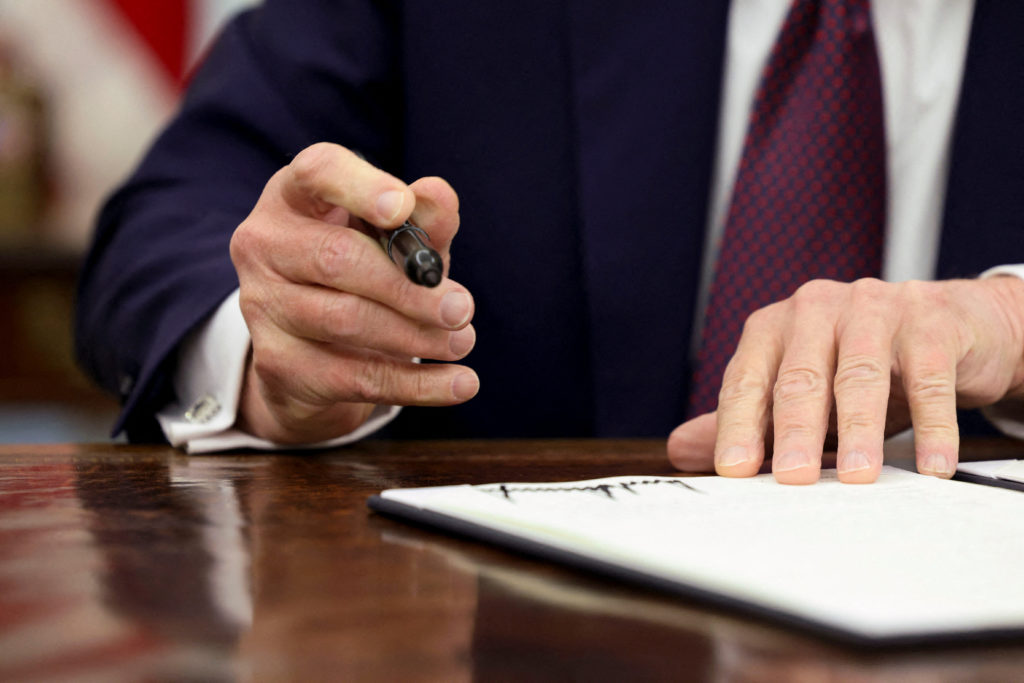
U.S. President Donald Trump signs an executive order in the Oval Office of the White House, in Washington, U.S., January 23, 2025. REUTERS/Kevin Lamarque

By Julia Lagano, Political reporter

Since his inauguration, President Trump has issued eight executive orders on immigration, sending waves of uncertainty through communities across the nation. In Virginia, where immigrants make up about 12.6% of the population and approximately 227,100 individuals are undocumented, the impact is expected to be significant. With Virginia’s proximity to Washington, D.C., many fear it is only a matter of time before federal enforcement actions begin. 

One policy at risk under these executive orders is Deferred Action for Childhood Arrivals (DACA), a program initiated by former President Obama in 2012 that provides temporary protection from deportation and work authorization to undocumented individuals who arrived in the U.S. as children. While it is not a direct path to citizenship, DACA has allowed thousands of recipients, “Dreamers,” to pursue higher education and secure employment. 

Cities all over the state have already begun to prepare. In the New River Valley, help can be found in Roanoke and Blacksburg. Virginia Tech organizations, like Latin Link, are coming together to support those who are at risk of being affected. Latin Link is one of the largest Latinx student organizations on campus that strives to be a tight-knit community and a safe space for minority students attending a predominantly white institution. The club promotes its members’ cultures and heritages on campus through educational, cultural, and social events. Jennifer Lopez-Perez, senior and president of Latin Link, emphasized the importance of advocacy at this moment, “There is a community here at Virginia Tech that will not stand down and that will continue to fight for their [immigrants’] rights. They [Immigrants] are here for a better future, and they are seen.”  

One way that the club takes a stand is by participating in Undoculliance, a week-long event hosted every year by the Latino Association of Student Organizations (LASO). With the goal to raise campus awareness about immigrant rights and the undocumented experience, the event shows support for DACA recipients and children of immigrants. “We have various guest speakers on a panel, hosted by a few organizations, that will talk about their experiences throughout college and within the workforce,” Lopez-Perez describes, “On social media, there are more organizations that will provide informational videos and provide resources for students both in and out of VT.” 

Outside of Virginia Tech, Commonwealth Catholic Charities (CCC) is making efforts to support immigrants all over Virginia. The CCC has been serving vulnerable populations in Virginia since 1923. They offer a range of services, including but not limited to housing assistance, refugee resettlement, legal support, language education, and permanent residence status. The order, Realigning the United States Refugee Admissions Program, put a freeze on refugee admissions by suspending applications, and ceasing federal funding to resettlement programs. Katie Dillion, Communications Manager for the CCC, explains the impact of this, “Without federal funding, we are struggling to provide these services to newcomers during their first 90 days, which is the most intense time of support.” The CCC’s immigration team is small to begin with, their Roanoke office only has one staff person, making the capacity to help low.  

For many in Virginia, the fear is not hypothetical —it’s personal. Lopez-Perez, like many others, has witnessed the hardships and sacrifices made by her parents to provide a promising future for their children. “As a daughter of immigrants, I have seen first-hand the battle that my parents have struggled through and continue to struggle through to be able to provide a better future for myself and my siblings. There are countless people that are just trying to live day by day to provide the same for themselves and their families,” she shared, “There are systems that are set in place that leave so many at a disadvantage and yet, they continue to fight and continue to work for that opportunity.” 

House bills take aim at University Protestors

By Wilbert Ramirez, Politics Reporter

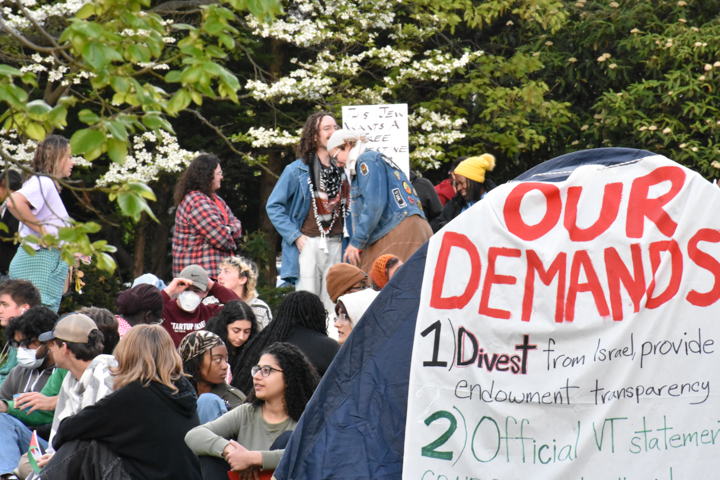
Student Protesters sit on the Graduate life center lawn at Virginia Tech, in Blacksburg, VA. Friday April 26, 2024 (Photo, Wilbert Ramirez)

Two House Bills introduced in the Virginia General assembly seek to stifle student protesters’ demands.

House Bill 2529 and H.B. 2207 have drawn the criticism of Students for Justice in Palestine at Virginia Tech. The Instagram page run by “sjpvtech,” called to action against the bills by posting a template to contact representatives in the Virginia General Assembly.

House bill 2529 introduced by Del. Micheal Jones (D) and Del. Dan Helmer (D), seeks to prohibit public institutions in the state of Virginia from divesting all funds from “any country or territory that is not the subject of an active sanctions program administered by the Office of Foreign Assets Control of the U.S. Department of the Treasury.”

“It would make it harder for Virginia tech to divest, but not impossible said Shahed Sanuri, a first-year graduate student at Virginia Tech and co-president for Students for Justice in Palestine. “So the movement is only stronger and only grows stronger and from the way we’ve seen people come together, to we combat these bills.”

H.B. 2529 would make it difficult for any student organization to have any significant policy change at all public institutions in Virginia. The bill appears to narrowly focus on the demands of many of the protestors across the Commonwealth that were arrested at public universities in 2024 around the state that included: the University of Virginia, Virginia Tech, Virginia Commonwealth University, and the University of Mary Washington.

The pro-Palestinian protestors at Virginia Tech were arrested the night of the April 28 in front of the Graduate Life Center Lawn at the public university. 82 individuals were arrested, and the University President Tim Sands released a statement on April 29, after the night of the arrests.

A student protester is arrested on the Graduate Life Center lawn at Virginia Tech, in Blacksburg VA. Sunday April 28, 2024 (Photo, Wilbert Ramirez)
Shahed Sanuri, Co-President of Students for Justice in Palestine at Virginia Tech, in Blacksburg, VA. Wednesday, Jan 29, 2025. (Photo Wilbert Ramirez)

House Bill 2207, which is a companion bill, introduced by Del. Terry Kilgore (R) and it is aimed at tackling terroristic threats on public institutions in the state of Virginia.

The companion bill to H.B. 2207, H.B. 1284 introduced by Sen. Bill Stanley was struck down on Jan. 27 by a Virginia Senate Education Subcommittee.

“It would put a lot of innocent international students as well as other people who are legally here, but not citizens at risk for simply participating in protests or even so much as like posting about their support for Palestine,” says Bella Gilbert, a sophomore majoring in Political Science Virginia Tech and outreach coordinator for SJP at Virginia Tech. “And even though one of the bills says, that deportation is conditional on pro-Hamas expression, we can safely assume that it will just be contingent on pro-Palestinian support.”

Critics from the Pro-Palestinian organization have expressed that these bills if they were to pass, they would make it more difficult for their organization to protest on public institutions.

“The bills basically ban protests from campuses and when we say, ‘liberation for Palestine is liberation for all’ this is what we mean. This is why we’re fighting for the liberation Palestine now and we’re fighting against these bills because these bills don’t just affect the Palestine movement that they affect any movement that’s to come. It just portrays a deep sense of U.S. imperialism and how the U.S. government tries to just target student protests,” Sanuri said.

“These bills are very narrowly tailored, by the way and are in reaction to the camp and the protests last year the arrest. I feel like anyone can look at these bills and see that they are a direct attempt to silence our movement,” Gilbert said.

In recent months the SJP voiced their grievances against the university’s policy 5000 which was altered in Aug. 2024 by university administrators at Virginia Tech, the policy change restricts encampments on university property from midnight to 6 a.m.

“Regardless of whether the bill is possible or not, regardless of what the government wants to do, regardless of how the administration wants to silence us, just know that Palestinian movement will always grow stronger, and we’re always going to fight for the liberation of Palestine,” Sanuri said.

H.B. 2529, as of Jan. 25, 2025, is being analyzed in a fiscal impact statement from the Department of Planning and Budget that informs lawmakers about the financial consequences of the bill.

H.B. 2207 as of Jan. 24, 2025, is also currently under analysis in a fiscal impact statement from the Department of Planning and Budget.

It is unclear where many lawmakers stand on the bills given the controversial actions and consequences of each bill need to first be assessed in the new session of Virginia’s legislature.

Virginia General Assembly Moves Towards Repealing Constitutional Ban on Same-Sex Marriage

By Evvy Fite, health & wellness reporter

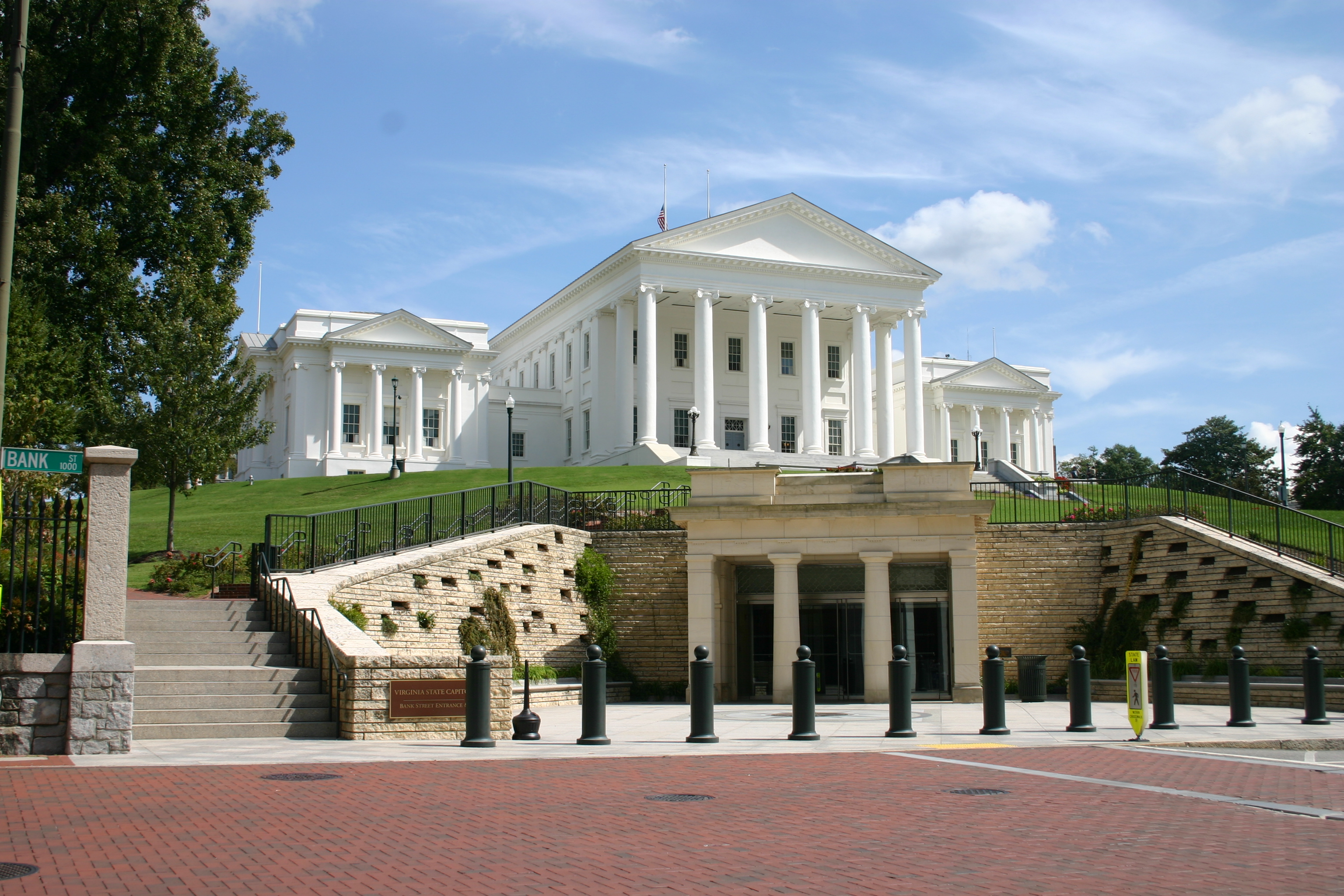
The Virginia Capitol building. Photo courtesy of Capitol Classroom.

In January, the Virginia General Assembly voted “yes” on a constitutional amendment that will bring hope to hundreds of thousands of Virginians.

Since 2006, the Constitution of Virginia has stated that “only a union between one man and one woman may be a marriage valid in or recognized by” the Commonwealth of Virginia. Although the U.S. Supreme Court’s decision in Obergefell v. Hodges overruled this and similar lines in state constitutions, many are concerned that the Trump administration and overwhelmingly conservative Supreme Court will attempt to overturn this precedent, which would leave each state to decide whether to allow same-sex marriage.

Senate Joint Resolution 11 (SJ 11), which was first introduced in January 2024, amends Section 15-A of Article I of the Constitution of Virginia, repealing the prohibition of same-sex marriage and affirming the right to marriage. If SJ 11 is passed, the Constitution will now state that “the right to marry is a fundamental right inherent in the liberty of persons, and marriage is one of the vital personal rights essential to the orderly pursuit of happiness.” The amendment protects the rights of Virginians to marry legally, regardless of sex, gender, or race. SJ 11 is moving through Virginia’s General Assembly right on time, as members of the Republican party are actively calling for a reversal of the previous decision on same-sex marriage.

If made into law, this amendment could improve the mental and physical health of the approximately 300,000 Virginians who are part of the LGBTQ+ community. According to a study published shortly after Obergefell v. Hodges, “LGBT persons experience higher rates of anxiety, depression, and substance abuse because of repeated experiences of social stigmatization.” This only worsens when the LGBTQ+ community is denied freedoms such as marriage to the person they love. A 2010 study on mental health of lesbians, gay men, and bisexuals in states with marriage equality versus those without showed that “LGB persons living in states with bans had a nearly 37% increase in any mood disorder, 248.2% increase in generalized anxiety disorder, 41% increase in alcohol use, and 36% increase in any psychiatric co-morbidity.”

Delegate Rozia Henson. Photo Courtesy of vahousedems.org.

Delegate Rozia Henson of Virginia’s 19th House of Delegates district stated that “especially with the current climate in Washington and the extreme right Supreme Court,” the potential threat to marriage equality “provides uneasiness and burdens people’s state of mind.” His hope is that the bill brings to Virginia’s LGBTQ+ community “the peace of mind that they will know that no matter what happens in Congress, you can marry who you love in the Commonwealth of Virginia, and [if Obergefell v. Hodges is overturned], you know the position the Commonwealth is in, and what we’re willing to do to fight for our constituents.”

The physical wellness of LGBTQ+ Virginians will also be impacted if SJ 11 is passed. Many studies have shown that “chronic stress can produce long-lasting changes in the brain, including structural changes and loss of brain volume in some regions, that are linked with anxiety, depression, and substance abuse.” Additionally, long-term stress can lead to physical problems, including digestive issues, sleep problems, and increased risk of heart disease, heart attack, high blood pressure and stroke.

Beyond general physical health, researchers found that there was a 14% decrease in suicide attempts among LGBTQ+ youth when their states legalized same-sex marriage ahead of Obergefell v. Hodges. Despite the growing tension and fear as attitudes towards the LGBTQ+ community shift, Virginia may serve as a safe haven for its citizens, leading to a lower suicide rate than in states where same-sex marriage will become illegal if Obergefell v. Hodges is overturned.

Although it has been passed by both houses of the 2025 General Assembly, SJ 11 is far from the finish line. In order to become part of the Constitution of Virginia, it will have to be passed again by both houses of the 2026 General Assembly. If the amendment makes it through the second round of General Assembly voting, then it will be on the ballot in 2026 for Virginians to vote on whether or not it becomes part of the constitution. Although Virginia will elect a new governor in 2026, this will not affect the amendment’s prospects, as the Governor of Virginia plays no role in the process of amending Virginia’s Constitution.

Virginia is a highly divided state politically, with the majority of the state being rural and Republican, while Richmond and Northern Virginia overwhelmingly vote Democrat. This may present a challenge for SJ 11 to be voted into law, particularly with the current political climate of extreme views and divisiveness.

Despite this, Delegate Henson says that SJ 11 currently has strong bipartisan support from Virginia’s lawmakers, and that he is hopeful for its chances of passing the next few barricades and being voted into law.

Prioritizing Violence Prevention: Community Builders

by Bianca Campoverde, crime, safety, and justice reporter

James Madison Middle School’s Community Builders program prioritizes violence prevention by creating comfortable, supportive environments that help students build a foundation for a bright future.

Gun violence is not just an isolated problem but a public health crisis that affects communities nationwide. In the United States, it remains a pressing concern, particularly among young people. The impact of gun violence on communities, schools, and families is devastating. However, efforts are underway to prevent it. One initiative is the James Madison Middle School Community Builders program in Roanoke, Virginia.

The program incorporates strategies to de-escalate conflict without resorting to violence by teaching students to recognize the signs and respond appropriately. This approach creates a generation of young people who are more informed, responsible, and proactive in preventing violence.

Students are also involved in community outreach and awareness campaigns, giving them a sense of responsibility to create safer environments for themselves and others. This engagement has a ripple effect throughout the community, as students who are educated in community safety advocate for change in their families, neighborhoods, and beyond.

Early intervention for middle school students is crucial, as this period serves as a pivotal turning point in their development. During this time, students develop the skills to navigate real-world challenges, avoid harmful behaviors, and build habits that will guide them toward success in high school and beyond. The program aims to curb violence and build a reliable foundation for students through early intervention and comprehensive support systems.

In speaking with various high school students, Joshua Johnson, youth development intervention coordinator for Roanoke City Public Schools, noted, “Many of them felt like they were becoming detached from school and less motivated around middle school. This is why we wanted to target them during this transition period, looking at some positive experiences that combat some of the adverse childhood experiences (ACEs) they’ve had.”

This detachment can be linked to a range of factors, including personal struggles, family challenges, and exposure to ACEs. These factors not only impact academic success but can also increase the likelihood of involvement in violence.

Regarding logistics, the program tracks participating students’ data to identify areas of challenge where resources and support can be provided to alleviate external factors outside of the school environment. The program offers support through conflict resolution, healthy coping strategies, and other resources.  In an effort to reach as many students as possible, those outside of the program who display academic struggles are contacted and directed toward it.

“I affectionately call them our temperature changers. They’re a small group, but depending on where they come in that day-good or bad-they can really change the temperature of a room. Those are the kids we really want to pour a lot of attention into, making sure they don’t slip through the cracks, ensuring they are seen, heard, and feel like they belong,” Johnson said.

In addition to educational resources, the program creates a stable and comfortable environment where students experience inclusivity, strong ties to their school and peers, healthy relationships, and an overall atmosphere that encourages their self-esteem and nurtures their self-worth. These elements are essential for building resilience in the face of external challenges.

Corey Allder, director of Community Engagement for Roanoke City Public Schools, said, “If students are engaged and have a sense of belonging, they are less likely to be a part of a violent group or community violence.”

The goal of the program is to provide students with real-world experiences and career opportunities to combat community and domestic violence, while also raising awareness about gun violence prevention. Allder and Johnson were tasked with developing a program to help students set and work toward personal goals.

From visiting colleges, businesses, and government agencies to organizing events at their school, students in the program learn to cultivate their leadership skills. They demonstrate the program’s effectiveness through their academics and overall attitude toward their community. These opportunities help students understand their potential and the importance of goal setting. The exposure helps broaden their understanding, motivating them to pursue academic excellence and future career aspirations.  

“It could be a good opportunity to find ways to be more adult and find more ways to be better in life,” said Javon Kotz, an eighth grader at James Madison, when asked what about the program interested him.

Kotz hopes to attend Radford University in the future to pursue a degree in real estate.

“I feel like some people don’t want to sell a home; they just care about the money. I want people to know what they’re buying and not get ripped off. I want them to get a good deal, not just a house that’s terrible,” Kotz said.

By emphasizing these emotional and social aspects, the program is working to address the root causes of violence.  

The General Assembly’s decision to provide two years of funding for the pilot of the Community Builders program is an important first step. However, the program remains temporary, and long-term funding and community support are essential for its success to be sustained. The results from this initial phase will help shape future efforts to expand and refine the initiative. Ensuring that more students benefit from its resources and guidance.

Gun violence remains a significant challenge in many communities, but through early intervention and comprehensive support, programs like James Madison Middle School’s Community Builders are taking steps to prevent it before it begins. With continued support, the program will play an important role in shaping a safer, more positive future for students, families, and communities.