A look ahead at the 164th Virginia General Assembly

by Jonathan Mususa, politics and government reporter

In the November 2025 elections, Democrats won all three statewide races – Abigail Spanberger for governor, Ghazala Hashmi for lieutenant-governor, and Jay Jones for attorney general. In the race for control of the House of Delegates, Democrats extended their majority from 51 to 64, coming three seats short of a supermajority.

More than a month later, Democrats are preparing to assume undivided control of state government for the first time since 2020, before Spanberger gets sworn in on January 17th and the sitting of the 164th General Assembly begins.

With Democrats now having the ability to enact legislative priorities without fear of a veto from outgoing Republican governor Glenn Youngkin, what can Virginians expect from Richmond in 2026?

Constitutional amendments

On November 17, Virginia House Democratic leadership announced that they had pre-filed a series of bills to be debated once the session starts. The first three bills on the Democratic agenda are constitutional amendments. Approved by the General Assembly during the last session, Democrats will have to approve them again this session in order to put these proposals before voters in a statewide referendum. 

This upcoming session, Democrats will attempt to pass proposals to enshrine access to abortion, automatic restoration of voting rights for ex-felons, and the right to same-sex marriage in the Virginia Constitution which would then be subject to referendums on or before November 3, 2026.

“To me, it seems as though we are clearly stating we are with where the American people are,” Sam Rasoul, the Democratic Delegate for the 38th district, said.

Rasoul’s district contains most of Roanoke, save for the southwest corner of the city located in the 40th district. First elected in 2014, his strongly Democratic district re-elected him for a sixth term. Of the proposed amendments, he is especially excited about the restoration of voting rights for ex-felons.

“This amendment, to me, actually only goes halfway,” Rasoul said. “It says, once you’ve served your time, your ability is automatically restored. I think we should even go further, but that is for another time. I am excited to, at least, take this significant step.”

Wren Williams, the Republican Delegate for the 47th district, who is especially opposed to the abortion rights initiative, hopes that “the people in Virginia will stand up and realize that, ‘no, this isn’t what we do here’ and step up and be strong and say, ‘we the people, we give the guidance to our representatives and this is beyond what we said we wanted in November.’”

Williams’ strongly Republican district contains Carroll, Floyd, and Patrick counties, as well as the city of Galax and parts of Henry County, and re-elected him to serve his third term in office.

The redistricting question

Democrats are also proposing another constitutional amendment: changing the redistricting process in Virginia so that the General Assembly can redraw congressional district lines between decennial censuses if other states do the same. This comes as states across the country are redrawing their congressional maps ahead of the 2026 midterms, in response to President Donald Trump calling for legislatures in Republican-controlled states to redraw districts to help Republicans hold onto control of the U.S. House of Representatives.

Currently, Virginia has a bipartisan redistricting commission composed of legislators and citizens from both parties. In the last redistricting cycle in 2020, however, gridlock on the commission caused the state Supreme Court to appoint two special masters from both parties to draw the current maps for the U.S. House and the General Assembly.

Del. Rasoul describes himself as “very passionate about redistricting reform” and supported the bipartisan commission. However, amid the nationwide pattern of partisan redistricting, he feels that Virginia Democrats are merely doing what they have to do.

“I think it would behoove us to do something to be able to say, ‘We know this is a sad moment, but what can we be doing to protect the fabric of the republic?’” Rasoul said.

Nicholas Goedert, a professor of political science at Virginia Tech with a research interest in the redistricting process, sees few short-term drawbacks to pursuing this strategy for Democrats in 2026, but believes that there would be potential adverse effects further into the future. 

“It does have more medium term potential drawbacks for Democrats in that, if they try to win as many seats as possible, they probably have to draw some of these seats to be only slightly Democratic,” Goedert said. “If we were to see a Republican wave election, perhaps, in 2030, which would be the last year that such a map would be in effect, you could see a lot of those seats won by Republicans because they will be only marginally Democratic and they could swing back to the Republicans’ direction.”

“To me, it seems as though we are clearly stating we are with where the American people are.”

– Del. Sam Rasoul (D–Roanoke)

(Saturday, December 13, 2025) An Appalachian Power utility pole near the Shawnee Swim Club in Blacksburg, Va., at the corner of University City Blvd. and Toms Creek Rd. – Jonathan Mususa, for The News Feed NRV.

Affordability, energy policy, and Virginia’s economy

Affordability has been an important plank in the Democrats’ platform, with pre-filed bills aimed at raising the minimum wage to $15 by 2028, mandating an hour of paid sick leave for every 30 hours worked in 2027, and authorizing localities to exercise a right of first refusal on property sales to the end of creating affordable housing.

Also on Democrats’ mind is energy policy, with legislation promising energy cost reductions for low-income families, efficiency mandates for Dominion Energy and Appalachian Power, and weatherization and retrofitting for low-income families’ homes by 2031. Del. Rasoul hopes that measures like these will help lower energy costs for Virginia families.

“I would venture to say that the largest tax increase in Virginia history has been the increase in our utility costs over the past decade, and people are getting hit from so many different angles, and, in this past year, we had, in AEP territory, not just people talking about $1,000 electric bills but even some cases of $2,000 electric bills for an average-sized home,” Rasoul said. “It’s really gotten out of control and it’s just for the wealth of a few.”

Del. Williams, on the other hand, finds Democratic proposals unfeasible and could lead to energy bills becoming more expensive and life in the Commonwealth becoming more unaffordable.

“The idea that the Democrats can legislate their way into a better economy is absolutely insane,” he said. “They need to back off. We need to cut regulations. We need to let the free enterprise market control, and we need to see small businesses thrive so that we can continue to be an economic and business leader in the nation.”

Governor–General Assembly relations

Some of the pre-filed bills had already passed the Democrat-controlled General Assembly, but were vetoed by Republican Governor Youngkin. Now, with a governor from the same party, Democrats in the General Assembly have a smoother path to delivering on campaign promises, with Virginia Tech political science professor Karen Hult calling it “somewhat less of a fraught-with-conflict situation than we’ve seen in the past.”

However, Spanberger’s background as a moderate Democratic Congresswoman could possibly lead to friction between the Governor’s Mansion and the General Assembly when it comes to the details of exactly how to implement their shared priorities.

“There may be some differences in priority and detail on a whole range of issues that Governor-elect Spanberger is going to be trying to push in the General Assembly, but many of those match the same kinds of matters and issues that members of the House of Delegates ran on as well,” Hult said.

To Del. Williams, Governor Spanberger might find herself out of step with her fellow Democrats in the General Assembly.

“Abigail Spanberger is going to want to paint herself as a moderate and she does not have a moderate backing when it comes to the General Assembly and their majority – their expanded majority,” Williams said. “She is really going to have a hard time keeping any kind of control or say over those legislative bodies because they’re going to do whatever they want and then they’re going to hand it to her and say, ‘your move.’”

“I hope … that the people in Virginia will stand up and realize that, ‘no, this isn’t what we do here’ and step up and be strong and say, ‘we the people, we give the guidance to our representatives and this is beyond what we said we wanted in November.’” 

– Del. Wren Williams (R–Patrick County)

The Republican minority

The road to the Democrats’ expanded majority in the House of Delegates ran through 13 Republican-held districts. For Williams, these losses were indicative of a failure on the part of Republicans to put forward an appealing message to voters in the face of a wave of anti-Trump sentiment.

“I don’t think that we brought a real cohesive message of how we were going to make life better for the constituents of the Commonwealth,” Williams said. “We just had an absolute failure to attract those independents, to give them the motivation to turn out, because I’m not sure that they could articulate what we were going to bring to the table if we had been handed those reins.”

Williams will be part of a 36-member Republican House caucus. Republicans will find themselves in the minority in the State Senate as well, with Democrats controlling the upper chamber 21–19 since 2024. Despite being in the minority, he said that he is looking forward to working with his House colleagues of both parties.

“We have to make sure that we are doing our duty by looking after the constituents that sent us to Richmond, which means advocating for smart policies that best benefit our communities,” he said, adding that he hoped that “the Democrats, rather than steal our legislation and slap their name on top of it, will join us in those bipartisan efforts to pass good-sense legislation and policy.”

(Monday, December 8, 2025) A faded poster promoting a get-out-the-vote rally featuring now-Delegate-elect Lily Franklin, by the Newman Library at Virginia Tech. – Jonathan Mususa, for The News Feed NRV.

Virginia Tech growth and and town housing development converge in Blacksburg, Va

The Town of Blacksburg considers the increasing enrollment at Virginia Tech with recent ordinance decisions regarding off-campus housing. (Photo by Emily Dorsey, TheNewsFeedNRV.com)

By Emily Dorsey, politics and government reporter

_______________________________________________
“It’s really the destruction of the place … [Blacksburg is] unrecognizable anymore,” said Kimberley Homer in an interview regarding recent housing developments, sustainable living and quality of life in Blacksburg, Virginia. Homer has lived in Blacksburg since 1980, first as a student and later as a Virginia Tech  employee, working with Technology-Enhanced Learning and Online Strategies (TLOS). Throughout her years as a Blacksburg resident she has seen more large-scale student housing developments, increasing student presence in residential neighborhoods and growing town-gown tension. 

“Town-gown” refers to the relationship or tension between a university and local residents which is a popular concept talked about in Blacksburg, Virginia. Town-gown housing issues can be dated back to 1996 when Virginia Tech’s off-campus housing was in a shortage. The university has seen a 7.3 percent increase in first-year enrollment from 2020 to 2025, now enrolling over 7,000 freshmen undergraduate students. This leaves roughly 2,000 beds for upperclassmen, transfer or graduate students if they choose to live on campus.

In Fall of 2022, Virginia Tech’s Student Life Village was proposed by Virginia Tech Board of Visitors (BOV). The board comprises a range of representatives and experts appointed by the Governor of Virginia including the President of CMG Leasing, CEO of Clark Construction, Virginia’s executive vice president of Dominion Energy and more. The Student Life Village presented a new residential district that involved dining, recreation, housing and enrichment opportunities for up to 5,000 students. In March of 2025, the BOV rescinded the proposal and stopped all action in reference to the project. The BOV affects campus housing by deciding master plans, funding renovations and determining strategies. In tandem, limited on-campus housing options impacts the off-campus housing market

The proposed Student Life Village. Photo courtesy of Virginia Tech News/Sasaki

Mayor Leslie Hager-Smith commented on Virginia Tech’s part in Blacksburg’s housing crisis at the Town Council meeting on Dec 9. 

“The university will always have the upperhand. Virginia Tech can purchase any property it wishes,” said Hager-Smith. “The situation is confounded by the compounding conflict of interest that certain members of the politically appointed board of visitors have. They are crafting university policy on housing and enrollment while also profiting on the private side – building student housing.”

The off-campus student housing complexes vary based on price, availability and accessibility to campus. The Edge, Union and Hub are closer to campus with good walkability but nears $1,000/month for rent. Complexes like Foxridge and The Mill are slightly more affordable but are on the outskirts of town. The median price for off-campus student housing options fall between $700-$1,000 a month depending on how many bedrooms and bathrooms. If a student worked 20 hours a week at the median wage, they would earn around $1,000/month. With this take home pay, about half of the off-campus housing options are not affordable. This is one factor contributing to Blacksburg’s housing crisis. 

Blacksburg is unique to other Virginian universities and surrounding towns based on student population ratio. Compared to University of Virginia, James Madison University and Virginia Commonwealth University, Virginia Tech has the smallest city population to student population ratio. For every 100 permanent residents in Blacksburg, there are about 86 students at Virginia Tech. With roughly 9,000 campus beds and nearly 39,000 students, this creates a very high housing demand and affordability issues for both students and locals. 

“I’ve seen the amount of housing available continue to decline. We have more people who want to live in Blacksburg or move to the area who simply cannot find a house or afford the few houses that are available,” said Blacksburg town council member, Susan Anderson, in an interview regarding housing development growth she’s seen over the years.  

With apartment and townhome rent in Blacksburg being out of range for students’ budgets, many turn to residential neighborhoods in town or in Christiansburg which range from $400-$700/month per person. With more undergraduates filling up existing residential neighborhoods, this pushes out families, couples and graduate students looking for long-term housing options. 

If Virginia Tech continues to increase enrollment without developing more on-campus housing and if the Town of Blacksburg continually supports projects that are not realistically affordable, students and Blacksburg residents will be met with increasing rent, neighborhood displacement and tension between the town and university.

“It’s really the destruction of the place … [Blacksburg is] unrecognizable anymore.”

In the last decade, Blacksburg’s Town Council has added 5,400 beds in off-campus student housing. The Edge and Brexx at Blacksburg, formerly known as The Retreat, were built in this time frame alongside other complexes’ renovations. In 2016, a Collegiate Times article questioned if Blacksburg has too many off-campus options which now is contradicted by a handful of current developments occurring throughout town. 

Two developments close to South Main Street, Midtown and Legacy on Main, have been under construction for a couple years. Midtown will “offer civic, commercial and residential mixed-use public space for all to enjoy” according to their Facebook profile.. In essence, it is a multi-purpose buildout which offers four-story townhomes, two-level condos and other recreation and dining experiences near Downtown Blacksburg. These townhomes and condos are listed from 600,000 to over one million dollars on Eagle Construction of Virginia website and are geared towards teachers, police officers and other full-time workers in Blacksburg.

Dec. 13, 2025, Blacksburg, Va – Construction for Midtown happening along Church St and Midtown Way. (Photo by Emily Dorsey, TheNewsFeedNRV.com)

Legacy on Main is a three-story apartment complex with 56 units which prioritize Blacksburg residents, not undergraduates, who need affordable living options. The future residents will have to qualify and earn up to 80 percent of Blacksburg’s Area Median Income (AMI) which was $63,000 in 2021.

Ordinances 2090 and 2094 were voted down on Tuesday, Dec 9 by the Town Council. They proposed housing developments on Webb Street and University City Boulevard respectively. Both ordinances proffered multi-story, luxury apartment complexes with limited parking and high increase in pedestrian, biker and vehicle safety concerns. While these ordinances were cut, various opportunities for developers remain. Ordinance 2095, was recently approved which will add a handful of townhomes next to an existing apartment complex on Whipple Drive.

Dec. 13, 2025, Blacksburg, Va – Whipple Drive Townhomes will back up to existing student housing, Uptown Village. (Photo by Emily Dorsey, TheNewsFeedNRV.com)

The proposed Whipple Drive Townhomes plan. Image courtesy from the Town of Blacksburg website. 

Lastly, a close 4-3 Town Council vote approved a controversial development on North Main Street in March 2025. This development includes an eight-story, 700+ bedroom apartment complex being constructed near the well-known Downtown round-a-bout. Many citizens raised concerns at the public hearing regarding population density, traffic, pedestrian concerns, parking availability and the effect it will have on Blacksburg’s overall character. 

The proposed 801 North Main Street development. Image courtesy from the Town of Blacksburg website.

“We can’t say no more student housing, no more other people housing,” said Anderson. “That’s just ridiculous. We have to try to balance everybody’s housing needs. That’s a really hard struggle.”

Anderson shared that the Town and Council are working in various committees to mediate these issues. First, the Blacksburg-Virginia Tech Liaison Committee which includes the Mayor, Vice-Mayor, Town Manager and the two Deputy Town Managers who meet with six vice presidents from Virginia Tech monthly to discuss needs and topics that affect both the town and university. Second, is the Montgomery County Liaison Committee. The members include Blacksburg’s Mayor and Vice-Mayor who meet with others from Christiansburg and Radford to discuss and collaborate their shared issues and concerns.

“The university will always have the upperhand. Virginia Tech can purchase any property it wishes.”

The housing crisis Blacksburg is facing affects both students and long-term residents, deciding who can afford to live in town and the change in character. As off-campus developments increase rental prices, students turn to other options like residential neighborhoods or find housing in Christiansburg which intensifies competition for limited space. As a result, families, couples and full-time workers are consistently priced out, unable to find housing that fits their needs and budgets. Virginia Tech and the Town of Blacksburg are urged by its citizens to take a more collaborative approach that prioritizes affordability, sustainable growth and values community concerns. Without more change, the divide between students and residents will deepen, further straining the town-gown relationship that defines life in Blacksburg, Virginia. 

Hokie Spirit Never Dies: Evan Hughes on Why Virginia Tech Football Still Unites Fans

By: Zoe Santos, arts & culture reporter

Evan Hughes, Assistant Director of Broadcast Services and Voice of Virginia Tech women’s basketball and baseball, poses for a portrait in Blacksburg, Va.

Even with recent losing seasons, Virginia Tech football continues to draw sold-out crowds to Lane Stadium. The passion is strong as ever, and Hokies, students and alumni alike, say the program represents more than wins and losses. 

Evan Hughes, a Virginia Tech alumnus and assistant director of broadcast services for Virginia Tech Athletics, has experienced the culture from both sides of the stands. As a student and now a staff member, Hughes offers a perspective on the influence of Frank Beamer, the game day atmosphere in Lane Stadium, and why Hokie spirit continues to thrive.

(Edited for clarity)

You’ve been both a student and an employee at Virginia Tech. How would you describe what makes the culture here unique?

I think first and foremost, it’s the people, and I think that it’s so overly used when it comes to organizations or universities, “the people, the people, the people,” but truly, there’s a reason why Virginia Tech is near the top every year in student life happiness.

You hardly meet people who come to Virginia Tech who don’t like Virginia Tech. I just think there’s something about the way others treat fellow students and professors that makes this community so special.

I don’t know if it’s the small-town vibe. I don’t know if it’s being in the mountains. But it’s contagious. You can feel it. And there’s a sense of real pride in being a part of something bigger than yourself, too, which is kinda cool.

Every day, there’s one thing that hasn’t changed from when I was a freshman in college to now being an employee. It’s the people.


Frank Beamer was at the South Carolina game recently, supporting his son Shane. What did you think about the fan response to him being there in another team’s colors?

I think it’s a really good question. Obviously, Coach Beamer is arguably the biggest celebrity and one of the most impactful people to ever graduate from Virginia Tech, but then had the biggest impact that one person has had.

The growth of the football team really helped the growth of the university from an academic standpoint. So to see him there supporting Shane, I thought it was cool because he had a Virginia Tech pin. That was so cool, just paying homage like, “Hey, I am a Hokie. I love you guys. This is probably the hardest thing I’ve ever had to do, but of course I’m going to cheer for my son first.”

Just about every Hokie understood that. Nobody’s like, “Hey, why isn’t Coach cheering for the Hokies?” Everybody gets it. It’s his son. Of course, he’s going to cheer for him. That was really unique. I mean, it’s not every day that your legendary coach is going up against his son.

If you could put it into words, what lasting impact did Beamer leave beyond numbers and wins?

When he first got here, from an athletic department standpoint, we were a very small athletic department. We had not achieved a lot from a team perspective. We’d had some good football seasons in the past, but nothing like where we are now in the ACC and from a competitive standpoint.

We are where we are because of Frank Beamer. I think the rise of the football program allowed for so many more people to get on the bandwagon, so to speak, and then students started saying, “Hey, Virginia Tech’s good. Are they good in school? Maybe I should apply there.”

I don’t think you can sum up what he has meant to this place. Even in his retired life, he walks around campus almost every day, and he’s been around for years. In my opinion, Frank Beamer is one of the most impactful people to ever be a Hokie.

I think about Virginia Tech, how many students we can admit every year, how competitive it is, and how we need to expand. All these things. It’s because of him. He is one of the common denominators for why we are the way we are.

I hope he knows that. I hope he feels that from Hokies, because I don’t think he fully understands that he is one of the primary driving forces of why we are where we are as a university and athletic department today.

As a student and now an alumnus, how do you think the experience changed? Does the passion remain the same?

I think the passion absolutely remains the same. As a student, it depends. Some people come in having grown up a Hokie, and they know everything about it. Some come from out of state and don’t know who Frank Beamer is. Everybody has different starting points for when they started following Tech football. But once you’re in, you’re hooked.

As an alum, so many people who love sports follow Tech football because it takes them back to their college days. Tech football is that placeholder in their heart. It’s their way of staying connected to what’s happening with their alma mater.

It is cool how Tech football continues to give to those who have already graduated. That Hokie Stone the players touch running out of the tunnel comes to mind, “For those who have passed, for those to come, reach for excellence.” That’s what it represents.  

If you had to sum up a gameday in Lane Stadium to someone who’s never been here, how would you describe it?

Exhilarating. Jumping, a lot of jumping. Coming together with 66,000 of your closest friends to cheer on one common goal, and that is for Virginia Tech to win a football game. You are the 12th man, helping push the team to victory. You’re also sharing in three hours of one of the most special moments you’ll have all week.

From kids who are five to alumni who are 90, people love being Hokies. And there’s no better way to show that than being inside Lane Stadium on a Saturday.


Virginia Tech to continue climate action efforts following US exit from Paris Agreement

By Evan Hull, environment, climate, and sustainability reporter

Solar panels at Perry Street Parking Garage.

For a second time, the U.S. is set to exit the Paris Climate Agreement, but Virginia Tech isn’t backing down from its climate action commitments.

Why it matters: As an internationally recognized institution for environmental engineering and natural resources management, Virginia Tech plays a key role in researching sustainable practices across the globe. With President Donald Trump’s signing of the “Putting America First in International Environmental Agreements” executive order, many environmental initiatives across the country are now in limbo. 

The big picture: Virginia Tech will not stray away from its nearly 16-year-old Climate Action Commitment, but there may be some hurdles for researchers.

  • “Our impact on the environment matters to us,” said Mark Owczarski, interim vice president of communications and marketing at Virginia Tech. “It’s part of ‘Ut Prosim.’ We’re serving our community. We’re serving our students and faculty. We serve our environment because, without our environment, we can’t function.”
  • Carbon neutrality and 100% renewable electricity are among the goals Virginia Tech currently has set for its Blacksburg campus by 2030. It is one of many universities that remains in-tune with international climate initiatives.
  • “Right now, there are governors, mayors, and institutions across the U.S. saying ‘we’re still in,’ and ‘we’re going to comply with the Paris Agreement,’” said Carol Franco, senior research associate at Virginia Tech, and climate advisor to the Ministry of the Environment of the Dominican Republic.
  • While the university isn’t concerned about continuing their plans for a more sustainable campus, questions have been raised about research funding—particularly from the federal level.
  • “As faculty, we apply for funding—even departments apply for funding,” Franco said. “Having that funding will impact our availability and our capacity to do research in certain areas.”
  • Still in the early stages of Trump’s second administration, it remains unclear as to what environmental programs and projects will continue to receive federal funding.

Zoom in: While Virginia Tech is unwavering in its commitment to climate action initiatives, officials recognize that times of intense change can always be met with adaptability.

  • “The university believes that responsible stewardship of the environment is important, and that may look different from generation to generation,” Owczarski said. “The plan will continue to change, evolve, and grow over time.”
  • Virginia Tech’s Climate Action Commitment has been revised twice since initial approval in 2009.
World leaders celebrate the signing of the Paris Climate Agreement in Paris, Dec. 12, 2015. (Photo/Carol Franco)

Flashback: Over the last several years under the Biden administration and the Paris Agreement, U.S. sustainability plans closely resembled those of Virginia Tech.

  • In April 2021, Biden created a goal of reducing U.S. emissions by 50 to 52% by 2030 according to the Natural Resources Defense Council. By December 2024, the goal was changed to 61 to 66% by 2035.

What we’re watching: While Virginia Tech’s climate initiatives remain safe from federal intervention, experts from countries still in the Paris Agreement are keeping a close eye on the U.S. before they officially exit.

  • The U.S. will still be members of the agreement until January 26, 2025 according to Reuters.
  • “During the first administration of President Trump, the U.S. basically stayed on the sidelines,” Franco said, noting that United Nations Framework Convention on Climate Change decisions must be made by consensus. “Now, if the idea is to stay on the sidelines, we’re going to be able to move forward. If the idea is to oppose, then we’re going to have issues.”

The 2025 Flu Takeover

Photo Courtesy: iStock.com Photo credit to Getty Images

By Madi Poole, Health and wellness reporter

A look into what Influenza, a viral infection of the nose, throat and lungs, and also better known as “the flu”, has done and caused this year for all ages. Giving you a 2025 flu update from how many people got their flu shot this year to how many suffered from the flu this year and just how intense was this year’s flu season compared to past years?

Why it matters: The flu continues to take over each year, this year produced some new records on flu rates and deaths caused by the flu taking precautions where needed like getting your flu vaccine can be critical especially those of high risk.

  • As of February 1st, 2025 the CDC has reported that 45% of adults have received a flu vaccination and 45.7% of children have received a flu vaccination. 
  • These rates are just about the same as compared to last year. Unable to see a huge increase in people getting their flu shots each year.
  • While only less than half the United States received their flu vaccination it has been reported that the CDC estimates at least 24 million people have had the seasonal flu this season.
  •  Of the 24 million who caught the flu this season 310,000 were hospitalized and 13,000 deaths caused by the flu this 2024-2025 flu season, 57 of those deaths were children. 

The Big Picture: Looking at statistics from just a few weeks ago it was reported for the week of January 25th through February 1st:

  • 31.6% of people who visited a doctors tested positive for the flu
  • 48,661 people with the flu were admitted into the hospital
  • 2% of deaths attributed to the flu
  • 10 pediatric deaths due to the flu were all reported in just one week.

Jaymie Bollman, a pediatric nurse, tells us about how bad it has been in her office for the flu this year “I have been at this office for four years now and this has probably been the most intense flu season I have seen yet.” Bollman tells us that she has seen children ranging from all ages come in and test positive for the flu “Seeing the flu in kids is not super rare just because once it starts in school it doesn’t stop for a while but we have had kids from three years old all the way to 17 come in here and test positive for it just in the past two weeks.”

Zoom In: One aspect of this year’s flu season that surprised doctors was for the first time since the pandemic there was a week that had more deaths caused by the flu than COVID-19. CBS News reported the week ending on January 25th, 2025:

  •  1.7% of all deaths reported were due to the flu
  •  1.5% were reported due to COVID-19
  • Rates of hospitalizations due to the flu were three times higher than COVID-19 because of this season’s record high of Influenza cases.

Luke Darrah talked to us right after having the flu, comparing it to COVID-19 “I have had both Covid and the flu multiple times but the flu I had this year was worse than any other year and worse than when I had covid.” Darrah tells us a little about the symptoms he was feeling this time around “I just felt very weak and exhausted but the congestion was the worst part. I struggled breathing out of my nose for a while.”

Stores like Target, Walmart, CVS, and Walgreens are making sure cold and flu medicine stays stocked due to the high demand for the medicine during flu season.

What we’re watching for: Moving forward this year as “flu season” comes to an end precautions should still be taken. The CDC always recommends health advice on how to avoid or minimize the chance of getting the flu. The CDC recommends:

  • Everyone six months or older should get a flu vaccine
  • Stay at home when you are sick
  • Cover your nose and mouth
  • Clean your hands
  • Practice good hygiene and other healthy habits

Virginia battles against bird flu outbreak

by: Gracie Gosier, environment reporter.

A new outbreak of the avian influenza virus, otherwise known as bird flu, caused by the H5N1 strain, has been confirmed in many states, including Virginia. Rapid increase in the number of cases raises concern among the state’s public and health officials.

Wild turkeys by the side of the road. Photo by Gracie Gosier.

The big picture: There is a statewide demand for all poultry farmers to improve biosecurity to preserve the health and welfare of all chicken raised in Virginia

Why it matters:

  • On January 16, 2025, Virginia Department of Agriculture and Consumer Services (VDACS) stated that testing of a commercial poultry flock in Accomack County revealed positive findings for H5 bird flu.
  • On January 20, the Metro Richmond Zoo reported H5 bird flu detections in two deceased cranes.
  • Hunt Club Farm in Virginia Beach killed nearly 300 birds after a handful tested positive for H5 bird flu.
  • H5 bird flu outbreaks have also been found at three poultry sites in the Delmarva region, affecting over 500,000 chickens.

The Virginia Department of Wildlife Resources (VDWR) has reported an increasing number of sick or dead wild birds along the Eastern Shore. Due to this increase the VDWR released a list of recommended precautionary measures for dealing with dead wild birds that may end up on one’s property to avoid it spreading to people. The Virginia Department of Health also has a resource page on the virus and what to do if you think the H5 bird flu is present. However, almost all the cases where H5 bird flu was found in humans in the U.S were people who work with poultry and cattle regularly. Still, this doesn’t mean that the outbreak shouldn’t be of public concern.

Dr. Mike Persia, John W. Hancock Professor and Extension Specialist, Poultry Nutrition & Management. Photo by Virginia Tech School of Animal Science.

Zoom in: Poultry expert Dr. Mike Persia, warns that wild birds migrating toward flocks and cattle have the ability to fly over local farms and spread the virus. According to Persia, the virus causes 60-80% death in birds, and it just takes a few extra precautions to keep the entire flock safe. Persia outlined extra preventive steps to avoiding the virus among wild birds. “The alternative is if you have a positive, you’re going to lose your entire flock,” said Dr. Persia.

What we’re watching: Although H5 bird flu has not been discovered in people or dairy cattle in Virginia, the latest cases are extremely troubling for the state’s economy. Cattle, dairy, and eggs are some of the top commodities that the state produces. The outbreak has already contributed to record high egg prices and low demand, as the H5 bird flu has reduced the total number of laying hens.

  • According to the VDACS, Virginia’s agriculture industry has an economic impact of $82.3 billion annually and provided more than 381,800 jobs in the past year.
  • Since December 1, 2024, over 16 million laying chickens have been infected and depopulated due to the virus, which represents approximately 5% of our total national flock lost.

Although the prevalence overall in the country seems relatively low, tracking human infections in the dairy industry has been an ongoing challenge throughout the bird flu outbreak. Residents and officials can work together to reduce the effect of the outbreak and limit its spread by remaining informed, adopting sufficient biosecurity, and following recommended health precautions.

The Impact of Hate Speech in Schools: What Montgomery County Public Schools Incoming Policy Could Mean for Students and Staff 

By: Nyles Stone, Politics Reporter

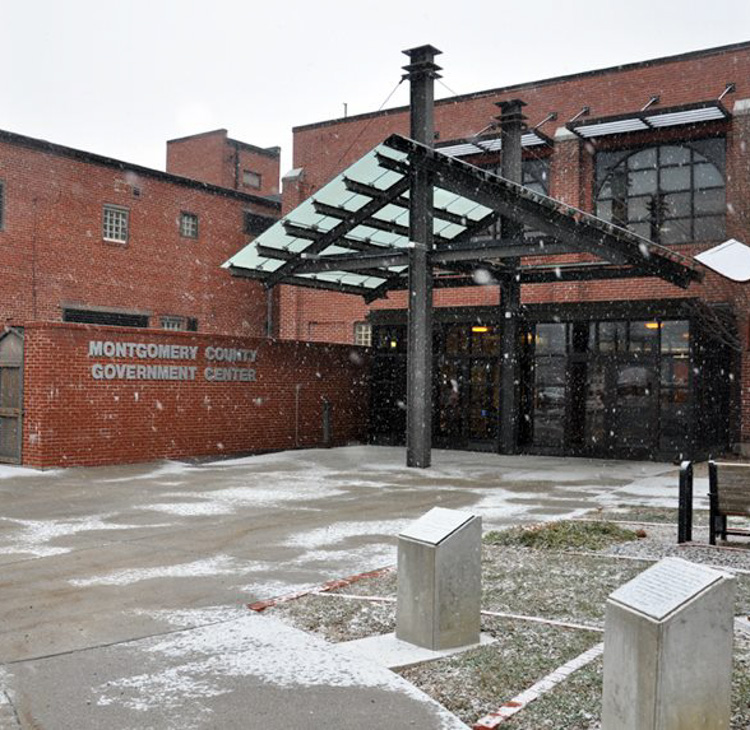
1/5/2025 – Montgomery County Government Center – Photo Credit, Montgomery County, VA Facebook Page

What will the new policy look like: While there is no current update on policies on the MCPS website, multiple sources including Cardinal News and News Messenger have been able to provide information regarding the new policy. 

  • The new policy will outline hate speech, structuring ways for reporting and investigating instances of hate speech;  
  • Elementary students could face up to three days of in-school suspension, while middle schoolers and high schoolers could face detention or in-school suspension on the first offense and 10-days of out-of-school suspension on the third offense. This could bring a longer punishment if student has persistent behavioral issues regarding the policy. 
  • The policy is said to not address staff related issues, having staff related issues investigated by human resources. 
Blacksburg High School Hallways, Photo Credit, Branch Builds

How does hate speech impact students and staff: James Hawdon, a sociology professor at Virginia Tech advises that exposure to hate speech can have serious psychological consequences. 

  • These include mood swings, fear, feelings of anger, and feelings of loneliness. Long term exposure can lead to lower levels of trust in individuals as well as social institutions. It can also lead to perpetuation of stereotypes and intergenerational transmission of prejudices.” said Professor Hawdon. 
  • Teachers and staff could not only be affected by being targeted by hate speech, but they can also witness and emotional strain, “if they see children they work with every day and who they have come to really care about use hate speech or be targeted by someone using hate speech, that is likely to be hard to watch.” 

But where does it start: For many students, hate speech is something that isn’t fully understood, being something that is repeated after hearing it from their parents, siblings, or peers. 

  • “Much of this is likely simply children parroting what they hear parents, other adults, or older siblings say. People often hate that which is different and unknown, but we have to learn that many characteristics that are often targeted for hate are “worthy” of being considered different and feared,” Hawdon explained. 
  • “So why hate some differences and not others?  We have to be told that this difference is somehow “so different” that it is deserving of being targeted for hate, and, more often than not, it is the people closest to us who tell us that.” 

Challenges: Hate speech falls into a gray area in U.S. law, with schools needing to find a balance enforcing students first amendment rights while also implementing a policy to stop hate speech in classrooms. 

  • “Speech, even that professing hate, is considered free speech that is protected by the First Amendment unless it meets very specific criteria about the imminent threat of violence,” Said by Hawdon. 
  • MCPS could follow a similar framework to that of other districts, an example of a policy that tackles harassment and discrimination while protecting first amendment rights is Richmond Public Schools’ Title IX procedures. 

Next Steps: As the district plans to move forward with the hate speech policy, we could possibly see staff training to ensure adequate enforcement of the policies. With multiple hate speech polices in place all around Virginia, MCPS possesses the resources to combat hate speech. 

The impact of substance addiction on the New River Valley community

By Evvy Fite, health & wellness reporter.

Photo by Pixabay

Among the many difficulties faced by rural communities, one that often goes unnoticed and under-discussed is the prevalence of substance use and abuse. In many cases, the resources that could help are few or non-existent, and life’s circumstances leave people defeated and more likely to turn to drugs or alcohol.

Why it matters: 

  • According to the Rural Information Health Hub (RIHH), “substance use disorders can result in increased illegal activities as well as physical and social health consequences, such as poor academic performance, poorer health status, changes in brain structure, and increased risk of death from overdose and suicide.” 
  • These problems perpetuate existing difficulties within many rural communities, and in many cases people in these areas are held back from improving themselves and their lives because of them.
  • The vicious cycle of substance abuse and other compounding problems holds these communities back and makes them a place to get out of, rather than a home to be proud of.

The big picture: RIHH states that “factors contributing to substance use in rural America include:

  • Low educational attainment
  • Poverty
  • Unemployment
  • Lack of access to mental healthcare
  • Isolation and hopelessness
  • A greater sense of stigma”
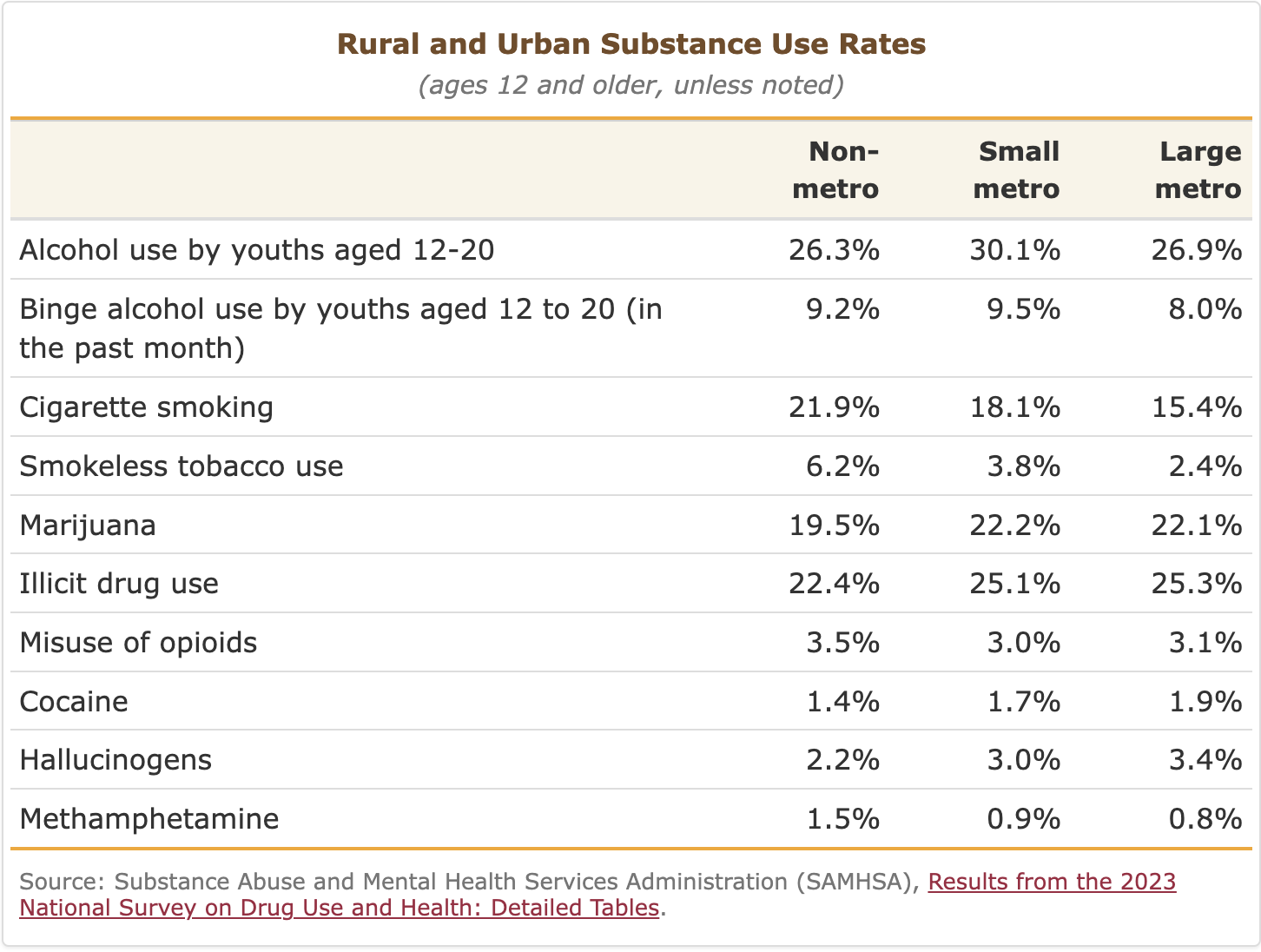
Screenshot from Rural Information Health Hub website.

Alcohol and nicotine are the most notable offenders. 

  • According to the RIHH chart on Rural and Urban Substance Use Rates in youths age 12-20, youths in non-metro areas use and abuse alcohol at similar rates to youths in metro areas, but use cigarettes, smokeless tobacco and methamphetamine at significantly higher rates.

Zoom in: The New River Valley is very rural, with over 15% living below the poverty line and nearly 25% considered cost-burdened. 

Photo by cottonbro studio from Pexels
  • A 2021 New River Valley Community Health Assessment by Carilion Clinic on the overall health of the NRV community found that “rates of drug overdoses higher than the national and state average [were] present in the New River Valley—especially in Pulaski and Wythe County.” 
  • As may be expected, those two counties also have the highest percentages of their population living below the poverty line – 24% and 21% respectively as of 2021.

In addition to substance abuse problems, the New River Valley also sees a large portion of the population experiencing other health problems. 

  • Chronic disease rates are higher than the Virginia average, including chronic lower respiratory disease, coronary heart disease and high blood pressure. 
  • Carilion Clinic also reports that much of the population lives in food deserts, and that “23.8% of adults report no leisure time physical activity.”

These are the situations that lead people to use and abuse substances. 

  • An updated 2024 New River Valley Community Assessment by United Way of Southwest Virginia found that rates of death by drug overdose have been climbing since 2018, with an increase of 105% in the past five years.

What is being done: Various organizations in the New River Valley are working to provide the resources that are often lacking in rural communities. 

The existence of any resources is a major step forward. 

Yes, but: Despite the efforts of these organizations, rates of addiction and health issues in the New River Valley remain high.

  • Even though resources are present, greater effort will be needed to connect people with those resources and decrease the stigma of asking for help. 
  • Time and the next NRV Community Assessment will tell how effective these resources truly are and what more is needed to free the New River Valley community from the shackles of substance addiction.

RCPS submits a proposal for a historical marker celebrating educator Lucy Addison

Will Frank, arts and culture reporter

Roanoke City Public Schools is currently in the process of applying for a state historic marker to highlight the pioneering education work of Lucy Addison.

The Big Picture: Lucy Addison was born to enslaved parents in 1861 in Fauquier County, Virginia. She ventured to Philadelphia to earn her education degree and returned to Virginia to teach in Loudoun County. After some time there, Addison was offered the position of interim principal at Roanoke’s First Ward Colored School in 1887. 

In 1918, she became the principal of Roanoke’s Harrison High School. At this time, the high school only offered classes as high as the eighth grade. Addison tenaciously campaigned and advocated for a secondary school curriculum and was able to steadily add advanced classes. The State Board of Education accredited Harrison as a high school in 1924, establishing it as the first black high school in Roanoke and providing Black students their first opportunity to receive an education.   

In 1928 the city renamed the school after Addison, attaining the title of Roanoke’s first public building named after one of its citizens.

 (Lucy Addison, photo curtsey of RCPS)

Zoom Out: The process of getting a marker proposal approved is complex and challenging. The Roanoke County Public School (RCPS) is opening the Booker T. Washington Community Empowerment and Education Center where the proposed marker would be located. RCPS is working with Nelson Harris, a Roanoke historian and former mayor, to help review and submit the proposal. He has had 10 proposals approved by the VDR

  • “The Virginia Department of Historic Resources (DHR) only approves about 25 per year for the entire state. Your marker application will compete with marker applications from Richmond, Lynchburg, Northern Virginia, Shenandoah Valley, Charlottesville, and anywhere else that people are submitting historic marker applications”, stated Harris.

For the marker, the team submitting has to provide research that backs up their claim on why the proposed individual, institution, or organization is historically significant. Once the research is completed the proposal is submitted to the DHR for review. They go over the research to make sure everything is accurate or add additional information. After the vetting process, if they accept your proposal, they then will work with the group who submitted it on editing and drafting the final text on the marker.

  • “Everything will take anywhere from four to six months. If the marker is approved, then the order is placed and it goes to the foundry. Right now, there’s about a six to eight-month lag time from the time the orders are placed until the marker arrives. So by the time I mail in my marker application, and everything goes well, the marker arrives in the city after a year and a half”, explained Harris.    

Zoom In: RCPS plans to open the new Booker T. Washington Community Empowerment and Education Center in the old RCPS Central Office, which is set to be the new hub for the Roanoke community, as well as the location of the proposed marker. Claire Mitzel, the school’s division spokesperson who also works very closely with Harris, has high hopes for the new community center’s impact.

  • “It’s going to serve, I hope, to support our students and families from all around the city. It’ll act as a welcome center, so families can come here to enroll their students, get immunizations, receive needed resources, and have a sort of parent and guardian empowerment workshop series”, Mitzel remarked hopefully. 

The idea of the new education center came from the inspiration of Lucy Addison, and her pioneering work in black education.

  • “Honoring Miss Lucy Addison, who the school is named after, is just a small way that we can shine a light on history, and make sure that generations of students and families know who she is. The building was built almost 200 years ago, and going into the future, we want to honor those who came before us”, stated Mitzel.

(Roanoke County Public School when it was first constructed circa 1920, photo courtesy of RCPS)

The opening of this center brings Addison’s achievements full circle. A new community center, by the community and for the community, supports students and families throughout Roanoke and provides them with the tools to help them thrive.

Federal funding cuts may threaten the breadth of research conducted at Virginia Tech 

The Virginia Tech Corporate Research Center houses laboratories and workspaces for a diversity of research initiatives at Virginia Tech.  

by: Kyndall Hanson, education reporter 

On Feb. 7, the National Institute of Health (NIH) issued a policy outlining a standardized 15% cap on indirect costs incurred through research funded by grants, including maintenance, operational, and administrative expenses. While the NIH’s policy is questioned in federal courts, universities like Virginia Tech are left to weigh the potential impacts of reduced federal support on research initiatives. 

Why it matters: The NIH is one of the first governmental agencies to outline research funding restrictions following the Trump administration’s now-rescinded memo outlining a federal funding freeze. According to a statement by Virginia Tech President Timothy Sands, the NIH’s decision to cut the reimbursements of indirect costs could have a $13 million impact on the university’s annual research budget and over $55 million if the policy was extended across all federal agencies.  

  • “Lives will be lost,” said Sands, describing the potential “debilitating effects” of funding cuts on biomedical research at the university, among other impacts across research disciplines.   
  • “Research is an integral part of who we are and what we do,” said Mark Owczarski, interim vice president of communications and marketing at Virginia Tech. “It’s going to take us time to figure this stuff out.” 

The big picture: As an R1 university, Virginia Tech undergoes significant research activity. In 2024, Virginia Tech’s sponsored research expenditures were $453.4 million. According to Sands, over $308 million of these research expenditures were federally sponsored. As the university works to understand the mandates of federal agencies, the long-term impact on research is unclear, described Owczarski. 

  • According to Sands, of the over $308 million in federally sponsored research, $73 million was attributed to indirect cost reimbursements, or facilities and administrative research costs – with an additional $18 million in indirect expenses subsidized by alternative university funding sources.  
  • “It requires us to ask a lot of questions, do a lot of analysis, figure out what we are doing and [what] each of these executive orders really mean,” said Owczarski. “In the long term, there could be significant impacts, or there could be very little impacts – we don’t know.”  
A graphic by Virginia Tech displays the growing sponsored research expenditures at the university.  

Zoom in: The Virginia Tech Office of Research and Innovation has established a ‘Federal Agency Update’ webpage to notify the university community of updates surrounding university compliance with executive orders and additional impacted federal guidelines. 

  • According to Owczarski, as of early February, Virginia Tech’s research is continuing. 
  • “We’re asking researchers to continue the good work they do,” said Owczarski. “Engage in their research, keep applying for grants – just keep doing what you’re doing, and we’ll figure out how we’re going to support that long-term.”  
  • While university research is largely supported by federal grants, additional funding opportunities are available to support to learning experiences at Virginia Tech. According to Julia Ward, assistant director for professional development and experiential programs at Virginia Tech, programs like Campus internEXP are supported by state grants and not affected by federal funding regulations.  

What we’re watching: The long-term impacts of the NIH’s regulations on research and university funding are still in question as recent mandates are challenged in federal courts. The early days of the Trump administration have demonstrated a push for policy demonstrating government efficiency, meaning university funding may be a continued target for regulation.  

  • “It’s about how much research we can actually do,” described Owczarski discussing the potential loss in federal funding. “We’d have to make up the costs somehow, redirect things, but we don’t know what the outcome is going to be.”