Hokie Spirit Never Dies: Evan Hughes on Why Virginia Tech Football Still Unites Fans

By: Zoe Santos, arts & culture reporter

Evan Hughes, Assistant Director of Broadcast Services and Voice of Virginia Tech women’s basketball and baseball, poses for a portrait in Blacksburg, Va.

Even with recent losing seasons, Virginia Tech football continues to draw sold-out crowds to Lane Stadium. The passion is strong as ever, and Hokies, students and alumni alike, say the program represents more than wins and losses. 

Evan Hughes, a Virginia Tech alumnus and assistant director of broadcast services for Virginia Tech Athletics, has experienced the culture from both sides of the stands. As a student and now a staff member, Hughes offers a perspective on the influence of Frank Beamer, the game day atmosphere in Lane Stadium, and why Hokie spirit continues to thrive.

(Edited for clarity)

You’ve been both a student and an employee at Virginia Tech. How would you describe what makes the culture here unique?

I think first and foremost, it’s the people, and I think that it’s so overly used when it comes to organizations or universities, “the people, the people, the people,” but truly, there’s a reason why Virginia Tech is near the top every year in student life happiness.

You hardly meet people who come to Virginia Tech who don’t like Virginia Tech. I just think there’s something about the way others treat fellow students and professors that makes this community so special.

I don’t know if it’s the small-town vibe. I don’t know if it’s being in the mountains. But it’s contagious. You can feel it. And there’s a sense of real pride in being a part of something bigger than yourself, too, which is kinda cool.

Every day, there’s one thing that hasn’t changed from when I was a freshman in college to now being an employee. It’s the people.


Frank Beamer was at the South Carolina game recently, supporting his son Shane. What did you think about the fan response to him being there in another team’s colors?

I think it’s a really good question. Obviously, Coach Beamer is arguably the biggest celebrity and one of the most impactful people to ever graduate from Virginia Tech, but then had the biggest impact that one person has had.

The growth of the football team really helped the growth of the university from an academic standpoint. So to see him there supporting Shane, I thought it was cool because he had a Virginia Tech pin. That was so cool, just paying homage like, “Hey, I am a Hokie. I love you guys. This is probably the hardest thing I’ve ever had to do, but of course I’m going to cheer for my son first.”

Just about every Hokie understood that. Nobody’s like, “Hey, why isn’t Coach cheering for the Hokies?” Everybody gets it. It’s his son. Of course, he’s going to cheer for him. That was really unique. I mean, it’s not every day that your legendary coach is going up against his son.

If you could put it into words, what lasting impact did Beamer leave beyond numbers and wins?

When he first got here, from an athletic department standpoint, we were a very small athletic department. We had not achieved a lot from a team perspective. We’d had some good football seasons in the past, but nothing like where we are now in the ACC and from a competitive standpoint.

We are where we are because of Frank Beamer. I think the rise of the football program allowed for so many more people to get on the bandwagon, so to speak, and then students started saying, “Hey, Virginia Tech’s good. Are they good in school? Maybe I should apply there.”

I don’t think you can sum up what he has meant to this place. Even in his retired life, he walks around campus almost every day, and he’s been around for years. In my opinion, Frank Beamer is one of the most impactful people to ever be a Hokie.

I think about Virginia Tech, how many students we can admit every year, how competitive it is, and how we need to expand. All these things. It’s because of him. He is one of the common denominators for why we are the way we are.

I hope he knows that. I hope he feels that from Hokies, because I don’t think he fully understands that he is one of the primary driving forces of why we are where we are as a university and athletic department today.

As a student and now an alumnus, how do you think the experience changed? Does the passion remain the same?

I think the passion absolutely remains the same. As a student, it depends. Some people come in having grown up a Hokie, and they know everything about it. Some come from out of state and don’t know who Frank Beamer is. Everybody has different starting points for when they started following Tech football. But once you’re in, you’re hooked.

As an alum, so many people who love sports follow Tech football because it takes them back to their college days. Tech football is that placeholder in their heart. It’s their way of staying connected to what’s happening with their alma mater.

It is cool how Tech football continues to give to those who have already graduated. That Hokie Stone the players touch running out of the tunnel comes to mind, “For those who have passed, for those to come, reach for excellence.” That’s what it represents.  

If you had to sum up a gameday in Lane Stadium to someone who’s never been here, how would you describe it?

Exhilarating. Jumping, a lot of jumping. Coming together with 66,000 of your closest friends to cheer on one common goal, and that is for Virginia Tech to win a football game. You are the 12th man, helping push the team to victory. You’re also sharing in three hours of one of the most special moments you’ll have all week.

From kids who are five to alumni who are 90, people love being Hokies. And there’s no better way to show that than being inside Lane Stadium on a Saturday.

A semester of protests at Virginia Tech

By Wilbert Ramirez, politics reporter

Student protests were frequently observed during the 2025 Spring Semester at Virginia Tech in response to rapid changes made by federal and university administrations.

The protests were from a large variety of different student organizations that had different goals in mind against university policy regarding Virginia Tech’s policy changes due to the new Presidential administration in the United States.

On Jan. 20, President Donald J. Trump enacted executive order 14151 titled “Ending Radical And Wasteful Government DEI Programs And Preferencing,” which stirred confusion among universities and educational institutions around the United States – Virginia Tech included.

Student researchers at the university underwent a “chilling effect” regarding speaking publicly about their research in fear of retaliation from the Presidential administration. Virginia Tech students questioned from the Diplomacy Lab and other social science research requested         The Newsfeed for anonymity to speak freely without fear of retaliation to themselves or their colleagues.

A protest by the Students United Front began on Feb. 21 with students protesting any future action of letting U.S. Immigration and Customs Enforcement or ICE on to Virginia Tech’s campus. The SUF’s worries were propelled by earlier emails sent out by university admin on Feb. 18 discussing what staff such as professors should do if an ICE officer is seeking a student in their classes with bulleted topics regarding “points of contact, private spaces, and communications and rights.”

The situation regarding student protests was then galvanized following the arrest of Mahmoud Khalil on March 8 of a pro-Palestinian student leader at Columbia University who was detained by ICE officers after his green card was revoked.

The next protest of many at Virginia Tech was an emergency protest march by the organization “Students for Justice in Palestine,” which met and marched from the Pylons memorial at the university to the townhall in downtown Blacksburg. The organization called for Virginia Tech to divest from Israel and weapons manufacturing organizations that supply the Israeli military.

The protest was in response to the ceasefire between Hamas and Israel being broken by the state of Israel.

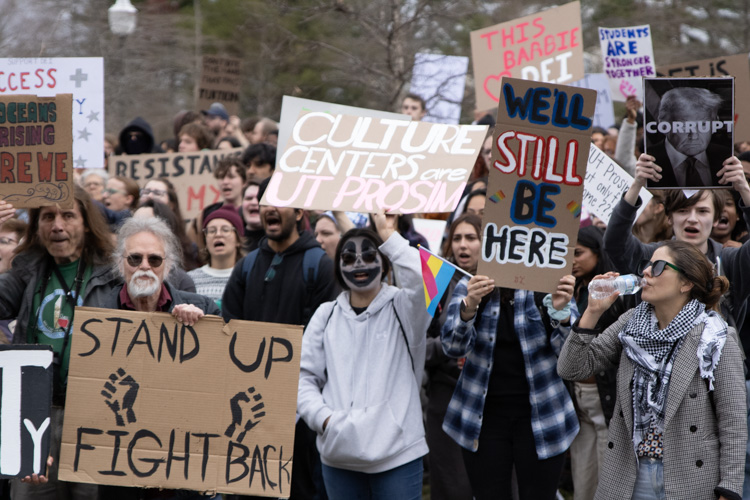
Shahed Sanuri (seen left holding megaphone) and pro-Palestinian student Protesters gather at the Pylons memorial at Virginia Tech, in Blacksburg, VA. Wednesday March 19, 2025 (Photo, Wilbert Ramirez)

“There’s no time for us to debate whether we should be fighting for Palestine or fighting against injustice because it’s Palestinians today and it’s happening to us today, but it could be anybody else tomorrow.”

Shahed Sanuri

Shahed Sanuri, a first-year graduate student at Virginia Tech and co-president for Students for Justice in Palestine is an ardent supporter of the Palestinian rights and recognition.

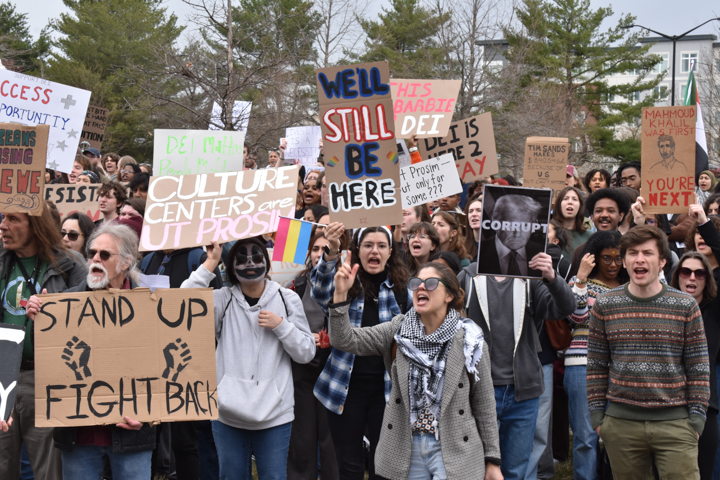
The largest and most diverse of the protests organized was the march for civil and human rights in response to the board of visitors decision to eliminate the DEI office at Virginia Tech on March 25. The march involved a wide coalition of many organizations such as Black mindedness, Students United Front, Students for Justice in Palestine, and students from varieties of backgrounds. Approximately upwards of 1000 people participated in the march according to organizers of the march.

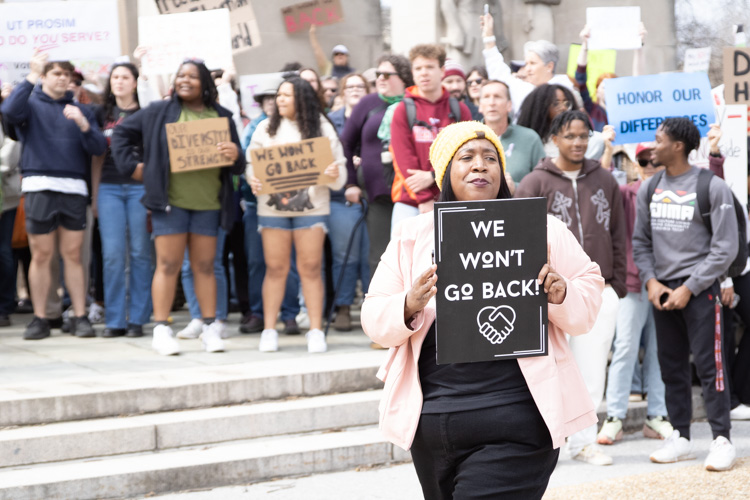
Protesters gather in front of the Skelton Inn at Virginia Tech, in Blacksburg, VA. Tuesday March 25, 2025 (Photo, Wilbert Ramirez)

“It’s one thing to be able to get 1000 people to show up one day, and it’s when you’re comparing it like qualitatively, how does getting 1000 people to show up one day compare to getting 50 to 100 people to show up every single week, you know, for months, right?,” said Cameron Baller, a PhD student in Sociology at Virginia Tech with a Bachelors in Natural Resources and Environmental Science, Minors in Gender and Women’s studies and Economic with an interest in researching social movements. “That’s another kind of lens in which I would be thinking about the history, the recent history of protest on this campus.”

The board of visitors at Virginia Tech went through with the vote to eliminate the DEI office at Virginia Tech in a 12 to 2 vote.

Another moment that galvanized students at Virginia Tech to protest involved the sudden revoking of international student visas around the country including seven Virginia Tech students and 2 alumni on April 9.

President Tim Sands of Virginia Tech released a statement issuing information to assist those who may have been affected.

The following day on April 10 the “Latino Association for Student Organizations” carried out a protest marching through campus against ICE enforcement and student speakers noted the revocation of the international student visas as one their largest grievances in speaking out against the U.S. presidential administration’s decision.

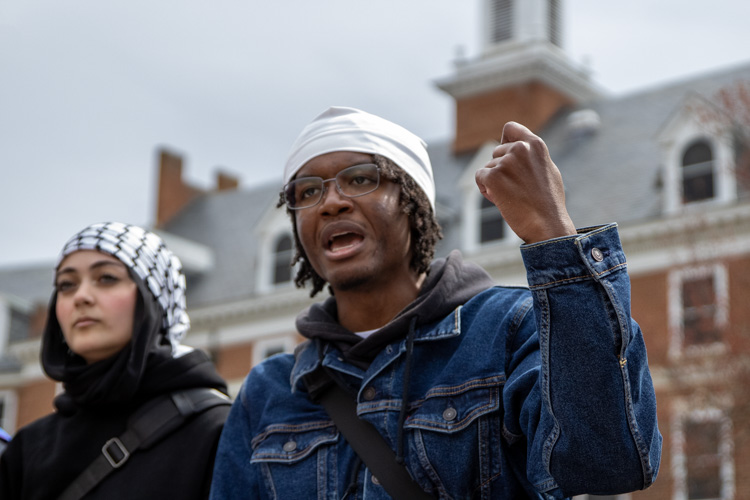
Student protesters gather at the Pylons memorial at Virginia Tech, in Blacksburg, VA. Thursday April 10, 2025 (Photo, Wilbert Ramirez)

“It’s very heartbreaking and disheartening to see how higher education administrations don’t really give mind to why students are protesting and they’re not really trying to find an active solution towards that,” said Tiffany Suarez the newly elected president of Latino’s for Student Organizations at Virginia Tech and an undergraduate majoring in environmental policy and planning and political science. “I feel like I’ve been seeing a lot of protests, almost every week, and the result of that has honestly just been the administration, turning their back on us not being responsive, not wanting to be at the table and constantly making up excuses about their unwillingness to cooperate with the students.”

The Trump administration reversed the decision of revoking the student visas on April 25 following numerous lawsuits contesting the terminations of visas.

The organization “VTforClimateJustice” held a climate protest on Earth Day, April 22, in front of Burruss Hall that then proceeded to march across campus and ended at the Pylons. The grievances by the organizers consisted of calls for Virginia Tech’s administration to be more transparent regarding Virginia Tech’s climate goals and where the university was currently at in meeting said goals.

In one of the final major protests on Virginia Tech’s campus this semester, Students for Justice in Palestine had a 1-year anniversary protest remembering the arrest of 82 pro-Palestinian protestors that included 53 students the year prior on April 29, 2024 following their 3-day encampment.

The protestors called for the need to stay strong to their cause of getting Virginia Tech to divest from Israel and weapons manufacturers at a time in which rapid changes are shifting against protesting on college campuses around the nation and at Virginia Tech.

The protests and their frequency at Virginia Tech this spring semester signaled an immediate resistance to the rapid, uncertain, and wide range of changes that began with the Trump administration and its combativeness against higher education institutions that challenge the president.

The largest of the educational institutions to rally against the U.S. president is Harvard in Boston Massachusetts, which sued the administration for freezing $2.2 billion in funding to the university. The Joint Task Force to Combat Antisemitism of the Trump administration announced the freeze in funding because of the university’s failing to protect its Jewish students after Harvard refused to comply with a list of demands from the administration.

Student protests around the nation culminated under a time of great uncertainty for their rights and causes depending on their citizenship, international status, and background.

“I think to be a protester, especially during this administration is to have the courage to stand up for something, knowing that there could be legal implications involved.”

Tiffany Suarez

“I think there’s a level of courage that we haven’t seen beforehand in the student protesters on campus – people knowingly going out and protesting given that people are getting their visas revoked.” Said Suarez. “People are actively getting targeted by ICE officials because of their support for either Palestine or criticism of the current administration. I think that shows a new level of courage that I don’t think we haven’t seen in college campuses in quite a while.”  

DEI Removal Sparks A Semester of Outrage at Virginia Tech

By Nyles Stone, politics reporter

(Nyles Stone/ Politics Reporter) Picture taken from the We Will Not Go Back Civil and Human Rights March

The start of the Spring 2025 semester at Virginia Tech was marked with uncertainty among students and faculty alike due to the January 20th executive order 14151, which was aimed at dismantling diversity, equity, and inclusion initiatives across all federal institutions. Many faculty grappled with the anxiety of the potential changes, while students all around the campus came together and planned for change, the professors, faculty, and staff were struggling to find a voice.  

Dr. Brandy Faulkner, Professor in the College of Liberal Arts and Human Sciences talks about the uncertainty the DEI removal brings, and the amount of stress it caused to faculty when it was first announced. 

“There was so much uncertainty. Nobody really knew what was going to happen or where we would end up. And so, there was nervousness, there was some fear, there was anxiety.”

Dr. Brandy Faulkner, Professor at Virginia Tech

The executive order, titled “Ending Radical and Wasteful Government DEI Programs and Preferencing,” mandated the termination of all DEI-related mandates, policies, programs, scholarships, funding, and activities associated with federal agencies. Furthermore, all DEI-related workers were forced to go on paid administrative leave Jan. 22. The order characterized DEI as causing a divide, promoting that special treatment was being given instead of equality, a claim that drew backlash from educators nationwide. Public universities like Virginia Tech that rely on federal funding followed suit with the executive orders, with many universities getting rid of grants, academic programs, and student and faculty support services tied to DEI. 

In response to the executive order, the Virginia Tech’s Board of Visitors came together to discuss the potential outcomes, and on March 25, the Board of Visitors voted to dissolve the university’s Office for Inclusive Strategy and Excellence, which oversaw more than 700 DEI programs across the university. This led to speculations of things that could be removed from classes, funding, and student organizations. The Board of Visitors decision sparked outrage around the campus, leading to protest outside of The Inn at Virginia Tech and Skelton Conference Center, where the Board of Visitors gathered to make their decision. Students, Faculty, and Staff all gathered in dismay over the decision to get rid of the DEI programs, with over 1,000 people in attendance. 

(Nyles Stone/ Politics Reporter) Students and Citizens of Blacksburg Gathered at The Inn at Virginia Tech

“Absolutely, there was fear about classes like Africana Studies getting shut down, because we didn’t know,” Dr. Faulkner said. “We don’t yet have the answers to whether some of our courses are going to disappear, whether they might be renamed, whether the content will have to change. So, there is still a whole lot of uncertainty, even as we are at the end of the semester and already thinking about next year.” 

The environment of fear and speculation paralyzed many departments, with an alarming amount of distress on whether some faculty were going to able to keep their jobs. “There was a lot of hesitancy. Nobody wants to be a target,” Faulkner explained. “It felt sometimes that to even talk about was to just speculate because we had nothing concrete.” 

For Faulkner and other Virginia Tech faculty and staff, the implications of the DEI removal are deeply imbedded into their professional workplace. “That fear of the unknown is still continuing. Some things have been solidified; we know research funding for NSF grants and NEH, much of it has been taken away if it was classified as DEI-related,” she said. “Now there are more conversations about those kinds of things and how we will move forward, but you still see a lot of hesitancy.” 

Yet, even with the removal of DEI-related programs and the Office for Inclusive Strategy and Excellence, none of this was new to Dr. Faulkner.  

“As a black faculty member at a predominantly white institution, I have to assume day to day that this could happen at any time, that’s my lived experience,” Faulker said. “We know, if we study history, when there are gains, there will always be pushback and plans to undo the progress.”  

This semester brought tough conversations into the classroom for Dr. Faulkner. With the loss of a grant and gaining more evidence of what Faulkner calls the university’s “constant and open opposition” she remains determined, aiming to stay vigilant, reminding students and faculty that they must continue moving forward. Dr. Faulkner even expressed happiness for the powerful student leadership seen on campus. “I’ve been so proud to see students decide that they are going to be engaged, to do what they can to protect not only themselves, but their community.”  

When reminiscing about a moment of student leadership that stands out, Dr. Faulkner mentioned the We Won’t Go Back March for Civil and Human Rights, highlighting the march as something she was proud of. With the march being organized by multiple student organizations, Faulkner iterated her happiness for Black Mindedness founder Emon Green, with him being at the forefront of many of the university protests. 

(Nyles Stone/ Politics Reporter) Picture of Dr. Brandy Faulkner at the We Won’t Go Back Civil and Human Rights March

The civil rights march stood as a reminder for Dr. Faulkner, with the thousands of students, faculty, and staff in attendance, it showed Faulkner that she is not alone, saying that “there are plenty of people who don’t want us to take these progressive steps backwards.”  

Despite the Board of Visitors decision, organizations like Black Mindedness have continued to advocate for inclusivity and community support. “Honestly, with Black Mindedness, it’s not difficult. Our organization has no affiliation with Virginia Tech, so we aren’t subject to the immediate impact of these type of decisions.” said Emon Green, a senior majoring in philosophy, politics, and economics and founder of Black Mindedness. “I think we will face a generative type of difficulty that comes with the process of building alternatives for what is being taken away with the dismantling of DEI.” 

(Nyles Stone/ Politics Reporter) Picture of Emon Green at the We Won’t Go Back Civili and Human Rights March

Julia Alexander, a senior majoring in wildlife conservation at Virginia Tech voiced her frustration with the dismantle of DEI and the Board of Visitors decision. I’m disappointed by the removal of DEI positions and the insensitive impression of the Board of Visitors towards the protesting students,” said Alexander. 

While Alexander, unlike Emon, is not a part of organizations aimed at building community, she found the use of DEI beneficial when needing someone to talk to. With her majoring lying in the College of Natural Resources and Environment, a college according to an article published by College Factual, 78% of students in the College of Natural Resources and Environment are White, with African American making up only 1.7% of the college.  

“As a student at Virginia Tech, I looked to the director of DEI in my college for advice, it felt more comfortable speaking with someone who understands the perspective of a minority at a predominantly white institution,”

Julia Alexander, Wildlife Conservation Student

Alexander elaborated that DEI was something symbolic, talking about the use of cultural centers in the Squires Student Center, the living-learning communities, and the acknowledgements of an inclusive campus all around the university. Alexander, who stayed three-years in the Ujima living-learning community talked about how communities like Ujima helped get opportunities that tailored to minority groups, “It was a way to stand out and get opportunities, DEI has supported my success in college, and I wouldn’t have as many professional and personal development opportunities without it.” 

As the spring semester comes to a close and the effects of the executive order continue to unfold, the Virginia Tech campus remains caught between student outcry, and faculty hesitancy. While academic grants, programs, and voices within the institution have dwindled, many within the community are finding ways to speak out, with organizations like Black Mindedness continuing to advocate for civil justice  

“It makes me mad as hell. I’m angry. People have poured their hearts, their time, their energy into making Virginia Tech better, a more welcoming, inclusive, fair, and equitable campus, To see that work just wiped away makes me extremely angry.” 

Dr. Brandy Faulkner

Women Take Center Stage in Virginia Politics

By Julia Lagano, political reporter

Former U.S. Representative Abigail Spanberger (left) and Lieutenant Governor Winsome Earle-Sears. (Photos by Parker Michels-Boyce and Mechelle Hankerson for the Virginia Mercury).

All eyes are on Virginia as the state gears up for a high-stake gubernatorial election this November. Often viewed as a bellwether, Virginia’s off-year election offers both Democrats and Republicans an early litmus test on national political trends and voter sentiment heading into 2026 midterms and 2028 presidential race.

Regardless of the outcome, this race will be historic; Virginia will elect its first female governor. This marks a milestone in U.S. political history, given the resistance to female leadership at the national level in past presidential elections. The winner will also help shape the state’s ideological direction.

Since 1977, Virginia has a tradition of electing governors from the opposite party of the sitting president, with the exception of 2013. This pattern has made the state a testing ground for political trends, fundraising patterns, campaign tactics, and future party strategies. The state’s ever-shifting demographics, particularly in Northern Virginia, have turned it into one of the country’s most watched battlegrounds.

Although the Virginia primaries are set for June 17, both major parties have officially confirmed their candidates: Lieutenant Governor Winsome Earle-Sears and Democratic former U.S. Representative Abigail Spanberger.

Earle-Sears is already a trailblazer in Virginia politics. She is the first woman to serve as lieutenant governor and the first woman of color to hold a statewide office in Virginia. If she wins this race, she would be the first Black woman elected governor of any U.S. state. Additionally, it would be the first time Virginia has elected back-to-back Republican governors since Jim Gilmore in 1997.

Born in Kingston, Jamaica, Sears immigrated to the United States at the age of six and grew up in the Bronx, New York. After receiving her Master’s in organizational leadership from Regent University, Sears served as an electrician in the United States Marine Corps from 1983 to 1986.

Sears entered politics in 2001, when she won a seat in the Virginia House of Delegates by upsetting 10-term Democratic incumbent Billy Robinson. In 2018, she ran for U.S. Senate but lost in the Republican primary. She has served on the Advisory Committee on Women’s Veterans to the Secretary of Veterans, as the vice president of the Virginia Board of Education, and as the co-chair of the African American Committee on the U.S. Census Bureau.

A staunch conservative, Sears brands herself as a someone who embodies traditional Republican values. Her platform focuses heavily on education reform, economic growth, law and order, the Second Amendment, and social conservatism, specifically reproductive rights and LGBTQ+ policies.

She has closely aligned herself with Donald Trump, referring to herself as “Trump in heels.” This association may help her among the GOP, but she risks alienating moderate voters, particularly women. Democrats are framing her as too extreme for Virginia as they hope to replicate their wins from 2018 and 2020.

In contrast, Abigail Spanberger, is running as a centrist Democrat focused on bipartisanship. Born in New Jersey and raised in Short Pump, Virginia, Spanberger holds an MBA from Purdue University. After graduating, she briefly worked as a postal inspector with a focus on money laundering and narcotics.

From 2006 to 2014, Spanberger served as a Case Officer for the Central Intelligence Agency (CIA), working on international security and counterterrorism operations. After leaving the CIA, she was appointed to the Virginia Fair Housing Board in 2017 by former Governor Terry McAuliffe. In 2018, she was elected to represent Virginia’s 7th Congressional District in the U.S. House of Representatives; she served until she announced her candidacy for governor in November 2023.

Spanberger’s platform centers on economic development, education, reproductive rights, environmental protection, and public safety. Like Sears, she is prioritizing veterans’ affairs, as Virginia has one of the nation’s largest military and veteran populations.

To broaden her appeal, Spanberger has distanced herself from the Democratic Party’s progressive wing. She’s known for working across party lines and pushing for bipartisan legislation such as the Transactional Fentanyl Prevention Act, American Food Supply Chain Resiliency Act, and Supporting Federal Employees in the National Guard and Reserves Act.

“Virginia is seen as ‘purple,’ and this result can be viewed as where the nation is heading as to what’s happening in Virginia.” – John Tedesco, Director of Virginia’s School of Communication and expert in political communication.

Historically, Virginia has leaned Republican. Between 1952 and 2004, the state voted for every conservative presidential candidate, except for the 1964 election of President Lyndon B. Johnson. However, the rapid growth in Northern Virginia during the 1990s shifted the political landscape. Since 2008, Democrats have won Virginia in five consecutive presidential elections, though by narrow margins. In the 2024 presidential election, Kamala Harris defeated Donald Trump by only five points.

2024 Presidential election results in Virginia. Source: Virginia Department of Elections.

Virginia comprises a unique blend of rural conservatism, urban liberalism, and suburban swing voters. The state has about 320,000 full-time federal employees, with 190,000 federal jobs are based there. This job sector constitutes a significant portion of Virginia’s workforce, and the recent news has become a major issue in this year’s race.

In April, CNN reported that more than 121,000 workers have been laid off since the beginning of Trump’s second term by the Department of Government Efficiency (DOGE). These cuts have highlighted Virginia’s vulnerable economy and made job security a central campaign issue.

Compared to a Presidential General Election, voter turnout for gubernatorial elections is significantly lower. Last November, Virginia’s voter turnout was 73%, the highest on the East Coast. However, that percentage drops considerably in state elections. Virginia state elections attracts about 42-50% of voters. In 2013, approximately 43% of registered voters cast a ballot.  

In 2021 there were record breaking numbers, with 55% of Virginians voting, the highest turnout for a gubernatorial election in about quarter century. Virginia passed 14 bills to improve voter turnout, such as 45 days of no-excuse early voting, expanding identification options, and designating Election Day a statewide holiday. Because of the state’s unique election schedule, these races are more dependent on voter enthusiasm, local issues, and campaign mobilization.

“I have only voted in presidential elections.Until now, I never realized that [the governor’s race] is held in off-years or the impact it is has on the nation.” – Alana Peyton, voter in Hanover County

To reach voters like Peyton, both campaigns are using different media strategies. Sears is relying more on traditional media, TV, radio and in-person events, to engage more traditional and older electorates. Her messaging places a large emphasis on patriotism, faith, and tradition.

On the other hand, Spanberger is embracing a digital-first approach, using platforms such as Instagram and TikTok to connect with the younger generation and tech-savvy voters. Because she is catering to a younger demographic, Sears has begun to label her as an extreme left winged, or “woke” politician.

Fundraising is crucial in elections, and this one is no exception. Expected to be Virginia’s most expensive gubernatorial campaign, Spanberger has raised around $16 million since launching her campaign in 2023. In the first quarter of 2025, she has raised $6.7 million, a record-breaking number for the first quarter of an election year. Comparatively, Sears has raised around $3.1 million, a record for the Virginia GOP.

Sears’ alignment with Donald Trump could be seen as a strength and a liability. It cements her position with Trump loyalists, it risks alienating moderates and swing voters. “There are advantages for those in strong support of Trump,” Tedesco said, “But that is not going to win over any liberal voters, and it may even scare away moderate voters.”

Voters understand what this election could mean for the future of the U.S. “[The political climate] is very tense right now,” Peyton said, “It feels like you are on one extreme or the other. Which is really frustrating because politicians should be able to work with their cohorts to improve our country as a whole, not just serve one group.”

Not only is this race highlighting key national issues like education curriculum, reproductive rights, economic development, and public safety. It is also confronting a bigger question: is there is any bipartisanship left in the United States?

“In the past year, I have become much more in tune with national politics,” Peyton said, “I plan on voting in the [gubernatorial and local] elections because ultimately, change starts at the bottom.”

Editor’s Note: Dr. John Tedesco is the Director of the Virginia Tech School of Communication which publishes The News Feed NRV.

Federal hiring freezes and funding cuts leave college graduates with uncertainty

By: Kyndall Hanson, Elizabeth Hill, and Janae Neely, education reporters

Throughout 2025, federal hiring freezes and funding cuts implemented by the Trump administration have created uncertainty for graduating college seniors. As students navigate post-graduate plans, they are often left to choose between entering the workforce or pursuing higher education, both of which present challenges. Kate Renz, assistant director of employer relations and career services in the College of Liberal Arts and Human Sciences, discusses the potential impacts on graduating seniors and offers advice on navigating the job market.

The News Feed NRV Podcast: Discussing Art-based Activism

By: Caroline Herbert, Will Frank, and Zain Omar, arts and culture reporters

This podcast discusses the recent “Just Stop Oil” protest in London at a performance of The Tempest. We then discussed the implications and consequences of art based protest and spoke with David Gammons, Assistant Professor of Directing, on his thoughts regarding protesting in the theater.

Differences in diet around the world

By Elizabeth Ann Miller, Evvy Fite and Madi Poole, health & wellness reporters.

Recently, on The Newsfeed podcast, we discussed the differences in diet within the U.S compared to other countries around the world. From the ingredients used in the food to the outside of food factors that we see worldwide, and the effects this may have on people and their daily lives. The group speaks on personal experience in and out of the country and knowledge learned from a Virginia Tech professor, Sean O’Keefe, from Canada.