Snag Delivery has gained a large amount of popularity in Blacksburg in its first few weeks of business. With over 1,400 convenience store options with delivery in under 10 minutes, are students compromising their health for convenience?
The phrase “Freshman 15” is a widespread saying in college lore. See the truth and lies behind the term, and how to stay on track during that first year of college.
“The Freshman 15” is an intimidating saying in college pop culture. But it’s not really about the weight a freshman gains. It’s about the lifestyle changes that happen when someone goes away to college. Being in charge of yourself and your own habits for the first time can be tricky. Paying attention to nutrition and physical activity can become an everyday staple for some and an afterthought for others.
To sort out the true and false, Kasey Giles, a dietetics intern at Virginia Tech, and Charles Chalmers, a certified personal trainer, share advice and facts that can help freshmen start on the right foot.
Kasey Giles, dietics inten at Virginia Tech. Courtesy of Kasey Giles.
Simply put, the “Freshman 15” is a total myth. According to Kasey Giles, “There’s really no peer-reviewed evidence that supports a mean weight gain of 15 pounds during the freshman year… the research really shows it’s like two to five pounds.” She went on to discuss that it varies from person to person. Some will gain weight, some will lose weight, and some will maintain their weight.
When asked about the pressure to stay physically active to avoid weight gain, Charles Chalmers said, “It really starts with your diet, if you’re making good choices. It’s like alcohol. If you drink alcohol, you get a little tipsy; you’re gonna make bad choices. You’re gonna eat whatever’s available, so I don’t know if it’s a stigma, thinking you’re gonna get fat because of that. But more or less, you guys are still growing. Your body’s changing rapidly, your hormones are adjusting, all that comes into it.”
It’s important to remember that freshman year is a time of change. The number on the scale might change, but there are a lot of factors that play into that change. So although the number 15 is not as significant as the saying suggests, the changes freshmen experience to their body and habits are real.
Much of it boils down to one thing: the newfound independence freshmen have. For a lot of students, college is the first time they are making food decisions for themselves on a daily basis. And now they find themselves with more options than ever.
“College is a major transition for most students. You’re learning how to feed yourselves often for the first time, unrestricted. And you begin to make those independent food decisions, and that’s just a big transition. Dining halls offer greater access, variety, and availability. And that’s new for a lot of students,” Giles said.
Owens Food Court at Virginia Tech in Blacksburg, Va. Photo by Aidan Edelson, TheNewsFeedNRV.com
That new freedom doesn’t always mean students will make the right choices. It can also open the door to unhealthy habits that can cause more harm than good.
“It’s hard because when you enter college sort of with the voice in the back of your head that you don’t want to gain the freshman 15, students can quickly find themselves restricting what they eat. Changing calories, counting calories, weighing themselves, participating in unhealthy habits. And I think that narrative can be really damaging,” Giles explained.
When students come to college, it’s on them to try to have a routine. There is much less structure than in high school. Although that allows for more spontaneity and freedom, it can also be hard to adapt and create the structure needed to eat well and stay physically active.
Chalmers chimed in on this by saying, “A lot of people eat bad because they don’t have the time and the structure in their life to make healthy choices. Plus, you have the dining halls, top tier, and you have friends that you’re hanging out with, and you’re drinking, and you’re making bad choices. And one thing leads to the other, and you fall out of shape, sleeping a little too much, not moving around, and it’s very easy to put on the pounds.”
Giles agreed that finding structure is hard, but suggests a different approach. Don’t focus on finding the perfect solidified routine. Focus on your mental stability and sustainability. “I think something that a lot of college students find themselves struggling with is routine, and routine is just not normal for college students. I think it’s less about focusing on the lack of routine and more about focusing on your mental health and your mental stability and understanding that it’s unlikely you’re going to be able to eat a quote-unquote regular diet. So it’s focusing on those habits that are gonna support your overall well-being. If you’re able to at least eat a regular breakfast, that is a starting place. Or, when you do eat inconsistently, ensure that your plate has variety; ‘eating a colorful plate’ is what we like to say. It’s an easy starting place.”
So how can students create healthy physical fitness habits? Chalmers says it doesn’t take hours in the gym every day. “At least three days a week of hardcore [exercise]. I’d say, anywhere from 45-minute to 60-minute sessions. But also, it’s what’s outside the gym. What takes place outside, whether they’re making good choices; rather than riding the bus, if the weather’s good, they should be walking. Anytime you can ride a bicycle, jump on a bicycle; it’s a better choice than a scooter. Anything that you can do.”
For freshmen looking to stay on the right track, remember it’s not about avoiding the “Freshman 15”. It’s about understanding that changes will happen and building habits that are healthy and sustainable.
Your first Virginia Tech game day can be an overwhelming experience. The Virginia Tech Rescue Squad shares advice on staying safe and responsible.
With football season finally here, new students have the chance to experience their first Virginia Tech game day. Whether it’s your first time on Center Street, at the tailgating lots, or at Lane Stadium, it can be a lot for first-timers.
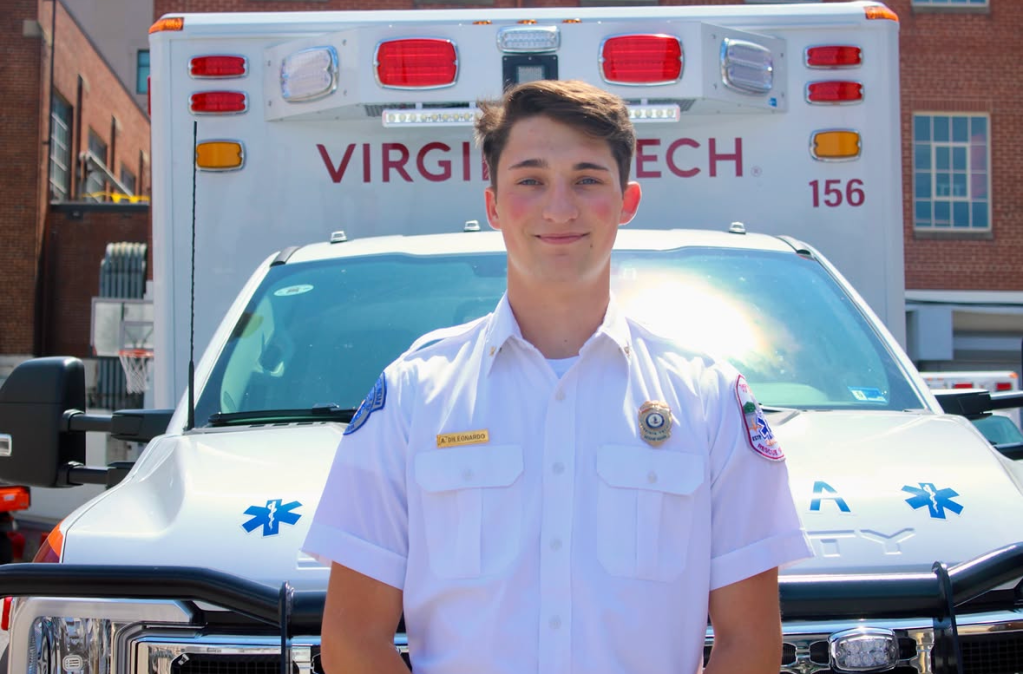
Senior undergraduate student and Virginia Tech Rescue Squad Chief Alec DiLeonardo has been a part of the Rescue Squad since his freshman year. This has given him firsthand experience with health and safety concerns on and around game days.
This interview has been edited for length and clarity.
Virginia Tech Rescue Squad Chief Alec DiLeonardo, courtesy of @vt_rescue on Instagram.
For a freshman experiencing their first game day, what are the biggest safety concerns they should be aware of?
For first game day of the year for freshmen, it’s an exciting time; you’re going out, you get to experience the Lane Stadium experience for the first time.
Some of the safety concerns that we, on a public safety side, want everyone to watch out for is obviously, a lot of people like to consume alcohol. We encourage you to be mindful, be smart, and to not overdo it.
Hokie Wellness actually has a really good web page called Party Positive. It has a whole page of things to consider, such as choosing if and what you drink, pace yourself, it’s not a race, eat before you drink, and make sure you designate a non-drinking driver.
So those are all things that we want people to take into account before they take a sip of alcohol. What could the potential consequences come of this if they are not responsible? This web page also talks about at what point it’s no longer just recreational drinking, and now we’re transitioning to alcohol poisoning, and when medical interventions need to take place.
If someone realizes their friend has had too much to drink, what is the safest next step?
So for us, where EMS and Rescue Squad intervene and where we get called for, on typical game days, weekends… it is a higher level of alcohol intoxication, so alcohol overdoses. Those usually are apparent if, say, your friend is now breathing abnormally. They’re breathing less than 10 times a minute. Those are things that we start to get concerned with, and where the alcohol has now transitioned from no longer just being an intoxicated state to now where medical interventions may need to be taken.
The biggest thing too is checking for pain responses. So give them a nice big old pinch right on the traps, right above your shoulder. Pinch them anywhere. If there’s no pain response, they don’t look up at you or speak to you after that, and they are fully unconscious; that’s when we encourage people to call 911.
Center Street is a big frenzy, and people are always excited to go there. That’s not our territory, but we do partner with Blacksburg Rescue and Blacksburg PD on that. Both of those agencies are staged at Center Street during the festivities. So if there is at any point where you feel a friend is either having a medical emergency or is showing signs of alcohol poisoning, find a police officer, find a rescue member, or just call 911.
Where should a student go if they start feeling sick or overwhelmed in Lane Stadium?
Kind of the same as if you have a friend, or you see someone in the stands or at Center Street, who’s exhibiting signs of unconsciousness, possible alcohol poisoning, or any medical emergencies that can pop up during these times. Find a police officer at any of the portals in the stadium, so the path out into the stands. There are always police officers there.
Come to one of our first-aid stations. They’re displayed on the scoreboard throughout the game. They are also indicated by the big red star or the cross over the doors. Any of our rescue members that are with Virginia Type Rescue will be in a high-vis vest. So either a lime green or a neon orange. That indicates that we’re EMS to people. Or, again, just call 911.
What mistakes do you see people making in their first few game days?
Overindulging or overintoxication is definitely one of the different things that we see. Some of it, too, is that they’re just not familiar with the area. So, getting lost, separating from their friends.
We always encourage you to stick together, whether you’re in a big group or not. Say you are in a group of 10, 15 people. Make sure there’s at least one or two people in there that you are always stuck with. One of the biggest things that we see is people coming to us solo. They don’t have any friends with them. Well, we need to find someone to release them with if they’re still in a certain state. In general, we encourage everyone to stick together. That’s for everyone’s safety as well.
With this new load-in procedure this year as well, when students enter the gates, pretty much whoever they’re standing with during load-in is who they’re going to be sitting next to. So when students are coming in through the portals to be seated into their seats, there’s actually going to be ushers putting them into rows, and whoever you’re sitting next to or standing next to going down the steps or going up the steps to your seat is who you are going to be stuck next to for the first half. Throughout the game, you can get a move around, but this is to help make load-in smoother and a lot safer for everyone as well.
What would you say to a freshman who’s afraid to get themselves or their friend in trouble by calling for medical help?
From an EMS side, this is something we deal with on a weekly, day-to-day basis. People are worried that they’re gonna get in trouble, and they won’t tell us stuff.
If your friend needs medical attention, call. We may ask you questions that may feel like you will get in trouble for. We are just trying to understand the full situation from an EMS side, how we can better treat that patient, your friend, if something has happened to them.