Ella Winterling, science and technology reporter
On August 24, 2026, Virginia Tech Athletic Director Brian White announced a plan to improve cellular coverage at Lane Stadium in his first address to the Virginia Tech Board of Visitors.
Cellular signal in Lane Stadium is often impacted on gamedays, with fans experiencing trouble sending text messages or making calls. A temporary solution will be put into place for the 2026 season, with a permanent solution following suit for the 2027 season.
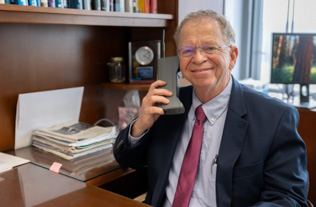
Jeffrey Reed, Willis G. Worcester Professor and co-director of Wireless @ Virginia Tech is a professor in the Bradley Department of Electrical and Computer Engineering. Reed’s areas of research include cognitive radio and smart antennas. In an interview ahead of Virginia Tech’s first gameday on Sept. 5, Reed spoke about the science behind cellular technology and what impacts cellular signals.
What’s your background in cellular technology?
I’ve been here since 1992. I was here during the early days of the wireless revolution. Before that, I worked for a defense company doing military communications and got my PhD at the University of California Davis looking at interference issues. It turns out that the key problem with cellular communications is interference issues. So it was natural for me to get involved within commercial wireless. I’ve been around, and I’ve seen a lot of things.
What is the basic science behind cell signals?
The basic science behind it and the key why cellular works is that signals get attenuated as a function of distance. So the farther you’re away from the cell tower, the lower the signal. Eventually, it reaches a point where the signal has degraded in strength enough where you could have another signal, and that could be from another tower that uses the same frequency. So, unlike a broadcast network, like a TV station or a radio station, it tries to maximize its coverage. The cellular networks take advantage of being able to transmit in a limited region and reuse the frequencies. That gives us the ability to reuse the channels, which allows for a lot more users to be able to use the spectrum, because we reuse the channels.
Is utilizing large cell towers still the norm for cellular networks?
The big cell towers are no longer really being deployed very often. It’s the small systems, the indoor systems that are very small. They may repeat the size of a Wi-Fi access point or a little bit more. Those have become popular, and cell sites that sit on top of a light pole — those are very popular. However, the big giant cell sites that people see from the highway — very few are being deployed.
Is it common for rural areas to have worse signals than urban areas?
That’s very true. There’s still places in the state in which there is very lousy cell phone coverage, if it exists at all. Mostly what’s being deployed now are low power systems that add capacity to the network. So you could have more simultaneous users of the cellular network. That’s the big problem in the stadium. You know, a touchdown happens, and people want to take a picture and send it to their friends and family. Everybody’s using their cell phone at the same time. There’s a capacity limit.
Are there other factors that would impact cell signals on a gameday?
If you’re moving or not, that could make a difference. It depends too on the frequency band that is being used. Lower frequency bands tend to have better propagation characteristics. They can go further. They’re not as likely to be blocked by obstacles. Higher frequencies, on the other hand, you have those issues. They tend to be shorter ranges and blocked by signals. Most of the new spectrum that has been released over the higher frequency, that’s because we ran out of spectrum in the lower frequencies. So now we have to resort to the higher frequencies, and the propagation characteristics aren’t as good.
Theoretically, what would updating the signal in Lane Stadium look like?
I suspect that they’re going to put more cell sites around. Even now, organizations such as Verizon bring in C.O.W.S. during a game. Cells on wheels. It’s a mobile cell site. They set it up to be able to handle the additional demand for the network. So they’ll probably deploy more infrastructure to be able to improve the capacity. They may use additional bands as well.
Does the quality of the cell signal change depending on the provider?
Yeah. Generally speaking, the best provider depends on the area. I’m not gonna go out on a limb and tell you what I think the best provider is, but if you don’t have good cell coverage, you can think about changing providers. It’s a matter of how much infrastructure they have and what frequencies you’re operating on.
What is the future of cellular technology innovation?
We’re in the 5th generation of cellular now, and starting next year, we’ll probably start the standardization for the sixth generation. So, engineers will be working together to come up with what that 6G standard will be. 5G was developed with three things in mind: mobile broadband access, ultra reliable and low latency communications and massive machine to machine communications. Mostly what people have seen, though, is the mobile broadband. We really haven’t seen much of the other applications yet. I suspect we will start to see them in 6G.
This interview was edited for length and clarity.