
by Kyndall Hanson, education reporter
January brought freezing temperatures and chilling winds to Southern Virginia, making local school districts weigh the costs of school closures with student well-being. Operational decisions made by administrators prompted backlash from local parents and community members.
“There are two sides to this,” commented Christina Chrisley on a Montgomery County Public Schools (MCPS) Facebook post notifying of a two-hour delay in the district. “Is attendance important? Yes. Is the student body and their safety during travels and waiting for buses in freezing temperatures, their health and well-being, more important? In this situation, I think so.”
According to the National Weather Service, areas across Montgomery County received 0.5-3 inches of snowfall from Jan. 6-7. Persisting freezing temperatures and icy road conditions in early January brought community members to express concerns regarding school operations through comments on MCPS Facebook posts.

During January, MCPS schools had two closures and two two-hour delays due to inclement weather. Pulaski County Public Schools (PCPS), a neighboring district, had two closures and four two-hour delays. The two days MCPS was closed, Jan. 6-7, were teacher workdays at PCPS and not considered closures due to weather conditions.
Robert Graham, superintendent of PCPS, said the district considers the weather forecast, temperatures, windchill, and the possibility for dangerous weather events when determining school closures on the basis of inclement weather.
According to MCPS policy, “the division superintendent or superintendent’s designee may order the closing, the delay in opening, or the early dismissal of any or all Montgomery County public schools in order to protect the safety and welfare of students, staff, and patrons.” MCPS was unable to provide comment on the explicit considerations taken into account in determining school closures or delays.
“Dr. Bragen, please think about some of our rural areas that have not been cleared and whose roads are sheets of ice, some teachers are still without power, and the temperature won’t go above freezing,” commented Alana Benavides, addressing Superintendent Bernard Bragen Jr. on an MCPS Facebook post. “It will feel like single digits, even at 9 a.m. when some students are having to wait for their bus at a stop – at those temperatures, frostbite is possible. Some of us have been fortunate enough not to worry about these things, but many other people do.”
According to Dr. Anne Washofsky, director of the pediatric residency program and interim section chief of pediatric hospitalists at Virginia Tech Carilion, children have a larger body surface area to mass ratio than adults, making them lose body heat more rapidly and be at a greater risk for cold weather-related ailments, such as hypothermia or frostbite.
“Kids aren’t always able to recognize or get out of environments that expose them to the risk of hypothermia,” said Washofsky. “That’s one of the reasons why it’s so important to make sure that they’re appropriately clothed, in particular, including a hat to help hold heat in their head when they go outside.”
MCPS transportation bus stop lists detail that students taking the bus are expected to be at their stops “five minutes prior to pickup time.” Stops for elementary school students may require up to 0.3 miles of walking and up to 0.5 miles for middle or high school students, meaning additional time spent in the cold on winter mornings.
According to Washofsky, brief periods spent waiting outside for buses in freezing temperatures, within a 20-minute window or less, are likely safe for children when they are appropriately dressed for the weather.
“Wearing hats, gloves, mittens, scarves, long sleeves, multiple layers, and making sure children are wearing stuff that’s water resistant is really important, said Washofsky. “Once you get that cold, that wet or damp, you’ll lose heat more quickly.”
While getting to school in cold weather may pose safety concerns, staying home for extended periods of time may have adverse health implications as well – especially for those who rely on the National School Lunch Program.
“It’s not just school lunches, but a lot of kids get their breakfast at school too – it might be two meals of the day,” said Washofsky. “Those might be their two biggest or primary meals based of family’s ability to otherwise provide.”
Six of 20 schools in the MCPS system offer free breakfast and lunch to students when school is in session. When schools are closed due to severe weather under severe weather code B and road conditions are deemed safe, meal services are available for pickup at specified locations. The district’s two January closures did not fall under severe weather code B.
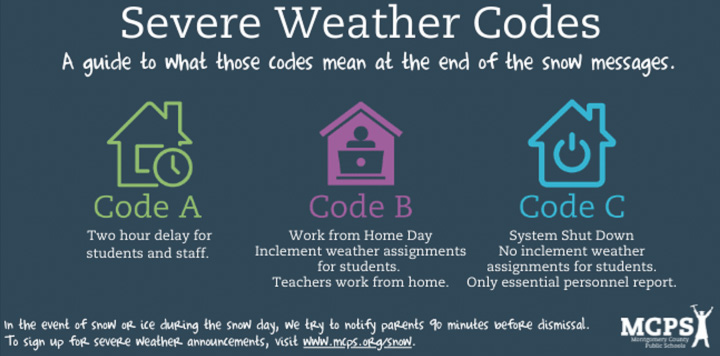
“Maybe it would have been better to simply open the schools for students and families without heat or power and offer meals like other counties are doing – for those who can make it there safely, of course,” said Lauren Black on an MCPS Facebook post. “Prioritize being human and empathetic rather than focusing on attendance and accreditation.”
According to the Code of Virginia, school closures due to “severe weather conditions or other emergency conditions” result in the addition of make-up days to the school calendar. Schools must be in session for 180 teaching days to avoid reduced funding due to closures.
“It’s not just that period that they’re outside in the cold, but there are a lot of other things that play into health if school is being canceled because it’s too cold to be able to go in,” said Washofsky.
 > THE NEWS FEED <