

By Julia Lagano, Politics reporter
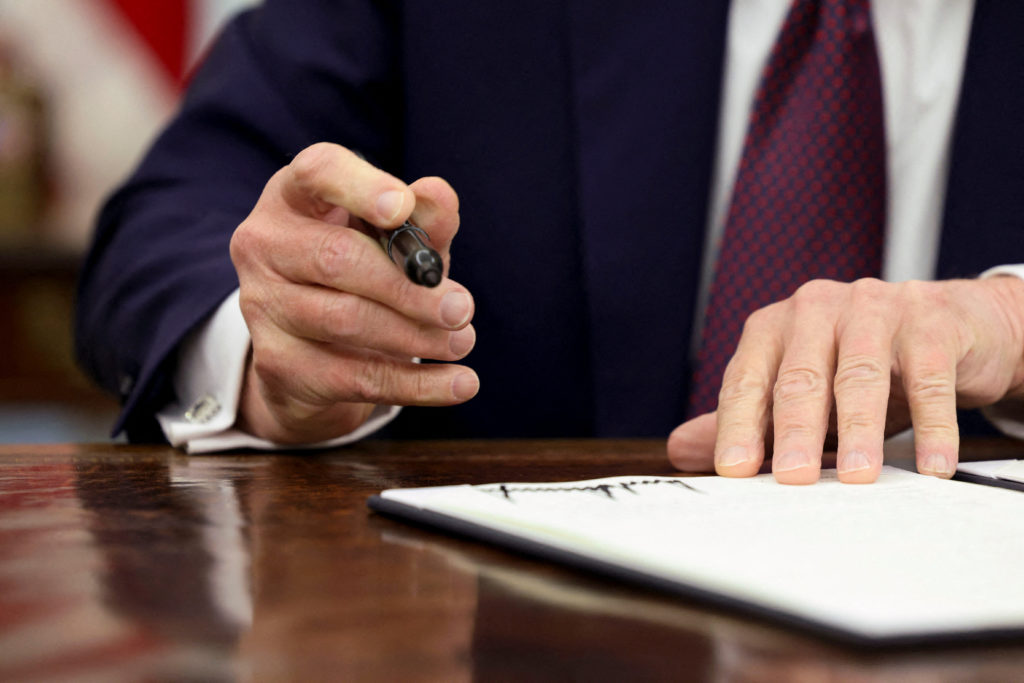
February 1, President Trump announced a 25% tariff on imports from Canada and Mexico. He also stated a 10% tariff will be applied on imports from China. Although these haven’t come into effect yet, the impact on the American consumer has already begun.
Why it matters: The economy is always a main concern for voters when it comes to the Presidential election. How will this candidate improve the economy? Many Americans felt that now-President Trump was the best fit for the job. One of President Trump’s main talking points during his campaign was to lower grocery store prices. He promised to do this on his first day in office.
Flashback: In 1992, the U.S., Canada, and Mexico signed the North American Free Trade Agreement (NAFTA). The trade pact was inspired by the European Economic Community. It eliminated most tariffs and other trade barriers between the three countries. The act provided mixed results; Mexico increased its exports. However, there was little economic growth for the United States and Canada. In 2020, a new trade agreement was enacted, the United-States-Mexico-Canada-Agreement (USMCA).
Zoom in: The average price for a dozen eggs in 2019 was $1.55. In 2025, it has soared to $4.95, a 219% increase. With this spike in prices, consumers nationwide are waiting to see the impact. They want to know how this will affect their community, like the New River Valley. There is concern for lower-income families. Will Supplemental Nutrition Assistance Programs (SNAP) adjust the allotted balances in response to these increases?
- “The estimated poverty rate in the NRV is about 19%, almost double the rate for Virginia as a whole. Poor people spend about 33% of after-tax incomes on food (compared to about 14% for the median household), explains Jeffrey Alwang, Agricultural and Applied Economics Professor at Virginia Tech
- “We do have a fairly good proportions of customers that come in with EBT,” Ella White, Assistant Store Manager at the local grocery store, Earth Fare, shares, “If they see a decrease in what their benefits are, then we will probably lose customers to stores that offer more economical choices.”

Zoom out: The United States relies on both Mexico and Canada for popular food and beverage products. These include fresh fruits, vegetables, and beer.
- “About 17% of food consumed in the U.S. is imported and Canada and Mexico are first and third in terms of value of exports to the U.S. (the E.U. is second),” says Alwang.
To be specific, fresh fruits are the biggest import from Mexico. Last year, that was about $9 billion worth. Avocados made up one-third of that total.
Yes, but: A tariff is a tax on imported goods. These taxes are paid by companies that import the goods in question. Advantages of tariffs are that they protect American industries, increasing federal revenue, and encourage domestic manufacturing. President Trump is using these tariffs to put “Americans’ safety and our national security first.” His approach of an isolationism is also a way to promote American companies.
- “It’s a bleak period right now,” White states. “I am trying to have a positive outlook on the whole thing. I would like to see that [the tariffs] will drive up the country’s economy by encouraging consumers to buy from within the United States.”
What we’re watching for: This was originally supposed to go into effect on February 4. Trump postponed the starting date to March 4. These tariffs could lead to a trade war with Canada and Mexico. The two countries have begun to retaliate in response. If the tariffs are implemented, only time will tell those effects, positive or negative, on groceries and Americans.



 > THE NEWS FEED <