
By: Eli Lamport, science reporter
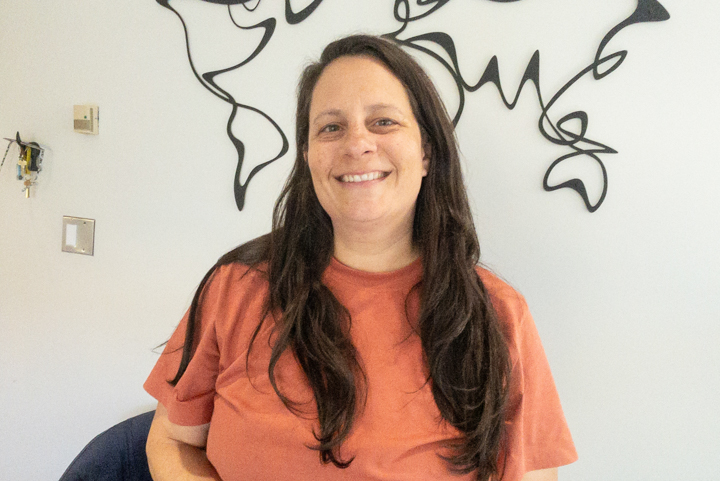
Dr. Korine Kolivras in her office in Wallace Hall, on Virginia Tech’s campus.
Dr. Korine Kolivras is a medical geographer with more than 20 years of experience in her field. At Virginia Tech, she has embarked on research into the spread of Lyme disease in the New River Valley area.
Dr. Kolivras also teaches several undergraduate courses and works directly with graduate students in Virginia Tech’s Department of Geography. I sat down with Dr. Kolivras to discuss her background, research, and thoughts on the current state of science in the United States.
(Editied for clarity)
You describe yourself as a medical geographer. Can you elaborate on that? What does that mean? What does your day-to-day look like?
Stepping back a little bit, as a geographer we study why things are where they are. So some people call it the science of where, because we’re understanding why is that type of plant here and not there? Why is this city here and not somewhere else? So I study why diseases and health concerns are where they are, what factors are unique to making certain places healthy or less healthy and also how diseases spread from place to place. So day to day, I do research related to that.
How do medical geographers work alongside other kinds of geographers, and what other fields does your work overlap with?
Yeah, so I collaborate with people within geography as well as in other fields and disciplines. It’s pretty interdisciplinary. So, within geography, we’re trying to figure out where diseases are, but oftentimes that’s where certain insects are. So it’s like, where are ticks living? Where they’re living, we’ve found that Lyme disease is higher, where we have land cover change, where we have different land covers next to each other. So a forest, a large forest patch next to a farm field, for example, that’s the type of place where we would have Lyme disease more typically. And so I could work with bio-geographers and people that study land cover change. And then outside of geography, I collaborate with people in epidemiology and public health, but also, I could collaborate with people in sociology, because they understand population patterns and population level decision making within society.
How did you end up in this field? Do you remember a moment where you realized this is what you wanted to do long term?
First of all, in K-12 education we don’t get a really good understanding of what geographers do. Students come into my class, and it’s just like memorizing capitals and where rivers are and stuff. That’s not really what we do, you know, the location of things is definitely important, but it’s more about what else is going on in that place?
In college, I started out as a Spanish major because I love to travel. I love languages, and then I just randomly took a geography class. And I’m like, oh my gosh, this is where the cool stuff is, the stuff that I’m excited about. So I switched my major to geography. And actually, it was my senior year of undergrad when I first took a medical geography class. It was fascinating to combine this idea of geography and why things are where they are, with thinking about human health. It also made me realize that I could do research that could make a difference. I feel like everyone deserves good health, and so by doing this kind of research, it could help with that. So I went on, I got my master’s degree and then my PhD doing medical geography related work.
You have done extensive research on Lyme disease trends within Virginia. Can you tell me more about that process, and why Lyme disease continues to spike in this area?
I first got started working on it a little over 15 years ago when the Virginia Department of Health noted that Lyme diseases were increasing in Virginia. I think the number of cases tripled over a 20 year span, and they were looking to do a study to try to understand why that was happening. And so that’s when I first got started on it. And then eventually I got funding from the National Science Foundation, which was critical in getting this research started and trying to understand Lyme diseases spread. Early on, we had a lot of cases around northern Virginia. There’s a lot of people living there. There’s also a lot of suburbanization. Suburban areas are often hotspots for the disease. Starting around 2014, the New River Valley was a hot spot. We had a lot of cases down here. So my research is centered around trying to understand why that spread happened and why some places have high rates of Lyme disease and some places have low rates.
Even when we standardize and adjust by population, some areas stand out as having a lot of cases. And so what we found is that within plots of land that had high rates of forest patches next to herbaceous land. So like a pasture, a farm field, you know, grassy areas, those were the census tracks that had the highest rates of Lyme disease. And honestly, if you drive around, that’s what a lot of neighborhoods around Blacksburg are like. And honestly it’s kind of a cultural thing where that’s what we want our suburban developments to look like. We want to live in areas where you’re close to forest or greenspace, which is understandable, but at the same time, it supports this Lyme disease cycle.
How do you feel about the state of your field going forward?
I’ll speak about science more broadly. The United States has been an innovator and leader within science for decades. Developing new things, new solutions, discoveries. And I am a bit concerned about the decreased focus on research funding that we’ve seen recently. I’ve gotten funding from the NSF, and that’s definitely something that could be in jeopardy. Science research is so important, and I’m not just saying that as a researcher, but also as a member of the public.
 > THE NEWS FEED <