
By Evvy Fite, health & wellness reporter.

Among the many difficulties faced by rural communities, one that often goes unnoticed and under-discussed is the prevalence of substance use and abuse. In many cases, the resources that could help are few or non-existent, and life’s circumstances leave people defeated and more likely to turn to drugs or alcohol.
Why it matters:
- According to the Rural Information Health Hub (RIHH), “substance use disorders can result in increased illegal activities as well as physical and social health consequences, such as poor academic performance, poorer health status, changes in brain structure, and increased risk of death from overdose and suicide.”
- These problems perpetuate existing difficulties within many rural communities, and in many cases people in these areas are held back from improving themselves and their lives because of them.
- The vicious cycle of substance abuse and other compounding problems holds these communities back and makes them a place to get out of, rather than a home to be proud of.
The big picture: RIHH states that “factors contributing to substance use in rural America include:
- Low educational attainment
- Poverty
- Unemployment
- Lack of access to mental healthcare
- Isolation and hopelessness
- A greater sense of stigma”
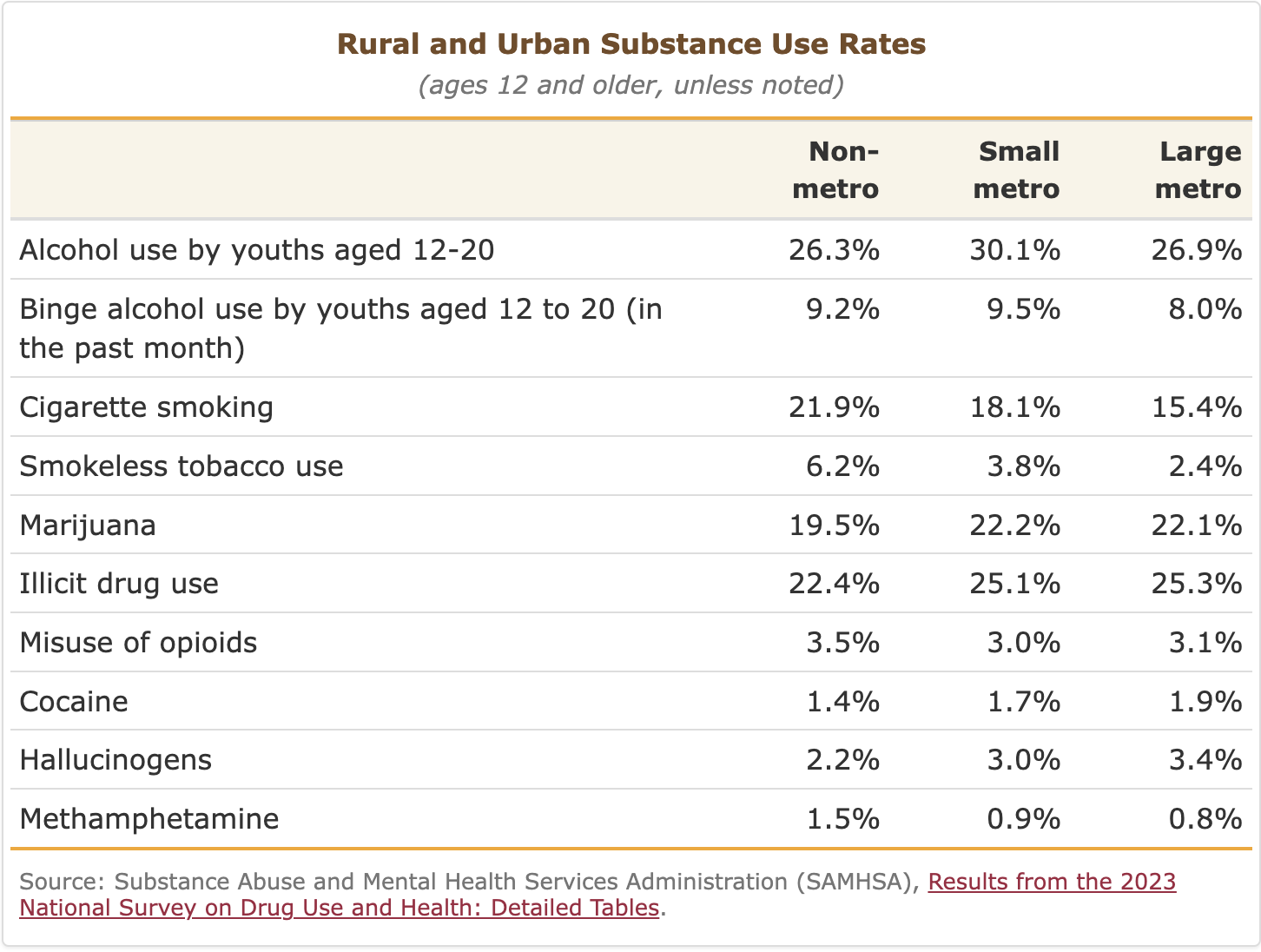
Alcohol and nicotine are the most notable offenders.
- According to the RIHH chart on Rural and Urban Substance Use Rates in youths age 12-20, youths in non-metro areas use and abuse alcohol at similar rates to youths in metro areas, but use cigarettes, smokeless tobacco and methamphetamine at significantly higher rates.
Zoom in: The New River Valley is very rural, with over 15% living below the poverty line and nearly 25% considered cost-burdened.

- A 2021 New River Valley Community Health Assessment by Carilion Clinic on the overall health of the NRV community found that “rates of drug overdoses higher than the national and state average [were] present in the New River Valley—especially in Pulaski and Wythe County.”
- As may be expected, those two counties also have the highest percentages of their population living below the poverty line – 24% and 21% respectively as of 2021.
In addition to substance abuse problems, the New River Valley also sees a large portion of the population experiencing other health problems.
- Chronic disease rates are higher than the Virginia average, including chronic lower respiratory disease, coronary heart disease and high blood pressure.
- Carilion Clinic also reports that much of the population lives in food deserts, and that “23.8% of adults report no leisure time physical activity.”
These are the situations that lead people to use and abuse substances.
- An updated 2024 New River Valley Community Assessment by United Way of Southwest Virginia found that rates of death by drug overdose have been climbing since 2018, with an increase of 105% in the past five years.
What is being done: Various organizations in the New River Valley are working to provide the resources that are often lacking in rural communities.
- With 18 facilities across the area, New River Valley Community Services (NRVCS), which is part of the Virginia Association of Community Services Boards, has provided addiction treatment, resources for developmental disabilities, mental health services, psychiatric services, prevention resources and community transportation since 1969.
- NRV Road to Wellness provides many similar services, as well as resources for vaccination and immunization, international travel, environmental health and family planning.
The existence of any resources is a major step forward.
Yes, but: Despite the efforts of these organizations, rates of addiction and health issues in the New River Valley remain high.
- Even though resources are present, greater effort will be needed to connect people with those resources and decrease the stigma of asking for help.
- Time and the next NRV Community Assessment will tell how effective these resources truly are and what more is needed to free the New River Valley community from the shackles of substance addiction.
 > THE NEWS FEED <