“What We Were Wearing” – Virginia Tech Student Exhibit Advocating for Survivors

By: Zain Omar, arts & culture reporter

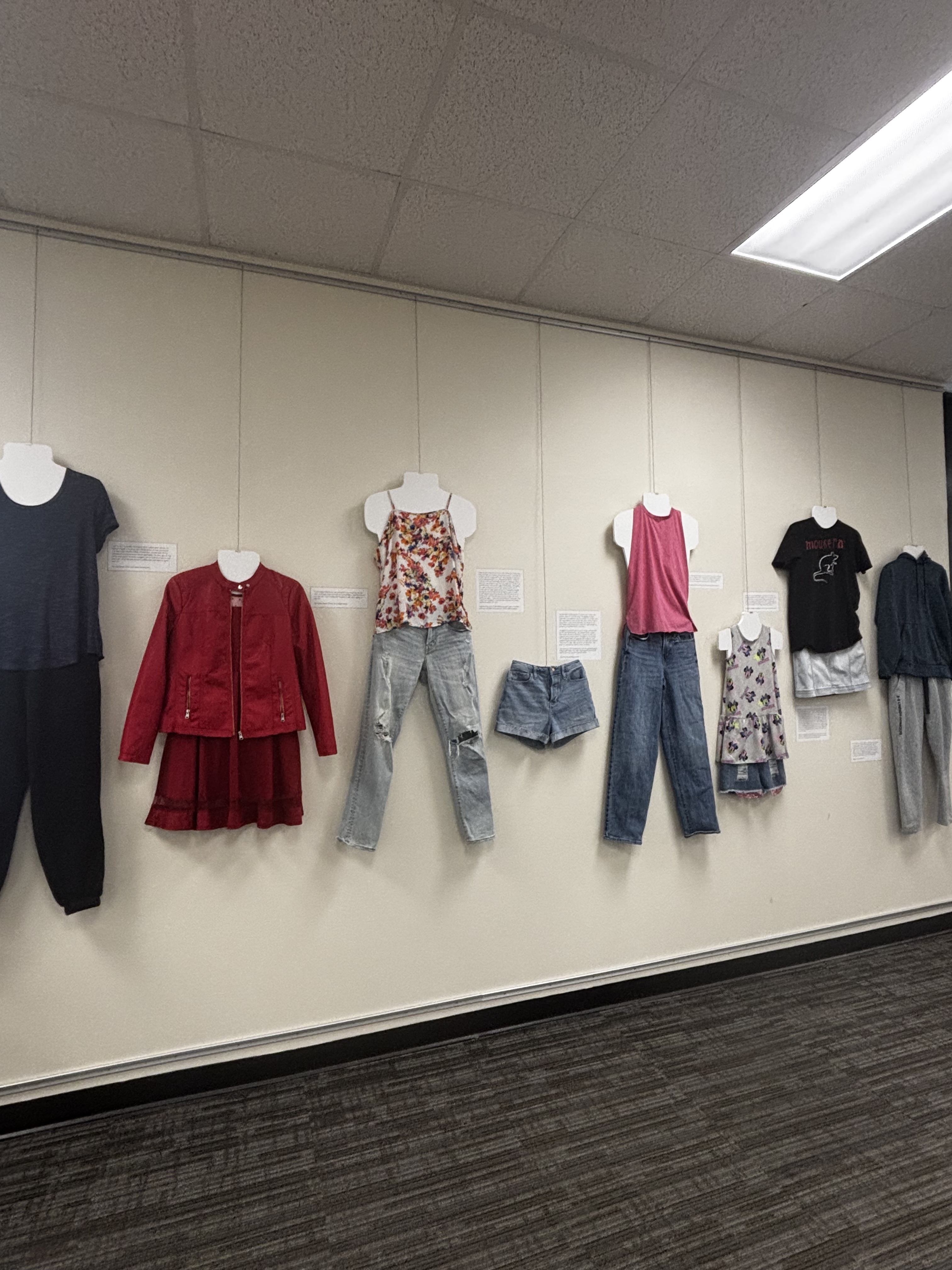
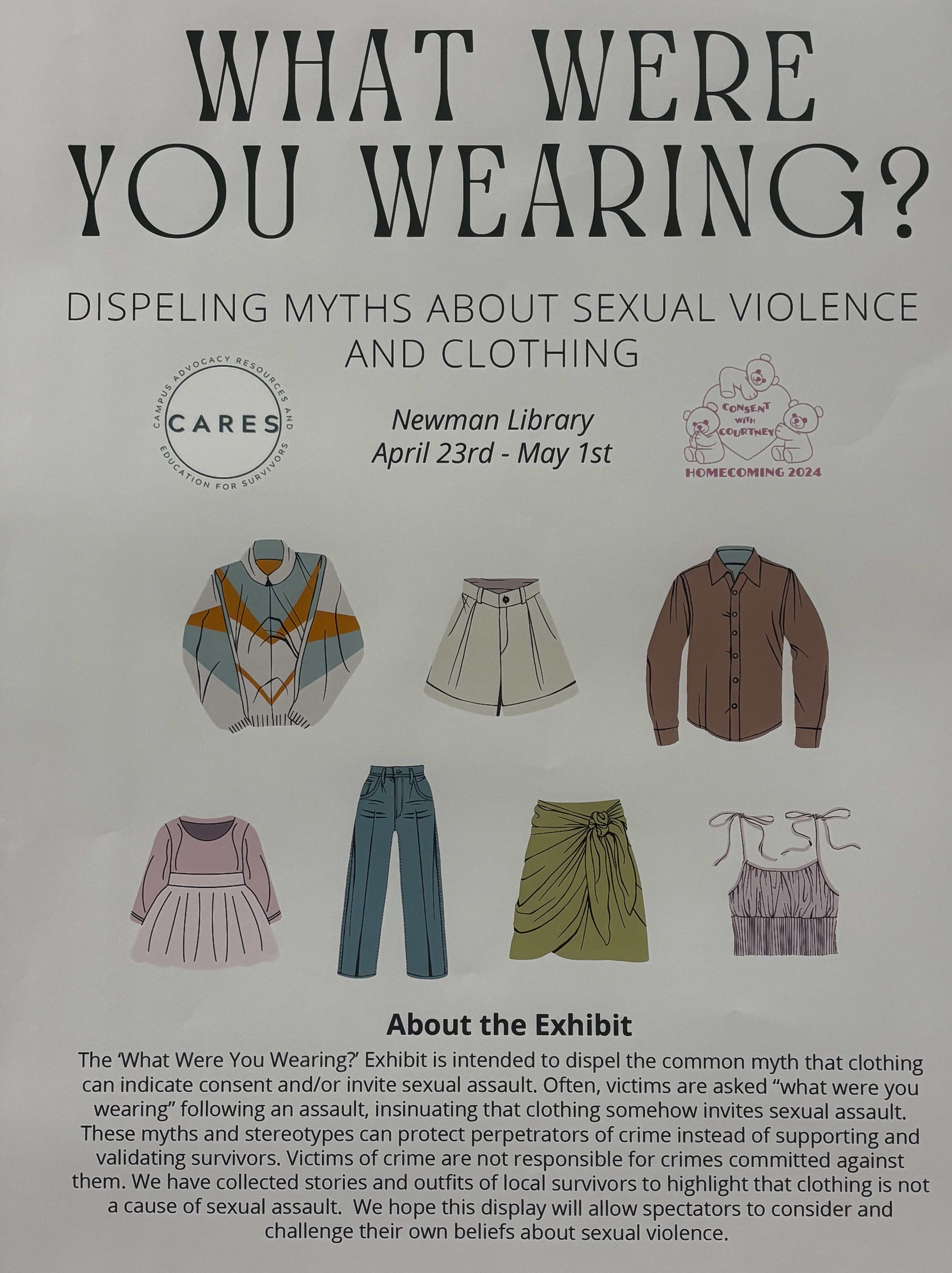
In collaboration with the Women’s Center at Virginia Tech, graduating senior Courtney Bergeron, debuted an installation titled “What We Were Wearing”. The exhibit was part of Bergeron’s homecoming platform, Consent with Courtney, and was on display in Newman Library from April 21st until May 1st.

The exhibit showcased clothing that local victims were wearing when they became a victim to sexual assault. The purpose of the exhibit is to challenge thoughts that what a person is wearing is equivalent to consent. The clothing in the exhibit represents a range of ages and genders, showing exactly what the person was wearing when the act happened.

Bergeron’s personal experience with sexual assault was the main motivator to start Consent with Courtney. “As a victim of sexual assault, I made it my mission to help others just like me. I faced a lot of challenges when going through the medical and legal process and most of it was from lack of knowledge. I knew if I could have a platform, I could spread information I wish I had,” Bergeron said.

After Bergeron’s own sexual assault case was dismissed, she decided she wanted to make a change. Bergeron shared her story on the Consent with Courtney Instagram to show others they were not alone and to better educate everyone on the subject. She became a victim to sexual assault her freshman year at Virginia Tech and the Women’s Center was one of the main advocacy sources Bergeron worked with.

 In a statement on Consent with Courtney’s official account, Bergeron stated, “Instead of harboring anger for my situation, I took that hate and turned it into passion to help others just like me. I never want anyone to go through what I went through.”

“What Were You Wearing” exhibits have gained popularity worldwide. With a rise in activism against sexual violence and campaigning to give voices to all victims of sexual assault, exhibits dismantling the stigma against sexual assault have become an international trend.

The What Were You Wearing exhibit was first conceptualized when The Director of The Sexual Assault Prevention and Education Center at the University of Kansas, Jen Brockman and Dr.  Mary A. Wyandt-Hiebert from the University of Arkansas Rape Education Center, attended a reading of Dr. Mary Simmerling’s poem “What I Was Wearing”. The poem touches on Simmerling’s feelings of dealing with the aftermath of sexual assault and having everyone ask her about the outfit she was wearing, as if that caused it.

According to the Sexual Assault Prevention and Education Center at the University of Kansas, “Dr. Wyandt-Hiebert and Ms. Brockman wanted to create a project that would place the work of bearing witness to this question’s answer back on the shoulders of the community and humanize the survivor in the answer. To ask the question, ‘what were you wearing?’ cost the questioner nothing, there is no labor in making this statement. However, the survivor must pay dearly in not only their answer but also, in the burden of self-blame.”

One of the largest exhibits of this kind was held by the United Nations. The exhibit originally had 5 outfits, each representing a different region in the world. By July 2022, the exhibit grew to feature 103 outfits. These outfits represent the 1.3 billion sexual assault survivors worldwide.

The United Nations exhibit had many celebrities, business leaders, and influential figures from around the world sharing their stories of sexual assault. The United Nations exhibit put the issue on a grand scale to show no matter where you are from or what you are wearing, the fault is not with the victim.

The exhibit is meant to show that clothing does not offer consent or permission. Sexual assault can happen in any outfit, at any age, and any place. These exhibits ensure survivors that what they were wearing is not what caused their assault, it was the person who committed the act.

“It’s not the clothing that causes sexual violence; it’s the person who causes harm. Being able to find that peace for survivors and that moment of awareness for communities is the real motivation behind the project,” stated Brockman in an interview with Huff Post.

Courtney not only wants to help provide a platform for survivors but also educate everyone on the concept of victim blaming, especially around sexual assault.

“I hope they see that sexual assault can happen to anyone at any time. Clothing is not consent. It does not determine your safety or your worth. The only way to end this horrible issue is to come together as community, educate ourselves, and support survivors,” Bergeron said.

The Women’s Center at Virginia Tech provides advocacy and care to women facing any issue related to sex or gender. The CARES program has a direct focus on advocacy to victims of sexual assault and other forms of harm.

“CARES stands for campus advocacy, resources and education for survivors, so our primary objective is to just provide support and advocacy to students, faculty and staff of all gender identities that have experienced any kind of sexual violence, domestic violence, stalking or harassment. We do that primarily through advocacy-based counseling, we also do a lot of resource recommendations and accompaniments. For example, some of the resources that are available for students is the Title IX office and the Virginia Tech Police Department or the Blacksburg PD. With accompaniments, what that means is we can go with students or faculty who are making reports or meeting with Title IX or the police to kind of act as a third-party, emotional support person, so they don’t have to go through the process alone,” said Bailey Williams, Advocacy Coordinator for CARES.

The Women’s Center also has resources for students and faculty to better educate themselves on sexual and domestic violence. They host events and give presentations to classes and organizations to help them learn more about the Women’s Center and how to get more involved. The Women’s Center also has a webpage where they have all the advocacy resources that they provide listed.

Bailey Williams said, “Obviously doing the research is always a big part of that, taking the time to really understand what consent is, why sexual violence occurs, there’s a lot of really great research and literature out there. Coming to events hosted by the resources that are designed to aid students following an assault is also a big one, we do a lot of tabling and outreach events. Organizations and classes can also request presentations from us. Keeping an eye out for what the resources have available and take the time to do outside research.”

The community of Blacksburg saw the exhibit as a source of comfort and solace, especially those who are victims of sexual assault. Students and other community members felt welcome to share their stories and open about their own experiences.

“I received several messages from survivors and families of survivors reaching out and thanking me for speaking out on this sensitive topic. There is such a stigma around sexual assault and people are scared to talk about it. I am continuously trying to break the stigma. Having the people of this community reach out and let me know that I was helping them was genuinely so rewarding. I said when I started this all if I helped just one person this would all be worth it, and I feel like I really achieved that goal,” Bergeron said.

Bergeron hopes to continue making a difference with her platform after graduation. While she will no longer be in Blacksburg, the Women’s Center at Virginia Tech hopes to keep the legacy going.

“Unfortunately, I will be graduating, so I will be continuing my fight in Northern Virginia. However, we raised over $1000 for the Women’s Center to continue their support of sexual assault victims and educating the community. They hope to make this an annual event,” Bergeron said.

While Bergeron will not be in Blacksburg to continue her platform in the future, the Women’s Center is hoping to keep educating students. The Women’s Center is available to any students and community members looking to learn more or find support regarding sexual assault.

A semester of protests at Virginia Tech

By Wilbert Ramirez, politics reporter

Student protests were frequently observed during the 2025 Spring Semester at Virginia Tech in response to rapid changes made by federal and university administrations.

The protests were from a large variety of different student organizations that had different goals in mind against university policy regarding Virginia Tech’s policy changes due to the new Presidential administration in the United States.

On Jan. 20, President Donald J. Trump enacted executive order 14151 titled “Ending Radical And Wasteful Government DEI Programs And Preferencing,” which stirred confusion among universities and educational institutions around the United States – Virginia Tech included.

Student researchers at the university underwent a “chilling effect” regarding speaking publicly about their research in fear of retaliation from the Presidential administration. Virginia Tech students questioned from the Diplomacy Lab and other social science research requested         The Newsfeed for anonymity to speak freely without fear of retaliation to themselves or their colleagues.

A protest by the Students United Front began on Feb. 21 with students protesting any future action of letting U.S. Immigration and Customs Enforcement or ICE on to Virginia Tech’s campus. The SUF’s worries were propelled by earlier emails sent out by university admin on Feb. 18 discussing what staff such as professors should do if an ICE officer is seeking a student in their classes with bulleted topics regarding “points of contact, private spaces, and communications and rights.”

The situation regarding student protests was then galvanized following the arrest of Mahmoud Khalil on March 8 of a pro-Palestinian student leader at Columbia University who was detained by ICE officers after his green card was revoked.

The next protest of many at Virginia Tech was an emergency protest march by the organization “Students for Justice in Palestine,” which met and marched from the Pylons memorial at the university to the townhall in downtown Blacksburg. The organization called for Virginia Tech to divest from Israel and weapons manufacturing organizations that supply the Israeli military.

The protest was in response to the ceasefire between Hamas and Israel being broken by the state of Israel.

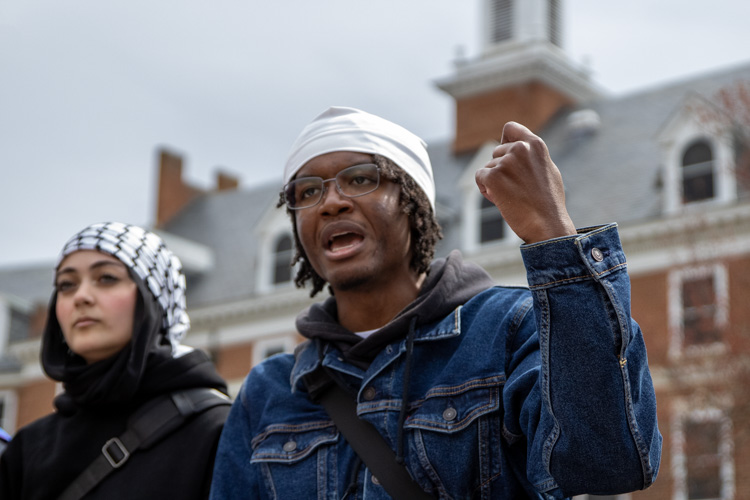
Shahed Sanuri (seen left holding megaphone) and pro-Palestinian student Protesters gather at the Pylons memorial at Virginia Tech, in Blacksburg, VA. Wednesday March 19, 2025 (Photo, Wilbert Ramirez)

“There’s no time for us to debate whether we should be fighting for Palestine or fighting against injustice because it’s Palestinians today and it’s happening to us today, but it could be anybody else tomorrow.”

Shahed Sanuri

Shahed Sanuri, a first-year graduate student at Virginia Tech and co-president for Students for Justice in Palestine is an ardent supporter of the Palestinian rights and recognition.

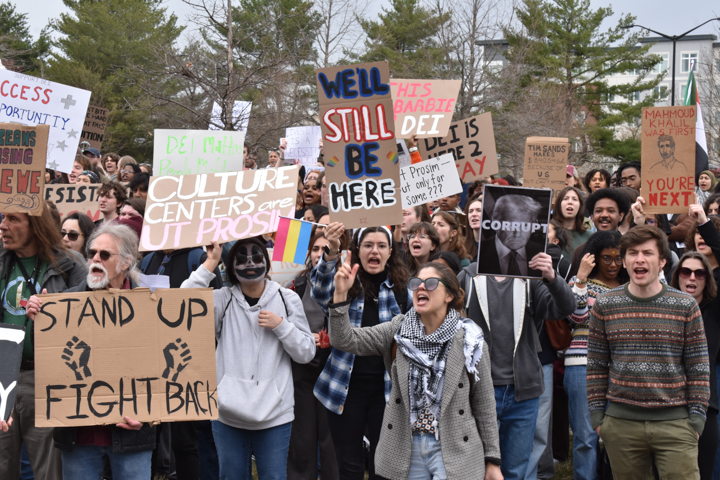
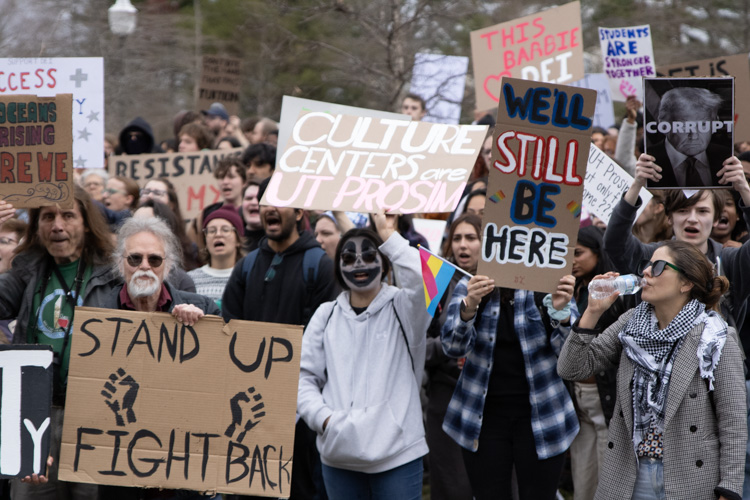
The largest and most diverse of the protests organized was the march for civil and human rights in response to the board of visitors decision to eliminate the DEI office at Virginia Tech on March 25. The march involved a wide coalition of many organizations such as Black mindedness, Students United Front, Students for Justice in Palestine, and students from varieties of backgrounds. Approximately upwards of 1000 people participated in the march according to organizers of the march.

Protesters gather in front of the Skelton Inn at Virginia Tech, in Blacksburg, VA. Tuesday March 25, 2025 (Photo, Wilbert Ramirez)

“It’s one thing to be able to get 1000 people to show up one day, and it’s when you’re comparing it like qualitatively, how does getting 1000 people to show up one day compare to getting 50 to 100 people to show up every single week, you know, for months, right?,” said Cameron Baller, a PhD student in Sociology at Virginia Tech with a Bachelors in Natural Resources and Environmental Science, Minors in Gender and Women’s studies and Economic with an interest in researching social movements. “That’s another kind of lens in which I would be thinking about the history, the recent history of protest on this campus.”

The board of visitors at Virginia Tech went through with the vote to eliminate the DEI office at Virginia Tech in a 12 to 2 vote.

Another moment that galvanized students at Virginia Tech to protest involved the sudden revoking of international student visas around the country including seven Virginia Tech students and 2 alumni on April 9.

President Tim Sands of Virginia Tech released a statement issuing information to assist those who may have been affected.

The following day on April 10 the “Latino Association for Student Organizations” carried out a protest marching through campus against ICE enforcement and student speakers noted the revocation of the international student visas as one their largest grievances in speaking out against the U.S. presidential administration’s decision.

Student protesters gather at the Pylons memorial at Virginia Tech, in Blacksburg, VA. Thursday April 10, 2025 (Photo, Wilbert Ramirez)

“It’s very heartbreaking and disheartening to see how higher education administrations don’t really give mind to why students are protesting and they’re not really trying to find an active solution towards that,” said Tiffany Suarez the newly elected president of Latino’s for Student Organizations at Virginia Tech and an undergraduate majoring in environmental policy and planning and political science. “I feel like I’ve been seeing a lot of protests, almost every week, and the result of that has honestly just been the administration, turning their back on us not being responsive, not wanting to be at the table and constantly making up excuses about their unwillingness to cooperate with the students.”

The Trump administration reversed the decision of revoking the student visas on April 25 following numerous lawsuits contesting the terminations of visas.

The organization “VTforClimateJustice” held a climate protest on Earth Day, April 22, in front of Burruss Hall that then proceeded to march across campus and ended at the Pylons. The grievances by the organizers consisted of calls for Virginia Tech’s administration to be more transparent regarding Virginia Tech’s climate goals and where the university was currently at in meeting said goals.

In one of the final major protests on Virginia Tech’s campus this semester, Students for Justice in Palestine had a 1-year anniversary protest remembering the arrest of 82 pro-Palestinian protestors that included 53 students the year prior on April 29, 2024 following their 3-day encampment.

The protestors called for the need to stay strong to their cause of getting Virginia Tech to divest from Israel and weapons manufacturers at a time in which rapid changes are shifting against protesting on college campuses around the nation and at Virginia Tech.

The protests and their frequency at Virginia Tech this spring semester signaled an immediate resistance to the rapid, uncertain, and wide range of changes that began with the Trump administration and its combativeness against higher education institutions that challenge the president.

The largest of the educational institutions to rally against the U.S. president is Harvard in Boston Massachusetts, which sued the administration for freezing $2.2 billion in funding to the university. The Joint Task Force to Combat Antisemitism of the Trump administration announced the freeze in funding because of the university’s failing to protect its Jewish students after Harvard refused to comply with a list of demands from the administration.

Student protests around the nation culminated under a time of great uncertainty for their rights and causes depending on their citizenship, international status, and background.

“I think to be a protester, especially during this administration is to have the courage to stand up for something, knowing that there could be legal implications involved.”

Tiffany Suarez

“I think there’s a level of courage that we haven’t seen beforehand in the student protesters on campus – people knowingly going out and protesting given that people are getting their visas revoked.” Said Suarez. “People are actively getting targeted by ICE officials because of their support for either Palestine or criticism of the current administration. I think that shows a new level of courage that I don’t think we haven’t seen in college campuses in quite a while.”  

DEI Removal Sparks A Semester of Outrage at Virginia Tech

By Nyles Stone, politics reporter

(Nyles Stone/ Politics Reporter) Picture taken from the We Will Not Go Back Civil and Human Rights March

The start of the Spring 2025 semester at Virginia Tech was marked with uncertainty among students and faculty alike due to the January 20th executive order 14151, which was aimed at dismantling diversity, equity, and inclusion initiatives across all federal institutions. Many faculty grappled with the anxiety of the potential changes, while students all around the campus came together and planned for change, the professors, faculty, and staff were struggling to find a voice.  

Dr. Brandy Faulkner, Professor in the College of Liberal Arts and Human Sciences talks about the uncertainty the DEI removal brings, and the amount of stress it caused to faculty when it was first announced. 

“There was so much uncertainty. Nobody really knew what was going to happen or where we would end up. And so, there was nervousness, there was some fear, there was anxiety.”

Dr. Brandy Faulkner, Professor at Virginia Tech

The executive order, titled “Ending Radical and Wasteful Government DEI Programs and Preferencing,” mandated the termination of all DEI-related mandates, policies, programs, scholarships, funding, and activities associated with federal agencies. Furthermore, all DEI-related workers were forced to go on paid administrative leave Jan. 22. The order characterized DEI as causing a divide, promoting that special treatment was being given instead of equality, a claim that drew backlash from educators nationwide. Public universities like Virginia Tech that rely on federal funding followed suit with the executive orders, with many universities getting rid of grants, academic programs, and student and faculty support services tied to DEI. 

In response to the executive order, the Virginia Tech’s Board of Visitors came together to discuss the potential outcomes, and on March 25, the Board of Visitors voted to dissolve the university’s Office for Inclusive Strategy and Excellence, which oversaw more than 700 DEI programs across the university. This led to speculations of things that could be removed from classes, funding, and student organizations. The Board of Visitors decision sparked outrage around the campus, leading to protest outside of The Inn at Virginia Tech and Skelton Conference Center, where the Board of Visitors gathered to make their decision. Students, Faculty, and Staff all gathered in dismay over the decision to get rid of the DEI programs, with over 1,000 people in attendance. 

(Nyles Stone/ Politics Reporter) Students and Citizens of Blacksburg Gathered at The Inn at Virginia Tech

“Absolutely, there was fear about classes like Africana Studies getting shut down, because we didn’t know,” Dr. Faulkner said. “We don’t yet have the answers to whether some of our courses are going to disappear, whether they might be renamed, whether the content will have to change. So, there is still a whole lot of uncertainty, even as we are at the end of the semester and already thinking about next year.” 

The environment of fear and speculation paralyzed many departments, with an alarming amount of distress on whether some faculty were going to able to keep their jobs. “There was a lot of hesitancy. Nobody wants to be a target,” Faulkner explained. “It felt sometimes that to even talk about was to just speculate because we had nothing concrete.” 

For Faulkner and other Virginia Tech faculty and staff, the implications of the DEI removal are deeply imbedded into their professional workplace. “That fear of the unknown is still continuing. Some things have been solidified; we know research funding for NSF grants and NEH, much of it has been taken away if it was classified as DEI-related,” she said. “Now there are more conversations about those kinds of things and how we will move forward, but you still see a lot of hesitancy.” 

Yet, even with the removal of DEI-related programs and the Office for Inclusive Strategy and Excellence, none of this was new to Dr. Faulkner.  

“As a black faculty member at a predominantly white institution, I have to assume day to day that this could happen at any time, that’s my lived experience,” Faulker said. “We know, if we study history, when there are gains, there will always be pushback and plans to undo the progress.”  

This semester brought tough conversations into the classroom for Dr. Faulkner. With the loss of a grant and gaining more evidence of what Faulkner calls the university’s “constant and open opposition” she remains determined, aiming to stay vigilant, reminding students and faculty that they must continue moving forward. Dr. Faulkner even expressed happiness for the powerful student leadership seen on campus. “I’ve been so proud to see students decide that they are going to be engaged, to do what they can to protect not only themselves, but their community.”  

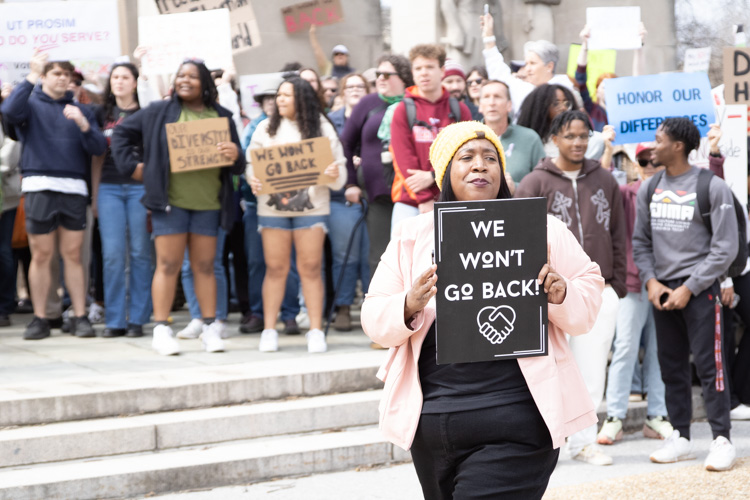
When reminiscing about a moment of student leadership that stands out, Dr. Faulkner mentioned the We Won’t Go Back March for Civil and Human Rights, highlighting the march as something she was proud of. With the march being organized by multiple student organizations, Faulkner iterated her happiness for Black Mindedness founder Emon Green, with him being at the forefront of many of the university protests. 

(Nyles Stone/ Politics Reporter) Picture of Dr. Brandy Faulkner at the We Won’t Go Back Civil and Human Rights March

The civil rights march stood as a reminder for Dr. Faulkner, with the thousands of students, faculty, and staff in attendance, it showed Faulkner that she is not alone, saying that “there are plenty of people who don’t want us to take these progressive steps backwards.”  

Despite the Board of Visitors decision, organizations like Black Mindedness have continued to advocate for inclusivity and community support. “Honestly, with Black Mindedness, it’s not difficult. Our organization has no affiliation with Virginia Tech, so we aren’t subject to the immediate impact of these type of decisions.” said Emon Green, a senior majoring in philosophy, politics, and economics and founder of Black Mindedness. “I think we will face a generative type of difficulty that comes with the process of building alternatives for what is being taken away with the dismantling of DEI.” 

(Nyles Stone/ Politics Reporter) Picture of Emon Green at the We Won’t Go Back Civili and Human Rights March

Julia Alexander, a senior majoring in wildlife conservation at Virginia Tech voiced her frustration with the dismantle of DEI and the Board of Visitors decision. I’m disappointed by the removal of DEI positions and the insensitive impression of the Board of Visitors towards the protesting students,” said Alexander. 

While Alexander, unlike Emon, is not a part of organizations aimed at building community, she found the use of DEI beneficial when needing someone to talk to. With her majoring lying in the College of Natural Resources and Environment, a college according to an article published by College Factual, 78% of students in the College of Natural Resources and Environment are White, with African American making up only 1.7% of the college.  

“As a student at Virginia Tech, I looked to the director of DEI in my college for advice, it felt more comfortable speaking with someone who understands the perspective of a minority at a predominantly white institution,”

Julia Alexander, Wildlife Conservation Student

Alexander elaborated that DEI was something symbolic, talking about the use of cultural centers in the Squires Student Center, the living-learning communities, and the acknowledgements of an inclusive campus all around the university. Alexander, who stayed three-years in the Ujima living-learning community talked about how communities like Ujima helped get opportunities that tailored to minority groups, “It was a way to stand out and get opportunities, DEI has supported my success in college, and I wouldn’t have as many professional and personal development opportunities without it.” 

As the spring semester comes to a close and the effects of the executive order continue to unfold, the Virginia Tech campus remains caught between student outcry, and faculty hesitancy. While academic grants, programs, and voices within the institution have dwindled, many within the community are finding ways to speak out, with organizations like Black Mindedness continuing to advocate for civil justice  

“It makes me mad as hell. I’m angry. People have poured their hearts, their time, their energy into making Virginia Tech better, a more welcoming, inclusive, fair, and equitable campus, To see that work just wiped away makes me extremely angry.” 

Dr. Brandy Faulkner

Transgender healthcare faces increasing challenges from the Trump administration

by Evvy Fite, health and wellness reporter

Amid the wave of conservatism currently present in the United States, one major focus of the Trump administration has been to restrict freedoms and limit access to gender-affirming healthcare for transgender Americans. Between executive orders, rising sentiments of hate, and doctors refusing to accept new patients for transgender healthcare, many U.S. citizens are scared for their rights, their safety and their lives.

Medical care bans for transgender youth as of April 29, 2025. From lgbtmap.org.

At the end of January, President Donald Trump signed Executive Order 14187, titled “Protecting Children from Chemical and Surgical Mutilation,” on January 28. According to the Center for Reproductive Rights, “The order specifically asks agencies to ensure that hospitals, medical schools, and other institutions receiving federal research and education funding stop providing such care to minors.” Interestingly, the order restricts gender-affirming healthcare for Americans 19 and under, despite the fact that Americans are legally adults at 18.

Previously, President Trump had signed a series of executive orders targeting transgender Americans. Within hours of returning to the White House, he signed Executive Order 14168, “Defending Women From Gender Ideology Extremism and Restoring Biological Truth to the Federal Government,” which stated that the federal government would only recognize binary sex as assigned at birth. He also reinstated the previous ban on transgender individuals serving in the military. 

Executive Order 14187 was placed under investigation by the U.S. Department of Health and Human Services (HHS), but as of May 2025 is still in effect.

“It is arguably one of the worst times to be trans in the USA since the AIDS epidemic in the 80s.”

H

Restrictions on healthcare could have massive impacts on the physical and mental health and wellbeing of millions of Americans.

Hormone Replacement Therapy, known colloquially as HRT, is a lifeline for many people who do not feel at home in the sex they were assigned at birth. A study conducted by the Trevor Project found that between 2018 and 2022, “anti-transgender laws significantly increased incidents of past-year suicide attempts among transgender and nonbinary youth by as much as 72%.”

Study Links U.S. Anti-Trans Legislation and Suicide Attempts. From Statista.

A student at Virginia Tech, who has asked to be referred to as H, said “The illegalization of trans medicine will cause the deaths of trans people from mental health. It’s proven that HRT is the #1 way to decrease trans depression and suicide rates. Think of it as a proven medicine to help the known illness of Gender Dysphoria. By eliminating this, you risk the lives of millions.” H also shared their experience being trans at this point in history, saying “it is arguably one of the worst times to be trans in the USA since the AIDs epidemic in the 80s.” 

“82% of transgender individuals have considered killing themselves and 40% have attempted suicide, with suicidality highest among transgender youth,” according to the National Library of Medicine. When attitudes shift against the LGBTQ+ community, studies have also shown an increased murder rate of transgender individuals. According to a 2022 article by CBS News, between 2017 and 2021, during Trump’s first term as president, “there was a 93% increase in tracked homicides of trans and gender-nonconforming people in the United States and Puerto Rico.” Around three quarters of these homicides were made up of Black transgender women, despite only 13% of the trans community being estimated to be Black.

Despite the executive order not actually making it illegal to provide gender-affirming healthcare, many healthcare providers rolled back these services immediately out of fear. Virginia Commonwealth University (VCU), the University of Virginia (UVA) and the Children’s Hospital of Richmond have all stopped taking new patients, though they have continued treatment of existing patients. Other providers have cut off prescriptions and other care to all transgender patients indefinitely.

Planned Parenthood and healthcare providers in various states have continued to provide care, although access to these resources may become limited as the Trump administration and various conservative state governments continue to push for further restriction.

These restrictions and the president’s actions concerning immigration point towards potential criminalization. H stated that her “biggest fear is [the government] criminalizing HRT and making it something you can be arrested, deported, or killed over… We have seen in the past few weeks that this administration is not opposed to violating our constitutional rights and strip US citizens of their privileges as American citizens. By criminalizing HRT and making it an offense similar to addictive drugs, you create an easier path to deport undesirables.”

This is not the first time that moves against transgender healthcare have been seen as a jumping off point for more extreme measures. In Germany in 1933, a group of youth who supported the Nazi movement broke into the Institute of Sexology and burned every book in the library. According to an article by Erin Reed, “the institute housed tens of thousands of books, research notes, and data documenting the first decades of scientific study on transgender and queer people.” Members of the LGBTQ+ community have seen the simultaneous moves against birthright citizenship and against LGBTQ+ identities as an echo of the past and a warning of what could follow.

“We have seen in the past few weeks that this administration is not opposed to violating our constitutional rights and strip US citizens of their privileges as American citizens. By criminalizing HRT and making it an offense similar to addictive drugs, you create an easier path to deport undesirables.”

H

H sees it as the Trump administration “trying to make the act of being Transgender illegal. They are trying to do the most spelled out bigoted end of transphobia… this is pretty clearly an attempt to eliminate all trans people.”

Many transgender people are worried about being targeted for being themselves in public or speaking up about their fears. H is anonymous here for that exact reason–to avoid the potentially deadly repercussions of sharing her experience being trans.

The fact that this executive order defines “minors” as people 19 and under also has members of the LGBTQ+ community concerned. While this could be due to the fact that some states have higher ages of adulthood than the federal government, some are worried that it is being used as a stepping stone towards banning gender-affirming care for transgender adults as well.

Overall, this is a volatile time for healthcare for transgender Americans. These restrictions, as well as the fear of new ones, will have a negative impact on the health and wellbeing of millions of Americans. Despite this, the community holds strong. H says that “there is an increased sense of community that comes out of hard times like this,” and that being around a community of other trans people is what “makes living through these times bearable.” In the midst of growing uncertainty and fear, this resilience and unity may provide some hope, as well as a reason to keep going despite the administration’s efforts otherwise.

 Artificial brain brings dead composer back to life through music 

By Will Frank, Arts and Culture Reporter

Across the world, Alvin Lucier is composing his latest project at the Art Gallery of Western Australia. But here’s the twist: he died in 2021.

The exhibit is constructed around 20 wall-mounted brass plates with mallets that are periodically struck, sending a ringing vibration throughout the room. What controls these mallets is the recently deceased Alvin Lucier. In the center of the room lives a small enclosure that hosts two white blobs (“brain on a dish”), which send electrical signals to the mallets, creating his newest compositions.     

The blobs are cerebral organoids, three-dimensional structures that resemble a developing human brain. They were created using Induced Pluripotent Stem Cell (IPSC) technology. Lucier’s cells were donated before his death in 2021. 

Cerebral organoids on a mesh of electrodes (Photo courtesy of  media release from the Art Gallery of Western Australia)

The “Revivification” project came to fruition in 2018, when Lucier and an assembled mix of artists and scientists came up with the prospect of generating art after death. The team includes artist Nathan Thompson, Guy Ben-Ary, and Matt Gingold, along with University of Western Australia neuroscientist Stuart Hodgetts. 

Lucier, in correspondence with his team, donated his blood for the project in 2020. They reprogrammed the blood cells into stem cells, which are what the “brain on a dish” is composed of, in the middle of the exhibit. The neuronal structure rests on a mesh of electrodes, which corresponds to the mallets that sit behind the brass plates. A statement from the gallery describes the process as generating “complex, sustained resonances that fill the space with sound.”

“Experimentation in the arts is just as vital as it is in the sciences and other fields.”- Ruth Waalkes

Alvin Lucier, pictured here in 2017 in Cambridge, Massachusetts (Photo courtesy of Wikimedia Commons)

Associate Provost for the Arts and Executive Director for Moss Arts Center at Virginia Tech, Ruth Waalkes, is responsible for setting strategic direction and creating programmatic priorities for university-level arts initiatives. She leads the overall development, artistic programming, and operations of Moss Arts Center.  

Waalkes noted, “Experimentation in the arts is just as vital as it is in the sciences and other fields. When the arts center was in development, we formulated the concept for what is now the Institute for Creativity, Arts, and Technology (ICAT) as a key element of the overall arts initiative here at Virginia Tech. ICAT has a variety of lab spaces here and supports many different types of projects at the intersections of science, engineering, arts, and design. Some projects are predominantly using art and design methods to explore a research topic, and some utilize technology and scientific data to create works of art. I do see these collaborations continuing to expand here at Virginia Tech through ICAT and other departments on campus.”

In his prolific 90 years of life, Lucier was known for his experimental edge, frequently drawing from the physics of sound in his music. One of his most famous works, “I Am Sitting in a Room,” consisted of him recording himself reading a passage, playing the tape, and re-recording it, and repeating the process until the words became too jumbled to register. He became a pivotal figure in the experimental music scene, revolutionizing the standards of how composition is thought of. His philosophy of composing focused on a shift from the traditional musical elements to experimenting and pushing the boundaries of experimenting with the properties of physical sound.

When asked how “Revivification” challenges the traditional notion of authorship and creativity, Waalkes commented, 

“Art-making that crosses the boundaries of technologies and the sciences is a big topic now, particularly with the proliferation of artificial intelligence. Many people are experimenting with these new tools, and it will be very interesting to see what paths both performing and visual artists take. In [this] case, I would say that the creative authors are a collaborative effort – Alvin Lucier who provided the concept, and plus all of [the] others who devised and implemented the installation.  However, the final product created needs to resonate with and provoke a response [from] its audience beyond the novelty of the process, I believe, to be considered a ‘successful’ work of art.” 

Through his avant-garde work with echolocation, brain waves, and room acoustics, the lines became blurred between music, science, and art. This is what garnered the attention of the artists and researchers at the Art Gallery of Western Australia.     

The team’s objective is greater than the act of preservation or paying tribute to a legend; they are, “fundamentally reimagin[ing] artistic immortality by creating a living extension of Lucier’s creative essence,” the team told Forbes

Still, it would be more accurate to attribute creativity to the “interaction” itself between humans and machines, rather than putting it solely on the robot or technology side…” – Myounghoon Jeon

The installation raises complex ethical and philosophical questions. Not only does this technology allow a lab-grown brain to compose music from the creative mind of a deceased artist, but it also challenges the status quo understanding of creativity, consciousness, and agency. 

Myounghoon Jeon, an Industrial and Systems Engineering/ Human-Computer Interaction (HCI) and Human-Robot Interaction (HRI) Professor at Virginia Tech, wrote a survey paper about robotic arts in 2017. AI technology has grown exponentially since then, and so have his thoughts on how the technology can be used. 

Jeon remarked, “In the paper, I argued that artists interact with technologies or robots (even though they don’t have consciousness) by receiving feedback and adjusting their interactions accordingly. This goes beyond just “responsiveness” or “reactivity” to something, but we can call it “interactivity”.  Still, it would be more accurate to attribute creativity to the “interaction” itself between humans and machines, rather than putting it solely on the robot or technology side, given that human input or “curation” plays a significant role in shaping both the style and meaning-making. At that time, I mentioned that it could still be difficult for machines to make a new “concept” or engage in “meaning-making”. But with recent AI advancements, my thought has evolved more. So, now I can imagine that AI can even make original concepts or artistic directions, which might imply that the interactions with those machines can be more meaningful.

The cells are not done growing either. The team is hoping to learn if they are capable of changing in response to the environment they are housed in. Noise from the gallery viewers is converted into electrical signals and is fed back into the “in vitro brain”. The group is aware of the strangeness this exhibit invites to mind. Part of their mission is to raise the questions of creativity and art: Can it exist outside the human body, and if it can, should it? They are trying to define what the ethical or philosophical guidelines should inform future collaborations between neuroscience, AI, and the arts. 

Jeon stated, “Regarding AI and artistic ownership, we should be careful when reusing or building [on] previous or existing work. With large language models (e.g., ChatGPT), it is easy to absorb and reproduce others’ ideas without clear attribution. Knowing where the source comes [from] and acknowledging it would be critical. When working with biological or neurological data (or even posthumous material), ethical collection and consent are crucial (e.g., IRB and consent procedure). In the example here, Lucier himself volunteered for this artwork, so there would be no problem. However, future applications may raise many more complex ethical challenges that we must thoughtfully navigate.

The Revivification Collective uses cross-disciplinary expertise of emerging technologies to initiate a critical public conversation of the blurred lines surrounding modern technology and its place in art culture. We are in a new age— an age of unprecedented biotechnological advancement, empowering thought-provoking and philosophically challenging notions of what constitutes art. Never before has the idea of ‘consciousness’ been as critical in defining what art is.

Jeon observed, “I agree that ‘consciousness’ is critical in creating art. At the same time, many scholars and artists recognize that ‘randomness’ or ‘happenings’ are also key in contemporary art. In the work we’re discussing, there was certainly conscious intent from the creators, researchers, and Lucier. However, the lab-grown brain cells lack consciousness, so there is no ownership or authorship there. Still, they could introduce unpredictable elements into the process (i.e., randomness). I believe that both consciousness and randomness meaningfully contribute to the art piece ultimately.”

Where we go from here is uncertain. The rapid growth of technology and the use of artificial intelligence seem to come straight from an Asimov story, but it is impossible to turn a blind eye to this technology. Discovering the reaches of this technology is the goal of this exhibit, it is meant to raise discomfort, to make us stop and reflect on humanity’s trajectory. After all, that has always been the intention of great art.

Hazing Awareness: Unity in Creating Safer Greek Life

By Bianca Campoverde, crime, safety and justice reporter

Despite various guidelines Virginia Tech has established prohibiting any act of hazing within Fraternity and Sorority Life, incidents continue to occur, with some organizations failing to adhere to policies, resulting in individual harm and chapter suspensions. As students seek connection and leadership opportunities through these organizations, maintaining a safe environment is a shared responsibility that requires both staff and students to remain vigilant, informed and committed to upholding the values of respect and inclusion. Students must stay educated and follow these guidelines to ensure that traditions do not come at the cost of student well-being.

Virginia Tech defines hazing as “any mental or physical requirement, request, or obligation placed upon an individual that could cause discomfort, pain, fright, disgrace, or injury, is personally degrading, or violates any federal, state, or local statute or university policy”. Implemented in July of 2022, Adam’s Law mandates in-person hazing prevention training for all prospective and current members of student organizations, as well as for advisors and university staff who work with these groups.

“Our office works with the chapters on an individual level to oversee and ensure active members are following policy; we hold various educational sessions throughout the year that include bringing in keynote speakers and Risk Management Institutes (RMI) covering various risk minimizing initiatives” – Eva Ruan, Coordinator for Fraternity and Sorority Life

(Photo: Virginia Tech Student Affairs)

“Hokies Don’t Haze” has become Virginia Tech’s leading initiative in the ongoing efforts to raise awareness and prevention. It plays a central role in National Hazing Prevention Week, a national observance where student groups are encouraged to host educational events, open forums, and peer-led discussions focused on what hazing can look like, harmful effects, and legal consequences. The campaign is a part of a broader movement within higher education to reshape campus culture and prioritize student safety, especially in organizations that have long-standing traditions. Reinforcing principles of mutual respect, personal responsibility, and inclusion,

“I think Virginia Tech does offer a safe environment for Fraternities and Sororities, it’s in our motto; it’s very much encouraged for organizations to hold social events to create that sense of community and care” – Ebony, Theta Tau Psi Gamma Chapter member

In compliance with Adam’s Law, Virginia Tech publicly reports all confirmed findings of hazing misconduct involving student organizations. Public disclosure is a key component in keeping transparency, holding student organizations accountable and serving as a preventative tool. By making reports available to the community, the university reinforces its commitment to student safety and ethical leadership as non-negotiable priorities. It also encourages students to speak up and report concerns, knowing the university is committed to taking action and that consequences are both real and visible.

“To ensure that our community is adhering to policies, every person is required to attend an Anti-Hazing training; participants must check out to receive credit for attendance, which our office will then cross-reference with chapter rosters in efforts to maintain accountability” – Eva Ruan, Coordinator for Fraternity and Sorority Life

If a viable claim of hazing is reported, Virginia Tech’s Office of Student Conduct will initiate a formal investigation. During this process, the organization in question may be required to suspend all upcoming events, activities and recruitment efforts until the investigation is completed. This pause is intended to protect student safety and preserve the integrity of the investigation.

If the organization is found responsible for hazing, it may face a range of progressive sanctions, depending on the severity and nature of the misconduct. These sanctions can include mandatory revisions to the chapter’s risk management plans, participation in additional trainings, and educational workshops facilitated by university departments such as Fraternity and Sorority Life, Hokie Wellness, or the Dean of Students’ Office.

In more serious cases, consequences may escalate to probation, loss of university recognition, or suspension of the chapter’s charter. The goal of these sanctions is education-based, ensuring that student organizations understand the impact of their actions and take concrete steps to prevent future violations.

“It’s [hazing policies] talked about a lot in our first few chapters as we go over policies, documents, and rule changes to make sure we are following everything that is asked of us” – Ebony, Theta Tau Psi Gamma Chapter member

Despite Virginia Tech’s extensive efforts to raise awareness around hazing prevention, not all students fully engage with or retain the information from training, creating gaps in understanding that can hinder prevention efforts.

“Not every member of fraternity and sorority life is fully informed on anti-hazing policies, as a community, we try our best to interpret them [hazing policies] to improve the way we practice them in real-life scenarios” – Juan Bonilla, founding member of Delta Upsilon at Virginia Tech

In some organizations, long-standing traditions–– such as initiation rituals, big/little reveal nights, new member challenges or competitive bonding activities–– are deeply embedded in the group’s culture and history and can create implicit expectations. Participation in these activities, especially when coupled with peer pressure, can be seen as a test of loyalty or belonging and may blur the line between harmless bonding and harmful behavior. As a result, students may feel compelled to take part in questionable activities, even if they feel uncomfortable or unsure– often not realizing that what they are experiencing could qualify as hazing under university policy or state law.

In 2024, several fraternities were found responsible for policy violations, including hazing and alcohol-related offenses, all placed under probation or deferred suspension until May 15, 2025.  Deferred suspension and probation mean the chapter remains recognized but operates under strict university oversight, has limited privileges, and must complete educational sanctions. Any further violations during this period may result in immediate suspension or loss of university recognition.

No matter how comprehensive the university’s policies may be, they can only be effective if student leaders and members actively choose to uphold them. University staff can offer resources, education and oversight, but the day-to-day culture of an organization is shaped by its members. It is up to students to ensure their practices align with university policies and to intervene when peers suggest or carry out behavior that crosses the line into hazing. This may include reevaluating traditions and questioning activities that previously went unchallenged.

“When it comes to a topic as delicate as hazing, members of both fraternities and sororities need to pitch their approaches carefully and meticulously to have more future prospective members be educated on the same policies they’re enforcing”  – Juan Bonilla, founding member of Delta Upsilon at Virginia Tech

Student leaders are meant to set the standard. They hold significant influence in shaping the values and behaviors that define their chapter’s culture. With that influence comes responsibility: to lead by example and model the kind of behavior that prioritizes safety, respect and inclusion.

In organizations where hierarchy and tradition play a strong role, new members often look to upperclassmen or executive board members to define what is acceptable. When leaders turn a blind eye to questionable behavior or partake in it, they send a clear message that rules are optional. Student leaders are uniquely positioned to create change from within, helping ensure that their organization upholds the values they promote. Which can sometimes mean making difficult decisions in calling out inappropriate behavior, reporting concerns when necessary and fostering a chapter environment where all voices are heard and respected.

“Organizations that continue to learn and build on their knowledge of hazing and risk management continue to engage in the conversation, helping  keep our community safe” – Eva Ruan, Coordinator for Fraternity and Sorority Life

Ongoing engagement is critical, as hazing prevention is not a one-time training or checklist. It is an evolving conversation that requires continuous reflection and adaptation. As student organizations change leadership each year and new members cycle in, the risks of misinformation, misinterpretation or complacency increase. Staying educated ensures that both seasoned and new members are aware of current policies, evolving best practices and the real-life consequences of unsafe or inappropriate behavior.  

By remaining active in these conversations, organizations demonstrate a commitment not only to compliance but also to the well-being of their peers and the reputation of their community. Risk management becomes more than just avoiding penalties– it becomes a tool for fostering a positive and sustainable environment that upholds the values of Greek life.

 When students, advisors and university staff work together with a unified purpose, safety and inclusion become more than policies– they become the standard.

FSL Showcase (Photo: Virginia Tech Fraternity and Sorority Life)

Pushing away from public schools: Why are parents making the switch?  

By Kyndall Hanson, education reporter  

Public schools provide a free, accessible means of education to children across the country. However, in recent years, parents have expressed worries regarding various aspects of the system, with many looking toward alternative means for schooling their children.  

“I am a proponent of public education,” said Charles Lowery, associate professor of educational leadership at Virginia Tech. “I think that public school, in a democratic republic, is a necessity – we have to have them.”  

Sitting at his desk surrounded by stacks of books, many with variations of the word ‘education’ plastered on the spine in bold letters, Lowery reflected on the mounting distrust and discontent toward public education expressed by parents across Virginia.  

“Political rhetoric drives a lot of distrust,” said Lowery. “There’s been an increase in distrust in education for years; we’ve had this misinformation about what’s happening in K-12 schools.” 

Charles Lowery, associate professor of education and leadership at Virginia Tech, in his office at the Virginia Tech School of Education.  

According to Cardinal News, Virginia’s public school enrollment rate is projected to decline 2.9% by 2029, with drops stemming from a declining birth rate and increased enrollment in private and homeschooling curricula both during and after the COVID pandemic.  

According to data obtained by the Johns Hopkins School of Education’s Homeschool Hub, from the 2023-24 to 2024-25 academic year, homeschooling rates in Virginia increased by 4.34%, with over 56,000 homeschooled students currently enrolled in the state. The data also reflects that significant gains were made during the COVID pandemic, with a 55.79% increase in homeschooled students from the 2019-20 to the 2020-21 school year. While gains have fallen since this period, the number of homeschooled students remains in the 50,000s.  

A graphic from Johns Hopkins Homeschool Hub illustrates the trend of homeschool enrollment among K-12 students in Virginia.  

Christine Berry, a parent in Virginia, started her journey with homeschooling during COVID in Pennsylvania. She describes that since then her family has tried both private and public schooling, with one of the motivators for their move to Virginia being the resources and opportunities allocated to children in public schools.  

While some families like Berry’s have moved back to the public school system, others have continued to embrace alternative means of schooling – suggesting the COVID pandemic is not the only reason for the continued decline in public school enrollment.  

“There’s an author who writes about how back in the 60s and early 70s, there was a shift from being front porch households to backyard households, Lowery described. “… I think COVID pushed us into a new generation of thinking like that, where it pushed us from ‘I feel safe in open areas’ to ‘there’s stuff out there that can not only hurt us but cause conflict between us and our neighbors.’” 

Danielle McCoy, a parent in the New River Valley with children in public school, describes that communication is a poignant issue informing her perspective on public school. McCoy says that if she could, she would “pull both of [her] boys and homeschool in a heartbeat.”  

“My issue mainly is communication and not being able to see what they’re learning,” said McCoy, describing her experience with the lessening connection between her and the school as her son moved from elementary to middle school. “I don’t feel like locally, I can’t speak for everyone in Virginia, that our school board or our administrators really listen to parents.” 

Both McCoy and Berry describe a desire to have a greater say as parents in what curriculum is being used to teach their children, voicing concerns with administrative decisions across public schools.  

“It’s like everything has moved away from actually teaching and doing a lot of hands-on things,” said McCoy, considering her two sons’ respective learning experiences. “Don’t get me wrong, there are some amazing teachers, and I support them fully, but there is a slight disconnect between what [children] need to survive in real life and what they need to learn versus what they’re learning on paper.”  

In Virginia, curriculum is determined largely at the state level, with Standards of Learning (SOLs) serving as a standard to measure students’ learning across the state.  

While these standards are determined at the state level, according to the Virginia Code, local school boards are responsible for “implement[ing] the Standards of Learning or objectives specifically designed for their school divisions that are equivalent to or exceed the Board’s requirements.”  

According to Virginia Mercury, the majority of Virginia’s school boards are elected, with 15 being appointed by local governance. For parents, this means having a say in curriculum can take place at the ballot box.  

“There is room there for parents to have a voice in curriculum…” said Lowery. “In the United States, we value independence and individualism. So, a lot of times you feel like, ‘well, my personal voice wasn’t heard.’ In a Democratic Republic, it’s everybody’s voice coming together – and we’re trying to capture that. I think education has always attempted to do that.” 

SOLs and Measures of Academic Progress (MAP) standardized testing can be a major point of contention for parents with children in public school.  

“The stress they put on these kids is insane,” said McCoy regarding MAP testing in her local school district. “I feel like they’re constantly readying them for a test, and there’s not real educating going on.”  

Lowery describes that SOLs can be limiting for educators, as well as students. With teachers and administrators working to accommodate and fulfill state testing standards, they may feel as though they have little room to explore other areas of interest with students, “narrowing” learning for children in K-12 public schools.  

“[Standardized testing] is one of the areas I’m definitely, as a parent myself, I’m very sympathetic with,” said Lowery as he recalled his experiences navigating testing as an educator and administrator. “But it’s our legislators that we vote in who keep putting this standardized testing in place, not schools.”  

With over 20 years dedicated to education, Lowery describes his worries that while many concerns with public schooling, like testing, are apparent in the system, other concerns cited in the news and across social media, like the teaching of controversial content, are often heightened by political rhetoric.  

McCoy describes that she feels the material her children are exposed to are often based on opinion, a sentiment shared by many parents across social media and in conversations surrounding the state of education: “I don’t want my kids to learn a teacher’s opinion,” said McCoy. I want them to learn facts.”  

Likewise, Berry describes feelings of wanting to have a greater say in her children’s educational environment, expressing discomfort with administrative decisions in areas surrounding what content is allowed in libraries. 

Federal and state actions in recent years regarding public school curriculum have often centered around regulating the content taught in schools, such as Virginia Governor Glenn Youngkin’s Executive Order entitled “Ending the use of inherently divisive concepts, including critical race theory, and restoring excellence in K-12 public education in the commonwealth.” 

“Divisive concepts can become a catch-all for all manner of things that make us feel ‘uncomfortable,” said Lowery, discussing parental dissatisfaction with K-12 curriculum. “Learning new information, whether it’s history or algebra, can make us all in different ways feel ‘uncomfortable. Too often, it’s guided by political perspective and not pedagogical means, and that’s led  some parents to want more control over what their kids are taught.”  

Public education, at large, is facing significant changes, no matter the source – from potential funding changes with the elimination of the Federal Department of Education to greater parental involvement in learning.  

Even as some parents steer away from this avenue of schooling, public schools remain the largest source of education for children in Virginia; according to the Virginia Department of Education, 1.2 million students were enrolled in public schools during the 2024-25 academic year.  

“The part that scares me [about homeschooling] is are we making these decisions based on a lack of information or maybe too much misinformation,” said Lowery. “Are we making these decisions on our emotional decision-making facilities, or are we basing these decisions on what’s best for my child? There’s a huge world between that, and I don’t fault people who want to homeschool their children. There’s legitimate reasons why a person may want to homeschool their child, but there are also reasons that are not grounded in the reality of what happens in education.”  

A new era of art

By Caroline Herbert, arts and culture reporter

The above image was generated by ChatGPT.

“The great thing about AI is it makes a lot of things more convenient, and the bad thing about AI is it makes a lot of things too convenient.”

-Dr. Justin Horn, Professor of AI Ethics at Virginia Tech

Dr. Justin Horn, a Professor of AI Ethics at Virginia Tech, recently had an eye-opening experience with artificial intelligence. 

“I was thinking about unique ways to teach something in particular for class and thought it would be useful to have a cartoon conversation explaining the material I was teaching,” Horn said. “I asked ChatGPT to create this image, and it created exactly what I needed in a matter of seconds.” 

As tools like ChatGPT and DALL-E become more widely used, professionals are incorporating AI into their daily workflow. The nature of human creativity is shifting fast. This has sparked a growing debate: Are we witnessing the expansion of art, or its transition into automation?  

AI’s ability to generate visual art has created a new creative space, where machine-generated and human-made art intersect. For some, this signals a new era of artistic innovation. For others, it raises difficult questions about authorship, value and authenticity. 

AI is changing how creators think, conceptualize and execute their work, presenting both opportunity and controversy. 

Savannah Penven, exhibitions program manager at the Moss Arts Center, has extensive experience working with various artists. While the Moss hasn’t actively sought artists who work with AI, she’s observed firsthand how technology is influencing creative work. 

“Artists who are already engaging in visual art have found ways to use AI to their advantage,” Penven said. “But also, a lot of people who haven’t really engaged with the arts before are dipping their toes in, and I think that comes from a feeling of not being able to create art themselves.” 

Penven’s observations highlight one defining characteristic of AI tools: accessibility. Now, anyone with an idea and just a few descriptive words can produce high-quality art or design in seconds. For some, that’s empowering. For others, it’s worrisome.  

Regardless of viewpoint, the ability to instantly create polished, visually appealing art from a text prompt is significantly transforming artistic expression and impacting the creative process. 

“We’re already at a point where AI-generated music and art can fool professionals. That’s one of the things I find most unnerving, that even the most human forms of expression are being created by machines.” 

-Dr. Justin Horn 

Horn explained that most generative AI models are trained on massive datasets, often created using artists’ original work without permission, compensation or credit. This raises several questions about ownership.  

“When someone creates a work of art, there’s a sense in which they should own it,” Horn said. “But a lot of the AI systems we have now are trained on huge quantities of artwork, and we don’t have any system in place for compensating the original creators.” 

In 2023, several artists filed lawsuits against companies including Stability AI, Midjourney and DeviantArt, alleging that their artwork was used to train AI image-generation models without permission. The case, Andersen v. Stability AI, highlights the legal gaps surrounding intellectual property and creative AI. According to the Copyright Alliance, the plaintiffs claim their work was repurposed without consent. 

A report by the Interaction Design Foundation, states that AI-generated art “challenges traditional notions of authorship, intent, and ownership.”  

One Van Gogh painting (far right) alongside two pieces of AI-generated art: Image retrieved from Goldpenguin.org 

While AI can mimic artistic styles, Penven argues it still lacks one essential element: emotion. Human art, she said, remains distinctive because of its emotional drive. 

“The core draw of art is still its personal, emotional connection to the viewer,” she said. 

Penven said AI can serve as a useful brainstorming tool, but the line between collaboration and creation matters.  

“AI can be helpful in conceptualizing different ways of creating art,” she said. “But when it’s used just to produce a final product without any intention behind it, that’s when it gets messy.” 

She compared today’s debates about AI to the 19th-century resistance against photography, another technology that disrupted how people viewed art.  

“There’s always been this battle of, ‘Is it art or is it not?’” Penven said. “AI is just the next chapter, just as photography was a new chapter at one point in time.” 

“Do people want to view something that is aesthetically pleasing, which AI can certainly generate, or something that reflects the inner world of an artist?” 

-Savannah Penven

Beyond the arts, Horn sees additional risks, especially as an educator. He worries about students taking advantage of AI on assignments, but his deeper concern is the long-term cost of dependence.  

“It’s very easy to let AI do things for us rather than struggle through them ourselves,” Horn said. “And if we don’t struggle, we risk losing the ability altogether.” 

Even something as intimate as a love letter, he warned, could soon become a task people will be tempted to use AI to write. 

Whether it’s composing letters, conducting research or developing original ideas, Horn cautioned that consistent shortcuts can hinder one’s creativity.

“We’re moving into a world where it’s going to be very tempting for things not to come from human beings,” he said. 

Horn compared the future of art to the fashion industry. While custom-made clothing still exists, most people buy mass-produced clothing made by machines. 

“I don’t think human art will die,” he said. “But it might be seen as more of a luxury.” 

Despite his concerns, Horn doesn’t reject AI altogether. 

“In medicine, AI can detect cancer earlier than a human can,” Horn said. “If the goal is to save lives, I don’t care if it’s a machine or a person doing the diagnosing.” 

Still, he noted, there’s a profound difference between scanning a medical image and composing a symphony. 

That difference, Penven believes, is what will make human art irreplaceable.  

“There’s always going to be people who want to see something created by a human,” she said. “We have this intrinsic drive to create art.” 

“AI is here,” she added. “And we’re going to keep finding new ways to deal with it.” 

As the creative world adapts, one thing remains clear: AI isn’t going away, and neither are the artists.  

Montgomery County Animal Care and Adoption Center Restores Hope and Health for Local Animals

By: Sophia Gerni, Crime, Safety, and Justice Reporter.

The Montgomery county animal care and adoption center sees it all. From the good to the bad, their goal is to give all animals a second chance at life. Many of the animals come to the shelter with heart wrenching stories behind them. The shelter wants to help and that is just what they will do. 

Editor’s note: This story includes images of neglected animals some viewers may find disturbing.

Women Take Center Stage in Virginia Politics

By Julia Lagano, political reporter

Former U.S. Representative Abigail Spanberger (left) and Lieutenant Governor Winsome Earle-Sears. (Photos by Parker Michels-Boyce and Mechelle Hankerson for the Virginia Mercury).

All eyes are on Virginia as the state gears up for a high-stake gubernatorial election this November. Often viewed as a bellwether, Virginia’s off-year election offers both Democrats and Republicans an early litmus test on national political trends and voter sentiment heading into 2026 midterms and 2028 presidential race.

Regardless of the outcome, this race will be historic; Virginia will elect its first female governor. This marks a milestone in U.S. political history, given the resistance to female leadership at the national level in past presidential elections. The winner will also help shape the state’s ideological direction.

Since 1977, Virginia has a tradition of electing governors from the opposite party of the sitting president, with the exception of 2013. This pattern has made the state a testing ground for political trends, fundraising patterns, campaign tactics, and future party strategies. The state’s ever-shifting demographics, particularly in Northern Virginia, have turned it into one of the country’s most watched battlegrounds.

Although the Virginia primaries are set for June 17, both major parties have officially confirmed their candidates: Lieutenant Governor Winsome Earle-Sears and Democratic former U.S. Representative Abigail Spanberger.

Earle-Sears is already a trailblazer in Virginia politics. She is the first woman to serve as lieutenant governor and the first woman of color to hold a statewide office in Virginia. If she wins this race, she would be the first Black woman elected governor of any U.S. state. Additionally, it would be the first time Virginia has elected back-to-back Republican governors since Jim Gilmore in 1997.

Born in Kingston, Jamaica, Sears immigrated to the United States at the age of six and grew up in the Bronx, New York. After receiving her Master’s in organizational leadership from Regent University, Sears served as an electrician in the United States Marine Corps from 1983 to 1986.

Sears entered politics in 2001, when she won a seat in the Virginia House of Delegates by upsetting 10-term Democratic incumbent Billy Robinson. In 2018, she ran for U.S. Senate but lost in the Republican primary. She has served on the Advisory Committee on Women’s Veterans to the Secretary of Veterans, as the vice president of the Virginia Board of Education, and as the co-chair of the African American Committee on the U.S. Census Bureau.

A staunch conservative, Sears brands herself as a someone who embodies traditional Republican values. Her platform focuses heavily on education reform, economic growth, law and order, the Second Amendment, and social conservatism, specifically reproductive rights and LGBTQ+ policies.

She has closely aligned herself with Donald Trump, referring to herself as “Trump in heels.” This association may help her among the GOP, but she risks alienating moderate voters, particularly women. Democrats are framing her as too extreme for Virginia as they hope to replicate their wins from 2018 and 2020.

In contrast, Abigail Spanberger, is running as a centrist Democrat focused on bipartisanship. Born in New Jersey and raised in Short Pump, Virginia, Spanberger holds an MBA from Purdue University. After graduating, she briefly worked as a postal inspector with a focus on money laundering and narcotics.

From 2006 to 2014, Spanberger served as a Case Officer for the Central Intelligence Agency (CIA), working on international security and counterterrorism operations. After leaving the CIA, she was appointed to the Virginia Fair Housing Board in 2017 by former Governor Terry McAuliffe. In 2018, she was elected to represent Virginia’s 7th Congressional District in the U.S. House of Representatives; she served until she announced her candidacy for governor in November 2023.

Spanberger’s platform centers on economic development, education, reproductive rights, environmental protection, and public safety. Like Sears, she is prioritizing veterans’ affairs, as Virginia has one of the nation’s largest military and veteran populations.

To broaden her appeal, Spanberger has distanced herself from the Democratic Party’s progressive wing. She’s known for working across party lines and pushing for bipartisan legislation such as the Transactional Fentanyl Prevention Act, American Food Supply Chain Resiliency Act, and Supporting Federal Employees in the National Guard and Reserves Act.

“Virginia is seen as ‘purple,’ and this result can be viewed as where the nation is heading as to what’s happening in Virginia.” – John Tedesco, Director of Virginia’s School of Communication and expert in political communication.

Historically, Virginia has leaned Republican. Between 1952 and 2004, the state voted for every conservative presidential candidate, except for the 1964 election of President Lyndon B. Johnson. However, the rapid growth in Northern Virginia during the 1990s shifted the political landscape. Since 2008, Democrats have won Virginia in five consecutive presidential elections, though by narrow margins. In the 2024 presidential election, Kamala Harris defeated Donald Trump by only five points.

2024 Presidential election results in Virginia. Source: Virginia Department of Elections.

Virginia comprises a unique blend of rural conservatism, urban liberalism, and suburban swing voters. The state has about 320,000 full-time federal employees, with 190,000 federal jobs are based there. This job sector constitutes a significant portion of Virginia’s workforce, and the recent news has become a major issue in this year’s race.

In April, CNN reported that more than 121,000 workers have been laid off since the beginning of Trump’s second term by the Department of Government Efficiency (DOGE). These cuts have highlighted Virginia’s vulnerable economy and made job security a central campaign issue.

Compared to a Presidential General Election, voter turnout for gubernatorial elections is significantly lower. Last November, Virginia’s voter turnout was 73%, the highest on the East Coast. However, that percentage drops considerably in state elections. Virginia state elections attracts about 42-50% of voters. In 2013, approximately 43% of registered voters cast a ballot.  

In 2021 there were record breaking numbers, with 55% of Virginians voting, the highest turnout for a gubernatorial election in about quarter century. Virginia passed 14 bills to improve voter turnout, such as 45 days of no-excuse early voting, expanding identification options, and designating Election Day a statewide holiday. Because of the state’s unique election schedule, these races are more dependent on voter enthusiasm, local issues, and campaign mobilization.

“I have only voted in presidential elections.Until now, I never realized that [the governor’s race] is held in off-years or the impact it is has on the nation.” – Alana Peyton, voter in Hanover County

To reach voters like Peyton, both campaigns are using different media strategies. Sears is relying more on traditional media, TV, radio and in-person events, to engage more traditional and older electorates. Her messaging places a large emphasis on patriotism, faith, and tradition.

On the other hand, Spanberger is embracing a digital-first approach, using platforms such as Instagram and TikTok to connect with the younger generation and tech-savvy voters. Because she is catering to a younger demographic, Sears has begun to label her as an extreme left winged, or “woke” politician.

Fundraising is crucial in elections, and this one is no exception. Expected to be Virginia’s most expensive gubernatorial campaign, Spanberger has raised around $16 million since launching her campaign in 2023. In the first quarter of 2025, she has raised $6.7 million, a record-breaking number for the first quarter of an election year. Comparatively, Sears has raised around $3.1 million, a record for the Virginia GOP.

Sears’ alignment with Donald Trump could be seen as a strength and a liability. It cements her position with Trump loyalists, it risks alienating moderates and swing voters. “There are advantages for those in strong support of Trump,” Tedesco said, “But that is not going to win over any liberal voters, and it may even scare away moderate voters.”

Voters understand what this election could mean for the future of the U.S. “[The political climate] is very tense right now,” Peyton said, “It feels like you are on one extreme or the other. Which is really frustrating because politicians should be able to work with their cohorts to improve our country as a whole, not just serve one group.”

Not only is this race highlighting key national issues like education curriculum, reproductive rights, economic development, and public safety. It is also confronting a bigger question: is there is any bipartisanship left in the United States?

“In the past year, I have become much more in tune with national politics,” Peyton said, “I plan on voting in the [gubernatorial and local] elections because ultimately, change starts at the bottom.”

Editor’s Note: Dr. John Tedesco is the Director of the Virginia Tech School of Communication which publishes The News Feed NRV.