Prioritizing Violence Prevention: Community Builders

by Bianca Campoverde, crime, safety, and justice reporter

James Madison Middle School’s Community Builders program prioritizes violence prevention by creating comfortable, supportive environments that help students build a foundation for a bright future.

Gun violence is not just an isolated problem but a public health crisis that affects communities nationwide. In the United States, it remains a pressing concern, particularly among young people. The impact of gun violence on communities, schools, and families is devastating. However, efforts are underway to prevent it. One initiative is the James Madison Middle School Community Builders program in Roanoke, Virginia.

The program incorporates strategies to de-escalate conflict without resorting to violence by teaching students to recognize the signs and respond appropriately. This approach creates a generation of young people who are more informed, responsible, and proactive in preventing violence.

Students are also involved in community outreach and awareness campaigns, giving them a sense of responsibility to create safer environments for themselves and others. This engagement has a ripple effect throughout the community, as students who are educated in community safety advocate for change in their families, neighborhoods, and beyond.

Early intervention for middle school students is crucial, as this period serves as a pivotal turning point in their development. During this time, students develop the skills to navigate real-world challenges, avoid harmful behaviors, and build habits that will guide them toward success in high school and beyond. The program aims to curb violence and build a reliable foundation for students through early intervention and comprehensive support systems.

In speaking with various high school students, Joshua Johnson, youth development intervention coordinator for Roanoke City Public Schools, noted, “Many of them felt like they were becoming detached from school and less motivated around middle school. This is why we wanted to target them during this transition period, looking at some positive experiences that combat some of the adverse childhood experiences (ACEs) they’ve had.”

This detachment can be linked to a range of factors, including personal struggles, family challenges, and exposure to ACEs. These factors not only impact academic success but can also increase the likelihood of involvement in violence.

Regarding logistics, the program tracks participating students’ data to identify areas of challenge where resources and support can be provided to alleviate external factors outside of the school environment. The program offers support through conflict resolution, healthy coping strategies, and other resources.  In an effort to reach as many students as possible, those outside of the program who display academic struggles are contacted and directed toward it.

“I affectionately call them our temperature changers. They’re a small group, but depending on where they come in that day-good or bad-they can really change the temperature of a room. Those are the kids we really want to pour a lot of attention into, making sure they don’t slip through the cracks, ensuring they are seen, heard, and feel like they belong,” Johnson said.

In addition to educational resources, the program creates a stable and comfortable environment where students experience inclusivity, strong ties to their school and peers, healthy relationships, and an overall atmosphere that encourages their self-esteem and nurtures their self-worth. These elements are essential for building resilience in the face of external challenges.

Corey Allder, director of Community Engagement for Roanoke City Public Schools, said, “If students are engaged and have a sense of belonging, they are less likely to be a part of a violent group or community violence.”

The goal of the program is to provide students with real-world experiences and career opportunities to combat community and domestic violence, while also raising awareness about gun violence prevention. Allder and Johnson were tasked with developing a program to help students set and work toward personal goals.

From visiting colleges, businesses, and government agencies to organizing events at their school, students in the program learn to cultivate their leadership skills. They demonstrate the program’s effectiveness through their academics and overall attitude toward their community. These opportunities help students understand their potential and the importance of goal setting. The exposure helps broaden their understanding, motivating them to pursue academic excellence and future career aspirations.  

“It could be a good opportunity to find ways to be more adult and find more ways to be better in life,” said Javon Kotz, an eighth grader at James Madison, when asked what about the program interested him.
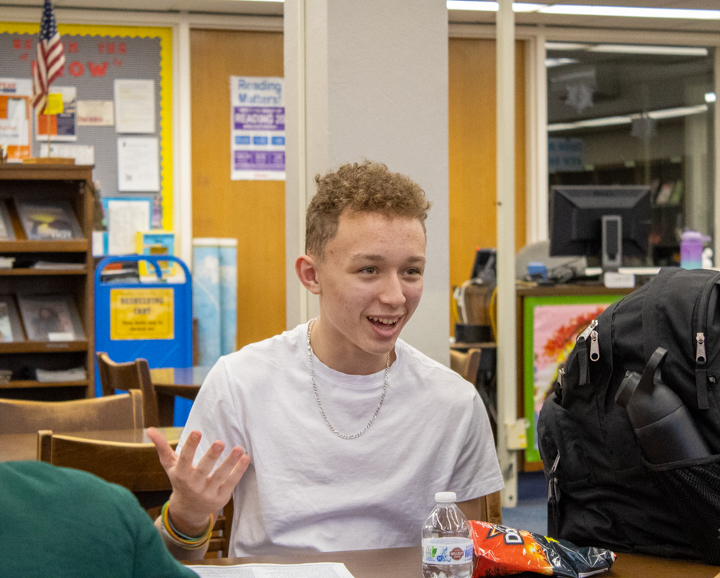
Kotz hopes to attend Radford University in the future to pursue a degree in real estate.

“I feel like some people don’t want to sell a home; they just care about the money. I want people to know what they’re buying and not get ripped off. I want them to get a good deal, not just a house that’s terrible,” Kotz said.

By emphasizing these emotional and social aspects, the program is working to address the root causes of violence.  

The General Assembly’s decision to provide two years of funding for the pilot of the Community Builders program is an important first step. However, the program remains temporary, and long-term funding and community support are essential for its success to be sustained. The results from this initial phase will help shape future efforts to expand and refine the initiative. Ensuring that more students benefit from its resources and guidance.

Gun violence remains a significant challenge in many communities, but through early intervention and comprehensive support, programs like James Madison Middle School’s Community Builders are taking steps to prevent it before it begins. With continued support, the program will play an important role in shaping a safer, more positive future for students, families, and communities.

New River Valley provides advocacy, resources, and emergency services to child victims 

By Bethany Lenhardt, crime, safety and justice reporter 

Former professor Michael Horning. Credit: Virginia Tech, via WSET ABC13 Lynchburg

Amid sexual or domestic trauma, the New River Valley of Southwest Virginia is well-equipped with resources for male, female and child victims. Notably, the Women’s Resource Center provides counseling, education and emergency services to aid individuals in their healing journey. 

This story’s intention and focus on minors’ experience has been derived from recent community events. 

Michael Horning, previously an associate professor in Virginia Tech’s School of Communication, was sentenced this January for possession of child pornography and additional sex abuse material. According to the Department of Justice’s press release, Horning downloaded over 600 images and 14 videos via peer-to-peer filesharing software, including depictions of infants and toddlers.  

Horning’s devices were seized in December 2021 as a part of the DOJ’s Project Safe Childhood initiative. In September 2024, Horning pled guilty to knowingly possessing one or more visual depictions of minors and was sentenced to 60 months in federal prison.  

“Children don’t always know that abuse and things are wrong,” said Sherry Kramer, Program Director of the Women’s Resource Center NRV. “Then when they tell people, the people they tell may not react in the best way. They may get angry about the situation, and the child may think they’re angry at them.” 

Kramer started working at the Women’s Resource Center of the NRV over 12 years ago. She has since served the community as a children’s counselor and program director. She contends that minors face unique challenges when reporting abuse. The response of their confidant must serve to empower and support the child, thus dictating if the incident gets taken seriously and reported. 

Due to this challenge, cases of child sexual exploitation and abuse are ultimately underreported, says Kramer.  

The United States Sentencing Commission reports that for the fiscal year of 2023, about 64,000 criminal cases were reported. Of that number, 1,408 cases involved child pornography. That number does not include cases in which the individuals are convicted of producing the material.  

To combat underreporting and increase education and awareness in adolescents, the Center runs the Peaceline Violence Protection Program for Teens. Peaceline is designed for middle and high school-age students on how to navigate relationships among friends, family and romantic partners.  

According to their website, “Education is the key to reducing the number of sexual assaults in the community.” If a student were to disclose a sexual assault or other experience to a Peaceline educator, they are trained in crisis intervention and can refer the student to further counseling services as needed. The program is free of charge. 

“We’d like to get that information out to the whole community and to adults as well, but our main priority with Peaceline is educating on safety and healthy relationships,” Kramer said. 

Peaceline aims to educate and encourage adolescents to come forward. The DOJ’s Project Safe Childhood (PSC) aims to increase the number of federal prosecutions on child predators. It was due to this nationwide initiative that Horning’s devices were seized and searched.  

The initiative was launched in 2006 and expanded in 2011 to span all federal crimes exploiting a minor. Their mission is to “combat the proliferation of technology-facilitated crimes involving the sexual exploitation of children.”  

Since its inception, federal prosecutions of child sex offenders have increased significantly. The success rate of these prosecutions is a direct result of the increased number of international, federal, state, local and tribal investigations spearheaded by PSC. 

“The threat of sexual predators soliciting children for physical sexual contact is well-known and serious,” according to PSC’s website. “The danger of perpetrators who produce, distribute and possess child pornography is equally dramatic and disturbing.” 

A distinct challenge to community resources and PSC is the advancement of technology and its entanglement in the dark web.  

“Technological advances have encouraged child sexual exploitation offenders, especially those operating online, to an unprecedented degree,” according to PSC’s website. “Among the most daunting and prevalent is offender utilization of anonymization networks, including Tor and Freenet, to obscure their identities. Because of the perceived anonymity, the most prolific and sophisticated offenders feel empowered to share enormous quantities of the most vile child exploitation images on a multitude of Internet bulletin boards.” 

Horning was a user of Freenet.  

The Women’s Resource Center of the NRV’s home page

For children who have experienced sexual exploitation or violence, once they’ve taken the steps to report it with a trusted adult, the struggle is not yet over. That’s why the Women’s Resource Center and other resources are with them every step of the way. 

“Honestly, children have told me the most while playing the game of cards,” Kramer said. “Just giving them that comfort, that power and that open door to talk is the best way to get the kids to express themselves. We believe in them, support them, let them know they’re not alone. We have emergency advocates that go to hospitals anytime anyone needs a forensic exam, we’ll go to police departments if somebody’s being interviewed, etc.”  

If a child needs to go through the court system, Court Appointed Special Advocates of the NRV is the tool for them. CASA volunteers are appointed by the court system to listen and advocate on behalf of a child in need. CASA of the NRV helps more than 100 children each year, according to their website. 

Despite the perverse actions of sex offenders, the NRV community and the DOJ are prepared to help and stand in solidarity with the victims. At the Women’s Resource Center, Kramer says that when they answer the phone, they always start with, “Are you safe?” These crimes can make people of all ages feel powerless, but by asking, the power is placed back in the hands of the individual.  

“Everybody has a right to safety,” Kramer said.  

Virginia Tech spokesperson Mark Owczarski could not be reached for comment on this story.  

Editor’s note: An edit was made on Feb. 20, 2025, to correct the name of the Women’s Resource Center.

Editor’s note: TheNewsFeedNRV.com is published by the Virginia Tech School of Communication’s Digital Newsroom course. Michael Horning was a former instructor of Digital Newsroom.

Supplying Passion: A Mini Documentary

By Alice Buckley and Lindsey Cook

New River Art & Fiber is a small business in Blacksburg, Virginia, owned and operated by a Virginia Tech alumna. While still relatively new on the downtown scene, the shop has become a staple for locals and a home base for many of Virginia Tech’s architecture and industrial design students. 

Two of these students give us a glimpse into what it takes to be an architecture student, and share why the shop often serves as a lifeline for them.

Many Miles, Many Years, Many Potential Impacts: The Mountain Valley Pipeline

By Emelia Delaporte and Sean Weinstock

After a decade filled with controversy the 303-mile-long Mountain Valley Pipeline became operational on June 13, 2024. Crossing several Appalachian counties, the pipeline has been a flashpoint for environmentalists concerned with the impact of expanding fossil fuel use on global warming, local industry and residents anxious to secure a reliable low cost energy source. This News Feed NRV mini-documentary provides an overview of the pipeline and presents both environmental and natural gas industry perspectives.

A Glimpse into Virginia Department of Education’s 2025 Plan Approaching Governor Youngkin’s Term Conclusion

By Nicole Cummings and Caroline Reed

With the nation desperately awaiting the fate of the department of education, Virginia has been proactive in preparing to improve upon the quality of students’ education as well as preparation for the end of Virginia Governor Youngkin’s term approaching. Virginia’s Secretary of Education, Aimee Rogstad Guidera, discusses Virginia’s “All In” Plan as the guiding principle for other improvement strategies moving forward. 

Waiting by the phone

By: Ainsley Cragin and Kennedy Gooden

Shortly after moving to their new home last year, Dona and Steven Durham discovered structural damage under their house. Extreme rain from Hurricane Helene flooded and deepened the existing cracks, weakening the foundation of their home. Now they’ve turned to FEMA for emergency funds to help repair storm damage that can’t be covered by insurance. Jeff Jones, FEMA Federal Coordinating Officer, sheds light on FEMA’s over-the-phone assistance program.

Radford Local Recently Named a National WomenHeart Champion

Heart disease continues to be the leading cause of death in the United States. But with certain health incidents–such as cardiac arrests–being commonly associated with the male population, a group of female volunteers have stepped up to spread awareness and educate fellow women. Lucinda McDermott Piro, a Radford resident, was recently named a WomenHeart Champion with The National Coalition for Women with Heart Disease.

Post-Election Mental Health Effects of Female Students, Minorities and Gen Z

Story by: Nicole Cummings and Caroline Reed

The NRV Newsfeed Podcast hosts an episode discussing post-election mental health effects on female students, female-identifying people, and minority groups; in light of the Presidential Administration’s promises. Interviewed by Nicole Cummings and Caroline Reed, Dr. Bonnie Zare, of Virginia Tech’s Women’s, Gender and Sexuality Studies department. Dr. Zare sheds some light on the election results from an analytical perspective.