Virginia Tech provides Safe Ride services to ensure transportation safety

By Sophia Gerni, crime, safety, and justice reporter.


Virginia Tech Safe Ride van. Photo by the Virginia Tech Police Department.

Blacksburg, Va. — Walking around campus or the greater Blacksburg area during late-night hours can bring uneasiness and possibilities of feeling unsafe. Virginia Tech’s Police Department provides Safe Ride, which ensures safe and free transportation for anyone who may feel unsafe.

Virginia Tech’s nighttime safety escort, “Safe Ride,” starts in the evening and runs well into the night. Through a request on the TransLoc Rider app, they will provide walking escorts as well as car pickup by trained student drivers. Safe Ride is there to help students, faculty and staff, visitors of the university and Blacksburg locals get to their next destination around the Virginia Tech campus safely. With the usual form of transportation being a van, there are times when the van is not in operation. In this case, a member of the Virginia Tech Police Department will drive a police car to your location or give a walking escort if requested.

TransLoc Rider app showing the outline of Safe Ride pick up area. Screenshot from the TransLoc Rider app.

Kendrah Cline, Administrative Captain and Safe Ride Supervisor at Virginia Tech Police Department, said she wants people to be and feel safe when walking around Virginia Tech.

“The premise of Safe Ride is that you feel safe going from one place on campus to the next. Whether that’s in the van, an officer comes to pick you up, a security officer comes to pick you up or we walk.”

Cline knows that requesting a Safe Ride could be intimidating to those who have never used the service before, which is why the drivers are instructed to not to ask questions regarding the reason for the ride.

“We don’t really need to know your business or why you want a Safe Ride; we shouldn’t be asking you,” Cline said. “Whether it’s a safety thing or you just really don’t feel like walking, we don’t ask. I don’t want to say that we don’t care, but that’s not our judgment to make; we’re always going to say, ‘Okay, where do you need to go?’

Brooke Nicholes, a junior at Virginia Tech, called Safe Ride to avoid walking alone in the dark. “I was in my car and ordered a Safe Ride to get back to campus. I didn’t want to walk alone at night,” Nicholes said. “They didn’t ask me any questions; it was great.” 

Nicholes understands the importance of having someone with you when walking alone, especially for freshmen who don’t have easy or quick access to their cars.

“I remember when I was a freshman, I wouldn’t want to go to my car at night if I had to go somewhere. I would only go places during the day because I was too scared to walk alone at night,” Nicholes said. “I think it’s nice for freshmen, especially because at night you park so far away from your dorm. I think a Safe Ride is nice because you can get picked up from your car and go straight to your dorm safely.”

Safe Ride’s goal is to provide comfortable, easy, and safe access around the Virginia Tech campus. Cline understands that in some circumstances, some may feel unsure about calling, especially if the van isn’t running and a police officer comes to help instead.

“We’re very well aware that if you call for a Safe Ride, maybe you’ve had a little too much to drink and you don’t want an officer to come pick you up. Because of this, we want to have more student drivers so those requesting a ride feel more comfortable.” 

Safe Ride’s goal for student drivers is to provide a friendly face when being picked up. The Safe Ride service runs from 8 p.m. to 3 a.m. Sunday through Friday in the fall semester and 7 p.m. to 3 a.m. during the Spring Semester. On Saturdays, both during the spring and fall semesters, Safe Ride service begins at 4 a.m. With many students not ready to commit to the late work hours, these positions have been hard to fill. 

Cline would like to have these positions filled sooner than later. “One way that Safe Ride can be improved is to try to get these positions filled so that it’s a really efficient, full set of drivers, every night of the week,” Cline said. 

While Safe Ride is available for use, Cline understands that people may use other forms of transportation alone. With Uber and Lyft being popular for students at Virginia Tech, it is important to be aware of your surroundings and with another person if possible. 

“There are going to be occasions where you will need to order an Uber or something, and you are getting in that vehicle by yourself. In that case, I think it’s good for someone to know where you are and that you have taken this Uber,” Cline said. “Try to have a good, trusted group or friend with you, even if you are walking across campus or out in Blacksburg. Whether you’ve had some drinks or not, I think it’s good just to stay with a trusted group, or at least one person.”

Transportation safety of any kind is always important. When you are in the car with someone that you don’t know, stay focused and aware at all times.
Virginia communities brace for change in light of Trump’s immigration orders 

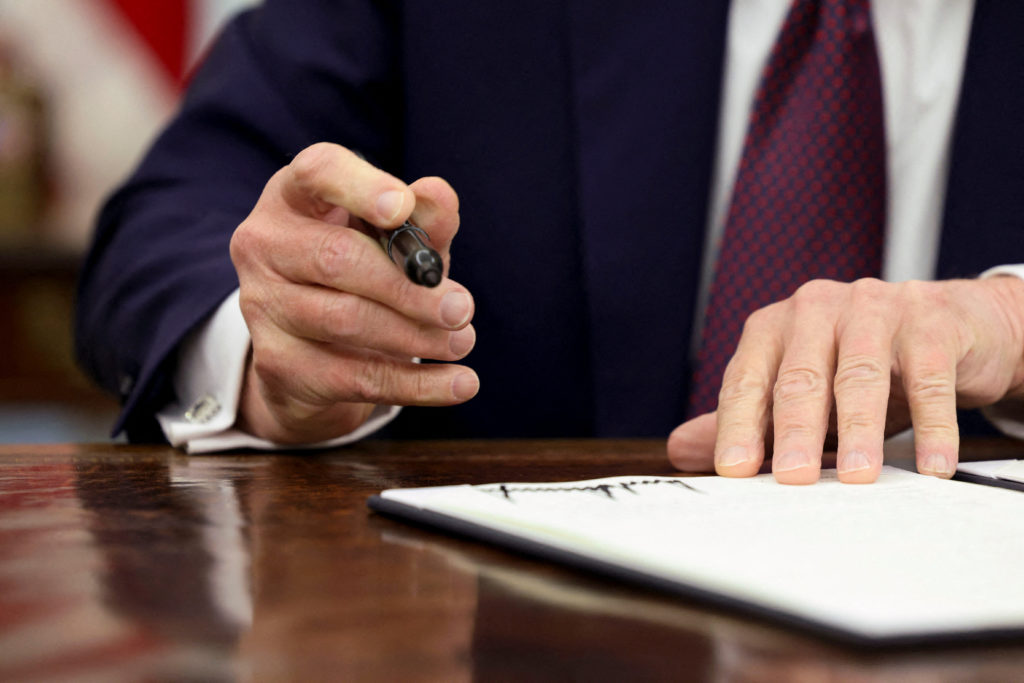
U.S. President Donald Trump signs an executive order in the Oval Office of the White House, in Washington, U.S., January 23, 2025. REUTERS/Kevin Lamarque

By Julia Lagano, Political reporter

Since his inauguration, President Trump has issued eight executive orders on immigration, sending waves of uncertainty through communities across the nation. In Virginia, where immigrants make up about 12.6% of the population and approximately 227,100 individuals are undocumented, the impact is expected to be significant. With Virginia’s proximity to Washington, D.C., many fear it is only a matter of time before federal enforcement actions begin. 

One policy at risk under these executive orders is Deferred Action for Childhood Arrivals (DACA), a program initiated by former President Obama in 2012 that provides temporary protection from deportation and work authorization to undocumented individuals who arrived in the U.S. as children. While it is not a direct path to citizenship, DACA has allowed thousands of recipients, “Dreamers,” to pursue higher education and secure employment. 

Cities all over the state have already begun to prepare. In the New River Valley, help can be found in Roanoke and Blacksburg. Virginia Tech organizations, like Latin Link, are coming together to support those who are at risk of being affected. Latin Link is one of the largest Latinx student organizations on campus that strives to be a tight-knit community and a safe space for minority students attending a predominantly white institution. The club promotes its members’ cultures and heritages on campus through educational, cultural, and social events. Jennifer Lopez-Perez, senior and president of Latin Link, emphasized the importance of advocacy at this moment, “There is a community here at Virginia Tech that will not stand down and that will continue to fight for their [immigrants’] rights. They [Immigrants] are here for a better future, and they are seen.”  

One way that the club takes a stand is by participating in Undoculliance, a week-long event hosted every year by the Latino Association of Student Organizations (LASO). With the goal to raise campus awareness about immigrant rights and the undocumented experience, the event shows support for DACA recipients and children of immigrants. “We have various guest speakers on a panel, hosted by a few organizations, that will talk about their experiences throughout college and within the workforce,” Lopez-Perez describes, “On social media, there are more organizations that will provide informational videos and provide resources for students both in and out of VT.” 

Outside of Virginia Tech, Commonwealth Catholic Charities (CCC) is making efforts to support immigrants all over Virginia. The CCC has been serving vulnerable populations in Virginia since 1923. They offer a range of services, including but not limited to housing assistance, refugee resettlement, legal support, language education, and permanent residence status. The order, Realigning the United States Refugee Admissions Program, put a freeze on refugee admissions by suspending applications, and ceasing federal funding to resettlement programs. Katie Dillion, Communications Manager for the CCC, explains the impact of this, “Without federal funding, we are struggling to provide these services to newcomers during their first 90 days, which is the most intense time of support.” The CCC’s immigration team is small to begin with, their Roanoke office only has one staff person, making the capacity to help low.  

For many in Virginia, the fear is not hypothetical —it’s personal. Lopez-Perez, like many others, has witnessed the hardships and sacrifices made by her parents to provide a promising future for their children. “As a daughter of immigrants, I have seen first-hand the battle that my parents have struggled through and continue to struggle through to be able to provide a better future for myself and my siblings. There are countless people that are just trying to live day by day to provide the same for themselves and their families,” she shared, “There are systems that are set in place that leave so many at a disadvantage and yet, they continue to fight and continue to work for that opportunity.” 

Double trouble: the impacts of Trump pulling out of Paris Climate Agreement, again

by: Gracie Gosier, environment reporter.

President Donald Trump signed an executive order titled “Putting America First In International Environmental Agreements,” instructing the United States to immediately pull out of the Paris Agreement on January 20, 2025.

UNFCCC at the 2015 UN climate change conference that resulted in the Paris Agreement. Photo from Britannica.

The Paris Agreement, first signed in 2015 at the UN Climate Change Conference,  is a legally binding treaty where nations all over the world committed to reduce greenhouse gas emissions and maintain the global temperature increase below 1.5°C over pre-industrial levels, in an attempt to control global warming and slow down the effects of climate change. 

In September 2016, the United States and China, the world’s two greatest emitters of greenhouse gases, confirmed their combined commitment to the deal, boosting its worldwide momentum. In June 2017, President Donald Trump announced his intention to remove the United States from the Paris Agreement. The formal withdrawal procedure began in November 2019 and was completed on November 4, 2020, making the United States the first country to leave the deal. On January 20, 2021, President Joe Biden issued an executive order to rejoin the Paris Agreement, highlighting the need of combating climate change. The United States formally rejoined on February 19, 2021, reiterating its support for global climate policies.

Why it matters: Despite the fact that 2024 is the world’s hottest year on record, President Trump wants to shift the federal government away from former President Joe Biden’s climate program and toward a wider embrace of fossil fuels. Climate change raises the probability of storms, causes more severe rainfall, and increases the likelihood of intense and devastating wildfires.

  • During his first term, Trump fulfilled a campaign promise by withdrawing the United States from the climate accord, joining Iran, Libya, and Yemen as the only countries not part of the agreement.
  • When Biden resumed office in early 2021, he quickly rejoined the Paris Agreement after a brief absence of less than four months. Biden’s climate change policy focused on reducing greenhouse gas emissions, and many of the actions taken by the Biden administration reversed or attempted to reverse the first-term policies of Donald Trump.
  • In 2022, Biden signed the Inflation Reduction Act . The legislation allocated hundreds of billions of dollars to promote renewable energy, electric vehicles, and greener manufacturing. He also developed comprehensive new regulations to reduce pollution from automobiles and power plants during his term.
  • Environmental organizations such as the Sierra Club, Sunrise Movement, and Earthjustice, say that President Biden performed more environmental policy than any other president in history.

The big picture: Trump’s announcement to withdraw again from the Paris Agreement marks a return to isolationism at a moment when collective global action is most needed. Exiting the deal twice is enough to damage U.S. credibility internationally and sabotage global climate diplomacy. It would also serve as a risky model for other countries to ignore their climate obligations, which could have a cascading effect and undo the progress that has been made collectively.  

  • Countries must submit emission reduction targets and give quarterly progress updates under the terms of the Paris Agreement. Before leaving office, Biden declared a new US goal: to reduce greenhouse gas emissions by more than 60% from peak levels by 2035, which would likely require a quick transition away from fossil fuels.
  • During Trump’s inaugural address on January 20, 2025, he proclaimed a “national energy emergency” and urged oil companies to “drill baby, drill,” that would allow him to reverse many of Biden’s environmental regulations and open up additional places for oil and gas production on protected lands.
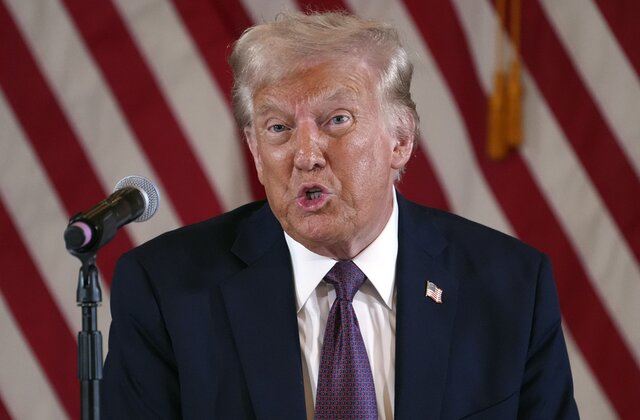
Donald Trump at Capitol One Arena giving his inauguration speech. Photo by USNews.com.

Zoom in: Environmental activist groups such as the POWHR Coalition, have taken the next step into fighting against the withdrawal with their own plans. Their current campaign is towards defunding the new Mountain Valley Pipeline (MVP).  

  • The MVP has been associated with several negative environmental and social impacts such as deforestation, water quality degradation, and lower property value for surrounding areas of the pipeline. 
  • POWHR goes after JPMorgan Chase, Bank of America, MUFG, TD Bank, PNC, and Wells Fargo, the top investors of the pipeline. 

Zoom out:  U.S Senator Tim Kaine (D-VA), as well as many other experts and officials, have shown their support for the Paris Climate Agreement.

  • “From sea level rise in Hampton Roads and on the Eastern Shore to hurricanes in Southwest Virginia, climate change is affecting us all and threatening the safety of our communities,” said Kaine. “I’m disappointed, but not surprised, by President Trump’s short-sighted withdrawal from the Paris Accords, and that’s why I’m joining my colleagues in introducing this resolution to express support for the goals of the climate agreement. I remain committed to building on our progress in recent years to reduce greenhouse gas emissions, improve resiliency, accelerate clean energy production, and keep Americans safe.”
  • The America Is All In coalition, which formed following the United States’ initial departure from the Paris Agreement, continues to motivate climate action. These initiatives have increased in power, with bipartisan leadership from the U.S. Climate Alliance, a coalition of 24 states (including Virginia) and territories that represents more than half of the US economy and committed to fulfilling the Paris Agreement’s targets.

What we’re watching: The pullout was a component of a larger plan to decrease funding for renewable energy sources and increase support for fossil fuels. The administration is giving traditional energy sectors precedence over renewable projects and underlying the significance of energy independence.

With the globe experiencing more severe climate consequences, the U.S. decision has prompted other big polluters, such as China, to reevaluate their own pledges to the Paris Agreement. Despite the U.S. position, many nations are moving forward with their climate initiatives.

Relying on fossil fuels might be detrimental to the nation’s long-term interests. The energy transition has great promise for job creation, economic vibrancy, and global competitiveness, as well as for the environmental health of the United States and the world. The U.S may find it more difficult to control those developing sectors in the future if it continues to concentrate on fossil fuels.

The Price of Education: Unpacking the Financial Strain on First-Generation College Students 

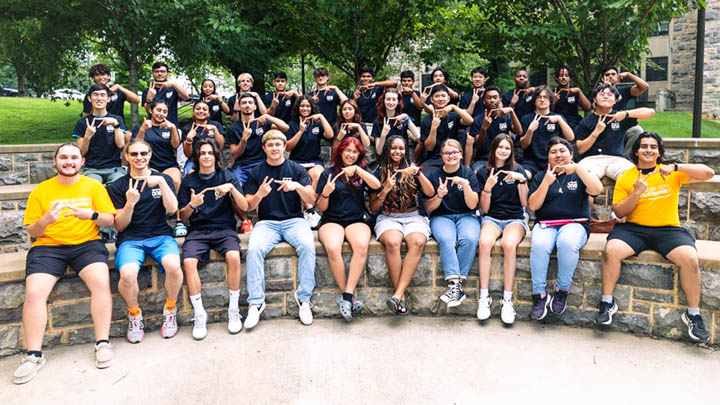
Image Credits: Virginia Polytechnic Institute and State University

By Janae Neely, Education reporter 

The bold “Congratulations!” and confetti bursting from a college acceptance letter evoke feelings of exhilaration, pride, and the promise of endless opportunities. However, for first-generation students, those initial feelings quickly fade as they are faced with an overwhelming question; how are they going to pay for it? 

According to a 2024 study, the average cost of college tuition has risen 141% over the last 20 years. And while resources such as student loans and grants are available, those systems can be faulty and don’t succeed in helping first-generation students. Citizens and Everfi reported, “51% of first-generation students said they were nervous about paying for college” and 11% of students said that the price of college wasn’t worth it. 

Over 6,000 first-generation students have found a home at Virginia Tech, and the university has taken strides to make sure that first-generation students have easy access to education and resources regarding finances and how to pay for higher education. 

GenerationOne, a living-learning community created solely to provide a support system for first-generation college students, held an event this Thursday called Thinkful Thursday: Being Fruitful with Your Finances/FAFSA. This event, hosted in collaboration with Virginia Tech’s Financial Aid Office, educated students on the federal student loan process and provided tips on how first-generation students can manage their finances over the next four years. Hannah Banks, a sophomore at Virginia Tech and a Student Leader in GenerationOne is extremely familiar with the stresses of the financial aid process, “On a scale of one to ten, I would say the stress of financials was a seven when I was deciding where to go to college. Finances were my deciding factor to come to Virginia Tech rather than JMU because they gave me more money.” 

Financial Aid Specialist, Diane Roberson headlined the event and gave thorough tips on how to navigate FAFSA, scholarships, grants, and questions from other students on how to navigate the strain of finances on the college experience. 

“It’s extremely important to have events like this,” said Banks, “When you’re coming to a large university like this, it is refreshing to be in a community where people have gone through the same experience as you.” A 2022 study conducted by The Ohio State University found, “First-generation students were significantly more likely to use federal student loans, private student loans, money from a job, scholarships/grants, and credit cards to fund their education…” (Rehr et al., 2022). However, the study also showed that first-generation students have less knowledge than their counterparts when it comes to financial literacy and financial self-efficacy. This highlights a clear issue in the education and resources that first-generation students receive. 

Image Credits: Ellucian

One of the resources that first-generation students have access to is scholarships. However, only two scholarships out of the 3,000 that Virginia Tech offers are designed for first-generation students. This by far is not enough to help first-generation students with grants and funds. Savannah Stephens, a first-generation senior felt like she didn’t receive the proper education when applying to college, “The FAFSA process was so confusing, and no one in my family had done it before, it was hard trying to find the right information and figure out what to do.” The lack of resources only felt like it continued once Stephens reached Blacksburg, “There were and are plenty of social, emotional, and academic resources but I didn’t need any of those, which wasn’t helpful. I received no financial help as a first-generation student which was extremely stressful at the time.” 

In a 2024 article discussing the difficulties of the FAFSA process, the CEO of iMentor, Heather Washington explained, “…I think students are generally sort of frustrated, but I think the real frustration starts to set in, and I think we’re starting to see this with each passing day as the acceptances come in,” Washington continued, “It almost undermines their excitement about getting in and going, because they either haven’t completed the FAFSA, they’re stuck getting it in, or they just submitted it so they know that this acceptance letter isn’t really telling them yet what they can do with this college acceptance that they have” (Anderson, 2024). 

In almost every area, first-generation students are starting at a disadvantage. It is constantly an uphill battle that needs to be recognized by universities, advisors, and organizations like FAFSA. There needs to be sectors to help these students so that they can succeed to the best of their ability.  Experiences continue to show the significant impact that finances have on first-generation students, highlighting the delicate balance between their success and discouraging them from pursuing higher education altogether. “There is definitely more to be done,” Banks concluded, “ First-generation students still don’t have the resources we need. I think it would be interesting to see a first-generation center where thousands of Virginia Tech students who are first-generation can have access to more resources.”

Virginia Tech’s Quiet DEI Removal Sparks Student Outrage and Uncertainty Across Campus 

By: Nyles Stone, Politics Reporter

01/28/2025 – Screenshot of DEI webpage

Editor’s note: As of February 10, 2025, the “Inclusive VT” site appears to be live

Virginia Tech quietly removes web pages dedicated to diversity, equity, and inclusion following President Trump’s Executive Order, Sparking concern among the student body. 

For months Virginia Tech has been implementing small changes to its inclusion initiatives, But President Trump’s executive order to dismantle DEI has led into the quiet removal of Virginia Tech’s DEI-related websites, raising questions about the future of inclusion and belonging at Virginia Tech. 

“It feels like they’re taking advantage of everything happening around us to secretly get rid of everything,” said Emon Green, a senior majoring in philosophy, politics, and economics at Virginia Tech. 

Virginia Tech has not provided any information or explanation about the quiet removal of the websites, leaving multiple students concerned about their safety and the protection of marginalized groups on campus. Other schools like the University of Virginia, Old Dominion University, and James Madison University all still have their own websites and DEI statements on the pages even though the executive order prohibits the practice of anything DEI related. 

The now missing pages on the Virginia Tech websites offered various information, from certain links to specific college mission statements about DEI to a page dedicated to the certain required course modules for undergraduate and graduate students and faculty to take to learn about DEI.  

Many students expressed their frustration and confusion about the lack of transparency about the changes, Leo Hoffman, a senior majoring in wildlife conservation at Virginia Tech, said “I think it’s unfortunate they got rid of the DEI websites, they provided a safe space for BIPOC students, and I haven’t heard it be talked about much. It’s a bit of a bummer.” reflecting a broader concern among the student body. 

Despite the removal of the DEI websites, Virginia Tech University Spokesperson Mark Owczarski provided a website dedicated to “Inclusive VT”, a broader initiative of Virginia Tech’s commitment to diversity and inclusion but it fails to directly address the recent website changes. Owczarski, who has been at Virginia Tech since 2003, was not able to clarify the reasons behind the removal of the websites and the lack of response from the school. 

For Green, the removal brings “ a sense of urgency and persecution,” Green said” Attacks on DEI are really just attacks on the progress we made, it’s crazy that something so ingrained and useful is now being dismantled.”  

Green also emphasized his belief that Virginia Tech’s lack of response in regards to DEI lines up with Virginia Tech’s own political interests. “Virginia Tech will always acquiesce to the broader system. The responsibility falls on us to protect what we’ve built and find new ways to support each other.” 

The timing of the removal of the websites directly ties to the recent changes in political climate. On January 23rd, President Trump signed an executive with the intention of dismantling all federal DEI agencies across the U.S. including public universities, which are primarily funded by grants. President Trumps attempt to get rid of DEI promotes the importance of Merit Based Hiring ,with President Trump saying, “My administration has taken action to abolish all discriminatory diversity, equity, and inclusion nonsense – and these policies were absolute nonsense – throughout the government and private sectors.” told to the World Economic Forum.

Many universities across the country are scaling back their own DEI programs in response to the new executive order, with many programs across the country being cut, or paused. While Virginia Tech has not acknowledged the changes, the website’s quick removal aligns with the national trend toward dismantling diversity-focused initiatives across higher education in America. 

Blacksburg Virginia, Emon Green talking on the phone inside the Black Cultural Center in Squires Student Center.

“It’s frustrating because it’s not impossible to say something, I’m more worried about if Virginia Tech is going support its students through action,” Green said, “If they’re not going to support students through action, we need to take an approach to push back and shift the university’s priorities,” believing activism will be able to hold Virginia Tech accountable for the administrations’ lack of response. 

Green also encourages students to get involved in advocacy efforts, saying, “It is on us to sustain what we have and push back,” 

The removal of DEI impacts various students and faculty who have relied on these resources to make their work and school environment safe. With the uncertainty in these resources many claim there is a “fear of being protected.” Additionally, the removal raises even more questions about the University with what happens to the dedicated DEI courses, certain organizations dedicated for minorities, grants and scholarships. 

As the concerns for transparency grow, students and faculty will be able to attend Virginia Tech President Tim Sands’ State of the Union address on February 5th in the Moss Art Center, in hopes that the removal of DEI resources will be acknowledged, and more of the unanswered questions hopefully being answered. It is uncertain whether President Sands will address the removal or not, but for students like Green, this is just one step in the for inclusion at Virginia Tech. 

Claytor Lake emerges from Hurricane Helene’s aftermath

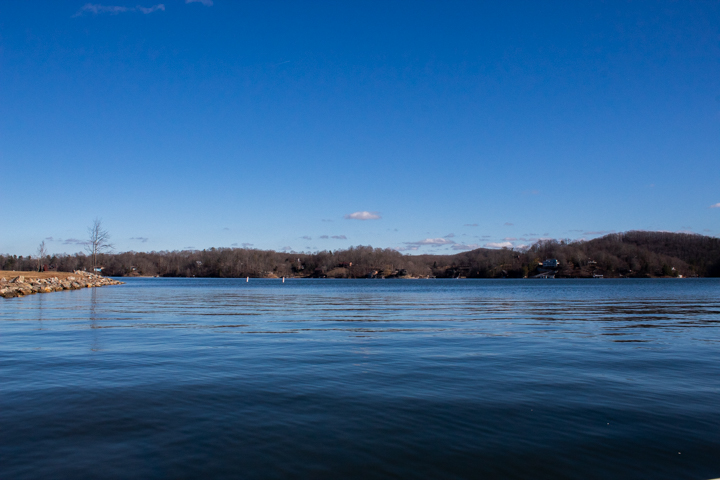
Dublin, VA, Feb. 1, 2025 – Heavy machinery remains at Claytor Lake following the completion of cleanup efforts. Photo by Alana Powell

by Alana Powell, environment and climate reporter

A usually serene Claytor Lake was turned into a debris-laden nightmare following Hurricane Helene back in October. Luckily, concerted efforts by federal agencies and local volunteers have successfully restored its recreational availability.

In the wake of the natural disaster, Claytor Lake was submerged under 300 acre-feet of debris, disrupting the ecosystem and local recreation. Over the past two months, the Norfolk District of U.S. Army Corps of Engineers and Friends of Claytor Lake have diligently removed over 27,000 cubic yards of debris and transported 6,000 tons to the landfill, concluding their efforts on Dec. 21, 2024. This extensive cleanup has not only cleared the waste and litter, but also reinstated the lake as an important community hub. 

According to the USACE, this was the largest debris removal mission in Virginia since Hurricane Isabel struck in September 2003. The team provided specialized equipment such as survey vessels and hydraulic excavators to help the non-profit, Friends of Claytor Lake, with the overwhelming task. 

Amanda Bishop, a ranger at Claytor Lake State Park, gave a chilling description of the lake immediately following the hurricane. “If you were here a couple of days after it hit, I personally compare it to what a horror movie kind of would look like.” She adds, “Usually when you look at the lake, you can see how the water’s moving. It was so still and debris sticking out of it and trash, propane tanks, just all kinds of people’s belongings that they didn’t think the flood would take.”

Jacob Ward, a local resident and frequent visitor, shared his initial shock at the damage. “I was so surprised. I was not expecting [the hurricane] at all and then I came here the day after and saw like everything floating in the water and I was just shocked because usually that doesn’t happen,” he recounted, highlighting the unexpected devastation to the region.

The cleanup process involved not just trash removal but also significant safety measures due to hazardous materials. “We had men in hazmat suits working to remove dangerous waste, making sure that the lake was safe for public use again,” Bishop added, indicating the complexities involved in making the area safe for visitors and wildlife. 

Local businesses felt the economic impact deeply, especially those reliant on lake tourism. “There’s a guy who runs a business down here renting out boats, he was hit pretty hard,” Bishop noted, “he saw a huge decrease in funds.” This downturn reflected the broader economic challenges posed by the lake’s temporary closure.

In an inspiring display of community solidarity, volunteers of all ages offered to assist in the cleanup, specifically helping with shoreline debris. “Our local middle school came and there were like over 150 kids that showed up and asked, ‘What can we do?’ There was a lot of trash that came in with the flood and plugged our shoreline with all the rocks,” Bishop stated.

Community members found other ways to assist if they were unable to participate in clean-up efforts. Several local churches provided meals daily to those who had extensive damage or lost their homes completely along the water. 

“The lake means a lot to the community. We get our electric from the dam and people from all over come to visit. It’s a relief to see it back to its normal state.” Ward added.

Photo by Alana Powell

With the cleanup complete, the park’s management has worked hard to keep the public informed. “We have a website that is, if you search Claytor Lake State Park, it comes up within DCR, which is the Department of Conservation and Recreation. We try to keep alerts on our page of what’s going on, what can you do or not do, where can you go, where can you not go, please stay out of these areas,” Bishop explained about the ongoing communication efforts to ensure visitor safety.

Dublin, VA, Feb. 1, 2025 – A man is seen boating on the lake now that it has reopened for recreational use. Photo by Alana Powell

The reopening of Claytor Lake has been met with enthusiasm from the community, eager to return to their normal activities. “Now that we’re open again, people are coming back, eager to enjoy the lake. It’s great to see the community bounce back after such a challenging time,” Bishop concluded.

The collective efforts at Claytor Lake are a testament to what can be achieved through collaboration and community engagement, effectively addressing, and overcoming the aftermath of natural disasters to restore and strengthen communal bonds and natural resources.

House bills take aim at University Protestors

By Wilbert Ramirez, Politics Reporter

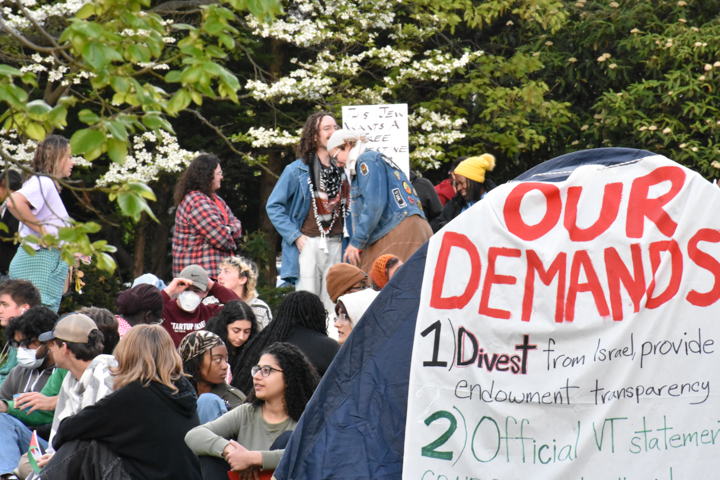
Student Protesters sit on the Graduate life center lawn at Virginia Tech, in Blacksburg, VA. Friday April 26, 2024 (Photo, Wilbert Ramirez)

Two House Bills introduced in the Virginia General assembly seek to stifle student protesters’ demands.

House Bill 2529 and H.B. 2207 have drawn the criticism of Students for Justice in Palestine at Virginia Tech. The Instagram page run by “sjpvtech,” called to action against the bills by posting a template to contact representatives in the Virginia General Assembly.

House bill 2529 introduced by Del. Micheal Jones (D) and Del. Dan Helmer (D), seeks to prohibit public institutions in the state of Virginia from divesting all funds from “any country or territory that is not the subject of an active sanctions program administered by the Office of Foreign Assets Control of the U.S. Department of the Treasury.”

“It would make it harder for Virginia tech to divest, but not impossible said Shahed Sanuri, a first-year graduate student at Virginia Tech and co-president for Students for Justice in Palestine. “So the movement is only stronger and only grows stronger and from the way we’ve seen people come together, to we combat these bills.”

H.B. 2529 would make it difficult for any student organization to have any significant policy change at all public institutions in Virginia. The bill appears to narrowly focus on the demands of many of the protestors across the Commonwealth that were arrested at public universities in 2024 around the state that included: the University of Virginia, Virginia Tech, Virginia Commonwealth University, and the University of Mary Washington.

The pro-Palestinian protestors at Virginia Tech were arrested the night of the April 28 in front of the Graduate Life Center Lawn at the public university. 82 individuals were arrested, and the University President Tim Sands released a statement on April 29, after the night of the arrests.

A student protester is arrested on the Graduate Life Center lawn at Virginia Tech, in Blacksburg VA. Sunday April 28, 2024 (Photo, Wilbert Ramirez)
Shahed Sanuri, Co-President of Students for Justice in Palestine at Virginia Tech, in Blacksburg, VA. Wednesday, Jan 29, 2025. (Photo Wilbert Ramirez)

House Bill 2207, which is a companion bill, introduced by Del. Terry Kilgore (R) and it is aimed at tackling terroristic threats on public institutions in the state of Virginia.

The companion bill to H.B. 2207, H.B. 1284 introduced by Sen. Bill Stanley was struck down on Jan. 27 by a Virginia Senate Education Subcommittee.

“It would put a lot of innocent international students as well as other people who are legally here, but not citizens at risk for simply participating in protests or even so much as like posting about their support for Palestine,” says Bella Gilbert, a sophomore majoring in Political Science Virginia Tech and outreach coordinator for SJP at Virginia Tech. “And even though one of the bills says, that deportation is conditional on pro-Hamas expression, we can safely assume that it will just be contingent on pro-Palestinian support.”

Critics from the Pro-Palestinian organization have expressed that these bills if they were to pass, they would make it more difficult for their organization to protest on public institutions.

“The bills basically ban protests from campuses and when we say, ‘liberation for Palestine is liberation for all’ this is what we mean. This is why we’re fighting for the liberation Palestine now and we’re fighting against these bills because these bills don’t just affect the Palestine movement that they affect any movement that’s to come. It just portrays a deep sense of U.S. imperialism and how the U.S. government tries to just target student protests,” Sanuri said.

“These bills are very narrowly tailored, by the way and are in reaction to the camp and the protests last year the arrest. I feel like anyone can look at these bills and see that they are a direct attempt to silence our movement,” Gilbert said.

In recent months the SJP voiced their grievances against the university’s policy 5000 which was altered in Aug. 2024 by university administrators at Virginia Tech, the policy change restricts encampments on university property from midnight to 6 a.m.

“Regardless of whether the bill is possible or not, regardless of what the government wants to do, regardless of how the administration wants to silence us, just know that Palestinian movement will always grow stronger, and we’re always going to fight for the liberation of Palestine,” Sanuri said.

H.B. 2529, as of Jan. 25, 2025, is being analyzed in a fiscal impact statement from the Department of Planning and Budget that informs lawmakers about the financial consequences of the bill.

H.B. 2207 as of Jan. 24, 2025, is also currently under analysis in a fiscal impact statement from the Department of Planning and Budget.

It is unclear where many lawmakers stand on the bills given the controversial actions and consequences of each bill need to first be assessed in the new session of Virginia’s legislature.

Virginia General Assembly Moves Towards Repealing Constitutional Ban on Same-Sex Marriage

By Evvy Fite, health & wellness reporter

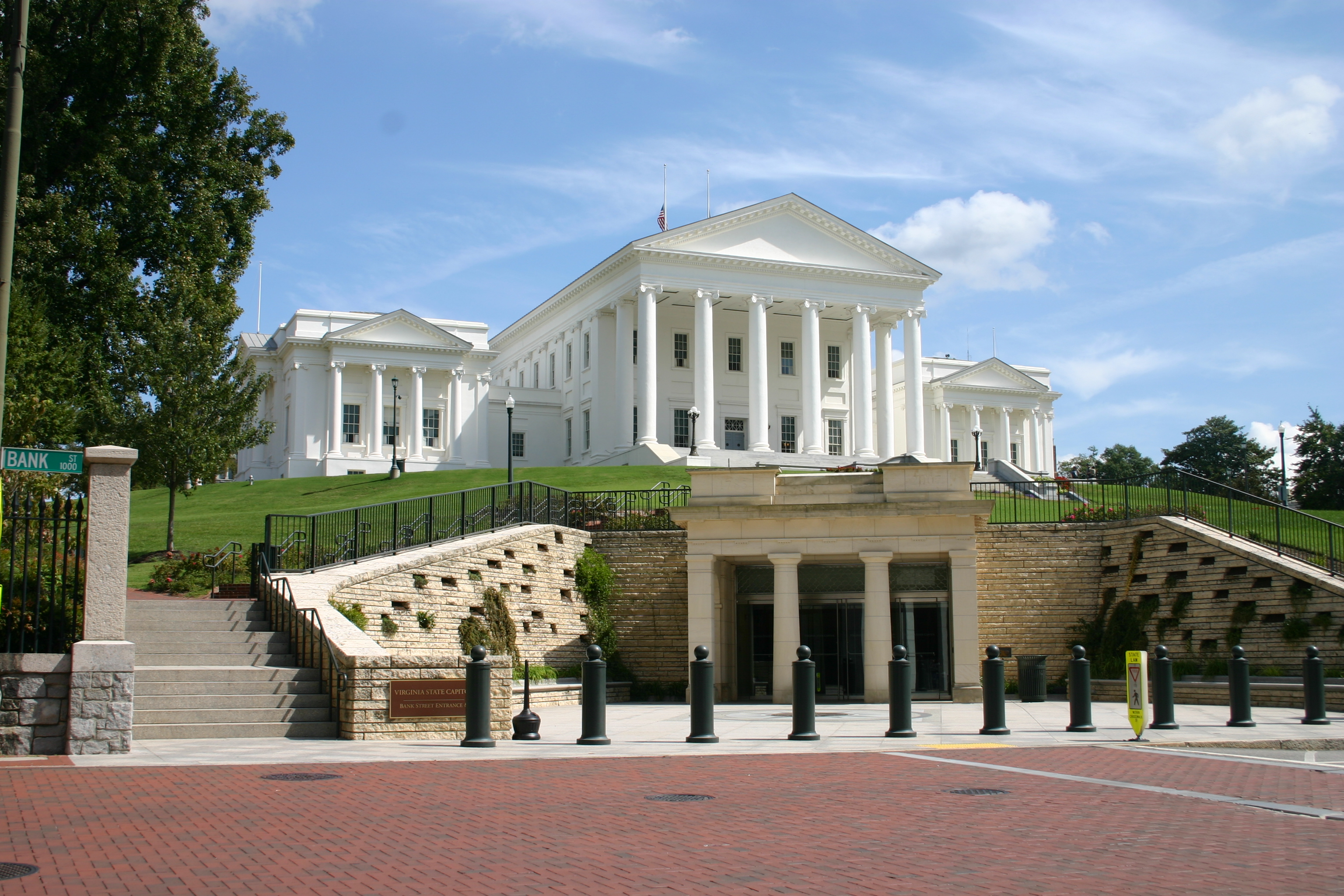
The Virginia Capitol building. Photo courtesy of Capitol Classroom.

In January, the Virginia General Assembly voted “yes” on a constitutional amendment that will bring hope to hundreds of thousands of Virginians.

Since 2006, the Constitution of Virginia has stated that “only a union between one man and one woman may be a marriage valid in or recognized by” the Commonwealth of Virginia. Although the U.S. Supreme Court’s decision in Obergefell v. Hodges overruled this and similar lines in state constitutions, many are concerned that the Trump administration and overwhelmingly conservative Supreme Court will attempt to overturn this precedent, which would leave each state to decide whether to allow same-sex marriage.

Senate Joint Resolution 11 (SJ 11), which was first introduced in January 2024, amends Section 15-A of Article I of the Constitution of Virginia, repealing the prohibition of same-sex marriage and affirming the right to marriage. If SJ 11 is passed, the Constitution will now state that “the right to marry is a fundamental right inherent in the liberty of persons, and marriage is one of the vital personal rights essential to the orderly pursuit of happiness.” The amendment protects the rights of Virginians to marry legally, regardless of sex, gender, or race. SJ 11 is moving through Virginia’s General Assembly right on time, as members of the Republican party are actively calling for a reversal of the previous decision on same-sex marriage.

If made into law, this amendment could improve the mental and physical health of the approximately 300,000 Virginians who are part of the LGBTQ+ community. According to a study published shortly after Obergefell v. Hodges, “LGBT persons experience higher rates of anxiety, depression, and substance abuse because of repeated experiences of social stigmatization.” This only worsens when the LGBTQ+ community is denied freedoms such as marriage to the person they love. A 2010 study on mental health of lesbians, gay men, and bisexuals in states with marriage equality versus those without showed that “LGB persons living in states with bans had a nearly 37% increase in any mood disorder, 248.2% increase in generalized anxiety disorder, 41% increase in alcohol use, and 36% increase in any psychiatric co-morbidity.”

Delegate Rozia Henson. Photo Courtesy of vahousedems.org.

Delegate Rozia Henson of Virginia’s 19th House of Delegates district stated that “especially with the current climate in Washington and the extreme right Supreme Court,” the potential threat to marriage equality “provides uneasiness and burdens people’s state of mind.” His hope is that the bill brings to Virginia’s LGBTQ+ community “the peace of mind that they will know that no matter what happens in Congress, you can marry who you love in the Commonwealth of Virginia, and [if Obergefell v. Hodges is overturned], you know the position the Commonwealth is in, and what we’re willing to do to fight for our constituents.”

The physical wellness of LGBTQ+ Virginians will also be impacted if SJ 11 is passed. Many studies have shown that “chronic stress can produce long-lasting changes in the brain, including structural changes and loss of brain volume in some regions, that are linked with anxiety, depression, and substance abuse.” Additionally, long-term stress can lead to physical problems, including digestive issues, sleep problems, and increased risk of heart disease, heart attack, high blood pressure and stroke.

Beyond general physical health, researchers found that there was a 14% decrease in suicide attempts among LGBTQ+ youth when their states legalized same-sex marriage ahead of Obergefell v. Hodges. Despite the growing tension and fear as attitudes towards the LGBTQ+ community shift, Virginia may serve as a safe haven for its citizens, leading to a lower suicide rate than in states where same-sex marriage will become illegal if Obergefell v. Hodges is overturned.

Although it has been passed by both houses of the 2025 General Assembly, SJ 11 is far from the finish line. In order to become part of the Constitution of Virginia, it will have to be passed again by both houses of the 2026 General Assembly. If the amendment makes it through the second round of General Assembly voting, then it will be on the ballot in 2026 for Virginians to vote on whether or not it becomes part of the constitution. Although Virginia will elect a new governor in 2026, this will not affect the amendment’s prospects, as the Governor of Virginia plays no role in the process of amending Virginia’s Constitution.

Virginia is a highly divided state politically, with the majority of the state being rural and Republican, while Richmond and Northern Virginia overwhelmingly vote Democrat. This may present a challenge for SJ 11 to be voted into law, particularly with the current political climate of extreme views and divisiveness.

Despite this, Delegate Henson says that SJ 11 currently has strong bipartisan support from Virginia’s lawmakers, and that he is hopeful for its chances of passing the next few barricades and being voted into law.

Winter weather prompts worries regarding student attendance and well-being in local school districts  

by Kyndall Hanson, education reporter 

January brought freezing temperatures and chilling winds to Southern Virginia, making local school districts weigh the costs of school closures with student well-being. Operational decisions made by administrators prompted backlash from local parents and community members.  

“There are two sides to this,” commented Christina Chrisley on a Montgomery County Public Schools (MCPS) Facebook post notifying of a two-hour delay in the district. “Is attendance important? Yes. Is the student body and their safety during travels and waiting for buses in freezing temperatures, their health and well-being, more important? In this situation, I think so.”  

According to the National Weather Service, areas across Montgomery County received 0.5-3 inches of snowfall from Jan. 6-7. Persisting freezing temperatures and icy road conditions in early January brought community members to express concerns regarding school operations through comments on MCPS Facebook posts.    

An MCPS Facebook post notifying of a two-hour delay receives over a hundred comments, reactions, and shares.  

During January, MCPS schools had two closures and two two-hour delays due to inclement weather. Pulaski County Public Schools (PCPS), a neighboring district, had two closures and four two-hour delays. The two days MCPS was closed, Jan. 6-7, were teacher workdays at PCPS and not considered closures due to weather conditions.  

Robert Graham, superintendent of PCPS, said the district considers the weather forecast, temperatures, windchill, and the possibility for dangerous weather events when determining school closures on the basis of inclement weather.  

According to MCPS policy, “the division superintendent or superintendent’s designee may order the closing, the delay in opening, or the early dismissal of any or all Montgomery County public schools in order to protect the safety and welfare of students, staff, and patrons.” MCPS was unable to provide comment on the explicit considerations taken into account in determining school closures or delays. 

“Dr. Bragen, please think about some of our rural areas that have not been cleared and whose roads are sheets of ice, some teachers are still without power, and the temperature won’t go above freezing,” commented Alana Benavides, addressing Superintendent Bernard Bragen Jr. on an MCPS Facebook post. “It will feel like single digits, even at 9 a.m. when some students are having to wait for their bus at a stop – at those temperatures, frostbite is possible. Some of us have been fortunate enough not to worry about these things, but many other people do.” 

According to Dr. Anne Washofsky, director of the pediatric residency program and interim section chief of pediatric hospitalists at Virginia Tech Carilion, children have a larger body surface area to mass ratio than adults, making them lose body heat more rapidly and be at a greater risk for cold weather-related ailments, such as hypothermia or frostbite.  

“Kids aren’t always able to recognize or get out of environments that expose them to the risk of hypothermia,” said Washofsky. “That’s one of the reasons why it’s so important to make sure that they’re appropriately clothed, in particular, including a hat to help hold heat in their head when they go outside.”   

MCPS transportation bus stop lists detail that students taking the bus are expected to be at their stops “five minutes prior to pickup time.” Stops for elementary school students may require up to 0.3 miles of walking and up to 0.5 miles for middle or high school students, meaning additional time spent in the cold on winter mornings.  

According to Washofsky, brief periods spent waiting outside for buses in freezing temperatures, within a 20-minute window or less, are likely safe for children when they are appropriately dressed for the weather.  

“Wearing hats, gloves, mittens, scarves, long sleeves, multiple layers, and making sure children are wearing stuff that’s water resistant is really important, said Washofsky. “Once you get that cold, that wet or damp, you’ll lose heat more quickly.”  

While getting to school in cold weather may pose safety concerns, staying home for extended periods of time may have adverse health implications as well – especially for those who rely on the National School Lunch Program.  

“It’s not just school lunches, but a lot of kids get their breakfast at school too – it might be two meals of the day,” said Washofsky. “Those might be their two biggest or primary meals based of family’s ability to otherwise provide.” 

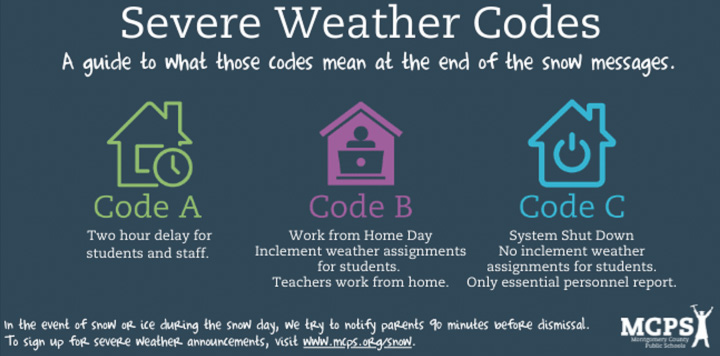
Six of 20 schools in the MCPS system offer free breakfast and lunch to students when school is in session. When schools are closed due to severe weather under severe weather code B and road conditions are deemed safe, meal services are available for pickup at specified locations. The district’s two January closures did not fall under severe weather code B. 

An informational graphic by MCPS depicts the district’s severe weather codes.  

“Maybe it would have been better to simply open the schools for students and families without heat or power and offer meals like other counties are doing – for those who can make it there safely, of course,” said Lauren Black on an MCPS Facebook post. “Prioritize being human and empathetic rather than focusing on attendance and accreditation.”  

According to the Code of Virginia, school closures due to “severe weather conditions or other emergency conditions” result in the addition of make-up days to the school calendar. Schools must be in session for 180 teaching days to avoid reduced funding due to closures. 

“It’s not just that period that they’re outside in the cold, but there are a lot of other things that play into health if school is being canceled because it’s too cold to be able to go in,” said Washofsky.  

Road salt raises larger questions for local waterways

By Evan Hull, environment, climate, and sustainability reporter

In response to winter weather sweeping across the east coast, the Virginia Department of Transportation deployed its usual slew of road salt. Experts say that while the popular ice and snow combatitant isn’t causing too many headaches in the NRV, it could in the future.

“Everything we do in the terrestrial environment creates ions,” said Joel Snodgrass, head of the Department of Fish and Wildlife Conservation. “When they get in water, they dissociate, they dissolve, and they kind of pass through everything. So, if we put [salt] on the road, it gets washed into the soil, into the groundwater, and ultimately into surface waters like streams, wetlands, and lakes.”

Anywhere from 15 to 32 million metric tons of road salt are dumped on roads every year in the United States according to the Cary Institute of Ecosystem Studies. With the NRV being geographically more susceptible to ions, such as calcium, entering groundwater systems, road salt adds another layer of complexity to the pollution problems we face.

“During the winter, you get these big spikes in salt runoff,” Snodgrass said. 

Researchers worry about winter chloride spikes in local waterways, but they are more concerned about the continual elevation of groundwater contamination, which has become a global problem.

“Road salts are part of this bigger phenomenon that’s going on basically everywhere in the world, in fresh water systems, where the amount of ions in the water is increasing,” Snodgrass said. “In other words, the water is becoming more saline in nature. It has more dissolved solids in it.”

Other runoff pollutants cause issues all year long.

“It’s not just salt that comes off these roads,” Snodgrass said. “Every time someone uses their brakes, particles come off their brake pads and collect on the road—all the belts, engines, and tires.”

When heavy metals are released onto roadways, most commonly cadmium, copper, and zinc, they can interact with road salt in harmful ways. The International Erosion Control Agency says road salt mobilizes heavy metals, permitting these materials to quickly infiltrate groundwater systems and contaminate plants and wildlife.

Additionally, high concentrations of sodium can reduce the permeability of soil, increase surface runoff, and raise erosion rates, directing pollutants straight toward major waterways.

But these aren’t new issues. In fact, stormwater management facilities such as Virginia Tech’s Duck Pond and Stroubles Creek are great examples of how runoff pollution is managed in southwest Virginia.

“Stormwater management facilities in the NRV serve two purposes,” said Kafi Howard, stormwater engineer for the town of Blacksburg. “The first is to mitigate volume increases due to developments like roads and commercial buildings.”

Even in less-urbanized areas, such as the NRV, large developments increase impervious surfaces, meaning that high volumes of road salt and other harmful materials run into waterways very quickly. Stormwater management facilities help hold that water back, and slowly release it in a less harmful manner.

“There’s also quality control,” Howard continued. “A lot of newer stormwater facilities incorporate mechanisms to filter pollutants.”

Howard noted that many older stormwater facilities do not have filtering systems, noting the importance of properly functioning stormwater ponds and wetlands.

“The New River Valley has quite a few streams that are impaired, which means they are not meeting water quality standards,” Howard said. “So it’s super important that those facilities function and help reduce these pollutants.”

In localities as close as northern Virginia, we can see what happens when pollutants are unfiltered by stormwater facilities.

“In Tysons Corner, Virginia, there is enough salt going down that people are losing their wells,” Snodgrass said. “The well becomes so contaminated that all their appliances start to rust.”

The question then turns to the economy. Does keeping roads clear of ice and snow boost the economy enough to justify the cost of maintaining highly contaminated waterways?

“There’s a whole social aspect to this,” Snodgrass commented. “There’s an economic piece to this. If it snows and nobody can get to work for three days, that slows down our economy, right? Now it’s in our mentality.”

Although road salt helps lower the freezing temperature of water, keeping the roads clear and economies moving, it comes with hidden costs, and not just in the environmental price we pay. According to the EPA, NBC, and Vox, the U.S. spends an estimated $2.3 billion to apply road salt, and another $5 billion to repair infrastructure and vehicle damages annually.

With a huge price tag, several alternatives have been considered including acetate deicers and organics, both of which can release equally harmful chemicals into waterways according to the Sustainable Technologies Evaluation Program. Neither option is nearly as cost-effective as road salt.

While waterways in the NRV do not currently have to give a second thought to the application of road salt, they should certainly keep a close eye out as commercial developments continue to pop up regularly, contributing to higher concentrations of pollutants entering local streams.

“I think that the consideration of road salt and stormwater management is certainly something that needs more investigation,” Howard said. “We all want clear streets and easy access in the winter, but we need to recognize that there is a price to pay for our convenience.”