“What We Were Wearing” – Virginia Tech Student Exhibit Advocating for Survivors

By: Zain Omar, arts & culture reporter
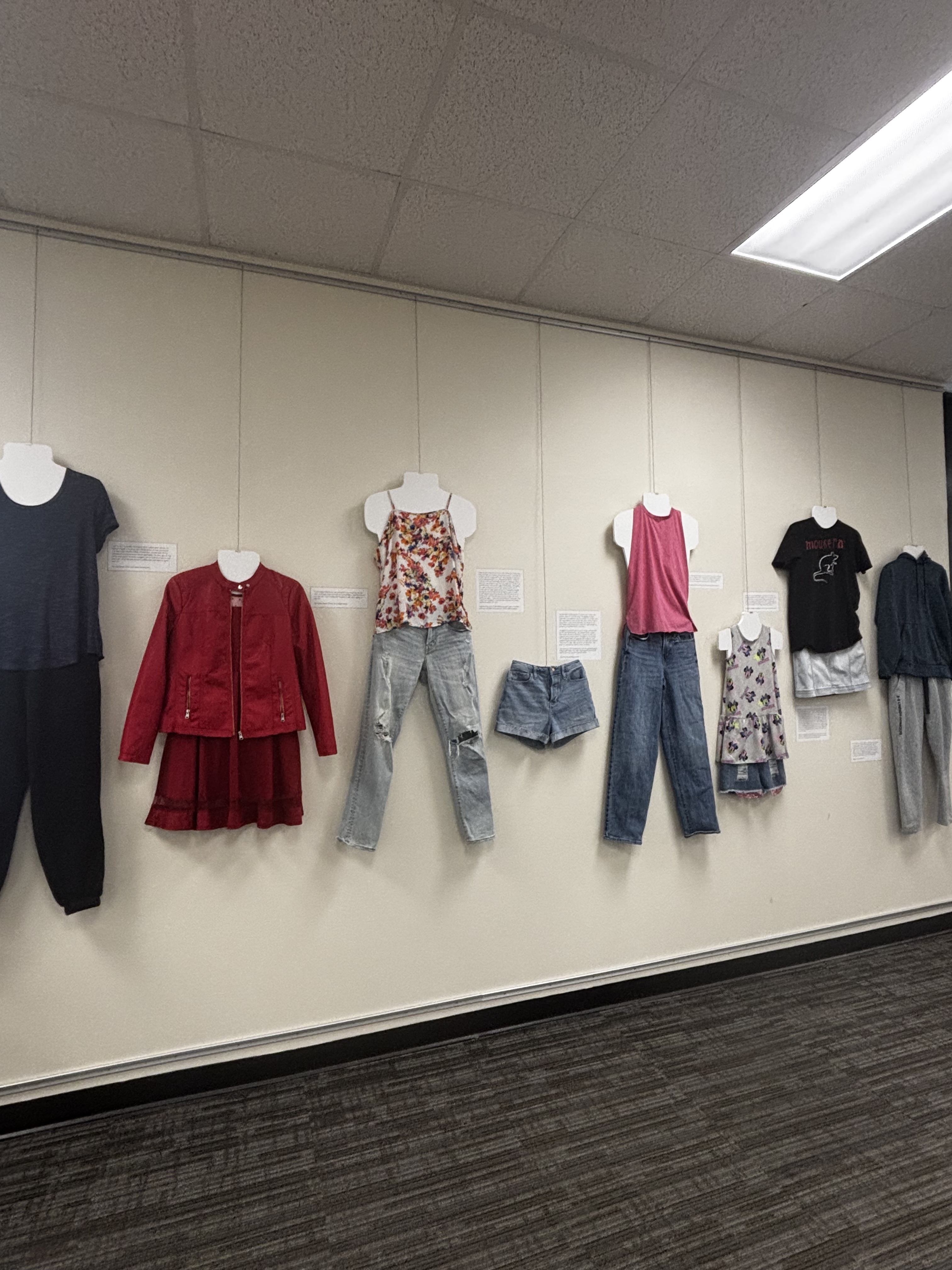
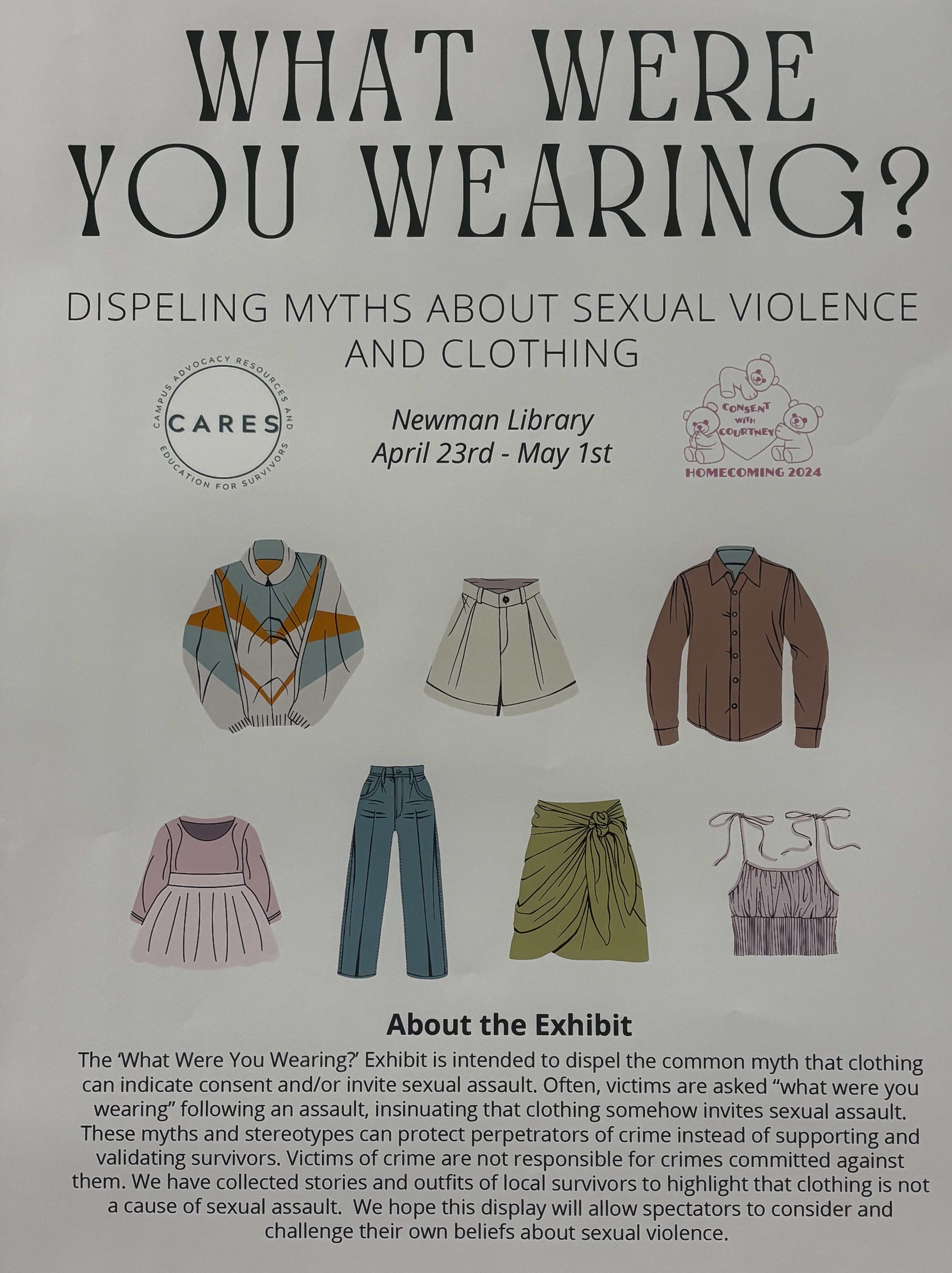
In collaboration with the Women’s Center at Virginia Tech, graduating senior Courtney Bergeron, debuted an installation titled “What We Were Wearing”. The exhibit was part of Bergeron’s homecoming platform, Consent with Courtney, and was on display in Newman Library from April 21st until May 1st.

The exhibit showcased clothing that local victims were wearing when they became a victim to sexual assault. The purpose of the exhibit is to challenge thoughts that what a person is wearing is equivalent to consent. The clothing in the exhibit represents a range of ages and genders, showing exactly what the person was wearing when the act happened.

Bergeron’s personal experience with sexual assault was the main motivator to start Consent with Courtney. “As a victim of sexual assault, I made it my mission to help others just like me. I faced a lot of challenges when going through the medical and legal process and most of it was from lack of knowledge. I knew if I could have a platform, I could spread information I wish I had,” Bergeron said.

After Bergeron’s own sexual assault case was dismissed, she decided she wanted to make a change. Bergeron shared her story on the Consent with Courtney Instagram to show others they were not alone and to better educate everyone on the subject. She became a victim to sexual assault her freshman year at Virginia Tech and the Women’s Center was one of the main advocacy sources Bergeron worked with.

 In a statement on Consent with Courtney’s official account, Bergeron stated, “Instead of harboring anger for my situation, I took that hate and turned it into passion to help others just like me. I never want anyone to go through what I went through.”

“What Were You Wearing” exhibits have gained popularity worldwide. With a rise in activism against sexual violence and campaigning to give voices to all victims of sexual assault, exhibits dismantling the stigma against sexual assault have become an international trend.

The What Were You Wearing exhibit was first conceptualized when The Director of The Sexual Assault Prevention and Education Center at the University of Kansas, Jen Brockman and Dr.  Mary A. Wyandt-Hiebert from the University of Arkansas Rape Education Center, attended a reading of Dr. Mary Simmerling’s poem “What I Was Wearing”. The poem touches on Simmerling’s feelings of dealing with the aftermath of sexual assault and having everyone ask her about the outfit she was wearing, as if that caused it.
According to the Sexual Assault Prevention and Education Center at the University of Kansas, “Dr. Wyandt-Hiebert and Ms. Brockman wanted to create a project that would place the work of bearing witness to this question’s answer back on the shoulders of the community and humanize the survivor in the answer. To ask the question, ‘what were you wearing?’ cost the questioner nothing, there is no labor in making this statement. However, the survivor must pay dearly in not only their answer but also, in the burden of self-blame.”

One of the largest exhibits of this kind was held by the United Nations. The exhibit originally had 5 outfits, each representing a different region in the world. By July 2022, the exhibit grew to feature 103 outfits. These outfits represent the 1.3 billion sexual assault survivors worldwide.

The United Nations exhibit had many celebrities, business leaders, and influential figures from around the world sharing their stories of sexual assault. The United Nations exhibit put the issue on a grand scale to show no matter where you are from or what you are wearing, the fault is not with the victim.

The exhibit is meant to show that clothing does not offer consent or permission. Sexual assault can happen in any outfit, at any age, and any place. These exhibits ensure survivors that what they were wearing is not what caused their assault, it was the person who committed the act.

“It’s not the clothing that causes sexual violence; it’s the person who causes harm. Being able to find that peace for survivors and that moment of awareness for communities is the real motivation behind the project,” stated Brockman in an interview with Huff Post.

Courtney not only wants to help provide a platform for survivors but also educate everyone on the concept of victim blaming, especially around sexual assault.

“I hope they see that sexual assault can happen to anyone at any time. Clothing is not consent. It does not determine your safety or your worth. The only way to end this horrible issue is to come together as community, educate ourselves, and support survivors,” Bergeron said.

The Women’s Center at Virginia Tech provides advocacy and care to women facing any issue related to sex or gender. The CARES program has a direct focus on advocacy to victims of sexual assault and other forms of harm.

“CARES stands for campus advocacy, resources and education for survivors, so our primary objective is to just provide support and advocacy to students, faculty and staff of all gender identities that have experienced any kind of sexual violence, domestic violence, stalking or harassment. We do that primarily through advocacy-based counseling, we also do a lot of resource recommendations and accompaniments. For example, some of the resources that are available for students is the Title IX office and the Virginia Tech Police Department or the Blacksburg PD. With accompaniments, what that means is we can go with students or faculty who are making reports or meeting with Title IX or the police to kind of act as a third-party, emotional support person, so they don’t have to go through the process alone,” said Bailey Williams, Advocacy Coordinator for CARES.

The Women’s Center also has resources for students and faculty to better educate themselves on sexual and domestic violence. They host events and give presentations to classes and organizations to help them learn more about the Women’s Center and how to get more involved. The Women’s Center also has a webpage where they have all the advocacy resources that they provide listed.

Bailey Williams said, “Obviously doing the research is always a big part of that, taking the time to really understand what consent is, why sexual violence occurs, there’s a lot of really great research and literature out there. Coming to events hosted by the resources that are designed to aid students following an assault is also a big one, we do a lot of tabling and outreach events. Organizations and classes can also request presentations from us. Keeping an eye out for what the resources have available and take the time to do outside research.”

The community of Blacksburg saw the exhibit as a source of comfort and solace, especially those who are victims of sexual assault. Students and other community members felt welcome to share their stories and open about their own experiences.

“I received several messages from survivors and families of survivors reaching out and thanking me for speaking out on this sensitive topic. There is such a stigma around sexual assault and people are scared to talk about it. I am continuously trying to break the stigma. Having the people of this community reach out and let me know that I was helping them was genuinely so rewarding. I said when I started this all if I helped just one person this would all be worth it, and I feel like I really achieved that goal,” Bergeron said.

Bergeron hopes to continue making a difference with her platform after graduation. While she will no longer be in Blacksburg, the Women’s Center at Virginia Tech hopes to keep the legacy going.

“Unfortunately, I will be graduating, so I will be continuing my fight in Northern Virginia. However, we raised over $1000 for the Women’s Center to continue their support of sexual assault victims and educating the community. They hope to make this an annual event,” Bergeron said.

While Bergeron will not be in Blacksburg to continue her platform in the future, the Women’s Center is hoping to keep educating students. The Women’s Center is available to any students and community members looking to learn more or find support regarding sexual assault.

The News Feed NRV Podcast: Discussing Art-based Activism

By: Caroline Herbert, Will Frank, and Zain Omar, arts and culture reporters

This podcast discusses the recent “Just Stop Oil” protest in London at a performance of The Tempest. We then discussed the implications and consequences of art based protest and spoke with David Gammons, Assistant Professor of Directing, on his thoughts regarding protesting in the theater.

Struttin’ for Paws: adoption fashion show brings together creative design students help animals find their forever home.  

By: Zain Omar, Will Frank, and Caroline Herbert, art & culture reporters

Virginia Tech’s Hokie Designer club is putting together a one-of-a-kind fashion show. On April 11th, the group is displaying a free fashion show showcasing adoptable pets alongside their models in custom clothing meant to represent the warmth of a future forever home. Finding a way to celebrate the designers’ work and utilize it for a greater cause, everyone is welcome to enjoy the show for free. 

West End Hosts Annual Saint Patrick’s Day Celebration.

By: Zain Omar, Arts and Culture reporter

West End at Virginia Tech hosted a Saint Patrick’s Day event on March 17th, 2025.

The event offered Irish themed dishes all day, including Shepards Pie, Irish Stew, and Rueben Sandwiches.

West End hosts a Saint Patrick’s Day event every year, along with events throughout the year to celebrate different holidays and embrace cuisine from other cultures.

ICAT Celebrates New Academic Building with Instillation

By: Zain Omar

The Institute of Creativity, Arts, and Technology at Virginia Tech has unveiled an art exhibit in celebration of the newest academic building on the Alexandria, VA campus.

“Carving Out Creativity”, is a multi-sensory experience that delves into the art of stone carving, how it effects our brain waves, and how art can connect others no matter how far away they are.

The installation was a collaboration of neuroscientists, engineers, and artists at Virginia Tech. Assistant Professor and Fellow at the Center for Health Behaviors Research, Dr. Julia Basso, has spent the last few years helping the team put together the scientific component of this exhibit.

The instillation, while limited time at the Cube in Moss Arts Center, will be up until May at the Virginia Tech Innovation Campus and the Torpedo Factory Arts Center in Alexandria, as well as The Taubman Museum of Art in Roanoke.

UNICEF at Virginia Tech is Making a Difference in The New River Valley.

By Zain Omar

Members of UNICEF at Virginia Tech gathered on February 6th, 2025, to create activity kits for children who are currently receiving care at the LewisGale Hospital Montgomery.

How it started: Freshman Sarah Soltani founded UNICEF at Virginia Tech in the spring semester of 2025.

  • Soltani was a member of her high school’s own UNICEF and was searching for a similar club when she arrived in Blacksburg for her freshman year at Virginia Tech.
  • Soltani values the meaning and mission of UNICEF and wanted to re-establish the club on Virginia Tech’s campus to spread those values in the Blacksburg area. “I feel like the mission is so important, basically helping disadvantaged children, and I feel like it really serves Virginia Tech’s motto, Ut Prosim,” said Soltani.

Zoom in: UNICEF at Virginia Tech dedicated their first meeting to create activity kits for children who are receiving care at the LewisGale Hospital Montgomery.

  • Students gathered in Torgersen Hall to put together bags of art activities to give to the children in the hospital.
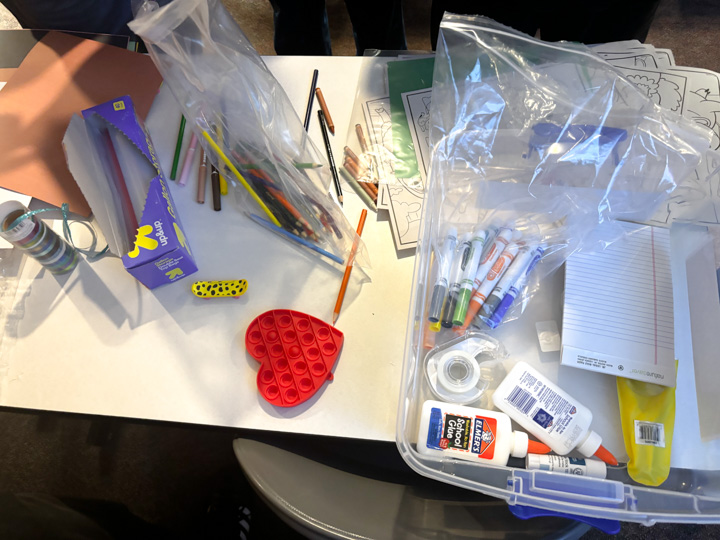
  • The activity bags contained coloring pages, markers and colored pencils, ribbons, stickers, and fidget trinkets.
  • “When they come in, either visiting because their sibling is in the hospital or they themselves in the hospital, it’s a way to kind of cheer them up and provide some entertainment in a place that can be very scary for a child,” said Soltani, when asked why she wanted to have this be the first project for UNICEF at Virginia Tech.

Zoom out: Art therapy is a highly recommended practice for children who are currently sick or hospitalized.

  • Having activities for children to engage in can help to take their mind off of their treatments and what they are currently going through.
  • According to The Crayon Initiative, an organization dedicated to bringing art therapy to pediatric patients, “a study from 2018 documented that letting pediatric patients engage in art activities decreased their stress levels. There was also a noticeable improvement in the children’s moods.”

The big picture: UNICEF at Virginia Tech is dedicated to bettering the lives of disadvantaged children living in the New River Valley.

  • UNICEF at Virginia Tech has a goal to provide resources to children in the New River Valley to help shape their futures and help them overcome disadvantages they may face.
  • When asked about her goals as the President of UNICEF at Virginia Tech, Soltani said “the goal of the club is basically to deliver the fundamental necessities that try to give every child an equitable chance in life. So, from safe water to nutrition to education to sanitation, we’re really trying to help children that are in communities that are a little bit neglected.”

What’s next: UNICEF at Virginia Tech is just starting on campus and they are looking forward to growing the club in the future.

  • The club plans to host meetings every two weeks where they will be working on various initiatives to benefit children in the New River Valley.
  • Soltani is hoping to get more students out to their meetings to help make a difference. “I think we had a really great turn out for our first meeting, so I just want to continue on growing,” said Soltani.
  • The operations director for UNICEF at Virginia Tech, Iman Monday, wants to get other clubs involved in their initiatives as well. “In the future, I really hope that we can collaborate with other clubs, even with sororities and fraternities, so we can get more recognition and more people to join the club,” said Monday.

International Art Exchange Gets It’s Start at Virginia Tech.

By Zain Omar

The Art, Research, and Technology Exchange (ARTx) was founded in collaboration with Virginia Tech’s Institute for Creativity, Arts and Technology (ICAT) and hosts conferences in specialized performance venues with universities on the advancement of technology’s role in art.

The idea of ARTx came to fruition when Kyle Hutchins, assistant professor of practice at Virginia Tech, played a piece that was composed specifically to be played at the Cube in Moss Arts Center. He realized that certain works could not be duplicated or transferred to digital media because the experience of the performance is affected by the environment.

ARTx allows for professionals and students in the art space to research the impact that advancements in technology affect the way art is shared, learned and taught. Universities and organizations have the opportunity to be awarded grants for their research to keep advancing multimedia performance spaces on their campuses. Virginia Tech was awarded the SEAD grant to fund future projects at the Cube during the spring 2024 ARTx conferences.

ARTx features guest lectures at their event where researchers and art faculty from around the world can share how they found that technology has impacted the learning and performance landscape. Music therapist, Grace Carr, has experienced first-hand how technology has affected the way we learn art. “As a music therapist, I have seen first-hand how teaching music and understanding it have changed because of technology. It is my opinion that technology has allowed for teaching to become much more accessible and readily available to people,” said Carr.

ARTx research focuses on advancements in technology and how they impact the way art is shared, whether in educational environments or in specialized performance venues, such as the Cube. According to Virginia Tech’s Institute for Creativity, Arts and Technology, “The initiative emphasizes collaborations with peer institutions that feature spatial audio and multimedia performance spaces and festivals.”

Advancements in technology also play a role in art classrooms. As new technology is being introduced each year, students and teachers must adapt to new ways to create.

Advancements in technology change the learning landscape for students who are pursuing careers in artistic fields. Former music education student and Music Therapist Grace Carr found that technology has enhanced the learning environment when it comes to artistic fields. “I would say that technology has changed the way we learn art, in that it had simply added on to what we learn. That is not to say that I didn’t learn anything the “old fashioned” way. When I was learning to transcribe music, I would first learn on paper, then on a computer software. So, I would say that in leaning art, technology can help us enhance what we already know,” said Carr.

With the rise of art created for specialized research environments, institutions have found that sharing their work in other settings can be difficult. “When institutions have highly specialized research spaces for art-making, sharing work with other institutions can become challenging, if not impossible,” according to ICAT. ARTx is a way for these institutions to team up to find ways to develop these works to be shared in other space.

Through ARTx, researchers are finding ways to better be able to share these works that have been composed to fit only certain environments. This research will open doors or new ideas and innovative ways that art can be created.

ICAT hosts collaborations with festivals, universities, and organizations throughout the year. They have currently teamed up with 11 partners with locations all around the world. Currently, ARTx has partners in Canada, California, Ireland, New York, and Washington, D.C.

Virginia Tech hosts the New Music and Technology Festival every two years, where faculty and researchers apart from ARTx convene to share their research through lectures, performances and installations. The festival also features student works and is an environment for art and technology disciplines to learn and collaborate with each other. According to ICAT, “the festival highlights diverse disciplines, including music, theatre, cinema, dance, visual art, creative coding, computer science, neuroscience, molecular biology, robotics, and cybersecurity.”

Events for this festival are held in specialized research and performance spaces around Virginia Tech’s campus, such as the Cube, the Sandbox, and Perform Studio.

When Virginia Tech is not hosting the organizations that are part of ARTx, faculty is sent to attend conferences all over the world hosted by other institutions in the art exchange. The most recent conference that Virginia Tech attended was a five-day conference at the Center for Interdisciplinary Research in Music Media and Technology in Montreal, Canada.

Through the collaboration with ARTx and ICAT, along with the other universities and organizations that have joined the art exchange, new understandings of the way technology and art intertwine will start to change the way we share and view art.