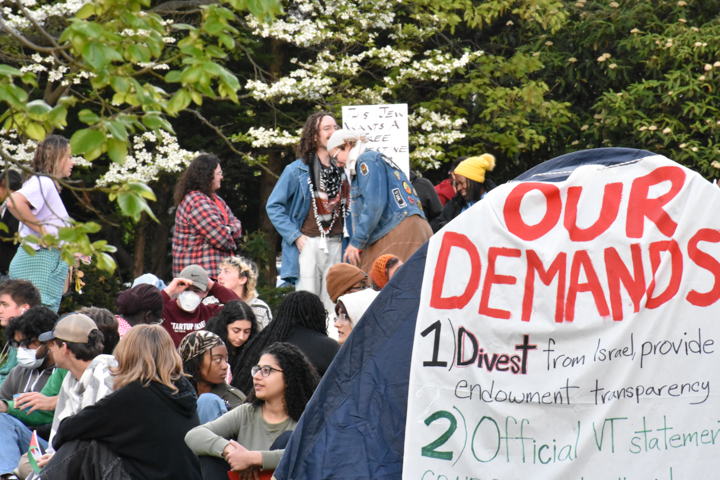
A semester of protests at Virginia Tech

By Wilbert Ramirez, politics reporter

Student protests were frequently observed during the 2025 Spring Semester at Virginia Tech in response to rapid changes made by federal and university administrations.

The protests were from a large variety of different student organizations that had different goals in mind against university policy regarding Virginia Tech’s policy changes due to the new Presidential administration in the United States.

On Jan. 20, President Donald J. Trump enacted executive order 14151 titled “Ending Radical And Wasteful Government DEI Programs And Preferencing,” which stirred confusion among universities and educational institutions around the United States – Virginia Tech included.

Student researchers at the university underwent a “chilling effect” regarding speaking publicly about their research in fear of retaliation from the Presidential administration. Virginia Tech students questioned from the Diplomacy Lab and other social science research requested         The Newsfeed for anonymity to speak freely without fear of retaliation to themselves or their colleagues.

A protest by the Students United Front began on Feb. 21 with students protesting any future action of letting U.S. Immigration and Customs Enforcement or ICE on to Virginia Tech’s campus. The SUF’s worries were propelled by earlier emails sent out by university admin on Feb. 18 discussing what staff such as professors should do if an ICE officer is seeking a student in their classes with bulleted topics regarding “points of contact, private spaces, and communications and rights.”

The situation regarding student protests was then galvanized following the arrest of Mahmoud Khalil on March 8 of a pro-Palestinian student leader at Columbia University who was detained by ICE officers after his green card was revoked.

The next protest of many at Virginia Tech was an emergency protest march by the organization “Students for Justice in Palestine,” which met and marched from the Pylons memorial at the university to the townhall in downtown Blacksburg. The organization called for Virginia Tech to divest from Israel and weapons manufacturing organizations that supply the Israeli military.

The protest was in response to the ceasefire between Hamas and Israel being broken by the state of Israel.

Shahed Sanuri (seen left holding megaphone) and pro-Palestinian student Protesters gather at the Pylons memorial at Virginia Tech, in Blacksburg, VA. Wednesday March 19, 2025 (Photo, Wilbert Ramirez)

“There’s no time for us to debate whether we should be fighting for Palestine or fighting against injustice because it’s Palestinians today and it’s happening to us today, but it could be anybody else tomorrow.”

Shahed Sanuri

Shahed Sanuri, a first-year graduate student at Virginia Tech and co-president for Students for Justice in Palestine is an ardent supporter of the Palestinian rights and recognition.

The largest and most diverse of the protests organized was the march for civil and human rights in response to the board of visitors decision to eliminate the DEI office at Virginia Tech on March 25. The march involved a wide coalition of many organizations such as Black mindedness, Students United Front, Students for Justice in Palestine, and students from varieties of backgrounds. Approximately upwards of 1000 people participated in the march according to organizers of the march.
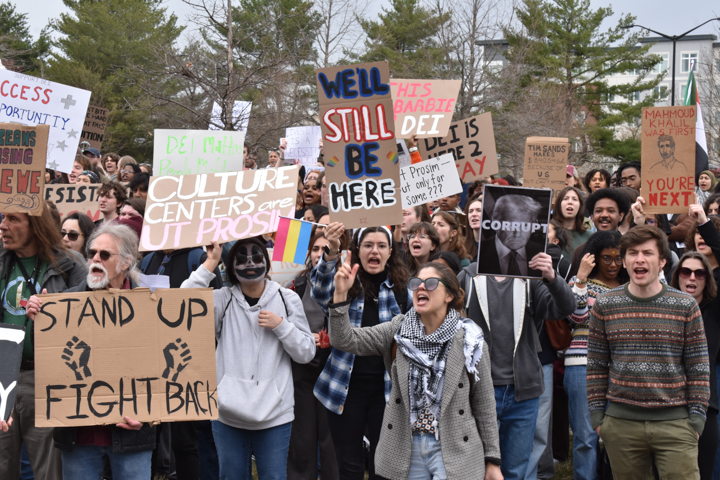
Protesters gather in front of the Skelton Inn at Virginia Tech, in Blacksburg, VA. Tuesday March 25, 2025 (Photo, Wilbert Ramirez)

“It’s one thing to be able to get 1000 people to show up one day, and it’s when you’re comparing it like qualitatively, how does getting 1000 people to show up one day compare to getting 50 to 100 people to show up every single week, you know, for months, right?,” said Cameron Baller, a PhD student in Sociology at Virginia Tech with a Bachelors in Natural Resources and Environmental Science, Minors in Gender and Women’s studies and Economic with an interest in researching social movements. “That’s another kind of lens in which I would be thinking about the history, the recent history of protest on this campus.”

The board of visitors at Virginia Tech went through with the vote to eliminate the DEI office at Virginia Tech in a 12 to 2 vote.

Another moment that galvanized students at Virginia Tech to protest involved the sudden revoking of international student visas around the country including seven Virginia Tech students and 2 alumni on April 9.

President Tim Sands of Virginia Tech released a statement issuing information to assist those who may have been affected.

The following day on April 10 the “Latino Association for Student Organizations” carried out a protest marching through campus against ICE enforcement and student speakers noted the revocation of the international student visas as one their largest grievances in speaking out against the U.S. presidential administration’s decision.

Student protesters gather at the Pylons memorial at Virginia Tech, in Blacksburg, VA. Thursday April 10, 2025 (Photo, Wilbert Ramirez)

“It’s very heartbreaking and disheartening to see how higher education administrations don’t really give mind to why students are protesting and they’re not really trying to find an active solution towards that,” said Tiffany Suarez the newly elected president of Latino’s for Student Organizations at Virginia Tech and an undergraduate majoring in environmental policy and planning and political science. “I feel like I’ve been seeing a lot of protests, almost every week, and the result of that has honestly just been the administration, turning their back on us not being responsive, not wanting to be at the table and constantly making up excuses about their unwillingness to cooperate with the students.”

The Trump administration reversed the decision of revoking the student visas on April 25 following numerous lawsuits contesting the terminations of visas.

The organization “VTforClimateJustice” held a climate protest on Earth Day, April 22, in front of Burruss Hall that then proceeded to march across campus and ended at the Pylons. The grievances by the organizers consisted of calls for Virginia Tech’s administration to be more transparent regarding Virginia Tech’s climate goals and where the university was currently at in meeting said goals.

In one of the final major protests on Virginia Tech’s campus this semester, Students for Justice in Palestine had a 1-year anniversary protest remembering the arrest of 82 pro-Palestinian protestors that included 53 students the year prior on April 29, 2024 following their 3-day encampment.

The protestors called for the need to stay strong to their cause of getting Virginia Tech to divest from Israel and weapons manufacturers at a time in which rapid changes are shifting against protesting on college campuses around the nation and at Virginia Tech.

The protests and their frequency at Virginia Tech this spring semester signaled an immediate resistance to the rapid, uncertain, and wide range of changes that began with the Trump administration and its combativeness against higher education institutions that challenge the president.

The largest of the educational institutions to rally against the U.S. president is Harvard in Boston Massachusetts, which sued the administration for freezing $2.2 billion in funding to the university. The Joint Task Force to Combat Antisemitism of the Trump administration announced the freeze in funding because of the university’s failing to protect its Jewish students after Harvard refused to comply with a list of demands from the administration.

Student protests around the nation culminated under a time of great uncertainty for their rights and causes depending on their citizenship, international status, and background.

“I think to be a protester, especially during this administration is to have the courage to stand up for something, knowing that there could be legal implications involved.”

Tiffany Suarez

“I think there’s a level of courage that we haven’t seen beforehand in the student protesters on campus – people knowingly going out and protesting given that people are getting their visas revoked.” Said Suarez. “People are actively getting targeted by ICE officials because of their support for either Palestine or criticism of the current administration. I think that shows a new level of courage that I don’t think we haven’t seen in college campuses in quite a while.”  
An interview with a student activist and protestor about DEI

By Julia Lagano, Nyles Stone, and Wilbert Ramirez, Politics Reporters

The Newsfeed politics team reached out to and interviews Tristan Reeves, a senior and student activist at Virginia Tech, about his recent role at a march protesting the board of visitor’s decision to dissolve DEI at the University. Tristan offers insight into what the board’s decision means for the future of students at Virginia Tech.

Executive orders create uncertainty for researchers and admin at Virginia Tech

By Wilbert Ramirez, Politics reporter

A flurry of executive orders having been made by President Donald J. Trump since his inauguration on Jan. 20 has led to confusion and fear among students/researchers and principal investigators at Virginia Tech regarding the freeze on federal grants towards higher education institutions.

Why it matters:

  • Research is predominant part of Virginia Tech, a designated R1 university, the highest designation for research universities, with 4,000 plus researchers and $453.4 million in sponsored research expenditures in 2024 according to Virginia Tech.
  • “There may be questions that are raised from the various orders and memorandum that come in. So, we try to understand what it what the impact will be at Virginia Tech and then as information and an understanding comes in, we communicate that back to the university”, said Mark Owczarski, Interim Vice President of Communications and Marketing and Chief Spokesperson for Virginia Tech.

Misconceptions about the Executive orders:

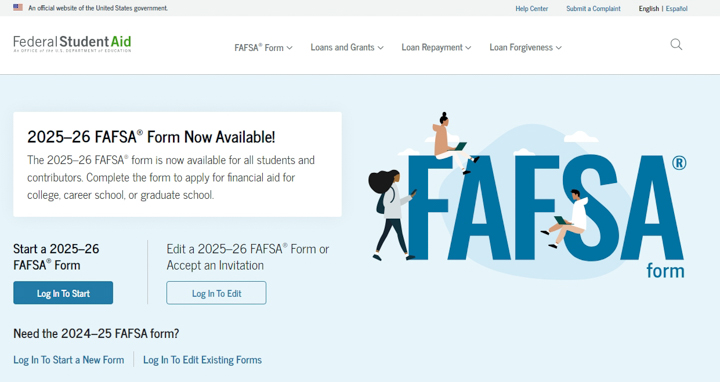
According to the Federal Student Aid Office of the U.S. Department of Education stated, “Federal student aid funds (for example, Direct Loans and Pell Grants) were not impacted by the initial guidance, and we continue to award and disburse federal student aid.”

A screenshot of the current Federal Student Aid website taken on Feb 14, 2024

How is it impacting students and researchers:

According to student researchers who requested anonymity to speak freely without fear of retaliation, many are worried about funding suddenly being cut if the content their research does not align with Executive Order 13985 that stated,

  • “Terminate, to the maximum extent allowed by law, all DEI, DEIA, and “environmental justice” offices and positions (including but not limited to “Chief Diversity Officer” positions); all “equity action plans,” “equity” actions, initiatives, or programs, “equity-related” grants or contracts.”
  • “With the list of words that the National Science Foundation released they are flagging grant applications now, but it’s stuff like “trauma,” “multicultural, “advocate” and it’s like how you do even do social science?” said a psychology student and researcher at Virginia Tech whose research project is focused on substance abuse on LGBTQ+ young adults’.
  • “We were told last week that the State Department pulled the program, so Dr. Hodges and our team leads told us, ‘hey just keep doing what you’re doing but as of right now,’ said an international relations student and researcher from the Diplomacy Lab at Virginia Tech, who also asked to remain anonymous fearing retribution against his fellow researchers. “This is literally useless, we’re just doing it in the hopes that they would accept it by May, which I have extreme doubt they will because I don’t see why they would.”

What university administrators have said and done:

  • “We are following the situation closely and reaching out to our congressional representatives in Washington, D.C., to express our deep concern about this decision and its potential effect on our university and our nation’s long-term viability as a science and technology leader,” said Tim Sands, president of Virginia Tech in an official message.

In response to the dynamic and rapid changes caused by the executive orders, the university created a page that offers guidance to those with questions regarding research and updates on the “Federal Agency Updates” page.

Mark Owczarski in an office at Virginia Tech during a Zoom interview on Feb. 14, 2024, in Blacksburg, VA. (Photo, Wilbert Ramirez)
  • “It’s going to evolve, and we recognize that this community is vested into this, and so as we figure out things, and as the landscape externally changes as well, some things have been rolled back. Some things might be in the courts. Some things will be changed because of additional directives or instruction,” Owczarski said. “What we do know is we are committed to communicating, we are committed to research. We’re not going to just say we’re done, it’s who we are, and it’s challenging.”

House bills take aim at University Protestors

By Wilbert Ramirez, Politics Reporter

Student Protesters sit on the Graduate life center lawn at Virginia Tech, in Blacksburg, VA. Friday April 26, 2024 (Photo, Wilbert Ramirez)

Two House Bills introduced in the Virginia General assembly seek to stifle student protesters’ demands.

House Bill 2529 and H.B. 2207 have drawn the criticism of Students for Justice in Palestine at Virginia Tech. The Instagram page run by “sjpvtech,” called to action against the bills by posting a template to contact representatives in the Virginia General Assembly.

House bill 2529 introduced by Del. Micheal Jones (D) and Del. Dan Helmer (D), seeks to prohibit public institutions in the state of Virginia from divesting all funds from “any country or territory that is not the subject of an active sanctions program administered by the Office of Foreign Assets Control of the U.S. Department of the Treasury.”

“It would make it harder for Virginia tech to divest, but not impossible said Shahed Sanuri, a first-year graduate student at Virginia Tech and co-president for Students for Justice in Palestine. “So the movement is only stronger and only grows stronger and from the way we’ve seen people come together, to we combat these bills.”

H.B. 2529 would make it difficult for any student organization to have any significant policy change at all public institutions in Virginia. The bill appears to narrowly focus on the demands of many of the protestors across the Commonwealth that were arrested at public universities in 2024 around the state that included: the University of Virginia, Virginia Tech, Virginia Commonwealth University, and the University of Mary Washington.

The pro-Palestinian protestors at Virginia Tech were arrested the night of the April 28 in front of the Graduate Life Center Lawn at the public university. 82 individuals were arrested, and the University President Tim Sands released a statement on April 29, after the night of the arrests.

A student protester is arrested on the Graduate Life Center lawn at Virginia Tech, in Blacksburg VA. Sunday April 28, 2024 (Photo, Wilbert Ramirez)
Shahed Sanuri, Co-President of Students for Justice in Palestine at Virginia Tech, in Blacksburg, VA. Wednesday, Jan 29, 2025. (Photo Wilbert Ramirez)

House Bill 2207, which is a companion bill, introduced by Del. Terry Kilgore (R) and it is aimed at tackling terroristic threats on public institutions in the state of Virginia.

The companion bill to H.B. 2207, H.B. 1284 introduced by Sen. Bill Stanley was struck down on Jan. 27 by a Virginia Senate Education Subcommittee.

“It would put a lot of innocent international students as well as other people who are legally here, but not citizens at risk for simply participating in protests or even so much as like posting about their support for Palestine,” says Bella Gilbert, a sophomore majoring in Political Science Virginia Tech and outreach coordinator for SJP at Virginia Tech. “And even though one of the bills says, that deportation is conditional on pro-Hamas expression, we can safely assume that it will just be contingent on pro-Palestinian support.”

Critics from the Pro-Palestinian organization have expressed that these bills if they were to pass, they would make it more difficult for their organization to protest on public institutions.

“The bills basically ban protests from campuses and when we say, ‘liberation for Palestine is liberation for all’ this is what we mean. This is why we’re fighting for the liberation Palestine now and we’re fighting against these bills because these bills don’t just affect the Palestine movement that they affect any movement that’s to come. It just portrays a deep sense of U.S. imperialism and how the U.S. government tries to just target student protests,” Sanuri said.

“These bills are very narrowly tailored, by the way and are in reaction to the camp and the protests last year the arrest. I feel like anyone can look at these bills and see that they are a direct attempt to silence our movement,” Gilbert said.

In recent months the SJP voiced their grievances against the university’s policy 5000 which was altered in Aug. 2024 by university administrators at Virginia Tech, the policy change restricts encampments on university property from midnight to 6 a.m.

“Regardless of whether the bill is possible or not, regardless of what the government wants to do, regardless of how the administration wants to silence us, just know that Palestinian movement will always grow stronger, and we’re always going to fight for the liberation of Palestine,” Sanuri said.

H.B. 2529, as of Jan. 25, 2025, is being analyzed in a fiscal impact statement from the Department of Planning and Budget that informs lawmakers about the financial consequences of the bill.

H.B. 2207 as of Jan. 24, 2025, is also currently under analysis in a fiscal impact statement from the Department of Planning and Budget.

It is unclear where many lawmakers stand on the bills given the controversial actions and consequences of each bill need to first be assessed in the new session of Virginia’s legislature.