A short video news package from Virginia Tech’s Drone Park, where students and researchers practice flying in a controlled, netted flight space. Through interviews with the Drone Park manager, a student intern, a senior emergency coordinator and a drone journalism professor, the story highlights how safety rules and training shape responsible drone use on campus.
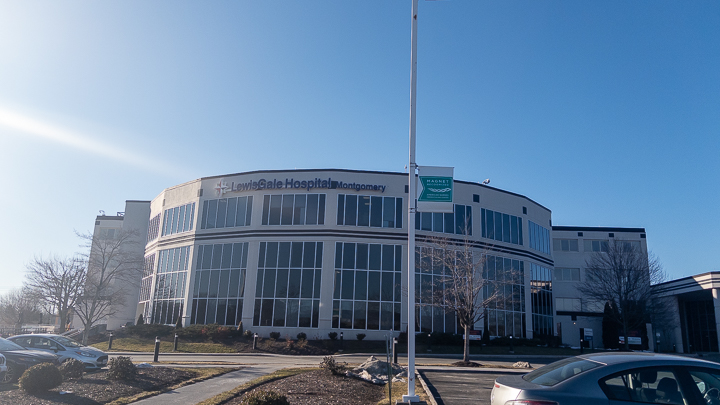
LewisGale Hospital Montgomery in Blacksburg provides in-person and telehealth services to patients across the New River Valley. Photo credited by Timothy Kwon.
For many residents of the New River Valley, a doctor’s appointment no longer requires a long drive through mountain roads or hours away from work. Telehealth has become a lasting part of rural health care, offering patients across the region more flexible access to medical and mental health services.
While telehealth use surged during the COVID-19 pandemic, local providers say it has evolved into a permanent tool for connecting rural patients with care. In communities such as Giles, Floyd and Pulaski counties, distance and transportation remain significant barriers to in-person visits.
At LewisGale Hospital Montgomery, telehealth is now integrated into outpatient workflows across the network. Rhonda Whaling, healthcare provider of LewisGale community outreach, said virtual care helps eliminate the burden of travel for many patients.
“Telehealth cuts out the long drive,” Whaling said. “For a lot of rural patients, it turns a half-day trip into a focused visit from home.”
Whaling said many telehealth appointments involve follow-ups, check-ins and specialty visits that do not require a hands-on exam. Patients still follow a structured process, checking in and joining secure video visits much like they would wait for a provider in a traditional office setting.
“The biggest benefit is simple access,” Whaling said. “It lowers the life cost of getting care..”
Taryn Wilson is a physician assistant who provides clinical assessments, tests, and prescriptions at Blacksburg Psychiatry. Photo courtesy of Blacksburg Psychiatry.
Mental health services have become one of the most common and effective uses of telehealth in the region. At Blacksburg Psychiatry, physician assistant Taryn Wilson said virtual visits help patients remain consistent with treatment.
“We use telehealth as a practical way to keep people connected to care,” Wilson said. “Telehealth helps us reach people who would otherwise skip care because the drive is too hard.”
Wilson said psychiatric assessments, medication management and routine follow-ups can often be handled effectively through video when clinically appropriate. That flexibility is particularly valuable in rural communities, where access challenges extend beyond provider availability.
“In the New River Valley, access isn’t just about whether a provider exists. It’s whether someone can realistically get to the appointment,” Wilson said. “It turns ‘I can’t make it’ into ‘I can show up.’”
For providers, consistency is one of the biggest advantages. When patients can attend appointments more regularly, treatment plans can be adjusted more quickly and progress can be monitored more closely.
“Better access usually means better follow-through and better outcomes,” Wilson said.
However, telehealth does not eliminate every barrier. Both providers emphasized the ongoing impact of the digital divide in rural communities. Spotty broadband access, limited data plans and lack of private space for appointments can still limit participation.
“The digital divide is real,” Whaling said. “Internet and technology are still the big challenges.”
Wilson also said that unstable internet connections can disrupt visits and that some situations require in-person care.
“Telehealth expands access, but it doesn’t erase broadband and privacy barriers,” Wilson said.
Clinically, providers stress that telehealth cannot replace all services. Physical exams, lab work and emergency care must still take place in person. In psychiatry, safety planning also requires careful attention during virtual sessions.
“We have to know where a client is located during a visit and have a plan if they’re in crisis,” Wilson said.
Telehealth policies continue to evolve at both state and federal levels. During the pandemic, reimbursement rules expanded to support virtual visits. In Virginia, Medicaid continues to update telehealth guidance, including provisions for live video and certain audio-only services in specific circumstances.
Whaling said telehealth has transitioned from an emergency solution to a long-term component of care delivery.
“Telehealth went from temporary fix to normal option,” Whaling said. “Now it’s about using it wisely.”
Looking ahead, both providers expect telehealth to remain part of a hybrid model that blends virtual and in-person services.
“I think telehealth will keep expanding, especially for specialties that are harder to access in rural areas,” Whaling said.
Wilson said the future of rural health care will likely focus on matching the format of care to the needs of the patient.
“Telehealth won’t replace clinics,” Wilson said. “But it will stay a key bridge between visits and help rural patients stay connected.”
In a region where geography has long shaped access to health care, that bridge may continue to narrow the distance between providers and the communities they serve.
Artificial intelligence is becoming a regular part of daily life at Virginia Tech, affecting how students complete assignments, how professors teach classes and how research is conducted. From AI-powered writing tools to software that generates computer code, the technology is increasingly used across campus and is raising questions about learning, ethics and the future of higher education.
To better understand how AI is changing everyday academic life and what it means for students, Chris North, a professor of computer science at Virginia Tech, discussed how AI is already being used on campus, how it is influencing teaching and coursework and why adaptability will be important for students entering an AI-driven workforce.
This interview has been edited for length and clarity.
How do you define artificial intelligence for people who use it every day but don’t have a technical background?
Artificial intelligence is a broad term, but in general it refers to designing computer systems that behave in intelligent ways. These systems rely on large amounts of data and past experience to guide how they respond to users.
A common example is large language models like ChatGPT. These tools are trained on massive amounts of text from across the internet, which allows them to produce responses that sound realistic. They work by learning patterns from how people communicate and then using those patterns to generate new responses.
How has AI changed everyday academic life for students and faculty at Virginia Tech?
It affects different people in different ways. One example from my own experience involves mentoring graduate students who are writing and publishing research papers. Many of those students are international students, and English is not their first language.
In the past, I spent a lot of time correcting grammar and improving the readability of their drafts. That was time-consuming and not really the main focus of my job, which is to evaluate the quality of the research. Over the past few years, language models have helped take on that proofreading role. Now, when students submit drafts, the writing is usually clearer, and I can focus more on the science rather than grammar.
From the students’ perspective, AI can also help them think more critically about their writing. Some students use AI tools to summarize their work. If the summary does not match what they intended to say, it shows them that their writing needs improvement before they submit it.
How is AI changing the way professors teach and design coursework in higher education?
AI has forced professors to rethink traditional assignments. Many quizzes, homework problems and programming exercises can now be completed easily using AI tools. That raises questions about what students are actually learning if the technology can generate answers on its own.
In computer science, it is still important for students to learn the basics of programming. AI can write good code, but it can also write bad code. Students need to understand how to evaluate code, fix problems and think about issues like security.
The challenge for educators is figuring out how to teach these skills in a way that feels meaningful. Some professors are experimenting with assignments that allow students to use AI for an initial draft and then require them to critique or improve the work. The goal is to use AI as a tool while still encouraging critical thinking.
How should universities balance innovation with concerns about academic integrity, privacy and bias in AI systems?
There are still many unknowns. Higher education is very much in a trial-and-error phase when it comes to AI. Academic integrity is a major concern, especially when students can submit AI-generated work without fully understanding it.
Creating assignments that encourage thoughtful use of AI is difficult, and grading that type of work takes more time. In the past, many assignments relied on automated grading systems that simply checked whether an answer was correct. Evaluating students’ reasoning and reflection is more subjective.
Bias is another concern. AI systems may push users toward certain ways of thinking or problem-solving that are not always ideal. Universities are still figuring out how to address these issues, and it will likely take time to understand the long-term effects.
What advice would you give students who are worried that AI might replace certain jobs or career paths?
Concerns about AI are understandable, but they are not new. Similar worries existed during the rise of internet search engines like Google. At the time, people feared those tools would destroy jobs or harm society. Instead, they changed industries and created new opportunities.
AI will likely change jobs rather than eliminate them entirely. Some roles may disappear, but new ones will be created. The most important thing for students is adaptability. Education should focus on helping students learn how to adjust, be creative and use new tools as technology continues to evolve.
That is why banning AI outright in education is not helpful. Students need to learn how to use these tools responsibly so they are prepared for an AI-driven world.
Looking ahead five to 10 years, how do you expect AI to further change college campuses?
I am not very good at predicting the future, but I think mindset matters more than specific predictions. Approaching AI with fear is not productive. Instead, students and educators should view it as an opportunity to do new and innovative things.
AI will continue to develop quickly, and success will depend on how well people adapt. Universities should focus on teaching creativity, critical thinking and flexibility so students can take advantage of new technologies as they emerge.



 > THE NEWS FEED <