At Virginia Tech, the Rape Aggression Defense system (R.A.D.) teaches women self-defense techniques. Gabrielle Vessal is a senior and VT police department intern taking the course for the first time. She shared her experience and key takeaways she learned from the R.A.D. program.
Protein is the latest health craze in the U.S. However, the exponential rise in protein-marketed products and consumption has experts warning that this may have gone too far.
“Now, protein is part of the marketing environment,” stated Vivica Kraak, who holds a doctorate and is an associate professor of food and nutrition policy at Virginia Tech University. “It’s the new gluten-free.”
Hyper protein consumption is a predominantly younger facing health trend. Younger generations, such as Millennials and Generation Z, on average, spend $71 on protein items (meat, dairy, powders, chips, etc.) per week, whereas older generations tend to spend about $27, according to Empower’s recent “The Protein is Extra” study.
Additionally, 43% of Americans reported that they are willing to pay higher prices for protein-enhanced items. That percentage is higher among Generation Z, 56% of whom reported splurging on protein goods. The study further affirms Americans’ protein preference; it found that 50% of respondents check protein content first when reading nutrition labels, and that 45% consciously look for protein-labeled items.
The muscle-building macro further solidifies itself as a health stamp of approval as 72% of study respondents reported that if a product is labeled as protein-enhanced, they are more likely to pay extra. A majority of respondents also stated that they are looking to increase their protein intake – enter Simple Truth Protein Line.
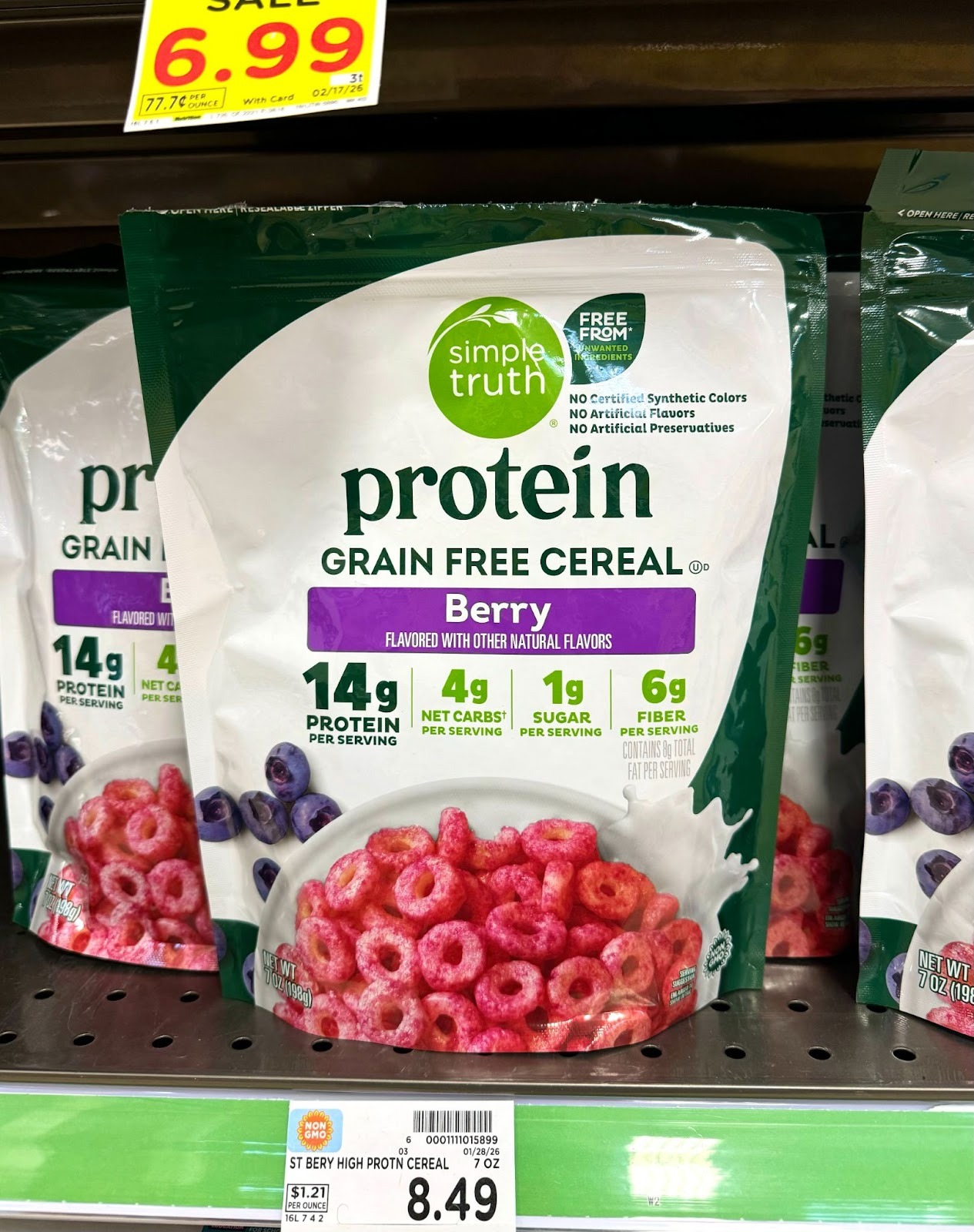
Launched on September 17, 2025, and marketed as an affordable and “free from unwanted ingredients” protein option, Kroger’s Simple Truth brand offers more than 110 protein-enhanced grocery items.
The line boasts everyday products enhanced with whey, pea, and various concentrated protein sources. Additionally, products that are already protein-rich are featured, like Simple Truth’s protein cottage cheese. Their version sports 15 grams per ½ cup serving, in juxtaposition to Good Culture’s 14 grams for the same serving size.
Other merchandise includes, but is not limited to:
Simple Truth Protein’s grain free berry flavored cereal on grocery store shelf. (photo by Sarah Shrader TheNewsFeedNRV.com)
The Simple Truth Protein Line appeals to health-conscious consumers, looking to eat right. While it may be grocery supplies, the line is marketed as health products and an investment in one’s overall well-being.
“We’re just talking about wellness more like a product or a service, but not comprehensively,” Kraak stated. “We live in a very saturated environment with commercial messages. That’s just the nature of American society.”
The U.S. is by far the largest health economy in the world. Valued at $2 trillion, it represents one-third of the global wellness economy according to the Global Wellness Institute.
“I think the opposite of mindful living and mindful eating is this optimization culture that’s being driven by marketers and advertisers,” Kraak stated. “There’s a whole monetary economy behind it. I think it’s going to have detrimental impacts if you can never reach perfection.”
As wellness is packaged and sold to American consumers, health fads often present themselves as a capitalist opportunity to gain market share. Spanning from ketogenic diets, Whole30, juice cleanses, gluten-free and now to protein-centric diets, Kraak noted that pervasive health claims and marketing have oversaturated the market and led to confusion surrounding nutrition.
Woman compares yogurt brands at Kroger in Blacksburg, VA. (photo by Sarah Shrader TheNewsFeedNRV.com)
“We don’t yet know how much ultra-processed food can be consumed without having health risks,” stated Brenda Davvy, who holds a doctorate and is a professor in the department of human nutrition, foods and exercise at Virginia Tech University.
Kroger’s push for protein is also a symptom of a larger trend in the U.S., according to Kraak. While American protein intake increased in recent years, the new federal dietary guidelines encourage greater protein intake across the board.
“For decades, the recommended daily intake of protein has been 0.8 grams of protein per kilogram of body weight,” Davvy stated. “The latest version of our dietary guidelines, which were just released, increase this a bit to about 1.2 grams protein per kilogram of body weight.”
Kraak addressed the change in nutrition guidance, asserting that, today, most Americans are not underconsuming protein, but more likely overconsuming it. She noted that without proper movement, excess protein stores as fat in the body. Further, Kraak added that protein diversity, specifically consuming plant-based proteins, is more crucial than eating it in large quantities.
Experts, like Davvy and Kraak, endorse the Mediterranean diet, which is ranked as the healthiest diet in 2025 by U.S.News. The diet focuses on whole foods with an emphasis on diverse plant consumption. Intuitive eating is also promoted, in contrast to other diets, which tend to suggest restriction of calories or elimination of food groups.
Kraak also emphasized the importance of integrating movement into daily life, such as ditching the car and walking, using public transport, engaging in frequent exercise and overall simplifying wellness in a media landscape that is designed to complicate it.
On Jan. 26th, Pulse Pilates debuted its Mat Studio, diversifying its class selections.
Since opening in May 2023, the establishment sports a staff of 13, and offers a variety of classes, ranging from high to low impact. Notably, Pulse Pilates provides specialty services including pre/post natal, 50+ and private sessions for those recovering from injuries or surgery.
In an interview, managing director, Sheryl Heath touched on a variety of topics, including her journey founding Pulse Pilates, service specifics and the studio’s relationship with the Blacksburg community.
Sheryl Heath of Pulse Pilates Studio.
Her comments were edited slightly for length and clarity.
You’re not a Blacksburg native; can you tell me about how you ended up here?
I’m from Florida. I was a nurse practitioner for 35 years. I started doing travel work because you make more money and travel the country. I landed here with a travel position with Carilion Clinic.
They had me start at Rocky Mount, then I was at Lexington for a while, and then Roanoke. I ended up being offered a full-time position at New River. I’ve always wanted to be in the mountains. I hated Florida; it’s too hot.
I accepted that full-time job, and formally became a Virginia resident in 2017.
How did you go from nurse practitioner to Pilates studio founder?
I was doing my nurse practitioner job, and then along came COVID. After going through two years of that, I was just fried. I didn’t want to see anything medicine, I was done.
I decided that I was going to retire from nursing. In the meantime, I had gained a lot of weight. When I finally did retire, I started taking Pilates lessons with my business partner, Ashlin.
I really liked it, and she and I had a great rapport. She was in a teeny tiny studio that was about the size of a bedroom. She wanted some help because she had too many clients. She encouraged me to go into Pilates training.
At the time, I saw places like Club Pilates that had group classes. I presented her with the idea to expand. It took me a while; I finally convinced her around December of 2022. We decided to go ahead and take the plunge – open the bigger business, start offering group classes and form this partnership.
Pulse Pilates debuted its Mat Studio on January 26th. What was the expansion process like?
We took over the suite next door and made that our Mat Studio. Our grand opening for Mat was this week. The first day, we had to cancel because of the snowstorm. The second, we had decent class numbers, but had a bunch of no-shows. Today is our fourth day open, and we had decent numbers, where people were showing up and filling up the class.
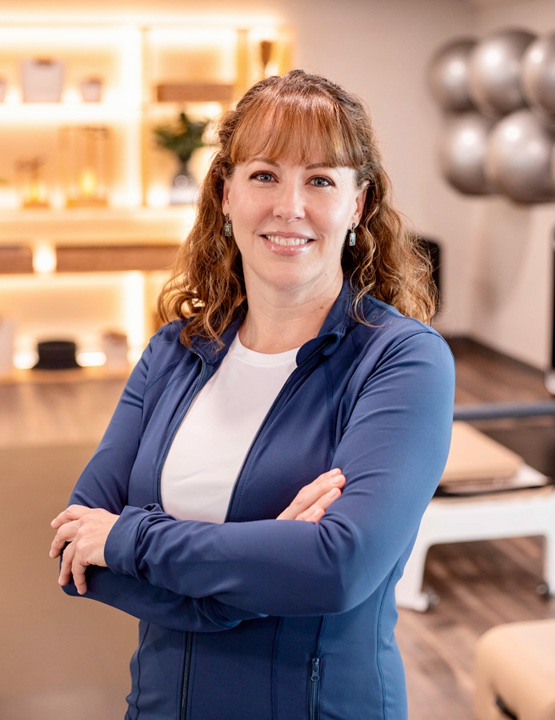
Sheryl Heath poses in her professional headshot.
On your website, a variety of specialized services are advertised. Can you tell me about the pre/post-natal courses?
Usually, with our prenatal classes, we give them a couple of private sessions to teach them techniques they’re going to need to know as they go through pregnancy.
Eventually, once they learn these techniques, they can flow in with the general public and be able to participate in group exercise. The majority of our pregnant women, up until about 20 weeks, can do any type of exercise. Further on, we start modifying exercises so they don’t develop diastasis recti.
The biggie is the pelvic floor. We try to focus more on abdominal and pelvic floor work to restore the body to where it was before they were pregnant and had the baby.
Pertaining to 50+ classes, how do you tailor Pilates to an older population?
The first thing we do is incorporate some kind of hand weight. They hate it, but we incorporate weights into our sessions, the thought being that you build muscle mass and bone density. Stronger bones equal less fractures.
We also incorporate balance work, whether we’re using a BOSU or a wobble cushion. We’re doing something requiring them to move and balance themselves to try to get that proprioception back so we can prevent falls down the road.
You require five level one reformer sessions in order to participate in level two classes; can you expand on this?
It depends on the person. Our Focus class routines were created by Joseph Pilates and is the classical repertoire. When we bring newcomers in, we want them to do classical moves, primarily to get them used to the machine.
We don’t want them potentially setting themselves up for an injury or not getting the most out of the class. The other key piece with Focus, or level one, is teaching control and pace. Pilates is about slow, controlled movements.
We generally stick to the five-class rule, but with younger students – able bodies who are a lot stronger – they may complete three classes and ping-pong into an Evolve class, our level two. Usually by then, I know who they are. Despite what it says on the website, it is person-by-person.
Being so close to Virginia Tech, I am curious about your relationship with the students. Can you speak to that?
We love our students. Every year, when they leave for breaks and summertime, we have to cut back our class load. We wait for that September-January surge when everybody comes running back.
We offer a 25% off special for the first class. We’re hoping that if the first class is effective, it will be enough to bring them back. Occasionally, it doesn’t – students are very transparent. They’ll say, “I love the class, but I can’t afford it.”
Those I put on a list, and say, “We have a teacher trainee who needs practice hours. You can volunteer for them, and can get free Pilates.”
We also opened the Mat Studio next door if the student cannot afford Reformer. It’s cheaper than any other business in town; you could attend for 10 bucks.
How have you used your studio to make a community with your clients?
It’s getting to know people. We bring them into class, introduce them to other students. During classes we queue, walk around, correct, give high fives, and call people out for doing great things – which makes them more comfortable. That’s partly why we’ve capped our classes at eight.
We also try to include our clients in our online pictures. We don’t use models, we don’t use ourselves, we use actual clients. We want to say that Pilates is for everybody, of every age.


 > THE NEWS FEED <