After President Trump’s recent claim linking Tylenol use during pregnancy to autism, public conversations about autism are increasing, but not always in a constructive way.
Autism is a neurological developmental disability that affects millions, and the language we use matters.
Featuring insight from Nathaniel Porter, a social data scientist at Virginia Tech and disability advocate, and Ashdon Sigmon, a mother and autism advocate, we explore why education, empathy, and curiosity are key to better conversations.
A recent statement by President Donald Trump suggesting a link between Tylenol (acetaminophen) use during pregnancy and autism has sparked concern among families, medical experts, and the autism community. In this video, we speak with Ashdon Sigmon, a Rocky Mount mother of a nonverbal autistic child, and Nathaniel Porter, a social science data consultant at Virginia Tech, autistic adult, and father of three autistic children.
Together, they break down the emotional, scientific, and social impact of such claims, from how they influence public perception, to the pressure they place on parents.
BLACKSBURG, Va. – Business instructor Josiah Showalter has created a well-loved persona for himself known as “Judge on a Scooter”.
Showalter rides a maroon Honda scooter wrapped in the university’s logo around Virginia Tech’s campus. His chosen mode of transportation is not only effective, but instantly recognizable by many Tech students, especially those in the Pamplin College of Business.
In addition to his scooter, Showalter is known for his signature bowtie and oval glasses. Students often spot him at Gillie’s, where he has breakfast every Sunday with his wife, and Weight Club, where he exercises regularly.
Showalter has also gained a following online. His Instagram account, with more than 3,000 followers, features educational and campus related content. During finals week last semester, he interviewed his students and quizzed them on class material as a method for review.
As Judge on a Scooter, Showalter is best known by his business law students, though his charism and authenticity has spread across campus. He even has his own merchandise, with t-shirts with the catchphrase: “Can you feel the law?”
Showalter refers to his wife affectionately as “Pure Evil” and his two children as “Evil One” and “Evil Two”.
The following interview has been edited for length and clarity.
How long have you been teaching at Virginia Tech and what classes do you currently teach?
I’ve been teaching for 15 years and I teach Business Law. I’ve always taught business law.
When did you first purchase your scooter and what inspired it?
It was a gift to my family from a dear friend. They wrapped it.
How did your nickname as “Judge on a Scooter” emerge?
My son, Evil Two.
You’ve developed a very recognizable brand and persona. Was that intentional or did it occur more naturally?
All natural.
I’m sure you’ve been recognized across campus and in Blacksburg pretty often. What’s it like being such a familiar face?
And I’m not. I mean, every now and then people will say, “Oh!”. It’s primarily the scooter. It’s not me. My wife does. Pure evil, my wife.
Do you ever get recognized at Weight Club?
I would say maybe every now and then. But a lot of students, not because of the Instagram page but because of the students.
Can you recall any instances with any students that told you that your presence made an impact or a difference?
It’s really moved me the people that have said that I’ve impacted their life.
What positive impacts do you hope to bring to the student body?
Instagram. I was never gonna do it and toyed with the idea because all of you young people are on social media whether its Twitter, TikTok, Instagram, Snapchat. Last year, the way that the spring semester spring break landed, it was right before an exam. My son suggested, “Why don’t you start an Instagram page?” So I mentioned it in class and one of my TA’s got four or five emails asking if I was going to do it for a review. It’s primarily for education. If you look at the ones during the week, they’re educational. They help to review the concepts we learned in class and my grades went up this past semester. I love that, so that’s good.
Do you think the reels encourage people to study harder?
It gave them an opportunity to review. I didn’t give them all the answers in terms of the questions, but it let them know where I was looking. That started in March. I started that.
Do you have a social media team that runs your Instagram?
My son, Evil Two, and my daughter, Evil One. They collaborated and my wife, Pure Evil, sometimes has a little part in it. But, my son just started law school. He’s not here so I have my adopted Evil Three and Four. They help me out and they are wonderful.
What overall impact do you hope that your scooter rides bring to the student body?
I hope that everybody realizes, and this is what I tell my class: the law impacts everything that you do. I mean, could you feel it when we went to Bollo’s, the law? I mean, seriously, could you feel the law? Because we did. I entered into an implied contract when I bought our coffee. Exceptions, consideration, legality, capacity. It was all there, you know? Think about it.
Are you trying to provide more real world context for students?
Absolutely.
If you could give one piece of advice to Virginia Tech students, what would it be?
I told my kids this every day and I tell my students this because Tech students are the best students. Do your best. Be happy.
After nearly four decades of dedicated service to the Roanoke Valley, WDBJ7’s Chief Meteorologist Brent Watts has announced his retirement from broadcasting. His final day will be Sept. 19.
Watts, a familiar and trusted face to viewers across Southwest Virginia, is not stepping away from public service entirely. He has accepted a new role as director of communications for Botetourt County, where he has already begun the onboarding process.
Watts first came to WDBJ7 as a news photographer. He then transitioned years later into a meteorologist and then finally as chief meteorologist as he developed a love for the forecast.
Throughout his career, Watts has been known not only for his accurate forecasting and calm presence during severe weather events. As Watts steps into his new chapter, WDBJ7 announced that meteorologist Justin Povick has been named the station’s next chief meteorologist.
Coverage in 2004 of tornadoes during Hurricane Ivan, one of Watts’ first severe storms with Meteorologist Leo Hirsbrunner on the left and Watts on the right.
As director of communications, Watts will be the interface between government sectors, various emergency departments and the people of Botetourt County, using his emergency protocol skills he developed at WDBJ7.
Watts is excited for his new position, exclaiming that he’s ready for a change after decades in broadcasting.
“I am looking for something more of a challenge, something that would give me more skills and meet people that that I haven’t met before,” Watts said. “I still wanted to use some of the same skills that I had when it came to weather and media, public relations and crisis management.”
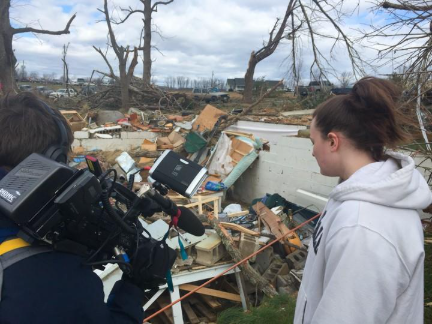
During his time at WDBJ7, Watts’ most memorable moment was when a Roanoke resident, Sharanda Totty, told him that one of his weather alerts saved her and her baby’s life during an EF3 tornado.
“She got a weather alert, and she took her baby into the basement, which literally was just some cinder blocks,” Watts said. “She got under an old mattress that was down there and when she got out, the entire structure was gone. Her home was gone; everything was missing. It kind of got me thinking like, ‘What would have happened if she had not gotten that warning?’”
WDBJ7 interviewing Sharanda Totty, covering an EF3 tornado that hit Sharanda Totty’s house.
Viewers of WDBJ7 who have watched and trusted Watts’ forecast for many years are sad to see him go. Jordan McDaniels, an avid WDBJ7 viewer has enjoyed watching Watts over the years.
“Watts is a great meteorologist,” McDaniels said. “When you watched, you could tell he really cared about his work and that’s why I loved watching him. I’m sad to see him leave for sure.”
Watts appreciates the support he has received from viewers since his departure was announced.
“After the announcement that I was going to be leaving WDBJ7, there was a huge outpour from people I’d never even met before,” Watts said. “It truly means the world to me that everyone trusted me with their forecast over the years and that I did a better job than I thought I did, actually, of getting the word out and giving them comfort during times when the weather was threatening or when they were scared.”
As chief meteorologist, it was Watts’ job to cover the newsroom if they were short-staffed or if someone had to stay overnight if the weather permitted. Watts is looking forward to a better work-life balance.
“I love traveling,” Watts said. “My wife and I love to travel, and I want to travel more locally as well. I love music, so getting out and hearing some local bands and being able to visit family more is going to be really nice.”
While he is stepping away from the green screen, Watts says that his curiosity and passion for learning will continue to serve him.
“I think the biggest thing over the years that I’ve learned is to never stop learning,” Watts said. “I’ve never wanted to be one of those people because I always feel like there’s something more that I can learn.
One of the most meaningful aspects of his job, Watts says, was sharing that knowledge with the next generation.
“The biggest thing that I have enjoyed over the years is teaching kids and being able to go visit schools over the years,” Watts said. “I’ve visited probably hundreds of schools during my time and met with thousands of kids of all ages. To be able to see their eyes light up when we do a really cool weather experiment or that moment where they understand something that they learned in class has been the most rewarding.”
Watts plans to continue to watch the weather but on his own time and as a hobby.
“I’ll be able to go watch storms more and observe them outside instead of being in the studio, which is going to be really cool,” Watts said. “While my main position is no longer a meteorologist on television, it’s one of those skills that you really nobody can take away from you.”
Eranga Galappaththi, an assistant professor at Virginia Tech, teaches a variety of classes surrounding geography, ecological systems and sustainability.
His research focuses on complex human-environmental system changes and has a strong focus on Indigenous communities across the world.
“I’m trying to understand how Indigenous people or communities experience climate change, specifically within the context of a climate-food-health nexus,” Galappaththi said. “I am also trying to understand the issues and dynamics around how they respond to climate change.”
Galappaththi has strong research partnerships with the Indigenous communities in Sri Lanka, Canada and the Artic. He has published 36 peer-reviewed research articles in leading journals, including The Lancet Planetary Health, Nature Climate Change and One Earth, along with three book chapters. He has contributed to high-profile reports for the United Nations, like the IPCC and FAO. Galappaththi received his doctoral degree from McGill University in Canada.
In an interview last week, Galathappaththi spoke on issues regarding climate change and affected communities.
His comments were slightly edited for length and clarity.
What motivates your passion for focusing on climate change affecting Indigenous communities?
Fifteen years ago, I migrated to Canada because I’m originally from Sri Lanka. After I moved to Canada, I worked in the northern communities reserves which were mostly occupied by Indigenous people.
Within my first three months I connected with those communities. I thought they would be a developed community, but I found that they were a very underdeveloped country. I was very touched, and I connected with those people and that’s how I continued my research with these communities. Slowly after my doctoral degree, I expanded to other countries as well with the help of other researchers and globally connected networks.
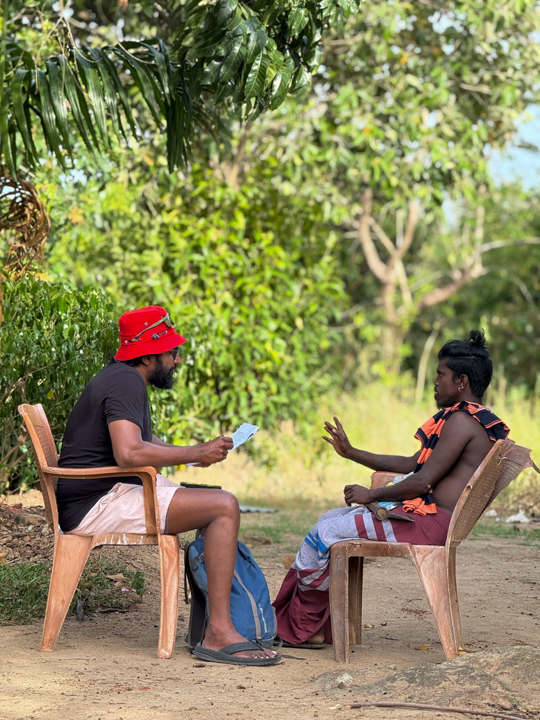
Eranga Galappaththi interviewing Indigenous community members in Sri Lanka. Photo courtesy of Eranga Galappaththi.
From your view, what are the biggest impacts of climate change on Indigenous people or minorities?
We have worked with over 100 Indigenous communities internationally and have a network of 14 partner countries as well. Based on this research and the work so far, we found that the way people experience climate change is very different.
Each Indigenous community has their own problems. For example, one community in Sri Lanka might experience tourism related issues because they get more tourists. Indigenous people are used as a tool to do tourism, and they are not given any benefits for doing so. For them, there’s a lot of social power gaps, marginalization, education problems and food security issues.
If you go to the Arctic, they have very different issues. They don’t have roads. They’re isolated communities and they have lot of food related health issues because of nutrition. They’re still highly relying on hunting, trapping and fishing for their food security. It’s because of the isolation and lack of economic opportunities that cause a high level of suicidal rates and high level of drug and violence issues.
These are very complex issues, and each community is affected in different ways. Climate change acts as a central hub for these issues because Indigenous people are still relying on natural systems for their food security.
When they lose their food security it causes food contamination, and they start to face different food related health impacts as well. That’s why I study a nexus of climate-food-health. These topics are interconnected especially when it comes to rural communities.
In your view, why do some individuals remain unconvinced about the reality of climate change?
I travel to places that specifically experience climate change. For example, in the Arctic you can see climate change because these places are totally covered with ice. They experience global warming at a very high level, so when they lose ice and lose their food, it’s obvious that it is real.
The problem is people have trouble believing in something that they can’t see. It’s all evidence based and it has a high-level of research. I contributed to the Intergovernmental Panel on Climate Change Assessment reports, and we know it’s real.
Have you seen any like climate change impacts in Blacksburg, Virginia?
I moved from Canada in 2021, and we got a really good snow here that winter. I was so happy. The next couple of years, we have gotten less and less snow each year, at least to my standards.
I’ve heard from a lot of elders here in Blacksburg, that have said we used to get a lot of snow in Blacksburg, but now we don’t. That’s one observation that I have made during my time here. Another thing I have noticed is the predictions. They’re sometimes inaccurate which could be a result of climate change impacts.
How do you think educators could better integrate Indigenous knowledge or concepts into student learning?
Most people limit their education to western knowledge systems. There are non-western knowledge systems like Indigenous knowledge, local knowledge and other knowledge systems. We need to go beyond science to integrate those systems. For example, I invite some of the Indigenous researchers and Indigenous community members to give guest talks with my students, so they get that opportunity.
My aim is to not only deliver knowledge to students, but to create a core learning environment. This makes an equal base learning environment. I want to learn, and they want to learn as well. It turns into a group learning environment; it’s not just reading and studying a textbook.
Do you include approaches or perspectives in your teaching that weren’t part of your own education?
I’m trying to integrate a lot of community perspectives and non-western type of perspectives. I’m really just trying to bring different perspectives into my classroom which was something I didn’t experience.
What advice would you give students who want to pursue research or careers focused on climate resilience and sustainability?
In any research, it’s very important to integrate multiple perspectives and to respect all of them.


 > THE NEWS FEED <