Pushing away from public schools: Why are parents making the switch?  

By Kyndall Hanson, education reporter  

Public schools provide a free, accessible means of education to children across the country. However, in recent years, parents have expressed worries regarding various aspects of the system, with many looking toward alternative means for schooling their children.  

“I am a proponent of public education,” said Charles Lowery, associate professor of educational leadership at Virginia Tech. “I think that public school, in a democratic republic, is a necessity – we have to have them.”  

Sitting at his desk surrounded by stacks of books, many with variations of the word ‘education’ plastered on the spine in bold letters, Lowery reflected on the mounting distrust and discontent toward public education expressed by parents across Virginia.  

“Political rhetoric drives a lot of distrust,” said Lowery. “There’s been an increase in distrust in education for years; we’ve had this misinformation about what’s happening in K-12 schools.” 
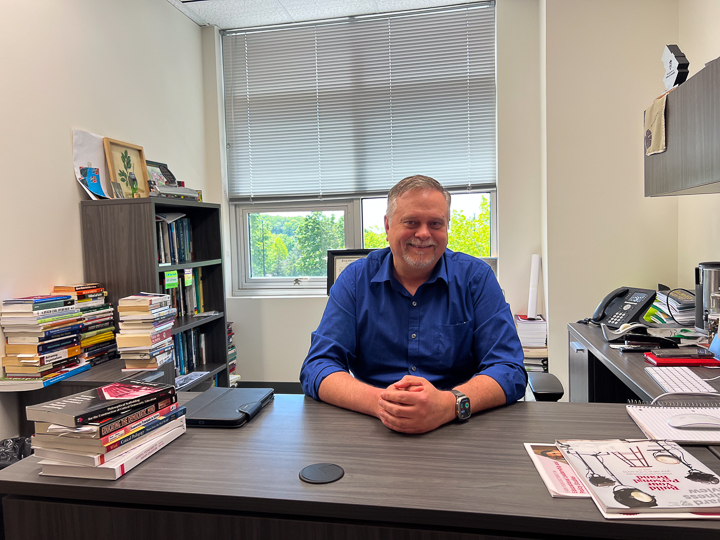
Charles Lowery, associate professor of education and leadership at Virginia Tech, in his office at the Virginia Tech School of Education.  

According to Cardinal News, Virginia’s public school enrollment rate is projected to decline 2.9% by 2029, with drops stemming from a declining birth rate and increased enrollment in private and homeschooling curricula both during and after the COVID pandemic.  

According to data obtained by the Johns Hopkins School of Education’s Homeschool Hub, from the 2023-24 to 2024-25 academic year, homeschooling rates in Virginia increased by 4.34%, with over 56,000 homeschooled students currently enrolled in the state. The data also reflects that significant gains were made during the COVID pandemic, with a 55.79% increase in homeschooled students from the 2019-20 to the 2020-21 school year. While gains have fallen since this period, the number of homeschooled students remains in the 50,000s.  

A graphic from Johns Hopkins Homeschool Hub illustrates the trend of homeschool enrollment among K-12 students in Virginia.  

Christine Berry, a parent in Virginia, started her journey with homeschooling during COVID in Pennsylvania. She describes that since then her family has tried both private and public schooling, with one of the motivators for their move to Virginia being the resources and opportunities allocated to children in public schools.  

While some families like Berry’s have moved back to the public school system, others have continued to embrace alternative means of schooling – suggesting the COVID pandemic is not the only reason for the continued decline in public school enrollment.  

“There’s an author who writes about how back in the 60s and early 70s, there was a shift from being front porch households to backyard households, Lowery described. “… I think COVID pushed us into a new generation of thinking like that, where it pushed us from ‘I feel safe in open areas’ to ‘there’s stuff out there that can not only hurt us but cause conflict between us and our neighbors.’” 

Danielle McCoy, a parent in the New River Valley with children in public school, describes that communication is a poignant issue informing her perspective on public school. McCoy says that if she could, she would “pull both of [her] boys and homeschool in a heartbeat.”  

“My issue mainly is communication and not being able to see what they’re learning,” said McCoy, describing her experience with the lessening connection between her and the school as her son moved from elementary to middle school. “I don’t feel like locally, I can’t speak for everyone in Virginia, that our school board or our administrators really listen to parents.” 

Both McCoy and Berry describe a desire to have a greater say as parents in what curriculum is being used to teach their children, voicing concerns with administrative decisions across public schools.  

“It’s like everything has moved away from actually teaching and doing a lot of hands-on things,” said McCoy, considering her two sons’ respective learning experiences. “Don’t get me wrong, there are some amazing teachers, and I support them fully, but there is a slight disconnect between what [children] need to survive in real life and what they need to learn versus what they’re learning on paper.”  

In Virginia, curriculum is determined largely at the state level, with Standards of Learning (SOLs) serving as a standard to measure students’ learning across the state.  

While these standards are determined at the state level, according to the Virginia Code, local school boards are responsible for “implement[ing] the Standards of Learning or objectives specifically designed for their school divisions that are equivalent to or exceed the Board’s requirements.”  

According to Virginia Mercury, the majority of Virginia’s school boards are elected, with 15 being appointed by local governance. For parents, this means having a say in curriculum can take place at the ballot box.  

“There is room there for parents to have a voice in curriculum…” said Lowery. “In the United States, we value independence and individualism. So, a lot of times you feel like, ‘well, my personal voice wasn’t heard.’ In a Democratic Republic, it’s everybody’s voice coming together – and we’re trying to capture that. I think education has always attempted to do that.” 

SOLs and Measures of Academic Progress (MAP) standardized testing can be a major point of contention for parents with children in public school.  

“The stress they put on these kids is insane,” said McCoy regarding MAP testing in her local school district. “I feel like they’re constantly readying them for a test, and there’s not real educating going on.”  

Lowery describes that SOLs can be limiting for educators, as well as students. With teachers and administrators working to accommodate and fulfill state testing standards, they may feel as though they have little room to explore other areas of interest with students, “narrowing” learning for children in K-12 public schools.  

“[Standardized testing] is one of the areas I’m definitely, as a parent myself, I’m very sympathetic with,” said Lowery as he recalled his experiences navigating testing as an educator and administrator. “But it’s our legislators that we vote in who keep putting this standardized testing in place, not schools.”  

With over 20 years dedicated to education, Lowery describes his worries that while many concerns with public schooling, like testing, are apparent in the system, other concerns cited in the news and across social media, like the teaching of controversial content, are often heightened by political rhetoric.  

McCoy describes that she feels the material her children are exposed to are often based on opinion, a sentiment shared by many parents across social media and in conversations surrounding the state of education: “I don’t want my kids to learn a teacher’s opinion,” said McCoy. I want them to learn facts.”  

Likewise, Berry describes feelings of wanting to have a greater say in her children’s educational environment, expressing discomfort with administrative decisions in areas surrounding what content is allowed in libraries. 

Federal and state actions in recent years regarding public school curriculum have often centered around regulating the content taught in schools, such as Virginia Governor Glenn Youngkin’s Executive Order entitled “Ending the use of inherently divisive concepts, including critical race theory, and restoring excellence in K-12 public education in the commonwealth.” 

“Divisive concepts can become a catch-all for all manner of things that make us feel ‘uncomfortable,” said Lowery, discussing parental dissatisfaction with K-12 curriculum. “Learning new information, whether it’s history or algebra, can make us all in different ways feel ‘uncomfortable. Too often, it’s guided by political perspective and not pedagogical means, and that’s led  some parents to want more control over what their kids are taught.”  

Public education, at large, is facing significant changes, no matter the source – from potential funding changes with the elimination of the Federal Department of Education to greater parental involvement in learning.  

Even as some parents steer away from this avenue of schooling, public schools remain the largest source of education for children in Virginia; according to the Virginia Department of Education, 1.2 million students were enrolled in public schools during the 2024-25 academic year.  

“The part that scares me [about homeschooling] is are we making these decisions based on a lack of information or maybe too much misinformation,” said Lowery. “Are we making these decisions on our emotional decision-making facilities, or are we basing these decisions on what’s best for my child? There’s a huge world between that, and I don’t fault people who want to homeschool their children. There’s legitimate reasons why a person may want to homeschool their child, but there are also reasons that are not grounded in the reality of what happens in education.”  

Federal hiring freezes and funding cuts leave college graduates with uncertainty

By: Kyndall Hanson, Elizabeth Hill, and Janae Neely, education reporters

Throughout 2025, federal hiring freezes and funding cuts implemented by the Trump administration have created uncertainty for graduating college seniors. As students navigate post-graduate plans, they are often left to choose between entering the workforce or pursuing higher education, both of which present challenges. Kate Renz, assistant director of employer relations and career services in the College of Liberal Arts and Human Sciences, discusses the potential impacts on graduating seniors and offers advice on navigating the job market.

Dismantling of the Department of Education brings uncertainty for rural schools  

By: Kyndall Hanson, Elizabeth Hill, & Janae Neely – education reporters  

Many rural school districts utilize federal funding to support initiatives and resources to support underserved and low-income student populations. Recent federal actions have called for the closure of the Department of Education, reducing the staffing of the department and its role in supporting public education on the national level. Charles Lowery, associate professor of educational leadership in the School of Education at Virginia Tech, discusses the potential impact of the closure on local schools, students, and educators. 

Virginia Tech senior showcases his passion for nature through living art  

by Kyndall Hanson, education reporter

Virginia Tech Perspective Gallery’s first show of the year, “Leos Love Letters to Nature,” showcases the work of senior wildlife conservation student Leo Hoffman. Within Hoffman’s 10 terrariums featured, he shares his knowledge and passion for nature with the community through his detailed depictions of the world’s environments. 

Federal funding cuts may threaten the breadth of research conducted at Virginia Tech 

The Virginia Tech Corporate Research Center houses laboratories and workspaces for a diversity of research initiatives at Virginia Tech.  

by: Kyndall Hanson, education reporter 

On Feb. 7, the National Institute of Health (NIH) issued a policy outlining a standardized 15% cap on indirect costs incurred through research funded by grants, including maintenance, operational, and administrative expenses. While the NIH’s policy is questioned in federal courts, universities like Virginia Tech are left to weigh the potential impacts of reduced federal support on research initiatives. 

Why it matters: The NIH is one of the first governmental agencies to outline research funding restrictions following the Trump administration’s now-rescinded memo outlining a federal funding freeze. According to a statement by Virginia Tech President Timothy Sands, the NIH’s decision to cut the reimbursements of indirect costs could have a $13 million impact on the university’s annual research budget and over $55 million if the policy was extended across all federal agencies.  

  • “Lives will be lost,” said Sands, describing the potential “debilitating effects” of funding cuts on biomedical research at the university, among other impacts across research disciplines.   
  • “Research is an integral part of who we are and what we do,” said Mark Owczarski, interim vice president of communications and marketing at Virginia Tech. “It’s going to take us time to figure this stuff out.” 

The big picture: As an R1 university, Virginia Tech undergoes significant research activity. In 2024, Virginia Tech’s sponsored research expenditures were $453.4 million. According to Sands, over $308 million of these research expenditures were federally sponsored. As the university works to understand the mandates of federal agencies, the long-term impact on research is unclear, described Owczarski. 

  • According to Sands, of the over $308 million in federally sponsored research, $73 million was attributed to indirect cost reimbursements, or facilities and administrative research costs – with an additional $18 million in indirect expenses subsidized by alternative university funding sources.  
  • “It requires us to ask a lot of questions, do a lot of analysis, figure out what we are doing and [what] each of these executive orders really mean,” said Owczarski. “In the long term, there could be significant impacts, or there could be very little impacts – we don’t know.”  
A graphic by Virginia Tech displays the growing sponsored research expenditures at the university.  

Zoom in: The Virginia Tech Office of Research and Innovation has established a ‘Federal Agency Update’ webpage to notify the university community of updates surrounding university compliance with executive orders and additional impacted federal guidelines. 

  • According to Owczarski, as of early February, Virginia Tech’s research is continuing. 
  • “We’re asking researchers to continue the good work they do,” said Owczarski. “Engage in their research, keep applying for grants – just keep doing what you’re doing, and we’ll figure out how we’re going to support that long-term.”  
  • While university research is largely supported by federal grants, additional funding opportunities are available to support to learning experiences at Virginia Tech. According to Julia Ward, assistant director for professional development and experiential programs at Virginia Tech, programs like Campus internEXP are supported by state grants and not affected by federal funding regulations.  

What we’re watching: The long-term impacts of the NIH’s regulations on research and university funding are still in question as recent mandates are challenged in federal courts. The early days of the Trump administration have demonstrated a push for policy demonstrating government efficiency, meaning university funding may be a continued target for regulation.  

  • “It’s about how much research we can actually do,” described Owczarski discussing the potential loss in federal funding. “We’d have to make up the costs somehow, redirect things, but we don’t know what the outcome is going to be.”  

Winter weather prompts worries regarding student attendance and well-being in local school districts  

by Kyndall Hanson, education reporter 

January brought freezing temperatures and chilling winds to Southern Virginia, making local school districts weigh the costs of school closures with student well-being. Operational decisions made by administrators prompted backlash from local parents and community members.  

“There are two sides to this,” commented Christina Chrisley on a Montgomery County Public Schools (MCPS) Facebook post notifying of a two-hour delay in the district. “Is attendance important? Yes. Is the student body and their safety during travels and waiting for buses in freezing temperatures, their health and well-being, more important? In this situation, I think so.”  

According to the National Weather Service, areas across Montgomery County received 0.5-3 inches of snowfall from Jan. 6-7. Persisting freezing temperatures and icy road conditions in early January brought community members to express concerns regarding school operations through comments on MCPS Facebook posts.    

An MCPS Facebook post notifying of a two-hour delay receives over a hundred comments, reactions, and shares.  

During January, MCPS schools had two closures and two two-hour delays due to inclement weather. Pulaski County Public Schools (PCPS), a neighboring district, had two closures and four two-hour delays. The two days MCPS was closed, Jan. 6-7, were teacher workdays at PCPS and not considered closures due to weather conditions.  

Robert Graham, superintendent of PCPS, said the district considers the weather forecast, temperatures, windchill, and the possibility for dangerous weather events when determining school closures on the basis of inclement weather.  

According to MCPS policy, “the division superintendent or superintendent’s designee may order the closing, the delay in opening, or the early dismissal of any or all Montgomery County public schools in order to protect the safety and welfare of students, staff, and patrons.” MCPS was unable to provide comment on the explicit considerations taken into account in determining school closures or delays. 

“Dr. Bragen, please think about some of our rural areas that have not been cleared and whose roads are sheets of ice, some teachers are still without power, and the temperature won’t go above freezing,” commented Alana Benavides, addressing Superintendent Bernard Bragen Jr. on an MCPS Facebook post. “It will feel like single digits, even at 9 a.m. when some students are having to wait for their bus at a stop – at those temperatures, frostbite is possible. Some of us have been fortunate enough not to worry about these things, but many other people do.” 

According to Dr. Anne Washofsky, director of the pediatric residency program and interim section chief of pediatric hospitalists at Virginia Tech Carilion, children have a larger body surface area to mass ratio than adults, making them lose body heat more rapidly and be at a greater risk for cold weather-related ailments, such as hypothermia or frostbite.  

“Kids aren’t always able to recognize or get out of environments that expose them to the risk of hypothermia,” said Washofsky. “That’s one of the reasons why it’s so important to make sure that they’re appropriately clothed, in particular, including a hat to help hold heat in their head when they go outside.”   

MCPS transportation bus stop lists detail that students taking the bus are expected to be at their stops “five minutes prior to pickup time.” Stops for elementary school students may require up to 0.3 miles of walking and up to 0.5 miles for middle or high school students, meaning additional time spent in the cold on winter mornings.  

According to Washofsky, brief periods spent waiting outside for buses in freezing temperatures, within a 20-minute window or less, are likely safe for children when they are appropriately dressed for the weather.  

“Wearing hats, gloves, mittens, scarves, long sleeves, multiple layers, and making sure children are wearing stuff that’s water resistant is really important, said Washofsky. “Once you get that cold, that wet or damp, you’ll lose heat more quickly.”  

While getting to school in cold weather may pose safety concerns, staying home for extended periods of time may have adverse health implications as well – especially for those who rely on the National School Lunch Program.  

“It’s not just school lunches, but a lot of kids get their breakfast at school too – it might be two meals of the day,” said Washofsky. “Those might be their two biggest or primary meals based of family’s ability to otherwise provide.” 

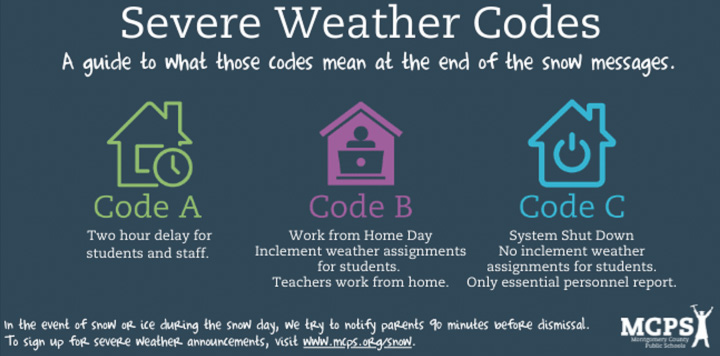
Six of 20 schools in the MCPS system offer free breakfast and lunch to students when school is in session. When schools are closed due to severe weather under severe weather code B and road conditions are deemed safe, meal services are available for pickup at specified locations. The district’s two January closures did not fall under severe weather code B. 

An informational graphic by MCPS depicts the district’s severe weather codes.  

“Maybe it would have been better to simply open the schools for students and families without heat or power and offer meals like other counties are doing – for those who can make it there safely, of course,” said Lauren Black on an MCPS Facebook post. “Prioritize being human and empathetic rather than focusing on attendance and accreditation.”  

According to the Code of Virginia, school closures due to “severe weather conditions or other emergency conditions” result in the addition of make-up days to the school calendar. Schools must be in session for 180 teaching days to avoid reduced funding due to closures. 

“It’s not just that period that they’re outside in the cold, but there are a lot of other things that play into health if school is being canceled because it’s too cold to be able to go in,” said Washofsky.