Once used to transport coal between Blacksburg and Christiansburg, the now-paved Huckleberry Trail has connected Montgomery County for more than a century. As warmer weather arrives and construction wraps up, residents are eager for full access to the trail.
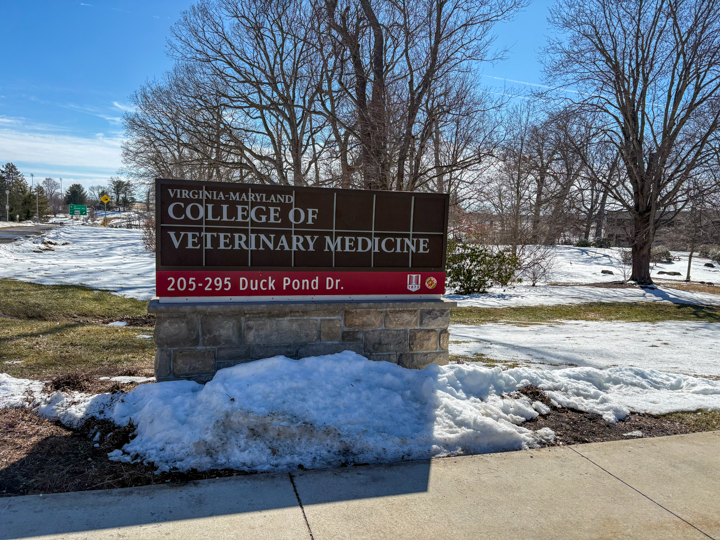
Sign outside the Virginia-Maryland College of Veterinary Medicine (Josie Sellers, TheNewsFeedNRV.com)
By: Josie Sellers, health and wellness reporter
BLACKSBURG, Va. (Feb. 13, 2026)- Researchers at the Virginia-Maryland College of Veterinary Medicine at Virginia Tech are testing a new approach to treating brain tumors using the drug verteporfin in combination with photodynamic therapy.
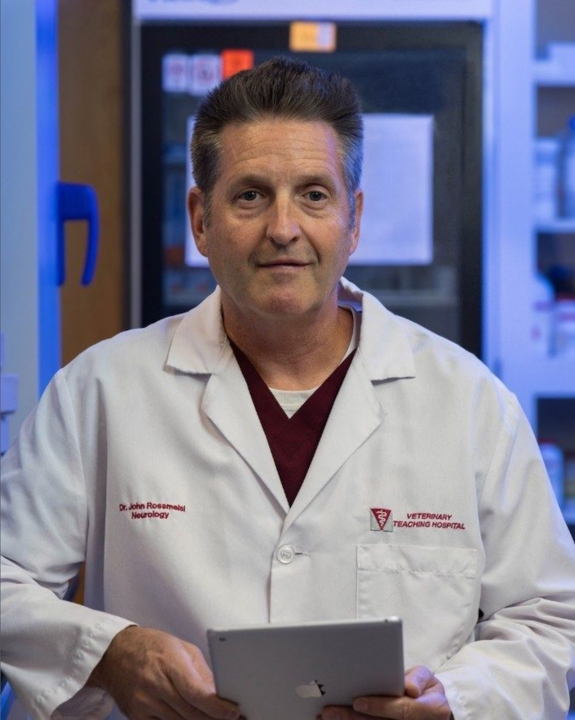
Dr. John Rossmeisl working at the Virginia-Maryland College of Veterinary Medicine. Photo by @vamdvetmet
Led by Dr. and Mrs. Dorsey Taylor Mahin Professor of Neurology and Neurosurgery at Virginia Tech, Dr. John Rossmeisl, the study will test three dogs diagnosed with brain tumors over 180 days to determine a safe and effective dose of the photosensitive verteporfin, “NanoVP.”
The trial specifically targets glioblastomas, which are extremely aggressive and infiltrative. In the United States, about 12,000 people are diagnosed each year, and they account for 14% of brain tumors. They are especially hard to remove because they lack a clear border.
Hopefully, the findings from the trial will aid in research on tumors in humans, once again giving reason to believe dog is a man’s best friend.
Cancerous cells in brain tumors, especially glioblastomas, can travel from the tumor that is visible using diagnostic techniques, such as magnetic resonance imaging (MRI). Because it is difficult to see the invasive cells, it is a challenge to remove the entire mass. As a result, it often recurs.
Rossmeisl is collaborating with the University of Maryland Associate Professor Dr. Joe Huang, who developed NanoVP. He compares it to an eraser at the end of surgery, where cells that are not removed by hand are eradicated.
“The goal of this particular study will be to administer the drug and then shine the light into the resection cavity after the main tumor mass is removed, with the goal of the drug in the photodynamic therapy killing any remaining cancer cells that remain behind that we can’t see,” said Rossmeisl.
NanoVP differs from other photosensitizing drugs because it crosses the blood-brain barrier. This barrier is a wall of cells that defends the brain from harmful substances, preventing about 98% of small-molecule drugs from entering.
Because of the relatively small size of the drug, it can cross the barrier to reach tumors.
Already, data from previous trials on mice show that the drug effectively kills tumor cells. In preclinical trials, it extended the life of the mice beyond other treatments. The current study will determine effective doses with limited side effects for the dogs.
The target doses will be based on the data they already have from the mice. Because dogs are much bigger than mice, they will likely need more.
However, because of the photosensitization, the patient may have complications when they are exposed to light. This study aims to research the ideal amount of injection.
While the dogs are under anesthesia, as much of the tumor as possible will be removed through surgery. Then, NanoVP will be injected through a vein. Once the tumor is removed, a laser will shine to activate the drug, killing the remaining tumor cells.
Within the next two hours, five blood samples from each dog will be collected for research.
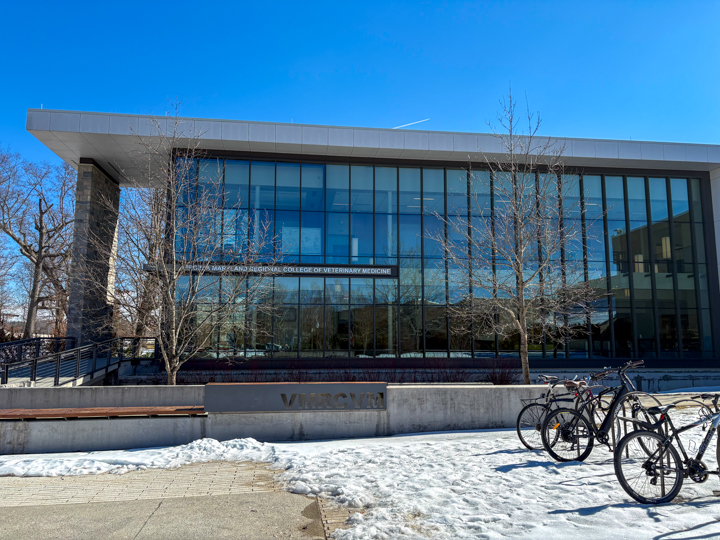
Virginia-Maryland College of Veterinary Medicine building (Josie Sellers, JMC 4814)
For the next six months, they will have follow-up visits, and owners may withdraw them at any point.
This trial differs from conventional animal testing, which involves generating a disease. Instead, his study focuses on dogs who already have brain tumors, which Huang says is a more ethical approach.
“If we give the drug with no drug-associated side effects in this trial, we’ll consider the trial successful,” said Rossmeisl. “It’s a very early-stage trial, so we’re not trying to prove that it’s going to totally eliminate cancer. That’ll be later on down the road.”
Rossmeisl hopes that in the future, this treatment will be used more frequently in combination with other forms of more traditional cancer treatment, such as chemotherapy or radiation.
While this trial specifically works with brain cancer, the drug is effective against any kind of tumor.
In fact, Dr. Huang has already used the drug for various kinds of tumors.
“You might need certain doses for certain types,” said Rossmeisl. “You might have to tweak the dosage or the exposures to light for certain types of tumors. But then again, those are details that would be answered in a different study.”
Researchers also want to utilize findings from the trial to improve treatment for humans, giving hope to those who may benefit.
“As a patient who has a brain tumor- and actually has had a couple- and has undergone two surgical interventions for it, I am really glad that they are doing this experiment, and it’s going through the phases of clinical trials before it approaches the patient,” said Virginia Tech student Sydney Hill. “It seems like a really good therapy, and I hope that it has some promising results.”
This trial is working with a European glioblastoma study using the same photodynamic therapy approach in people. Both trials are funded by the same company, Modulight, using a translational approach where the data from the trials are shared to improve both studies.
As of now, there are no dogs enrolled in the study. Those interested in the trial can find more information here.
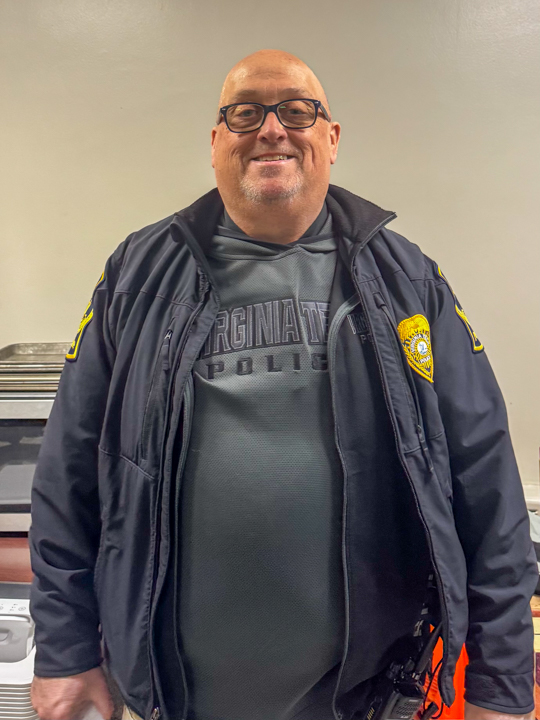
VTPD Cpl. John Tarter in his office. Photo by Gabi Vessal.
BLACKSBURG, Va.- Registration remains open for the next two to three weeks for Virginia Tech’s Rape Aggression Defense (R.A.D.) System program, a national course designed to teach males and females how to defend themselves in emergencies.
Offered by the Virginia Tech Police Department, the program consists of four classes throughout the semester. Registration remains available until the day before each session begins or until the class reaches its maximum capacity of about 50 participants.
I spoke with VTPD Cpl. John Tarter about the program’s purpose, format and background.
His responses have been slightly edited for clarity and conciseness.
Can you please give me a background on the program and what it is designed to do?
It was started by a police officer. He’d been in the Marine Corps. He was into martial arts, and he went to the police academy in Hampton, Virginia. Then he ended up going to Christopher Newport as a cop.
He went to one of his police chiefs and said, “Hey, can you come up with a basic self-defense class for women?”
And he started one. He got cops because he taught cops how to do defensive tactics at the police academy. Then he got other cops that taught defensive tactics to help him teach the R.A.D. program. And so, it’s spread. It’s not everywhere in the country, but a lot of colleges, universities and police departments have it.
It is four nights. It’s nine hours or 12 hours. The first night is in the classroom: how to stay safe on and off campus. The next two nights are punching: how to get out of chokes, how to get out if they grab your wrists and how to get out of that ground defense. Then the last night we do is each session is called simulation night, but I call it “Fight Night.”
And so basically, you put on a red suit and we put you through two or three scenarios. Most sexual assaults occur between people that know each other. We can’t simulate that. So, we simulate stranger-type situations. Somebody grabs you by the wrist and pulls you- how you can get away from that kind of thing.
Each night is three hours, and we do ours, say, four Mondays in a row. The next time, we’ll do four Thursdays in a row. It empowers a lot of people.
I can’t tell you when to defend yourself, and when not to defend yourself. That’s what the individual has to make the decision to do.
Can you please explain a typical class from start to finish?
On the first night, we meet at the police department. We go over the paperwork, review the manual, do a PowerPoint and talk about safety topics—like what to do if someone is following you home, whether it’s to your apartment or your house. We discuss where to keep a spare key, how to lock your windows and general safety tips for the public.
On the second night, like I said, we focus on upper-body techniques. We practice strikes, punches and blocks. We cover what to do if someone grabs you by the wrist and how to get out of it.
On the third night, we work on ground defense. If you get knocked down, we teach you how to get back up. We show you how to kick from the ground and what to do if you’re on your back and someone gets on top of you—how to throw them off. The instructors demonstrate these techniques on each other, but no one ever gets on top of the students.
We also teach how to escape choking from the front and from the back. I always tell participants that they don’t have to do anything they’re uncomfortable with. They are in control of what they choose to practice.
I explain that they’ll partner up with someone who will gently place their hands around their neck so they can safely practice escaping. But if someone is a survivor of choking and finds that triggering, I tell them not to do it. They can watch and learn instead. No one is forced to participate in anything.
I noticed you offer a men’s and women’s program. What is the difference between the two?
If you decide to defend yourself, we try to amp you up, right? The men’s program, we try to amp them down. We try to deescalate. Because, you know, a lot of times guys are like, “I don’t need no self-defense class. I can take care of myself” and puff out their chests.
Well, that’s what Sergeant Michael Pascal also teaches the police officers: how to deescalate situations like on traffic stops and things like that. So, for me that is the big difference. One is if you decide to defend yourself, we try to amp you up a little bit. And then, if you’re in the men’s program, we try to deescalate them or amp them down.
How do you deal with those who may find the program triggering?
We’ve had people that have been triggered, like when we do the simulations and Fight Night. I’ll never forget, we were in our Dietrich police office, and this young lady came in. She had the fight suit on, and we put her through a scenario.
After she fought—she did well—I said, “Go over there in the corner. Take your helmet off so you can rest. We’re going to go through this first scenario, and then we’re going to put you through a second scenario.”
She went over and sat down, watching the next person come in. She became very upset. She started crying and yelling, saying, “You’re teaching these people wrong. It’s not some stranger at a bus stop—it’s somebody you know.”
Was she right? Absolutely. The vast majority of the time, it is somebody you know. So, she was triggered by that situation. When the next person came in and went through it, she was triggered again as well.
We’ve never had two back-to-back cases where you could tell someone was triggered by the situation. Both of them, we got counseling. We offered them counseling, came out and talked to them, and then they came back and they continued the fighting part. We didn’t make them, but they finished it.
So, in a class, I don’t know who is going to be a survivor of a sexual assault. In that class, there’s probably going to be at least one person that has experienced something in their life. And if we know they’re triggered, we get them resources.
If we don’t know, we still push resources. Now I can’t go ask them, obviously, but over the years, we have had people come forward to us. And we tell them at the beginning of class, “We’re mandated reporters.” So you can’t come up to me and say, “Hey, can I tell you something? But I don’t want to tell anybody else.” That’s not the way it works as far as mandated reporters go, because you have to report it to make a police report.

 > THE NEWS FEED <