Just as Blacksburg began to see warmer temperatures, it was hit with a wintry mix. St. Patrick’s Day saw freezing temperatures and even light snowfall. Locals are confused by the varying weather, which does not fit common expectations for springtime.
Virginia Tech’s Anderson Observatory is often unnoticed by the school’s students, but has served as a major asset for astronomical research for decades. Its high-tech telescopes and camera systems allow faculty and students to explore the cosmos. Open-house events allow astronomers of all kinds to tap into astrophotography opportunities.
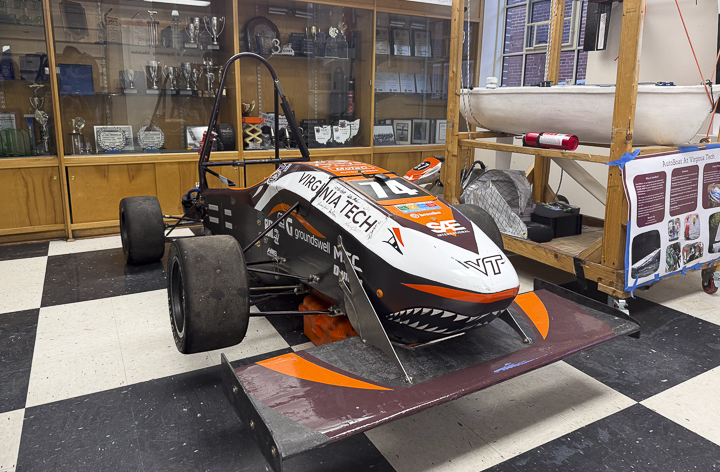
12 Feb. – 2026 – Virginia Tech Motorsports Formula’s team vehicle from the 2025 competition year sits on display at the front of the Ware Lab in Blacksburg, VA. (Jacob Jenkins, TheNewsFeedNRV)
After a year of design and preparation, the Virginia Tech Motorsports Formula SAE team is currently in the process of manufacturing their vehicle for the 2026 competition year. The student design team will soon face off against 120 teams nationally to try and prove their vehicle ranks highest in regard to dynamic ability, superior design, and reliable technology.
The Virginia Tech Formula team, which is based at the school’s Ware Lab, has been competing in Formula SAE (Society of Automotive Engineers) competitions since 1985, which offers an incredible hands-on learning experience. Students across majors are tasked with designing, manufacturing, and racing a small formula-style race car. The Virginia Tech Formula team has consistently delivered since its conception, establishing itself as a powerhouse nationally. A strong performance last year earned the team 15th place in the ‘25 competition. With three months until the ‘26 competition, it is officially crunch time for the team as they ramp up their building phase in pursuit of first place.
What many might not know is just how much work goes into planning and developing a miniature race car. Eighty engineers and 10 business leaders work diligently throughout the school year to ensure final products will perform at competition and amplify Virginia Tech’s status as a premier team. There are strict timelines, various sub-teams, funding needs, and interdisciplinary work that make for a complicated and rigorous process.
Hank Pete, the Formula SAE ‘26 and ‘27 Chassis Lead, shed light on navigating the challenges of the competition and what it takes to keep Virginia Tech’s team at the forefront. “Our team runs a two-year cycle, so the ‘26 car was designed through the last year and is being built this year through 25 fall, 26 spring,” said Pete. “While that’s happening, the 27 car is also in tandem, being designed as the 26 is being built.”
It’s not as simple as working on one car at a time. The team is constantly balancing design and manufacturing, contributing to multiple projects at once. Since the ‘26 and ‘27 competition builds include internal combustion and electric variants, the team is essentially working on four different vehicles at once while modifying previous models for testing platforms. “We’re consistently having meetings trying to ensure that everyone stays on the same page,” said Pete. “It’s so much project management. That’s the one thing in engineering that they never really go over a lot. We’re consistently trying to get this car funded, make sure that our timelines align, and make sure that the weather is permitting [for testing].”
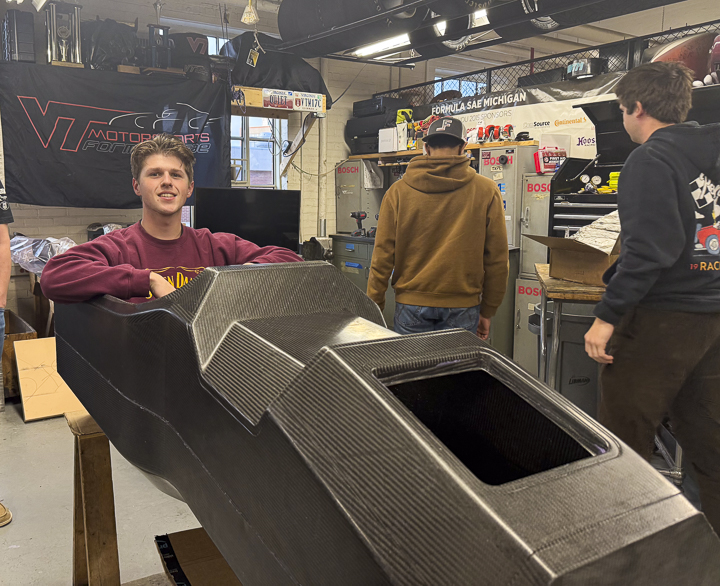
12 Feb. – 2026 – Hank Pete, left, sits inside the ’26 vehicle’s carbon fiber front monocoque at the team’s Ware Lab bay in Blacksburg, VA. This “single shell” piece serves as a light yet stiff structure for the vehicle chassis. (Jacob Jenkins, TheNewsFeedNRV)
In the midst of all the hecticness and challenges, the team’s end goal is to achieve first place. Competition consists of three categories, including technical inspection, static analysis, and dynamic testing. Technical inspection ensures that the vehicle can operate safely in real-world conditions. There are three static events which involve a design portion, business presentation, and cost analysis. The dynamic events are where the vehicle is pushed to its limits, testing acceleration, cornering, speed/handling, and endurance.
“I feel confident. We got 15th last year [nationally] and are ranked 25th internationally out of about 370,” said Pete. With last year’s competition bringing unexpected hiccups, Pete believes the team can improve on last year’s placement. “The hope is a top 10 finish this year. Last year, because of some issues with testing and overall verification, the aerodynamics package was basically rendered useless by the time of testing. So we were the highest placed team without an aero package on our car.”
While the main focus is competition ‘26, the team is constantly reviewing past performances and learning how to best approach new vehicle design and development. Nick Carneiro, the suspension lead for competition ‘27, discussed the importance of intentional design and applying past experiences to improve at competition. “Leading a team through design, we start off the first semester mainly brainstorming and researching, looking at data from the previous years, seeing what could be improved, what could stay the same,” said Carneiro. “That’s the end goal, we are designing this car to win. What will make us the most points that we missed last year, right?”
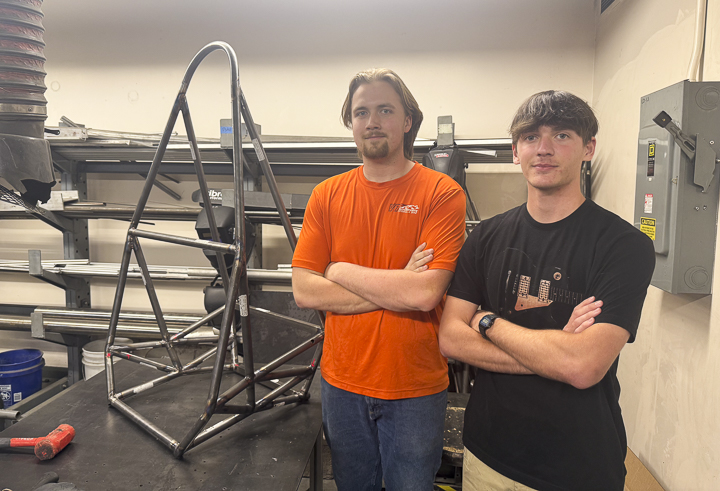
12 Feb. – 2026 – Nick Carneiro, right, and a fellow Formula team member pose next to the ’26 vehicle’s rear basket at the Ware Lab’s welding site in Blacksburg, Virginia. This structure attaches to the rear of the monocoque, housing the engine and rear suspension. (Jacob Jenkins, TheNewsFeedNRV)
These combined efforts across sub-teams to put the team in a position to succeed have created a strong community for Virginia Tech’s team. There is a collective passion that brings its members together even when presented with rigorous tasks and unexpected hurdles. “It’s definitely a labor of love, right? At the end of January, I had a week where I pulled 110 hours in the lab,” said Pete. “This is the stuff that I’m really passionate about. I get to be on the cutting edge of technology that college students are able to work on.”
The team also acts as a second home for many of its members and serves as a place to make new friends over shared passions. “I made most of my friends on this team coming into tech,” said Carneiro. “There are new faces every year, new freshmen, new sophomores that come in, and we all have common interests in building this race car. It’s a massive community. We all have to support each other.”
The Virginia Tech Motorsports Formula SAE team is hoping for a stellar performance at this year’s competition in May. Along the way, the team will continue to overcome challenges, push the boundaries of Formula development, and build their community.
Dr. Andrew Ellis, professor and director of graduate studies in Virginia Tech’s department of geography.
Last week, the United States experienced a significant winter weather event that stretched from New Mexico to the far corners of Maine. Forecasts saw conditions such as consistent heavy snow, freezing rain, and harsh temperatures across more than 30 states.
While the U.S. is no stranger to powerful winter storms, questions have been raised regarding the nature of the storm and how it developed. The sheer size and reach were without a doubt anomalous characteristics. Areas that hadn’t experienced such fierce weather in 3-4 years, such as Blacksburg, VA, were met with dangerous conditions that have lingered since. The storm also managed to travel across the entire country, forming in the Pacific Ocean and making its way across the Midwest to the East Coast.
Dr. Andrew Ellis, a Virginia Tech professor and director of graduate studies in the department of geography, gave an in-depth look at the science behind Storm Fern and whether or not its conditions could be deemed unnatural. His background as a hydro-climate scientist brought great insight to what factors allowed the storm to develop, how it maintained strength during its course, and how its harsh conditions arose.
(Edited for clarity)
What was your first reaction to the storm?
Impressive aerial coverage. That was fairly unprecedented in terms of the length of the storm. We haven’t had many storms in recent years that have come out of the Southwest and all the way across the southern tier and up the east coast of the US.
What factors came into play regarding how the storm stretched so far and how it became so large?
This winter, we’ve had little storm systems that have been associated with the northern jet stream, which is basically dropping out of Canada. We haven’t had much interaction from what’s called the subtropical jet stream, which is more of a Southern Tier coming in off the Pacific Ocean. This was really the first instance where the subtropical southern jet stream got involved. Usually, that jet stream brings the moisture, and the northern jet stream brings the cold. We’ve had cold but not a lot of moisture. This one brought a heck of a lot of moisture. The subtropical jet, the wet jet from the south, is really what made this one more unique than what we’ve been dealing with, not just this winter, but in recent years.
Did climate change have any impact on the storm?
Probably not this one. These things have been happening like this for as long as we’ve been looking at records. In fact, it’s been less frequent here in the last few years. The climate change angle probably has more to do with the cold that was associated with this one, which sounds counterintuitive, right? Global warming and cold outbreaks. That northern jet that we were talking about, it gets a little bit more wavy with global warming, and so it can sort of drop farther south at times and bring cold air into places that don’t necessarily typically experience that.
Arctic amplification, the rapid warming up at the Arctic region of the Northern Hemisphere, has caused the jet to be a little weaker. That weakness of the jet, less strong winds, has caused it to sort of meander a little bit more. When it meanders it can drop south and that’s when the cold air comes into play. Back in the 1970s really strong jet cold air tended to stay bottled up more to the north. But here, in recent years, we get these episodes of cold air outbreaks when the jet weekends and drops South from time to time. You could make the argument that the warming climate change has played a role in the temperature, at least at the surface.
How often do these powerful winter storms occur?
In recent years, it hasn’t been the case. It’s probably been four or five years since we’ve had a really strong east coast storm like that. Traditionally, a handful, two or three of these a year, would be fairly typical up until the recent period.
In Blacksburg, we saw heavy snow, sleet, and ice. How did we get such a variety in the forecast?
The amount of cold that we had at the surface was a bit unusual. The models started to move the storm more northwest, and so we were on the warm side of the storm, drawing warm air up from the south. Once you start to inject some warm air in the middle part of the atmosphere, the snowflakes on their way down melt. If they completely melt, when you’ve got some really warm air in the middle part of the atmosphere, then it remains liquid all the way down until it hits the cold surface and freezes as freezing rain.
The warm air aloft was really indicative of a pronounced freezing rain event. The forecast here was pretty dire, with half inch accumulation of ice, if not more, which would have been crippling. The cold air really hung in there for us, and kind of held most of the warm air to the south and didn’t let it get in here and totally turned it over to a freezing rain event, which is great.
Could you go into more detail on Blacksburg’s icy conditions?
What’s on the ground is like a block of ice. It’s like concrete. That’s because of the prolonged period of sleet events that we experienced, which was really rare. But I think the biggest issue too is we had an inch and a quarter of water equivalent. There was a ton of water in this little, tiny snow and ice pack that we have out there, so it’s not surprising that it’s like concrete.
Is there anything you’d like to add?
Looking ahead it does not look as extreme cold as we’ve had, but the pattern is still on the cold side. Anytime you’ve got the northern jet dropping down and bringing cold air, there’s always chances for little storms to spin up on the periphery. I don’t think we are heading into a totally snow free period for the next few weeks. I think we’ve got some more interesting weather on the horizon.


 > THE NEWS FEED <