The Linkous-Kipps Historical House was approved for an Outdoor Recreational Camp Conditional Use permit in Sept. by the Blacksburg Town Council. The house was established in 1799 and has maintained strong Appalachian roots throughout the years. The Graham family recently took ownership of the property, and with the permit approval, are able to provide various opportunities for the New River Valley.
“Our board has historically been reactive instead of proactive in terms of establishing satellite voter facilities,” Board of Supervisors Chair April DeMotts (District G) said.
On Aug. 11, 2025, Montgomery County’s Board of Supervisors unanimously approved a draft ordinance for three voter satellite offices for the General Election. Those locations were the Blacksburg Community Center, Shawsville Middle School cafeteria and Auburn High School cafeteria. This proposed ordinance provided in-person voting locations for those living in eastern and southern Montgomery County.
On Aug. 25, 2025, the Board of Supervisors adopted one location as a voter satellite office. Four out of seven supervisors were in favor of this ordinance. Supervisor Anthony Grafsky (District E), Vice Chair Steve Fijalkowski (District C) and Supervisor Todd King (District D) opposed the ordinance.
From the conversations between supervisors regarding the ordinance, comments from citizens, the concept of equitable voting, previous changes in voting and more, voter accessibility in Montgomery County is not a topic to ignore.
The state of Virginia has witnessed a lot of change over the past decade regarding voting. Taking effect July 1, 2020, Virginia required a 45-day early voting period. The Voting Rights Act of Virginia was passed in 2021 which brought about various changes with absentee ballot handling and voter discrimination. Other implementations include same-day registration at a citizen’s precinct and shortening the registration deadline from 21 to 10 days before a general or primary election.
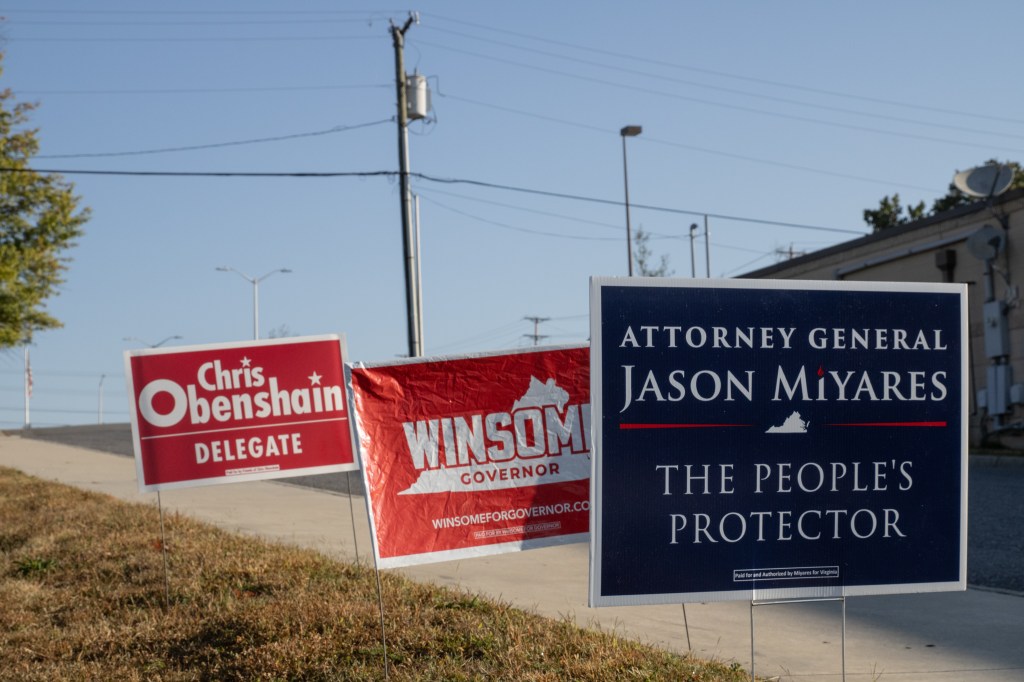
Sept. 19, 2025, Christiansburg, Va. – Campaigns for various offices fill the parking lot at the Office of Elections as early voting begins. (photo by Emily Dorsey, TheNewsFeedNRV.com)
Providing satellite locations alongside mail-in ballots and early voting options is an extra guarantee that all citizens of Montgomery County have the necessary means to vote.
The Board of Supervisors selected the Blacksburg Community Center as the singular satellite location. This site will provide in-person, early voting Oct. 25 and Nov. 1 from 9 a.m. to 5 p.m, in addition to Election Day on Nov. 4.
The Blacksburg location was chosen for four main reasons: Blacksburg Transit’s (BT) accessibility, statistics from previous years, citizen opinion and staffing concerns.
“We have numbers that we were able to look at from the last time we did satellite voting in Blacksburg,” DeMotts said. “Twenty-five percent of the early votes came from the Blacksburg satellite location.”
There is a correlation between a satellite location in Blacksburg and the routes BT provides. The free, public bus runs along popular streets for commuters to easily access grocery stores, Virginia Tech (VT) campus or popular Christiansburg locations like the Office of Elections.
Sept. 19, 2025, Christiansburg, Va. – Office of Elections officially open for early voting; conveniently located next to Food Lion and the Christiansburg Recreation Center. (photo by Emily Dorsey, TheNewsFeedNRV.com)
Traveling to the Office of Elections from Virginia Tech or Blacksburg via the BT takes about 80 minutes round trip. This option may not be feasible for voters who have busy schedules, full-time jobs, extracurriculars and other responsibilities. Also, the BT doesn’t reach all parts of Montgomery County like Shawsville and Riner.
Multiple citizens of Montgomery County spoke at the Aug. 25 Board of Supervisors meeting.
“This is your opportunity, as a board, to again show that you care about excessive and unnecessary spending of our tax dollars,” Wayman Pack, resident of Riner, said. “Let us all use the resources already available to us instead of spending taxpayers’ money on something that is not needed.”
“We need to not be afraid of who people are gonna vote for but give everybody ample opportunity to voice their vote,” Cindy Barton, resident of Montgomery County, said. “I think we can spend money on way worse things than making sure everybody has access to cast their vote.”
DeMotts explained why there are no satellite locations in other parts of Montgomery County.
“There was absolutely no demand,” DeMotts said. “Nobody from those areas emailed, called or came to the board and requested it. The two supervisors from those districts were also very clear they did not want satellite voting location in their district.”
Below are direct quotes from the Aug. 25 Board of Supervisors meeting:
“Voting couldn’t be easier than it is right now,” Fijalkowski said. “This proposal is unnecessary. I think it is a waste of tax payers dollars. It’s a burden on the registrar’s office and employees. Even if Shawsville had remained on the list, that doesn’t make it equitable.”
“I’m a big advocate for making sure [residents of Montgomery County] have access, but the flipside of that is how hard we worked our registrar’s office,” Supervisor Derek Kitts (District B) said. “I think it was 250, 260 hours of overtime … There are two sets of facts in this one. One is the workload, one is the access … Just cause one area of the county asked for it, and the other rest of the county doesn’t, we’ve got to be able to weigh that in.”
According to Connie Viar, director of elections and general registrar, this election was different because Viar’s electoral board was under the opinion, Montgomery County did not need a satellite location. Hence, the decision fell to the Board of Supervisors.
Viar’s team tested the potential sites in Shawsville and Auburn – primarily for internet connectivity. Shawsville did not pass the test, which meant there was no reliable internet to run poll books.
“Auburn tested perfect, but Supervisor King felt like it was not something his locality would be interested in,” Viar said. “The stats show that [voters] come [to the Christiansburg location].”
In previous years, the Office of Elections has been overworked because of the large voter turnout.
“When same day registration came about in 2020, that killed us,” Viar said. “Same day registration in 2023, it was horrible. Last year was worse. Last year we received 4,340 same day registrations. Counting myself, there are six of us here. For five people there were 756 hours of comp time last election cycle. Over and above your normal working hours…There’s never enough hands-on, so we work around the clock to meet the state’s deadline.”
In past elections, the registrar staff received comp-time. For this election, the Board of Supervisors gave the staff the choice between comp-time or overtime pay. In the future, the board will allocate money in their budget for temporary election staff.
There are many factors to consider when planning early voting options. DeMotts said it may be “possibly something the board will kind of have to deal with every election cycle.”
“Coming out of it this year, we have some pretty good direction for our staff,” DeMotts said. “What we want to do is proactively budget for future satellite voting locations as part of an early in the year process.”
Early, in-person voting at the Montgomery County Office of Elections in Christiansburg runs from Sept. 19 through Oct. 31, with one closure on Oct. 13. For more information, visit montva.com.
I sat down with Joseph Caldwell, an assistant principal at Christiansburg Middle School, to discuss the effects of cellphone policies he sees day to day.
CMS has implemented phone policies beginning in March 2024, ahead of Gov. Glenn Youngkin’s Executive Order 33, which took effect Jan. 1, 2025. CMS began with prohibiting cell phones and other electronic devices during the school day. By June 2024, all Montgomery County Public Schools issued a county-wide policy. In its final guidance for cellphone-free education, the Virginia Department of Education in September 2024 established the “bell-to-bell” cell phone-free policy.
Caldwell has 16 years of teaching experience including transition programs for students with behavior challenges, civics and economics and U.S. history from 1865 to present. Last year was his last year teaching in the classroom before this administrative role. Looking back on the last 17 months, Caldwell addresses the support from the community, policy details that acknowledge unique circumstances and the next challenge the education system is facing: artificial intelligence.
Caldwell’s comments were edited slightly for length and clarity.
Joseph Caldwell, assistant principal at Christiansburg Middle School. (Courtesy of Joseph Caldwell)
MCPS was doing cellphone free school days last academic year. In January, a bell-to-bell phone ban was implemented. What changes, positive or negative, have you seen with that extra implementation?
Students are more engaging academically than they were previously. Technology still tends to be a challenge; now the technology is Chromebooks. We’ve been trying this year, as an administrative team, to communicate with teachers to use Chromebooks less than they are used to because students will find ways to be distracted. They are really quick about flipping tabs. Even though there is software teachers can use to monitor it, teachers get more distracted with management than they do teaching.
Students on a limited English proficiency plan or students with disabilities have access to programs on their phone or Chromebook. Why is it important for these students to have access to certain platforms other students may not have?
We will still make exceptions for students to use it [phones] for tools like translating purposes. Students with monitoring devices for their diabetes are allowed to carry their phones. That is just a different conversation we have with those students. And then there’s also 504 plans and IEPs in place that allow for that. But a lot of the tools that students would need their phone for, their Chromebook can serve that purpose, as well.
According to Cardinal News, policy violation does not lead to suspension or expulsion without being tied to an instance of disruptive behavior. Why is it important for administrators to see the differences between certain circumstances?
State law doesn’t allow us to expel students for phones. The heaviest punishment we have in our policy is to assign Saturday school and that’s either on the third or fourth offense. Those consequences become inconvenient enough for the parent that we usually don’t get that far. We have other systems in place, for students that need that technology, that becomes part of a bigger conversation. Like being responsible with technology and how they use it.
How do you or the MCPS staff navigate various parent or student opinions regarding these state laws?
We had a lot of positive support from the community. Last year we allowed it [cellphones] during bus-wait in the morning and afternoon, while other schools in the county did not. This year we became even more restrictive because we changed it to where they couldn’t have it during bus-wait and I expected a lot of push back from that, but we didn’t have any. We had a couple road bumps along the way, but for the most part parents didn’t say anything.
What day-to-day changes have you seen in students as a teacher over these couple of years with the cellphone policies implemented?
As a teacher I have observed the changes in young people not just phones, but screens in general. I observed a noticeable decline in academic achievement in my first decade of teaching. I started to unofficially poll my students asking them who owned phones. Those that didn’t, were more academically successful than those that did. Now, there’s not really an observable difference because most young people have some kind of screen in front of them at some point during the day. Behaviorally what I have observed in the building are kids being more social with one another.
How do you see the future of cellphone policy usage in schools?
I don’t see it changing any, we aren’t seeing a lot of public pushback from it. I think they [families] see the challenges of technology, too, so I think they are supportive of it [current cellphone policies]. If anything the bigger conversation is centering around what to do with AI.
Students seem to rely on AI as a crutch versus a resource. How should teachers and administrators approach AI in the classroom? Do you see a benefit to this technology as a learning function or is it disruptive like cellphones?
I see it costing students more at this point, since traditional classroom practices require us to process information deeper to get to places of real understanding. I think it needs to be a part of classroom conversations, but, at least for middle schoolers, not sure it is something that needs to be handed over to them. Most often we do have students use it [AI] to cheat which most of the time is blatantly obvious. Also, if it is used for feedback from a teacher to a student I believe it only weakens the role of the teacher to build authentic relationships with her/his students.
The benefits of not using cellphones definitely extend after the school day. Research shows the harmful correlations between cellphones and children. How can families help support this cause outside the classroom? How and why should students limit their cellphone usage even outside the classroom?
I think this goes for all of us, not just young people. I know that I am impacted by it, and now that I have been mindful of it, I know how it impacts me. At the end of the day, we don’t like people telling us what to do. It’s not really effective for genuine buy-in to bring change. I think parents need to be mindful of their use of technology in the home as well as the young people they are raising.



 > THE NEWS FEED <