By Evan Hull, environment, climate, and sustainability reporter
Paul Moody, founder and owner of New River’s Edge in Pembroke, and founding member of ReNew the New, has made it his mission to put locals and visitors in touch with a litter-free New River.
By Evan Hull, Alana Powell, and Gracie Gosier – environment, climate, and sustainability reporters
In Floyd, a growing company continues to innovate specially produced charcoal with extensive environmental benefits. SWVA BioChar manufactures carbon chips and powders with a variety of applications.
General manager, Jeff Wade, discussed the company’s products, goals and environmental mission with the News Feed.
By Evan Hull, environment, climate, and sustainability reporter
Former Volvo Trucks COO in North and South America, Patrick Collignon, is optimistic about the future of his battery-electric vehicle manufacturing start-up, Trova.
By Evan Hull, Environment, Climate, and Sustainability reporter
On February 22, 2025, Virginia Tech’s Squires Student Center welcomed the annual Southwest Virginia Woods and Wildlife Conference. Landowners and environmentalists from across the region came to learn new strategies for managing and conserving their natural resources.
By Evan Hull, environment, climate, and sustainability reporter
Solar panels at Perry Street Parking Garage.
For a second time, the U.S. is set to exit the Paris Climate Agreement, but Virginia Tech isn’t backing down from its climate action commitments.
Why it matters: As an internationally recognized institution for environmental engineering and natural resources management, Virginia Tech plays a key role in researching sustainable practices across the globe. With President Donald Trump’s signing of the “Putting America First in International Environmental Agreements” executive order, many environmental initiatives across the country are now in limbo.
The big picture: Virginia Tech will not stray away from its nearly 16-year-old Climate Action Commitment, but there may be some hurdles for researchers.
“Our impact on the environment matters to us,” said Mark Owczarski, interim vice president of communications and marketing at Virginia Tech. “It’s part of ‘Ut Prosim.’ We’re serving our community. We’re serving our students and faculty. We serve our environment because, without our environment, we can’t function.”
Carbon neutrality and 100% renewable electricity are among the goals Virginia Tech currently has set for its Blacksburg campus by 2030. It is one of many universities that remains in-tune with international climate initiatives.
“Right now, there are governors, mayors, and institutions across the U.S. saying ‘we’re still in,’ and ‘we’re going to comply with the Paris Agreement,’” said Carol Franco, senior research associate at Virginia Tech, and climate advisor to the Ministry of the Environment of the Dominican Republic.
While the university isn’t concerned about continuing their plans for a more sustainable campus, questions have been raised about research funding—particularly from the federal level.
“As faculty, we apply for funding—even departments apply for funding,” Franco said. “Having that funding will impact our availability and our capacity to do research in certain areas.”
Still in the early stages of Trump’s second administration, it remains unclear as to what environmental programs and projects will continue to receive federal funding.
Zoom in: While Virginia Tech is unwavering in its commitment to climate action initiatives, officials recognize that times of intense change can always be met with adaptability.
“The university believes that responsible stewardship of the environment is important, and that may look different from generation to generation,” Owczarski said. “The plan will continue to change, evolve, and grow over time.”
Virginia Tech’s Climate Action Commitment has been revised twice since initial approval in 2009.
World leaders celebrate the signing of the Paris Climate Agreement in Paris, Dec. 12, 2015. (Photo/Carol Franco)
Flashback: Over the last several years under the Biden administration and the Paris Agreement, U.S. sustainability plans closely resembled those of Virginia Tech.
In April 2021, Biden created a goal of reducing U.S. emissions by 50 to 52% by 2030 according to the Natural Resources Defense Council. By December 2024, the goal was changed to 61 to 66% by 2035.
What we’re watching: While Virginia Tech’s climate initiatives remain safe from federal intervention, experts from countries still in the Paris Agreement are keeping a close eye on the U.S. before they officially exit.
The U.S. will still be members of the agreement until January 26, 2025 according to Reuters.
“During the first administration of President Trump, the U.S. basically stayed on the sidelines,” Franco said, noting that United Nations Framework Convention on Climate Change decisions must be made by consensus. “Now, if the idea is to stay on the sidelines, we’re going to be able to move forward. If the idea is to oppose, then we’re going to have issues.”
By Evan Hull, environment, climate, and sustainability reporter
In response to winter weather sweeping across the east coast, the Virginia Department of Transportation deployed its usual slew of road salt. Experts say that while the popular ice and snow combatitant isn’t causing too many headaches in the NRV, it could in the future.
“Everything we do in the terrestrial environment creates ions,” said Joel Snodgrass, head of the Department of Fish and Wildlife Conservation. “When they get in water, they dissociate, they dissolve, and they kind of pass through everything. So, if we put [salt] on the road, it gets washed into the soil, into the groundwater, and ultimately into surface waters like streams, wetlands, and lakes.”
Anywhere from 15 to 32 million metric tons of road salt are dumped on roads every year in the United States according to the Cary Institute of Ecosystem Studies. With the NRV being geographically more susceptible to ions, such as calcium, entering groundwater systems, road salt adds another layer of complexity to the pollution problems we face.
“During the winter, you get these big spikes in salt runoff,” Snodgrass said.
Researchers worry about winter chloride spikes in local waterways, but they are more concerned about the continual elevation of groundwater contamination, which has become a global problem.
“Road salts are part of this bigger phenomenon that’s going on basically everywhere in the world, in fresh water systems, where the amount of ions in the water is increasing,” Snodgrass said. “In other words, the water is becoming more saline in nature. It has more dissolved solids in it.”
Other runoff pollutants cause issues all year long.
“It’s not just salt that comes off these roads,” Snodgrass said. “Every time someone uses their brakes, particles come off their brake pads and collect on the road—all the belts, engines, and tires.”
When heavy metals are released onto roadways, most commonly cadmium, copper, and zinc, they can interact with road salt in harmful ways. The International Erosion Control Agency says road salt mobilizes heavy metals, permitting these materials to quickly infiltrate groundwater systems and contaminate plants and wildlife.
Additionally, high concentrations of sodium can reduce the permeability of soil, increase surface runoff, and raise erosion rates, directing pollutants straight toward major waterways.
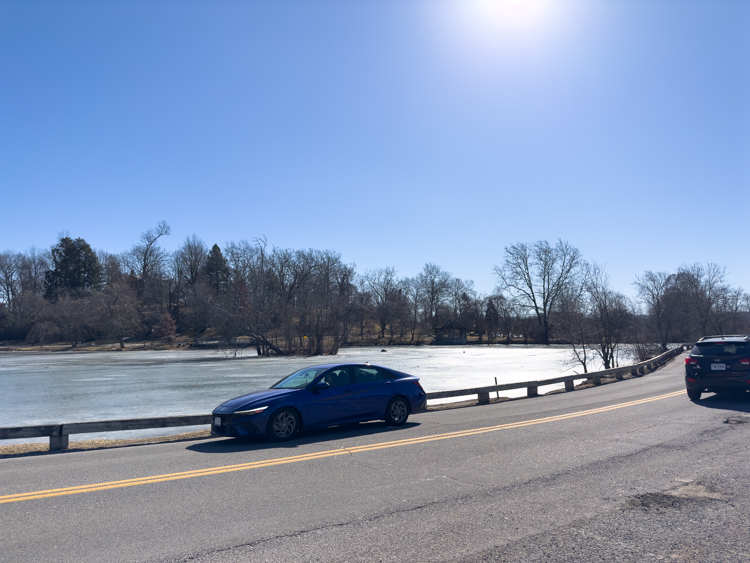
But these aren’t new issues. In fact, stormwater management facilities such as Virginia Tech’s Duck Pond and Stroubles Creek are great examples of how runoff pollution is managed in southwest Virginia.
“Stormwater management facilities in the NRV serve two purposes,” said Kafi Howard, stormwater engineer for the town of Blacksburg. “The first is to mitigate volume increases due to developments like roads and commercial buildings.”
Even in less-urbanized areas, such as the NRV, large developments increase impervious surfaces, meaning that high volumes of road salt and other harmful materials run into waterways very quickly. Stormwater management facilities help hold that water back, and slowly release it in a less harmful manner.
“There’s also quality control,” Howard continued. “A lot of newer stormwater facilities incorporate mechanisms to filter pollutants.”
Howard noted that many older stormwater facilities do not have filtering systems, noting the importance of properly functioning stormwater ponds and wetlands.
“The New River Valley has quite a few streams that are impaired, which means they are not meeting water quality standards,” Howard said. “So it’s super important that those facilities function and help reduce these pollutants.”
In localities as close as northern Virginia, we can see what happens when pollutants are unfiltered by stormwater facilities.
“In Tysons Corner, Virginia, there is enough salt going down that people are losing their wells,” Snodgrass said. “The well becomes so contaminated that all their appliances start to rust.”
The question then turns to the economy. Does keeping roads clear of ice and snow boost the economy enough to justify the cost of maintaining highly contaminated waterways?
“There’s a whole social aspect to this,” Snodgrass commented. “There’s an economic piece to this. If it snows and nobody can get to work for three days, that slows down our economy, right? Now it’s in our mentality.”
Although road salt helps lower the freezing temperature of water, keeping the roads clear and economies moving, it comes with hidden costs, and not just in the environmental price we pay. According to the EPA, NBC, and Vox, the U.S. spends an estimated $2.3 billion to apply road salt, and another $5 billion to repair infrastructure and vehicle damages annually.
With a huge price tag, several alternatives have been considered including acetate deicers and organics, both of which can release equally harmful chemicals into waterways according to the Sustainable Technologies Evaluation Program. Neither option is nearly as cost-effective as road salt.
While waterways in the NRV do not currently have to give a second thought to the application of road salt, they should certainly keep a close eye out as commercial developments continue to pop up regularly, contributing to higher concentrations of pollutants entering local streams.
“I think that the consideration of road salt and stormwater management is certainly something that needs more investigation,” Howard said. “We all want clear streets and easy access in the winter, but we need to recognize that there is a price to pay for our convenience.”


 > THE NEWS FEED <