From classroom to conference room: Virginia Tech engineering students tackle real-world challenges 

By Elizabeth Hill, education reporter 

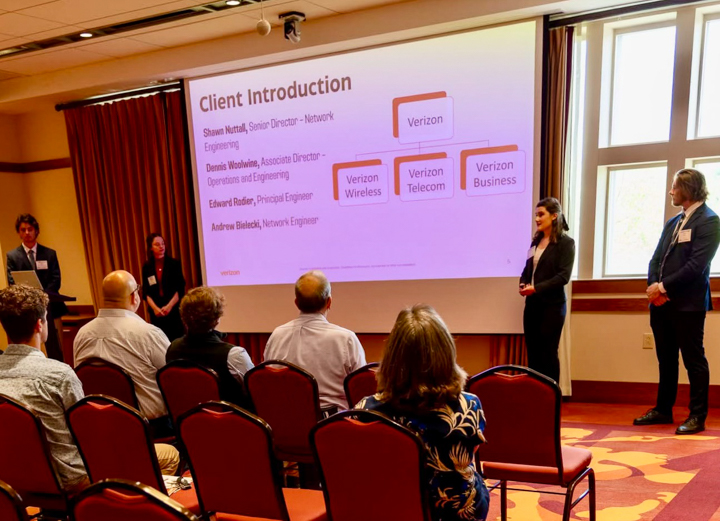
Students present their senior design project at the Virginia Tech Industrial and Systems Engineering Senior Symposium.

Each fall, a new cohort of Virginia Tech industrial and systems engineering seniors begin the final phase of their undergraduate journey, not with exams or essays, but by solving real problems for companies.  

The senior design program, part of the Grado Department of Industrial and Systems Engineering, challenges students to serve clients worldwide over a nine-month period. Teams are paired with company sponsors and have the responsibility of analyzing data, improving systems and delivering tangible results.  

Students meet with their clients regularly to align goals, ask questions and present their work in progress. These clients are more than just evaluators; they are active collaborators who offer insights from their own industry experience.

At the end of the academic year, their findings are presented at the Senior Design and Undergraduate Research Symposium, a professional conference where students deliver their findings to faculty, peers and industry representatives. The 2025 symposium was hosted at the Skelton Conference Center, located within The Inn at Virginia Tech. Recognized as the premier event facility in Blacksburg, the venue offers advanced technological resources and a seasoned events team, making it a preferred location for high-profile academic and professional gatherings. 

Eileen Van Aken, department head of the Grado Department of Industrial and Systems Engineering (ISE), shared her thoughts on the program’s impact with Virginia Tech News. “It is remarkable to see the impact of our senior design program at such a high level,” she said. “We continue to be impressed by our students and their commitment to delivering strategic, timely, and cost-effective solutions to their clients within our senior design program. We know this real-world experience will be applicable long after they graduate.” 

For students, that impact goes beyond academic achievement; it becomes a defining moment in their education. After years of lectures, labs and exams, senior design projects offer a rare opportunity to step into the role of a professional and tackle the kind of complex problems they will likely face after graduation. 

“Getting the chance to integrate skills from almost every class in the ISE curriculum was truly special. It put a lot of the theories and formulas that might not be intuitive in a textbook into context.” 

Vivek Gopalam, a senior design team member for The Boeing Company

While the academic value of these projects is undeniable, many students found the hands-on, off-campus components just as impactful. 

The excitement of leaving the Blacksburg campus and traveling for on-site company visits added an intriguing and memorable layer to the projects. “Pick a project that travels, as I got to go to Colorado twice and Chicago once. All amazing experiences,” said Matthew Speciale, a senior design team member for Woodward. For Speciale and his team, their trips to Fort Collins, Colorado, were among the highlights of their senior design experience, offering both professional insight and personal adventure. 

Speciale’s team visited Woodward’s facility on two separate occasions, each lasting a week, to gain hands-on experience and a deeper understanding of the project they were tackling. These on-site visits allowed them to work directly with the company and gain crucial insight into the operational side of their project. 

When the team was not present at the facility, the students took full advantage of Colorado’s natural beauty. From skiing at Winter Park to hiking in Rocky Mountain National Park, the students experienced the perfect blend of professional growth and personal adventure. 

For Speciale and his team, the combination of immersive work and unforgettable travel made their senior design project not just an academic requirement, but a defining chapter in their Virginia Tech experience. 

Photo courtesy of Matthew Speciale: After three days of hands-on work at Woodward’s Fort Collins facility, Matthew Speciale (on the left) and two of his teammates took a break to hit the slopes at Winter Park. 

For Mollie McKee, whose team partnered with Verizon, the early weeks of the project were filled with uncertainty. Unlike projects with clearly defined deliverables, her team’s assignment came with an open-ended scope. The lack of structure was challenging at first but ultimately led to valuable learning. 

“Our project was not strictly scoped in the beginning, which made for a really interesting first few meetings,” McKee said. “We set expectations and did the usual team bonding activities, but we really started to dive into the project once we visited one of the sites.” 

Each semester, students in the senior design program receive a list of industry-sponsored projects that outline genuine engineering challenges. After reviewing their options, the students rank their top choices. Teams are then matched with companies ranging from global tech firms to defense contractors, offering students hands-on experience in industries they may have never explored. 

For McKee, that meant stepping into unfamiliar territory. 

Drawing on her previous internship experience, she described the program as a very abbreviated version of an internship. However, unlike her prior roles, this project required her to approach problem-solving in a completely new environment. 

“It was an opportunity to explore a space I probably never would’ve considered otherwise,” she said. “And that ended up being one of the most rewarding parts.” 

One of the biggest lessons McKee learned was the importance of listening, especially to the people most closely connected to the issue. 

“I think talking to the people who are at ground zero of the problems you’re trying to solve at a larger scale is the most important place to start,” she said. “A lot of people, myself included sometimes, tend to jump to solving problems they don’t understand, and that leads to frustration from those on the ground.” 

By embracing the unknown, asking better questions and listening to those with firsthand experience, McKee and her team were able to find direction and purpose. Her experience reflects the heart of the senior design program: not only addressing operational challenges faced by major companies, but learning how to lead, adapt and grow in the face of the unknown. 

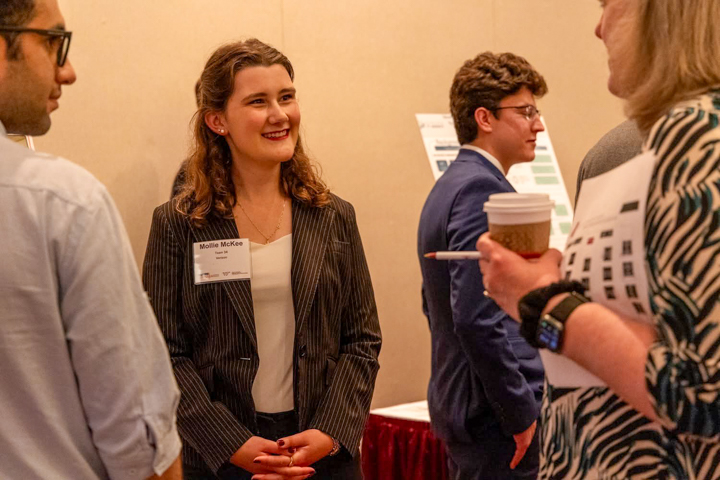
Mollie McKee speaking with industry professionals at the Virginia Tech Industrial and Systems Engineering Senior Symposium.

he students’ journeys, filled with discovery, collaboration and growth, came to a close at one of the department’s most anticipated events of the year. 

The 2025 Senior Design and Undergraduate Research Symposium marked the final milestone in a yearlong journey of applied problem-solving. Throughout the day, teams presented their findings through formal presentations and interactive poster sessions, engaging with faculty, fellow students, and industry representatives. The event served as both a culmination and celebration of the knowledge and skills students developed during their time in the program. 

To close out the symposium, several student teams were recognized for outstanding performance. Awards were presented across five categories: Application of ISE Tools, Project Performance, Innovation and Creativity, Integration and Implementation, and People’s Choice. Each award reflected a different dimension of excellence. 

For many students, the symposium was a rewarding opportunity to reflect on how far they had come.  

“It was so much fun, and it was nice to reflect on how far we came from the start of the project—showcasing everything to a packed room with your friends and professionals was a great way to end the project.”

Matthew Speciale, a senior design team member for Woodward

Others found the experience validating in terms of industry relevance and technical achievement. “I was very proud of our performance in the poster session and presentation,” said Vivek Gopalam, whose team worked with The Boeing Company. “We had industry representatives come talk to us about how pressing the issue that we were solving was to them, and how exciting it was to see research being done in this area. Our efforts paid off as we were told by the ISE teaching team that we were an extremely high scoring team.” 

These recognitions highlighted the program’s emphasis not just on delivering solutions, but on integrating core industrial and systems engineering principles in innovative and meaningful ways.  

As the symposium concluded, students walked away with more than just final deliverables, they left with real-world experience, new connections, and a sense of accomplishment. For many, the event was a turning point: the transition from student to emerging professional. 

By bridging classroom instruction with practical application, Virginia Tech’s ISE Senior Design program continues to prepare graduates for the complex challenges of the modern workforce, equipped not only with knowledge, but with confidence earned through experience. 

HYPNOS: Honors College students create sleep technology for astronauts

by Elizabeth Hill, education reporter

HYPNOS, a team in the Calhoun Honors Discovery Program at Virginia Tech, has developed Selene, an innovative sleep technology designed to improve sleep for astronauts. After dedicating more than 400 hours to its development, the prototype will be showcased at the prestigious Biennale Exhibition in Venice this May. With a focus on transdisciplinary innovation, the team has worked tirelessly to refine their design, and their efforts will be on display for a global audience, marking a significant milestone in their journey.

Virginia Tech’s Innovation Campus: Igniting Tech’s future in Alexandria 

By Elizabeth Hill, education reporter 

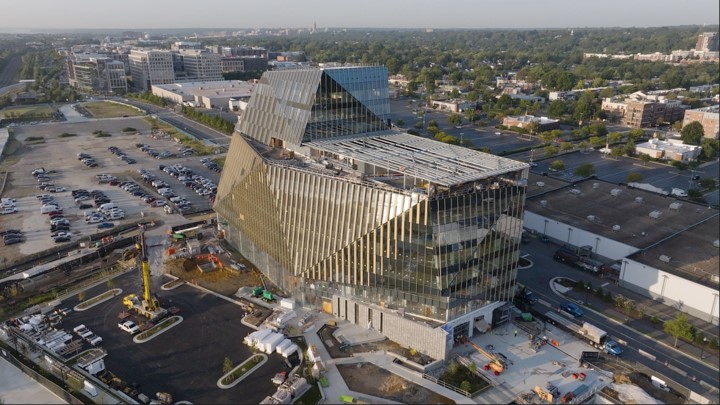
Virginia Tech’s new Innovation Campus, a striking and architecturally bold facility in Alexandria, opens Feb. 28. The cutting-edge campus in Northern Virginia will offer students state-of-the-art amenities to help them thrive in their future careers. The opening marks a transformative moment for the university. 

Innovation Campus under construction (Photo: Virginia Tech News) 

Why it matters: This major investment by Virginia Tech expands the university’s footprint in the greater Washington, D.C. area and reinforces its commitment to serving the Commonwealth. The facility will focus on high-demand fields like computer science and computer engineering, directly addressing the region’s growing need for tech talent, especially with the continued expansion of companies like Amazon’s HQ2

Located near the soon-to-open Potomac Yard Metro station, the campus offers convenient access for students, faculty and collaborators. Its proximity to major transportation hubs, including Reagan National Airport, further enhances accessibility and strengthens connections between Virginia Tech and the region’s booming tech sector. 

Flashback:  Construction on Academic Building One, the first building on Virginia Tech’s Innovation One campus, began in September 2021. The 300,000-square-foot, 11-story building was always going to be a major undertaking. 

SmithGroup, the architects behind the building’s design, and Whiting-Turner, the construction contractor, are collaborating to bring this complex vision to life. The finished building will showcase their combined creativity, teamwork and expertise. 

Virginia Tech News spoke with Sven Shockey, a 1996 alumnus and vice president and design director at SmithGroup, about the project. 

  • “We all felt this project was ideally suited for us because Virginia Tech set ambitious goals for a building with a high level of sustainability and wanted to house the computer science and computer engineering programs in a top-tier research environment,” Shockey said. 
  • “The building and site need to function as a self-sufficient mini-campus,” he added. “It must stand on its own for a while until the surrounding buildings are developed,” Shockey added. 

Zoom in: The Alexandria campus offers a range of revolutionary features designed to foster a sustainable and educational environment. From energy-generating windows to an indoor drone testing facility, the campus offers unique opportunities for research and collaboration. 

  • Sunlight powers the building through photovoltaic panels integrated into the south and southeast-facing windows. Unlike traditional rooftop solar installations, these window-mounted panels harness solar energy directly within the building’s facade. 
  • A two-story, 465-square-foot drone testing cage spans the third and fourth floors. This indoor facility complements the outdoor drone park near the Oak Lane community in Blacksburg, providing Innovation Campus students with year-round access to drone technology. 
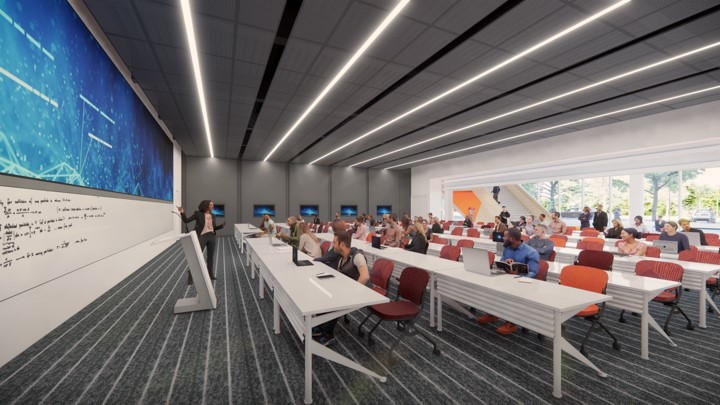
  • The spacious 3,000-square-foot Boeing Auditorium, conveniently located adjacent to the two-story lobby, will host lectures and presentations. Naming the auditorium after Boeing recognizes the company’s role as the Innovation Campus’s first foundational partner. 
Rendering of the Boeing Auditorium (Photo: Virginia Tech News) 

The design also incorporates a touch of Virginia Tech’s Blacksburg roots. While the Blacksburg campus features iconic Hokie Stone, the Alexandria building uses terracotta masonry. 

  • “We have our Hokie Stone masonry in Blacksburg, and the new building utilizes terracotta masonry,” said Liza Morris, university architect, in an interview with Virginia Tech News. “In this way, we’re still maintaining a textural masonry element. It felt like the right materiality and the right way to honor the legacy of collegiate Gothic stone architecture of our Blacksburg campus, but in a way that’s appropriate for the new context.” 

What we’re watching for: The Innovation Campus’s Academic One building opens Feb. 28, marking the start of what promises to be a hub for cutting-edge research and education. The official opening ceremony and ribbon-cutting will commence at 10 a.m. and is an event open to the public. 

This is just the first step for the Innovation Campus, which plans to add two more academic buildings to accommodate a growing number of students and faculty. 

A Taste of Home: Virginia Tech celebrates the 50th International Cafe Hour

By Elizabeth Hill, education reporter
 Braised pork with rice, sweet potato balls and brown sugar bubble tea at the International Cafe Hour (Photo: Elizabeth Hill)

The aroma of braised pork and rice mingled with the sweet scent of brown sugar bubble tea at Virginia Tech’s Deet’s Place on Jan. 31 as students and community members gathered for the 50th International Cafe Hour. This milestone event, hosted in collaboration with the Taiwanese Student Association, celebrated Taiwanese culture and traditions, reinforcing the university’s mission to foster a welcoming environment for international students and promote cross-cultural understanding.

Since its formation, the International Cafe Hour has provided students with a platform to share their cultures, develop a sense of belonging and connect with the wider community. These free events featuring food, presentations and interactive activities have become a vital part of campus life, enriching the student experience and encouraging global connections.

Fawna Zwart, assistant director for campus and community engagement at the Cranwell International Center, has led the initiative since the beginning. “I think one of the biggest goals is to help international students feel more welcome and more at home here at Virginia Tech,” Zwart said. “What I have discovered is that when students share their culture, they just light up. It helps them develop a sense of belonging, express pride in their culture and also helps them find their people.”

The event started as a small gathering in the Cranwell Center’s community room, offering students a space to connect. “We had 112 people in the first hour,” Zwart recalled. “We had a line out the door.” The overwhelming response quickly turned the event into a campus favorite, necessitating a move to a larger venue. Today, it takes place in Deet’s Place, where attendance continues to grow.

As participation increased, so did the offerings. In collaboration with Virginia Tech Dining Services, the program now provides authentic cuisine that resonates with the featured country or region. “We get their home recipes, and the chefs choose a sweet, a savory and a beverage,” Zwart said. This approach ensures each gathering feels like a taste of home for international students while inviting the broader campus community to explore global flavors.

Each cafe hour is unique, showcasing different cultures through food, music, presentations and hands-on activities. To mark the 50th event, organizers extended the celebration to three hours, offering attendees a deeper dive into Taiwanese culture. The event featured information boards, traditional dishes and a Mandarin calligraphy station. Attendees also participated in trivia with questions about Taiwan and the chance to win tickets to a Moss Arts Center performance. The Global Education Office (GEO) and the Council of International Student Organizations (CISO) were also on hand to connect students with international opportunities.

A student learning the art of Mandarin calligraphy (Photo: Elizabeth Hill)


For Maya Collins, a student eager to explore different cultures, the event offered an immersive experience. “This is my first time at an international cafe hour,” she said. “Since I have not had the opportunity to study abroad, this event made me feel like I teleported to a new country, even if it was just for a couple of hours.”

Beyond the event itself, the Cranwell International Center strives to maintain long-term cultural engagement. A key element of this initiative is the creation of “culture boxes”—collections of decorations and artifacts representing different countries.

Student groups receive a small budget to curate these materials, ensuring a meaningful representation of their heritage. “I have created the culture boxes for them because many of them don’t have things from home,” Zwart said. “You know, they are restricted with their two suitcases to get here. They are not packing all the things from home, so I try to buy a few things for them that they can use and decorate with.” These boxes serve as valuable resources, not only for the cafe hours but also for student organizations presenting at local schools and community events.

With its growing popularity, the International Cafe Hour has become a highly sought-after opportunity for student groups, with several already expressing interest in participating next year. Zwart envisions the program as a living travelogue, offering the entire community a chance to learn about different cultures and break down barriers. 

The impact of this program extends far beyond the walls of the cafe itself, highlighting the importance of international education outside of the traditional classroom setting. Experiences like these foster crucial intercultural skills, such as communication, empathy and adaptability, that are essential for success in today’s globalized world. These skills aren’t always effectively taught in lectures or textbooks; they are best learned through direct interaction and shared experiences, like those offered at the International Cafe Hour. 

By fostering global awareness and mutual understanding, the International Cafe Hour prepares students to navigate an increasingly interconnected world. Through food, conversation and shared traditions, the event continues to bridge cultures, create connections and celebrate the diverse voices that make up the Virginia Tech community.