The American Chestnut tree has a facinating history. It’s nutrient rich nuts, prized lumber, and large size made it an icon of eastern forests, until the species was wiped out by disease in the early 20th century. For years, groups have been working to develop a disease resistant American Chestnut tree, enabling the species to make a comeback.
Ponies have roamed 4,000 acres in Grayson Highlands State Park for over 50 years. They help keep the brush down on the park’s iconic bald mountaintops, and are a tourist attraction in their own right. The pony population has been diminished in recent years by predators, raising questions over their future in the park.
At Virginia Tech’s Nature Inspired Fluids and Interfaces (NIFI) lab, a team of student researchers are studying how jumping water droplets can be used to keep crops healthy, and improve energy efficiency.
The NIFI lab is the brainchild of Dr. Jonathan Boreyko, an associate professor in Mechanical Engineering. Boreyko’s research synthesizes environmental and life sciences concepts with his engineering background. A common thread in Boreyko’s work is biomimicry. Biomimicry is when natural phenomena are used as inspiration for systems or products that solve human problems. “Why be radically creative and think of completely new things when you can look around at how creative nature already is” says Borekyo.
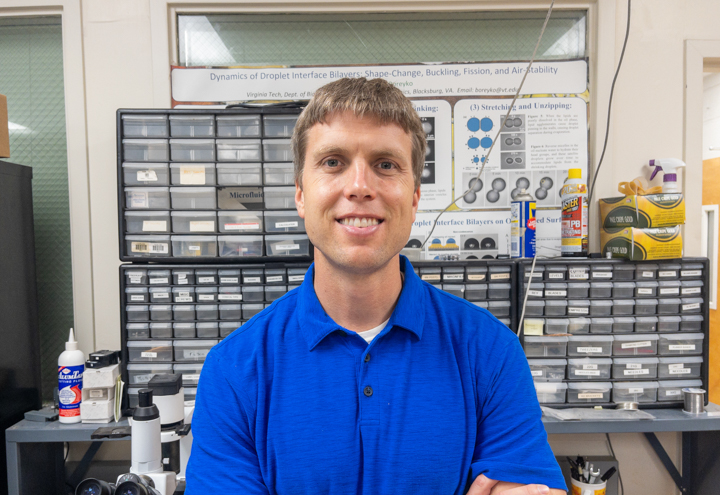
Sept. 12, 2025, Blacksburg Va. – Jonathan Boreyko leads the Nature Inspired Fluids and Interfaces Lab, located in Norris Hall at Virginia Tech. (Eli Lamport, News Feed NRV)
Currently, a dozen Virginia Tech students work in the NIFI lab on a variety of projects. One of these students is Grant Helm, a senior studying Mechanical Engineering. Helm started researching at NIFI earlier this summer. One project that Helm has been working on is using high speed videography to analyze how disease spores spread between barley plants. Helm explains how “when water droplets coalesce on a hydrophobic surface like a plant leaf, they release a little bit of kinetic energy and jump off the surface.” If a plant is sick, fungal spores on its leaves can hitch a ride on these jumping water droplets. Once the water droplets clear the “boundary layer” immediately around the leaf, the spores can be blown downwind, quickly spreading to nearby plants.
Jumping droplets were first discovered by Boreyko in 2012, who was studying the phenomena in wheat plants. Helm is trying to identify any differences in the behavior of jumping droplets on Barley leaves. Something new that Helm has observed is a “billiard ball” effect where all of the energy created by droplets fusing together is transferred directly into a spore, launching it into the air. All of this research is made possible by the NIFI lab’s Phantom high speed camera, which can capture up to 1 million frames per second. “The imaging is something that I didn’t expect to do in the lab, and it’s been really fun,” says Helm.
Another project that Helm is working on at NIFI involves figuring out how to improve the efficiency of heat transfer in boiling processes. Every liquid has a critical heat flux, which is the rate of heating at which a vapor barrier forms between the liquid and the heating element. At that point, the heat is no longer being transferred effectively into the liquid. “You aren’t heating the water anymore, you’re just melting the pot,” Helm explains. It’s been established that the best way to improve the efficiency of boiling is to raise the critical heat flux, which can be achieved by shrinking the size of the bubbles in the liquid.
What researchers at the NIFI lab are trying to do is get these small bubbles to leave the surface of the liquid prematurely, which would further improve efficiency. What they have found is that when the bubbles are small enough, they begin to act similarly to the jumping water droplets on a leaf. They merge together and jump off the surface, preventing a vapor barrier from forming and allowing for more heat to be transferred to the liquid.
Sept. 12, 2025, Blacksburg, Va. – Boreyko and a research student using the Phantom high speed video camera in the lab. (Eli Lamport, News Feed NRV)
A major practical application of this concept is in power generation. Most power plants, conventional and nuclear, use boilers to create steam to spin turbines. Improving the energy efficiency of this process at the source could have significant positive effects, including a reduced carbon footprint to cheaper energy costs for consumers.
Boreyko and his team are also interested in applying these same principles to cooling processes. Data centers are a particularly compelling use case because they are putting an increasingly significant strain on the power grid. “Currently we are just blowing chilled air across these entire facilities, so it’s not very efficient,” says Boreyko. As condensation forms on cooling equipment, it becomes less efficient. If this equipment was coated in a hydrophobic material those droplets could jump off the surface and evaporate, allowing for more heat to be absorbed.
The NIFI lab not only offers students the opportunity to work hands-on on a variety of projects, it also fulfills a longtime personal goal of Boreyko. “I didn’t do any research as an undergraduate, I didn’t have those experiential learning moments,” Boreyko explains. Running the NIFI lab allows Boreyko to provide the experience that he wishes he had gotten as a student. “I’ve published over 80 papers now, so that’s not necessarily going to blow my socks off anymore. But it never gets old seeing a student run up to my office to show me something they just discovered.” says Borekyo. Grant Helm says that “looking at things experimentally is a really great way to learn about how things work in the real world.” Helm is looking forward to the next breakthrough moment in the lab. “That’s going to be really really satisfying.” For more information on the NIFI lab at Virginia Tech, visit their website.
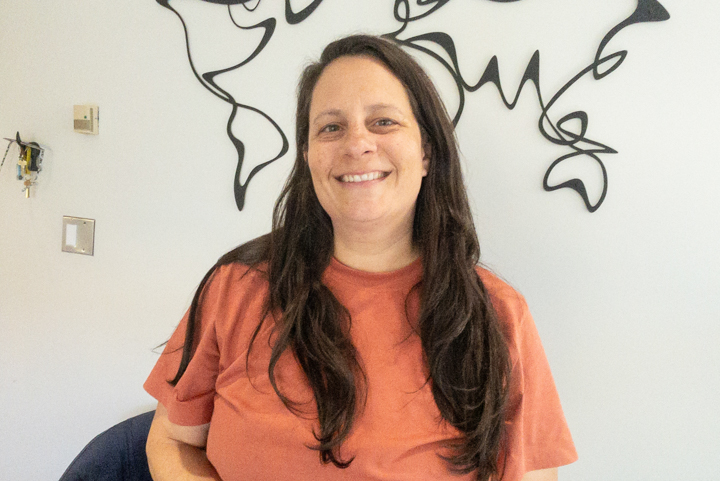
Dr. Korine Kolivras in her office in Wallace Hall, on Virginia Tech’s campus.
Dr. Korine Kolivras is a medical geographer with more than 20 years of experience in her field. At Virginia Tech, she has embarked on research into the spread of Lyme disease in the New River Valley area.
Dr. Kolivras also teaches several undergraduate courses and works directly with graduate students in Virginia Tech’s Department of Geography. I sat down with Dr. Kolivras to discuss her background, research, and thoughts on the current state of science in the United States.
(Editied for clarity)
You describe yourself as a medical geographer. Can you elaborate on that? What does that mean? What does your day-to-day look like?
Stepping back a little bit, as a geographer we study why things are where they are. So some people call it the science of where, because we’re understanding why is that type of plant here and not there? Why is this city here and not somewhere else? So I study why diseases and health concerns are where they are, what factors are unique to making certain places healthy or less healthy and also how diseases spread from place to place. So day to day, I do research related to that.
How do medical geographers work alongside other kinds of geographers, and what other fields does your work overlap with?
Yeah, so I collaborate with people within geography as well as in other fields and disciplines. It’s pretty interdisciplinary. So, within geography, we’re trying to figure out where diseases are, but oftentimes that’s where certain insects are. So it’s like, where are ticks living? Where they’re living, we’ve found that Lyme disease is higher, where we have land cover change, where we have different land covers next to each other. So a forest, a large forest patch next to a farm field, for example, that’s the type of place where we would have Lyme disease more typically. And so I could work with bio-geographers and people that study land cover change. And then outside of geography, I collaborate with people in epidemiology and public health, but also, I could collaborate with people in sociology, because they understand population patterns and population level decision making within society.
How did you end up in this field? Do you remember a moment where you realized this is what you wanted to do long term?
First of all, in K-12 education we don’t get a really good understanding of what geographers do. Students come into my class, and it’s just like memorizing capitals and where rivers are and stuff. That’s not really what we do, you know, the location of things is definitely important, but it’s more about what else is going on in that place?
In college, I started out as a Spanish major because I love to travel. I love languages, and then I just randomly took a geography class. And I’m like, oh my gosh, this is where the cool stuff is, the stuff that I’m excited about. So I switched my major to geography. And actually, it was my senior year of undergrad when I first took a medical geography class. It was fascinating to combine this idea of geography and why things are where they are, with thinking about human health. It also made me realize that I could do research that could make a difference. I feel like everyone deserves good health, and so by doing this kind of research, it could help with that. So I went on, I got my master’s degree and then my PhD doing medical geography related work.
You have done extensive research on Lyme disease trends within Virginia. Can you tell me more about that process, and why Lyme disease continues to spike in this area?
I first got started working on it a little over 15 years ago when the Virginia Department of Health noted that Lyme diseases were increasing in Virginia. I think the number of cases tripled over a 20 year span, and they were looking to do a study to try to understand why that was happening. And so that’s when I first got started on it. And then eventually I got funding from the National Science Foundation, which was critical in getting this research started and trying to understand Lyme diseases spread. Early on, we had a lot of cases around northern Virginia. There’s a lot of people living there. There’s also a lot of suburbanization. Suburban areas are often hotspots for the disease. Starting around 2014, the New River Valley was a hot spot. We had a lot of cases down here. So my research is centered around trying to understand why that spread happened and why some places have high rates of Lyme disease and some places have low rates.
Even when we standardize and adjust by population, some areas stand out as having a lot of cases. And so what we found is that within plots of land that had high rates of forest patches next to herbaceous land. So like a pasture, a farm field, you know, grassy areas, those were the census tracks that had the highest rates of Lyme disease. And honestly, if you drive around, that’s what a lot of neighborhoods around Blacksburg are like. And honestly it’s kind of a cultural thing where that’s what we want our suburban developments to look like. We want to live in areas where you’re close to forest or greenspace, which is understandable, but at the same time, it supports this Lyme disease cycle.
How do you feel about the state of your field going forward?
I’ll speak about science more broadly. The United States has been an innovator and leader within science for decades. Developing new things, new solutions, discoveries. And I am a bit concerned about the decreased focus on research funding that we’ve seen recently. I’ve gotten funding from the NSF, and that’s definitely something that could be in jeopardy. Science research is so important, and I’m not just saying that as a researcher, but also as a member of the public.


 > THE NEWS FEED <