A new era of art

By Caroline Herbert, arts and culture reporter
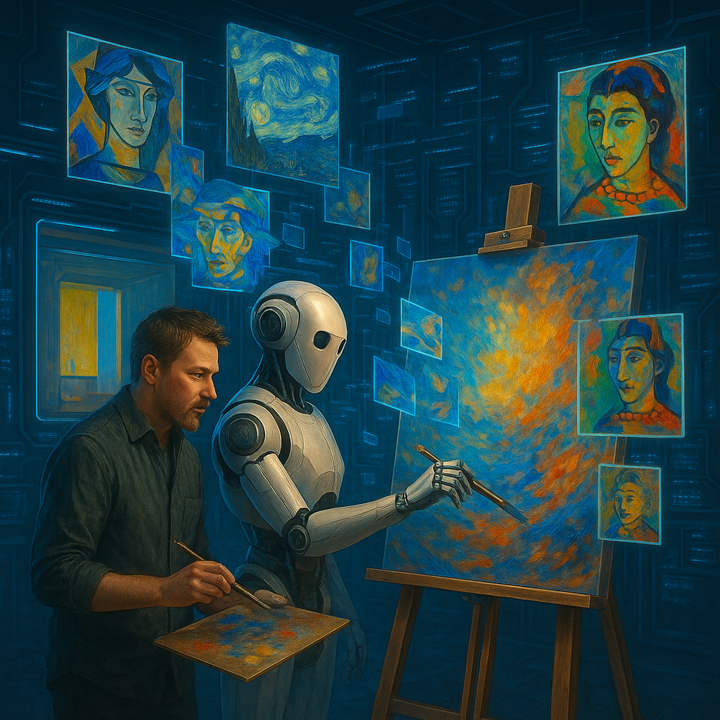
The above image was generated by ChatGPT.

“The great thing about AI is it makes a lot of things more convenient, and the bad thing about AI is it makes a lot of things too convenient.”

-Dr. Justin Horn, Professor of AI Ethics at Virginia Tech

Dr. Justin Horn, a Professor of AI Ethics at Virginia Tech, recently had an eye-opening experience with artificial intelligence. 

“I was thinking about unique ways to teach something in particular for class and thought it would be useful to have a cartoon conversation explaining the material I was teaching,” Horn said. “I asked ChatGPT to create this image, and it created exactly what I needed in a matter of seconds.” 

As tools like ChatGPT and DALL-E become more widely used, professionals are incorporating AI into their daily workflow. The nature of human creativity is shifting fast. This has sparked a growing debate: Are we witnessing the expansion of art, or its transition into automation?  

AI’s ability to generate visual art has created a new creative space, where machine-generated and human-made art intersect. For some, this signals a new era of artistic innovation. For others, it raises difficult questions about authorship, value and authenticity. 

AI is changing how creators think, conceptualize and execute their work, presenting both opportunity and controversy. 

Savannah Penven, exhibitions program manager at the Moss Arts Center, has extensive experience working with various artists. While the Moss hasn’t actively sought artists who work with AI, she’s observed firsthand how technology is influencing creative work. 

“Artists who are already engaging in visual art have found ways to use AI to their advantage,” Penven said. “But also, a lot of people who haven’t really engaged with the arts before are dipping their toes in, and I think that comes from a feeling of not being able to create art themselves.” 

Penven’s observations highlight one defining characteristic of AI tools: accessibility. Now, anyone with an idea and just a few descriptive words can produce high-quality art or design in seconds. For some, that’s empowering. For others, it’s worrisome.  

Regardless of viewpoint, the ability to instantly create polished, visually appealing art from a text prompt is significantly transforming artistic expression and impacting the creative process. 

“We’re already at a point where AI-generated music and art can fool professionals. That’s one of the things I find most unnerving, that even the most human forms of expression are being created by machines.” 

-Dr. Justin Horn 

Horn explained that most generative AI models are trained on massive datasets, often created using artists’ original work without permission, compensation or credit. This raises several questions about ownership.  

“When someone creates a work of art, there’s a sense in which they should own it,” Horn said. “But a lot of the AI systems we have now are trained on huge quantities of artwork, and we don’t have any system in place for compensating the original creators.” 

In 2023, several artists filed lawsuits against companies including Stability AI, Midjourney and DeviantArt, alleging that their artwork was used to train AI image-generation models without permission. The case, Andersen v. Stability AI, highlights the legal gaps surrounding intellectual property and creative AI. According to the Copyright Alliance, the plaintiffs claim their work was repurposed without consent. 

A report by the Interaction Design Foundation, states that AI-generated art “challenges traditional notions of authorship, intent, and ownership.”  
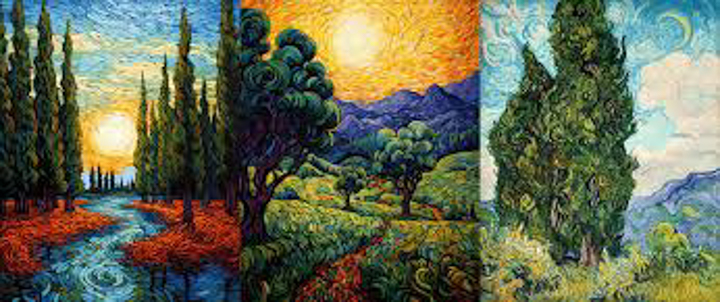
One Van Gogh painting (far right) alongside two pieces of AI-generated art: Image retrieved from Goldpenguin.org 

While AI can mimic artistic styles, Penven argues it still lacks one essential element: emotion. Human art, she said, remains distinctive because of its emotional drive. 

“The core draw of art is still its personal, emotional connection to the viewer,” she said. 

Penven said AI can serve as a useful brainstorming tool, but the line between collaboration and creation matters.  

“AI can be helpful in conceptualizing different ways of creating art,” she said. “But when it’s used just to produce a final product without any intention behind it, that’s when it gets messy.” 

She compared today’s debates about AI to the 19th-century resistance against photography, another technology that disrupted how people viewed art.  

“There’s always been this battle of, ‘Is it art or is it not?’” Penven said. “AI is just the next chapter, just as photography was a new chapter at one point in time.” 

“Do people want to view something that is aesthetically pleasing, which AI can certainly generate, or something that reflects the inner world of an artist?” 

-Savannah Penven

Beyond the arts, Horn sees additional risks, especially as an educator. He worries about students taking advantage of AI on assignments, but his deeper concern is the long-term cost of dependence.  

“It’s very easy to let AI do things for us rather than struggle through them ourselves,” Horn said. “And if we don’t struggle, we risk losing the ability altogether.” 

Even something as intimate as a love letter, he warned, could soon become a task people will be tempted to use AI to write. 

Whether it’s composing letters, conducting research or developing original ideas, Horn cautioned that consistent shortcuts can hinder one’s creativity.

“We’re moving into a world where it’s going to be very tempting for things not to come from human beings,” he said. 

Horn compared the future of art to the fashion industry. While custom-made clothing still exists, most people buy mass-produced clothing made by machines. 

“I don’t think human art will die,” he said. “But it might be seen as more of a luxury.” 

Despite his concerns, Horn doesn’t reject AI altogether. 

“In medicine, AI can detect cancer earlier than a human can,” Horn said. “If the goal is to save lives, I don’t care if it’s a machine or a person doing the diagnosing.” 

Still, he noted, there’s a profound difference between scanning a medical image and composing a symphony. 

That difference, Penven believes, is what will make human art irreplaceable.  

“There’s always going to be people who want to see something created by a human,” she said. “We have this intrinsic drive to create art.” 

“AI is here,” she added. “And we’re going to keep finding new ways to deal with it.” 

As the creative world adapts, one thing remains clear: AI isn’t going away, and neither are the artists.  

Aiming for precision, not perfection

By Caroline Herbert, Arts and Culture Reporter

Perfectionism can hold people back from not only starting a new thing, but also completing a new challenge. But at Virginia Tech’s Newman Library, Studios Network Coordinator Ellen Boggs is helping students unlearn perfectionism, one stitch at a time!

A taste of Asian culture at VT’s APIDA+ Center

By Caroline Herbert, Arts and Culture reporter

On Tuesday, Feb. 28, at the Virginia Tech APIDA+ Center, students and staff experienced something uniquely special. Asian food, culture, and games created a fun way to explore Asian culture and the origins of Asian food. These events bring the Virginia Tech community together to bond over both shared and diverse backgrounds. Led by Dr. Helen Schneider, this gathering added significant cultural value to everyone involved.

Snow forces Fiber Arts Collective and other events to adapt at Virginia Tech

Fiber Arts Collective details written on chalk board: Courtesy of VT Perspective Art Gallery Instagram

By Caroline Herbert, Arts and Culture Reporter


The Fiber Arts Collective event was supposed to take place at Virginia Tech’s Perspective Gallery on Tuesday, Feb. 11, but was cancelled due to snow.

Why It Matters: Events like the Fiber Collective at Virginia Tech are important because they bring students together that have similar passions and interest, to create a community. But when obstacles like weather get in the way of doing so, all those involved must adapt.

The Big Picture: Virginia Tech’s decision to close schools due to the snow on both Feb. 11 and 12 not only affected classes and regular activities, but also planned events scheduled for these days.

  • Virginia Tech’s statement on their website: “Due to inclement weather, the Virginia Tech campus in Blacksburg will be closed on Tuesday, Feb. 11, 2025. All Blacksburg campus in-person classes and activities are canceled for Tuesday.”
  • Examples of events this effected: Beginner bowling tournament, Financial Wellness Workshop, movie night at the student center, and the School of Communication Professors Q & A

Zoom In: Olivia Coutre, Art Program Coordinator for Student Engagement and Campus Life, works with Studio 72. Coutre designed and facilitates the Fiber Art Collective Program and the weekly events that take place.

  • About Fiber Art Collective: Fiber Art Collective is one of the “crafternoon” events among others such as Watercolor Wednesday and pop-up programs in Johnston Student Center on Thursdays.
  • This week’s event was supposed to be in a similar format to previous weeks.
  • “We do everything from crocheting, knitting, punch needling, embroidery, hand-sewing, needle felting, and I also just introduced some weaving,” said Coutre. “I am available to help teach them any of the projects that they want to start but don’t know how to do yet.”
  • “Typically, we have a pretty good group of returning students that come every week, and then we’ll have a few new students that will show up,” said Coutre.
Activity at Perspective Gallery: Courtesy of VT Perspective Art Gallery Instagram

How they adapted: Although Coutre says they are bummed that this week’s event fell on a snow day, she said they found ways to adapt to the circumstances.

  • “People were sharing updates on their projects through a group me that one of the students started, which was a nice alternative if we couldn’t meet.” said Coutre, “I encouraged people to work on their projects on the snowy day.”

Zoom Out: Beyond the Fiber Art Collective, there were many other events that were affected by the snow cancellations. On Tuesday, Feb. 11 there was supposed to be a School of Communication Professors Q and A.

  • Emma Duncan, Society of Professional Journalists (SPJ) member who has been
    playing a role in the planning of the School of Communication Professors Q and A, shares her experience with the event cancellations in Blacksburg. Originally supposed to be on Feb. 4, this event has been through a long planning process due to the room and professor availability. With the rescheduled date being Feb. 11, the snow cancellation date, they are having to reschedule once again. Duncan and others involved with the planning of this event decided to move it to Tuesday, Feb 18, on zoom to avoid any further rescheduling due to weather in the future.
  • Duncan shares that for SPJ, this type of cancellation is unusual.
  • “With planning any event, you never really think about weather because most of the events we do for our club are indoors. Our biggest challenges are normally scheduling guests to come,” said Duncan “It was the first time we’ve had to reschedule for weather.”
  • Duncan is adapting with a positive mindset. “We’re hoping zoom might even bring out more attendance,” said Duncan.

Winter Weeks of Welcome: Pottery night becomes paint night

By Caroline Herbert, arts and culture reporter 

On Tuesday, January 28,  New Student and Family Programs hosted a pottery night at Squires Student Center, one of the final  Winter Weeks of Welcome (WWW) events. 

“With all of our programming, we aim to create welcoming spaces for new students and their families. We really hope that by attending the Winter Weeks of Welcome, students start off on a good foot and get to know other people, and feel a little more at home on campus,” said Maeve Marley, Programs Coordinator of New Student and Family Programs at Virginia Tech. 

The event took an unexpected turn when organizers ran out of clay within the first thirty minutes due to higher-than-expected attendance. “This event was advertised as a pottery night, but we had so many more students attend than we expected. We ran out of clay in the first thirty minutes, and now it is a hangout and paint night,” said Marley. The Hokies on Track staff quickly adapted by adding tables, bringing in painting supplies, and playing a Disney movie in the Squires ballroom. Despite the change, the event exceeded expectations. 

Aanya Suri, a first-year fall transfer from California, has found the  Weeks of Welcome (WoW) events extremely beneficial. “It’s like a third place for us to interact and talk. It’s not just going out or getting food; it’s an activity we can do together,” Suri said. “Painting and pottery are hands-on things I can do with a group of friends or people I’m meeting.” 

Marley emphasized that the primary goal of the WWW events is to welcome new first-year and spring semester transfer students, helping them connect with others and learn about Virginia Tech. This semester, they are welcoming 300 new students and aim to make them feel part of campus life. 

The events also serve an educational purpose. “Whether it’s learning something small like where the Commonwealth Ballroom is or something bigger, we have more involved and specific events,” Marley said. For example, a paint night hosted by the Sexual Violence Prevention Education (SVPE) office facilitated conversations about healthy relationships, teaching students about the office and its resources.  

Another event at The Lyric Theatre allowed students to bond while watching “Pitch Perfect” and learn about the theater, a popular spot in the Virginia Tech community.  

Katie Robbins, a Hokies on Track (HOT) intern, shared how these events impacted her since attending as a freshman. “I got into this because I went to these events my freshman year and really liked them, so I applied to be a Weeks of Welcome leader,” Robbins said: “It’s one of the best experiences I’ve had.” Coming from a small town in West Virginia, Robbins understands the challenges of starting at a big school without knowing many people. “It’s a really good experience to be that one person someone can reach out to because starting college is a hard, confusing time,” she added. 

While the primary target for the WWW is new spring semester students, New Student and Family Programs welcomes students of all classes and continues to bring Hokies together.