
By Bianca Campoverde, crime, safety and justice reporter
Despite various guidelines Virginia Tech has established prohibiting any act of hazing within Fraternity and Sorority Life, incidents continue to occur, with some organizations failing to adhere to policies, resulting in individual harm and chapter suspensions. As students seek connection and leadership opportunities through these organizations, maintaining a safe environment is a shared responsibility that requires both staff and students to remain vigilant, informed and committed to upholding the values of respect and inclusion. Students must stay educated and follow these guidelines to ensure that traditions do not come at the cost of student well-being.
Virginia Tech defines hazing as “any mental or physical requirement, request, or obligation placed upon an individual that could cause discomfort, pain, fright, disgrace, or injury, is personally degrading, or violates any federal, state, or local statute or university policy”. Implemented in July of 2022, Adam’s Law mandates in-person hazing prevention training for all prospective and current members of student organizations, as well as for advisors and university staff who work with these groups.
“Our office works with the chapters on an individual level to oversee and ensure active members are following policy; we hold various educational sessions throughout the year that include bringing in keynote speakers and Risk Management Institutes (RMI) covering various risk minimizing initiatives” – Eva Ruan, Coordinator for Fraternity and Sorority Life

(Photo: Virginia Tech Student Affairs)
“Hokies Don’t Haze” has become Virginia Tech’s leading initiative in the ongoing efforts to raise awareness and prevention. It plays a central role in National Hazing Prevention Week, a national observance where student groups are encouraged to host educational events, open forums, and peer-led discussions focused on what hazing can look like, harmful effects, and legal consequences. The campaign is a part of a broader movement within higher education to reshape campus culture and prioritize student safety, especially in organizations that have long-standing traditions. Reinforcing principles of mutual respect, personal responsibility, and inclusion,
“I think Virginia Tech does offer a safe environment for Fraternities and Sororities, it’s in our motto; it’s very much encouraged for organizations to hold social events to create that sense of community and care” – Ebony, Theta Tau Psi Gamma Chapter member
In compliance with Adam’s Law, Virginia Tech publicly reports all confirmed findings of hazing misconduct involving student organizations. Public disclosure is a key component in keeping transparency, holding student organizations accountable and serving as a preventative tool. By making reports available to the community, the university reinforces its commitment to student safety and ethical leadership as non-negotiable priorities. It also encourages students to speak up and report concerns, knowing the university is committed to taking action and that consequences are both real and visible.
“To ensure that our community is adhering to policies, every person is required to attend an Anti-Hazing training; participants must check out to receive credit for attendance, which our office will then cross-reference with chapter rosters in efforts to maintain accountability” – Eva Ruan, Coordinator for Fraternity and Sorority Life
If a viable claim of hazing is reported, Virginia Tech’s Office of Student Conduct will initiate a formal investigation. During this process, the organization in question may be required to suspend all upcoming events, activities and recruitment efforts until the investigation is completed. This pause is intended to protect student safety and preserve the integrity of the investigation.
If the organization is found responsible for hazing, it may face a range of progressive sanctions, depending on the severity and nature of the misconduct. These sanctions can include mandatory revisions to the chapter’s risk management plans, participation in additional trainings, and educational workshops facilitated by university departments such as Fraternity and Sorority Life, Hokie Wellness, or the Dean of Students’ Office.
In more serious cases, consequences may escalate to probation, loss of university recognition, or suspension of the chapter’s charter. The goal of these sanctions is education-based, ensuring that student organizations understand the impact of their actions and take concrete steps to prevent future violations.
“It’s [hazing policies] talked about a lot in our first few chapters as we go over policies, documents, and rule changes to make sure we are following everything that is asked of us” – Ebony, Theta Tau Psi Gamma Chapter member
Despite Virginia Tech’s extensive efforts to raise awareness around hazing prevention, not all students fully engage with or retain the information from training, creating gaps in understanding that can hinder prevention efforts.
“Not every member of fraternity and sorority life is fully informed on anti-hazing policies, as a community, we try our best to interpret them [hazing policies] to improve the way we practice them in real-life scenarios” – Juan Bonilla, founding member of Delta Upsilon at Virginia Tech
In some organizations, long-standing traditions–– such as initiation rituals, big/little reveal nights, new member challenges or competitive bonding activities–– are deeply embedded in the group’s culture and history and can create implicit expectations. Participation in these activities, especially when coupled with peer pressure, can be seen as a test of loyalty or belonging and may blur the line between harmless bonding and harmful behavior. As a result, students may feel compelled to take part in questionable activities, even if they feel uncomfortable or unsure– often not realizing that what they are experiencing could qualify as hazing under university policy or state law.
In 2024, several fraternities were found responsible for policy violations, including hazing and alcohol-related offenses, all placed under probation or deferred suspension until May 15, 2025. Deferred suspension and probation mean the chapter remains recognized but operates under strict university oversight, has limited privileges, and must complete educational sanctions. Any further violations during this period may result in immediate suspension or loss of university recognition.
No matter how comprehensive the university’s policies may be, they can only be effective if student leaders and members actively choose to uphold them. University staff can offer resources, education and oversight, but the day-to-day culture of an organization is shaped by its members. It is up to students to ensure their practices align with university policies and to intervene when peers suggest or carry out behavior that crosses the line into hazing. This may include reevaluating traditions and questioning activities that previously went unchallenged.
“When it comes to a topic as delicate as hazing, members of both fraternities and sororities need to pitch their approaches carefully and meticulously to have more future prospective members be educated on the same policies they’re enforcing” – Juan Bonilla, founding member of Delta Upsilon at Virginia Tech
Student leaders are meant to set the standard. They hold significant influence in shaping the values and behaviors that define their chapter’s culture. With that influence comes responsibility: to lead by example and model the kind of behavior that prioritizes safety, respect and inclusion.
In organizations where hierarchy and tradition play a strong role, new members often look to upperclassmen or executive board members to define what is acceptable. When leaders turn a blind eye to questionable behavior or partake in it, they send a clear message that rules are optional. Student leaders are uniquely positioned to create change from within, helping ensure that their organization upholds the values they promote. Which can sometimes mean making difficult decisions in calling out inappropriate behavior, reporting concerns when necessary and fostering a chapter environment where all voices are heard and respected.
“Organizations that continue to learn and build on their knowledge of hazing and risk management continue to engage in the conversation, helping keep our community safe” – Eva Ruan, Coordinator for Fraternity and Sorority Life
Ongoing engagement is critical, as hazing prevention is not a one-time training or checklist. It is an evolving conversation that requires continuous reflection and adaptation. As student organizations change leadership each year and new members cycle in, the risks of misinformation, misinterpretation or complacency increase. Staying educated ensures that both seasoned and new members are aware of current policies, evolving best practices and the real-life consequences of unsafe or inappropriate behavior.
By remaining active in these conversations, organizations demonstrate a commitment not only to compliance but also to the well-being of their peers and the reputation of their community. Risk management becomes more than just avoiding penalties– it becomes a tool for fostering a positive and sustainable environment that upholds the values of Greek life.
When students, advisors and university staff work together with a unified purpose, safety and inclusion become more than policies– they become the standard.
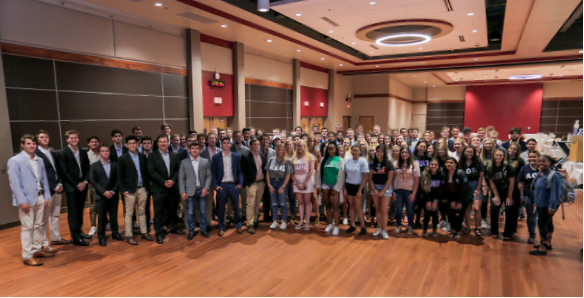
FSL Showcase (Photo: Virginia Tech Fraternity and Sorority Life)



 > THE NEWS FEED <