Bike helmets key tool in bicyclists’ safety, among other practices 

By Bethany Lenhardt, crime, safety and justice reporter 

Biking as transportation is valuable for various reasons, however, biking quickly loses its charm if safety is not a priority. Everyone on the road – bikes, cars, pedestrians – contributes to the safety of the environment and must recognize their role.  

“I’ve seen a number of benefits from bicycle commuting. Cycling to and from work and when I run errands is a way for me to get some exercise,” said Nicholas Quint, Sustainable Transportation Manager at Virginia Tech. “Also, I’ve been able to save a lot of money from gas and just the other maintenance related expenses with the car, and yes, there are maintenance related expenses with a bicycle, but to a much lesser degree.” 

Quint is based out of Virginia Tech’s Transit Center, located off Perry Street Garage. Inside the center is office space, a break area for Blacksburg Transit drivers and the Hokie Bike Hub.  

The Bike Hub is a self-service repair station, where passersby can come in and learn techniques and use the tools to execute repairs, but no items are available for purchase; they do not sell any parts as per an agreement with local bike shops. If an individual comes in with a bike that needs new parts, the Bike Hub workers will help them understand what they need to purchase to successfully execute repairs. They aid approximately 3000 people every year, according to Quint.  
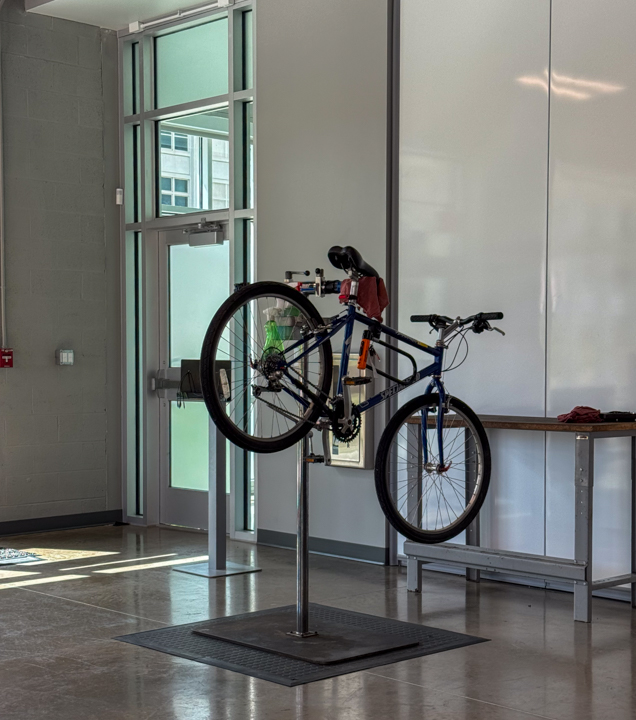
Hokie Bike Hub garage space. Photo by: Bethany Lenhardt

“The Hokie Bike Hub is a learning laboratory,” said Quint. “We are a space dedicated to hands on learning when it comes to working on your bicycle or even an E-scooter, unicycle or skateboard. Our staff are there to teach them how to how to work on their bicycles. We don’t perform any work for folks, and if the problem is bad enough that someone needs to replace a part, we can put together a parts list for them to wherever they can go to get those and then help them out once they have them on hand.” 

“The Hokie Bike Hub is a learning laboratory.”

Nicholas Quint

The emphasis on learning is purposeful. Ultimately, a bicycle is a mode of transport and also a vesicle of the rider’s safety. Proper care and upkeep of a bike is step one to ensuring the rider arrives at their destination safely. The Bike Hub and local bike shops help to ensure the bike remains in top running order and that the rider obtains the skills to fix issues on the fly.  

Another factor in bike safety is appropriate behavior. According to the Virginia Department of Motor Vehicles, bicyclists are subject to many of the same laws as those in motor vehicles. Additionally, drivers are subject to additional laws to prioritize safety in the shared space. These include keeping at least 3 feet of berth, including the mirror, and slowing down when passing a bicyclist on the road and changing lanes if this operation is not possible.  

Bikes may be ridden on and off roadways, excluding all Interstate Highways and when posted signs prohibit the activity. The bicyclist must act like a pedestrian when on the sidewalk, and act like a vehicle when on the road. Cherry-picking and being unpredictable with what laws they choose to obey endangers everyone involved.  

“Weaving in and out of traffic so that you’re unpredictable is not helpful; it’s dangerous,” said Quint. “It’s how others perceive you and expect your next move. Using hand signals, like when you’re going to turn, is also important.”  

The third aspect of safety is equipment, specifically a helmet. Virginia does not have a state bicycle helmet law; however, localities can choose to require the use of helmets by adolescent riders age 14 and under, in accordance with Virginia Code §46.2-906.1. The localities that abide by this rule can be found on the Virginia Department of Transportation website.  

Even with local ordinances, enforcing the use of a helmet is incredibly difficult given the number of children riding bikes at any time, says Dr. Barry Miller, Director of Outreach and Business Development for the Virginia Tech Helmet Lab. However, he highly recommends that everyone – regardless of age – should wear a helmet. 

“We have research that shows any helmet will drastically reduce 70 to 80% risk of concussion versus no helmet at all,” said Dr. Miller. “Helmets do wonders.” 

“Helmets do wonders.”

Dr. Barry Miller

The Helmet Lab seeks to quantify and understand what happens inside the helmet during real-life head impacts in order to evaluate which helmets are the safest for the activity. It all started with the football department asking Dr. Stefan Duma, the founder of the lab and a professor of biomedical engineering and mathematics, if he could determine the safest helmet for the team. Having just returned from a conference that demonstrated sensors inside military helmets, he was inspired to conduct an experiment.  

“We started putting sensors inside football players helmets,” said Dr. Miller. “They agreed to be subjects, so there was 50 players that we collected data on for the initial five years, and basically what we figured out is, when they got injured or concussed on the field, we started pairing that with what the helmet data tells us in linear and rotational head accelerations. From that, we created a bivariate risk function so when certain levels of acceleration are hit, the probability of concussion goes up.” 

Virginia Tech Helmet Lab test rig. Photo by: Bethany Lenhardt

The fundamental question is: How does an individual hit their head when they do X? They replicate that impact with test rigs in the lab and have created a system based on a summation of tests and data that determines which helmet better reduces the rapid head movements and therefore gets a better rating for the purpose of wearing it for that activity, specifically. They have set-ups that are unique to the sport, including one for cycling. That system is patented and was named the star rating system. These ratings are publicly available on their website. 

“The star ratings are consumer facing,” said Dr. Miller. “Part of our public service mission is to inform consumers on the relative difference between helmets. Just like any other thing, there’s product differentiation. Consider a Fiat versus the Ford F-150; there’s huge safety differences between those vehicles, and even in the everyday products you buy at the grocery store, you know, is it name brand or is it off brand?” 

Various helmets in the United States require certification to be sold because of safety concerns. Bicycle helmets are certified by the Consumer Product Safety Commission and must pass their standards to be compliant with the Consumer Product Safety Act. According to the CPSC, they certify a helmet when it passes four tests: it doesn’t block the rider’s vision, it doesn’t fall off when the rider falls off the bike, the straps don’t stretch enough to allow the helmet to fall off or become too displaced, and that the helmet “significantly reduces” force to the head when hit.  

“We’ve really revolutionized sport helmets,” said Dr. Miller. “Helmets must be certified at some organization. Bike helmets are the Consumer Product Safety Committee, football are the National Operating Committee on the Standards of Athletic Equipment, etc. All these different organizations control basic helmet performance and the point to pass or fail is catastrophic head injury, so skull fracture and death. The helmet lab has developed assistance, and we supplement those mandatory certifications to be legally sold with real world sport specific helmet ratings.” 

While serious bicycle crashes are a major reason to wear a helmet, even a simple fall that results in hitting your head on the ground can be dangerous. The National Safety Council reports that there were 1,377 preventable bicycle crash deaths in 2023. Additionally, they report that “The number of preventable nonfatal injuries also increased by 1% in 2023 but has declined by 29%, from 480,212 in 2014 to 341,774 in 2023.” 

Given these statistics, it appears to be imperative to wear a helmet to prevent serious injury, although no amount of precaution can stop the most serious of accidents. Numbers aside, Quint still recommends biking as a source of happiness and perspective, what he calls “bike joy.” 

“I acquired a bike shortly after moving to Richmond,” said Quint. “After a semester, I sold my car; I was kind of bicycling out of necessity but also to experience what that was like because there are some people that driving a car is not an option for them, so I thought it was important for me to gain that perspective. Most of the time you get on a bike, and you just can’t help but smile and be happy about it. I think that bike joy, as they call it, is another big benefit.” 

Whether a rider chooses to bike for purpose or pleasure, putting effort into the bike’s upkeep remains a top priority for safety on the road. Additionally, familiarizing oneself with local ordinances and obeying the rules can help prevent accidents. Finally, purchasing and wearing a highly rated helmet can help reduce fatal injury in the event of a crash.  

Early intervention in Childhood Behavior Key to Preventing Bullying and Tragedy

By Sophia Gerni, Bianca Campoverde and Bethany Lenhardt, crime, safety and justice reporters

The tragic loss of Autumn Bushman, a 10-year-old girl from Roanoke, VA, who died by suicide due to bullying, is a reminder of the urgent need for early intervention and consistent support systems for young children. Addressing behavioral and development needs early promotes empathy, resilience and long-term success. A proactive approach by caregivers and educators can significantly reduce future social and emotional challenges.

Fire safety and prevention through the lens of architectural design

By Bethany Lenhardt, crime, safety and justice reporter

View of Burchard Hall, home of the architecture department, from above ground. Photo by Bethany Lenhardt

When considering the design of a building, architects must balance aesthetics with fire safety considerations, including prevention, suppression and egress.

Why it matters: The design of a building determines the safety of those inside and their route to leave in the event of an emergency.  

  • “It’s [fire] a top priority when an architect is planning a building,” said Jim Bassett, Director of the School of Architecture at Virginia Tech. “All materials have a fire rating, and it’s really not just single materials, but also materials that come together as assemblies, so you’re talking about the way in which those things might perform together.” 
  • For example, steel encased by concrete. Without concrete, steel is more vulnerable to fire. 
  • “Steel loses 50% of its strength at 1100 degrees,” Bassett said. “A conventional structure fire can reach 1000 degrees in 10 minutes. You basically turn steel into spaghetti almost 10-15 minutes into a fire. This is why you have this network of responses, and the first one is protection of the assemblies.” 

Zoom in: Three major variables factor into the building’s function and design relative to fire. 

  • “The first one is occupancy/use,” Bassett said. “What is the building going to be used for? Then type of construction; that is really the combustibility rating of the structure. The third one is the maximum height and area of your building.” 
  • Bassett says that the three variables are integral to each other. They help determine the answers to practical questions and represent the balance between beautiful design and practical safety.  
  • “How does it have to function relative to fire,” Bassett asked. “What and where do your walls – interior and exterior load-bearing walls – need to be? What do your non load bearing walls and partitions need to be? What does your floor and roof construction need to be?” 

Flashback: Historical events, like the Cocoanut Grove Fire of 1942, significantly impact and update building code over time. 

  • According to the National Archives, a small fire in a popular Boston club, “The Grove,” took the lives of 492 people. A decorative palm tree began to light up in the basement lounge. Wall and ceiling decor acted as fuel, and the fire quickly spread and smoked, taking the lights out with it.  
  • “An inward-opening door effectively became a wall as the panicked crowd pushed forth in an attempt to flee to the streets,” according to the National Archives website. “Additional exits, if they could be located in the dark, were either blocked or obscured, leaving hundreds trapped within the inferno.”  
  • Bassett believes that the Grove fire is an example of an event that fundamentally changed building codes, and that fire is easily one of the most major shapers of code.  
  • “You might not even notice, but all doors swing out in public spaces, especially rooms of a certain size,” Bassett said. “Sometimes they swing in, like my office, but that’s just because the occupancy load is very small; there’s just one or two people that have to get out.”   

Zoom out: In the grand scheme of things when a fire occurs, the number one priority is to get everyone out of the building.  

  • Areas of egress are the exit routes for all individuals in a building. You need at least two exit strategies; more if the building composition is larger or holds a greater quantity of individuals. Common egress is an enclosed staircase, but accessibility also needs to be taken into account.  
  • “Accessibility is very important when designing areas of egress specifically for those who are disabled,” said Julia Briner, senior architecture student. “My top considerations would be width of pathways and doorways, nonslip surfaces with tactile paving for those with visual impairments, proper lighting and signage, and safe areas where individuals can wait for assistance.” 
  • “An area of refuge is simply an area where people that are unable to use the stairs can await emergency evacuation,” Bassett said. “If somebody in a wheelchair is in that space, for example, there’s an emergency button that they can press. When first responders show up, they will go through those routes to make sure there are not people stuck in those places.” 
Area of refuge in Burchard Hall. Photo by Bethany Lenhardt

New River Valley provides advocacy, resources, and emergency services to child victims 

By Bethany Lenhardt, crime, safety and justice reporter 

Former professor Michael Horning. Credit: Virginia Tech, via WSET ABC13 Lynchburg

Amid sexual or domestic trauma, the New River Valley of Southwest Virginia is well-equipped with resources for male, female and child victims. Notably, the Women’s Resource Center provides counseling, education and emergency services to aid individuals in their healing journey. 

This story’s intention and focus on minors’ experience has been derived from recent community events. 

Michael Horning, previously an associate professor in Virginia Tech’s School of Communication, was sentenced this January for possession of child pornography and additional sex abuse material. According to the Department of Justice’s press release, Horning downloaded over 600 images and 14 videos via peer-to-peer filesharing software, including depictions of infants and toddlers.  

Horning’s devices were seized in December 2021 as a part of the DOJ’s Project Safe Childhood initiative. In September 2024, Horning pled guilty to knowingly possessing one or more visual depictions of minors and was sentenced to 60 months in federal prison.  

“Children don’t always know that abuse and things are wrong,” said Sherry Kramer, Program Director of the Women’s Resource Center NRV. “Then when they tell people, the people they tell may not react in the best way. They may get angry about the situation, and the child may think they’re angry at them.” 

Kramer started working at the Women’s Resource Center of the NRV over 12 years ago. She has since served the community as a children’s counselor and program director. She contends that minors face unique challenges when reporting abuse. The response of their confidant must serve to empower and support the child, thus dictating if the incident gets taken seriously and reported. 

Due to this challenge, cases of child sexual exploitation and abuse are ultimately underreported, says Kramer.  

The United States Sentencing Commission reports that for the fiscal year of 2023, about 64,000 criminal cases were reported. Of that number, 1,408 cases involved child pornography. That number does not include cases in which the individuals are convicted of producing the material.  

To combat underreporting and increase education and awareness in adolescents, the Center runs the Peaceline Violence Protection Program for Teens. Peaceline is designed for middle and high school-age students on how to navigate relationships among friends, family and romantic partners.  

According to their website, “Education is the key to reducing the number of sexual assaults in the community.” If a student were to disclose a sexual assault or other experience to a Peaceline educator, they are trained in crisis intervention and can refer the student to further counseling services as needed. The program is free of charge. 

“We’d like to get that information out to the whole community and to adults as well, but our main priority with Peaceline is educating on safety and healthy relationships,” Kramer said. 

Peaceline aims to educate and encourage adolescents to come forward. The DOJ’s Project Safe Childhood (PSC) aims to increase the number of federal prosecutions on child predators. It was due to this nationwide initiative that Horning’s devices were seized and searched.  

The initiative was launched in 2006 and expanded in 2011 to span all federal crimes exploiting a minor. Their mission is to “combat the proliferation of technology-facilitated crimes involving the sexual exploitation of children.”  

Since its inception, federal prosecutions of child sex offenders have increased significantly. The success rate of these prosecutions is a direct result of the increased number of international, federal, state, local and tribal investigations spearheaded by PSC. 

“The threat of sexual predators soliciting children for physical sexual contact is well-known and serious,” according to PSC’s website. “The danger of perpetrators who produce, distribute and possess child pornography is equally dramatic and disturbing.” 

A distinct challenge to community resources and PSC is the advancement of technology and its entanglement in the dark web.  

“Technological advances have encouraged child sexual exploitation offenders, especially those operating online, to an unprecedented degree,” according to PSC’s website. “Among the most daunting and prevalent is offender utilization of anonymization networks, including Tor and Freenet, to obscure their identities. Because of the perceived anonymity, the most prolific and sophisticated offenders feel empowered to share enormous quantities of the most vile child exploitation images on a multitude of Internet bulletin boards.” 

Horning was a user of Freenet.  

The Women’s Resource Center of the NRV’s home page

For children who have experienced sexual exploitation or violence, once they’ve taken the steps to report it with a trusted adult, the struggle is not yet over. That’s why the Women’s Resource Center and other resources are with them every step of the way. 

“Honestly, children have told me the most while playing the game of cards,” Kramer said. “Just giving them that comfort, that power and that open door to talk is the best way to get the kids to express themselves. We believe in them, support them, let them know they’re not alone. We have emergency advocates that go to hospitals anytime anyone needs a forensic exam, we’ll go to police departments if somebody’s being interviewed, etc.”  

If a child needs to go through the court system, Court Appointed Special Advocates of the NRV is the tool for them. CASA volunteers are appointed by the court system to listen and advocate on behalf of a child in need. CASA of the NRV helps more than 100 children each year, according to their website. 

Despite the perverse actions of sex offenders, the NRV community and the DOJ are prepared to help and stand in solidarity with the victims. At the Women’s Resource Center, Kramer says that when they answer the phone, they always start with, “Are you safe?” These crimes can make people of all ages feel powerless, but by asking, the power is placed back in the hands of the individual.  

“Everybody has a right to safety,” Kramer said.  

Virginia Tech spokesperson Mark Owczarski could not be reached for comment on this story.  

Editor’s note: An edit was made on Feb. 20, 2025, to correct the name of the Women’s Resource Center.

Editor’s note: TheNewsFeedNRV.com is published by the Virginia Tech School of Communication’s Digital Newsroom course. Michael Horning was a former instructor of Digital Newsroom.