By Alexandra Guerra, Crime, Safety, and Justice Reporter
Lane Stadium is known for its electric game day atmosphere, especially when thousands of fans jump to “Enter Sandman.” The stadium is designed to handle large crowds and the movement created by these traditions. Engineers monitor the structure and its performance to help ensure Lane Stadium remains safe for fans on game day.
By Alex Guerra, Crime, Safety, and Justice Reporter
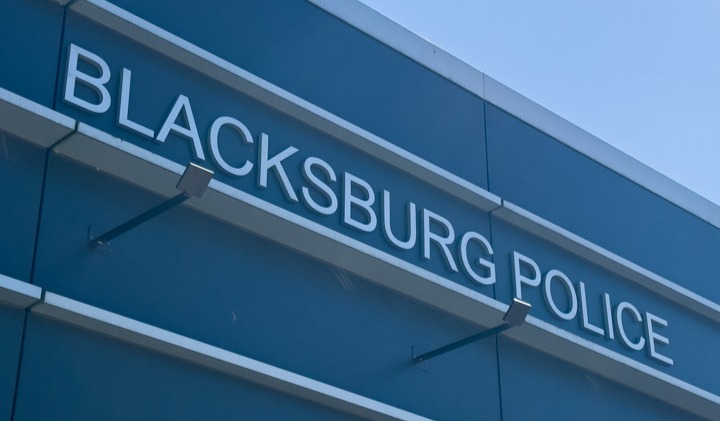
The Blacksburg Police Department is located on Patrick Henry Drive in Blacksburg, Virginia. Photo by Alex Guerra, Sep. 14, 2026
When people think about police work, they often picture officers patrolling the streets, responding to calls or helping people in moments of crisis. But some of the work that keeps Blacksburg safe happens away from the public eye, where employees help analyze information, oversee operations, and support the department’s response to problems.
While officers working in the field are often the people the public sees, other employees spend their time gathering information, identifying patterns, and helping the department prepare for issues that may arise. These roles may receive less attention, but they are an important part of how a police department operates.
Women in the Blacksburg Police Department are taking on roles both in the field and behind the scenes, contributing to safety through leadership, data analysis and daily police work. For women like Courtney Corriere, a crime analyst within the department, keeping the community safe means doing work that people may not always see.
Courtney Corriere, Blacksburg Police Crime Analyst. Photo courtesy of Blacksburg Police.
Corriere was recently recognized on the Chambers 40 Under 40 list, highlighting her contributions to the community and her career. While her job doesn’t typically put her in the middle of fieldwork, the information she provides helps the department better understand what is happening in times of need.
”I knew when I was going through my undergrad at Radford that I did not, nor have I ever wanted to be an officer, but I wanted to be close by. And that’s what I found in crime analysis in Blacksburg. So there are opportunities out there that support the bigger picture,” Corriere explained.
Much of Corriere’s work involves reviewing information and turning it into something the department can use. Data can help police identify patterns, understand where problems occur, and make more informed decisions about how to respond. Her work can also involve finding information that may benefit different investigations.
“I think how easy it is to find information through open-source, unpaid resources. I think that would surprise people,” Corriere said. For her, crime analysis provides a way to contribute to police work without being an officer in the field. Her role requires her to work with information that helps the department understand what is happening and gives officers another resource when responding to problems.
Her position also shows the range of responsibilities, including working with other departments, creating bulletins in her free time, and ensuring everyone is thoroughly prepared for any situation. While officers may be the most visible part of the department, employees working with information and analysis can provide support that helps guide the department’s work.
Jessica Moye, a captain with the Blacksburg Police Department, has built her career in a field historically associated with men. As a woman in a leadership position, she has experienced the changing role of women in law enforcement while advancing through the department. “For Blacksburg especially, everyone from the time I was hired here,through all of my promotions, all of my mentors and supervisors were always so supportive of me.”
Captain Moye of the Blacksburg Police Department is one of the many women working to keep Blacksburg safe. Photo by Alex Guerra, Sep. 14, 2026
Police work is not limited to what happens during a call. Leadership, communication, and understanding the town are also keys to safety. “If we see an issue that is growing, we’re very in tune to recognizing that. So we kind of take charge of those potential bigger issues before they become bigger,” Moye said.
Moye’s role involves helping oversee the department and making big decisions as issues develop. That can mean recognizing problems early and making sure the department is prepared to respond. Her experience also shows how women can take on leadership roles within law enforcement while working with the rest of the department.
The contrast between Corriere’s work with data and Moye’s leadership demonstrates how many different people are involved in public safety. One works with information that can help explain what is happening, while the other helps guide the people responsible for responding. Both roles require skills that may not be obvious to the public.
Women in law enforcement can take on a variety of responsibilities, from analyzing information to managing officers and responding to residents. Their careers can look different depending on their position, experience, and role within a department.
For women considering a career in law enforcement, Moye’s career shows how women can advance through the field and take on leadership roles. She began her career with the department in a lower-ranking position and worked her way up to become a captain. “I hope it helps draw other females into police work.”
Corriere’s recognition highlights the importance of roles that may not always receive the same attention as those working in the field. Her work shows how people can contribute to public safety through research, analysis, and information rather than responding directly to calls.
“It’s nice to be recognized, but I’m definitely someone who more so likes to fly under the radar for sure,” Corriere said.
By Alex Guerra, Crime, Safety, and Justice Reporter
For cyclists and scooter riders navigating Blacksburg’s busy roads, staying safe means more than knowing how to balance on two wheels. Local bike shop employees see firsthand the equipment, habits, and road conditions that can make the difference between a safe ride and a dangerous one.
Blacksburg’s large college population, busy streets, and growing use of bicycles and scooters make two-wheeled transportation common around town. For many students and residents, bikes and scooters offer an inexpensive and convenient way to get around, but riders face risks when sharing roads with cars and navigating intersections.
Local bicycle shops are one place where riders can turn for advice before heading onto those roads. Employees regularly interact with cyclists and scooter riders, giving them insight into the safety concerns riders face and the steps they can take to protect themselves.
In an interview, Mason Cherrics, manager at Trek Bicycle Blacksburg, discussed the biggest safety concerns for cyclists in Blacksburg, common mistakes riders make, and what drivers and riders can do to share the road more safely.
This interview has been edited for length and clarity.
Can you tell me a little bit about your role here and how long you’ve been working with bicycles and/or other forms of alternate transportation?
My role here is store manager at this location, so I typically do administrative work, whether that’s backend processes like budgeting or hours management. I give hours to my teams and typically serve as the communication liaison between our store and the rest of our district, which includes Virginia, D.C., and Maryland. I’ve been working on and around bicycles since 2015, so just about 11 years. I’ve only been in this role for about a year and a half, nearly two years. Prior to that, I was a service manager at a larger location and came down here for the job.
From your perspective, what are some of the biggest safety concerns for people riding bikes or even scooters around Blacksburg?
Visibility. I would say visibility of the cyclist, visibility of the lanes they’re riding in, and visibility at different times of the day. One thing we bring up every time with any new bike sale, or with anyone interested in commuting, is lights. Be as high-visibility as possible. We even sell helmets, for instance, with attachment lights on top. If you have them on the bike, they’re down low, and a driver may or may not see them. It’s a lot easier to see because it’s up here rather than down by your waist, essentially.
What do you think makes riding in a college town particularly challenging compared to riding somewhere else?
It’s a double-edged sword. You have a younger audience, so generally, younger cyclists will be a little bit more daring and typically may not follow into a pack or be the safest riders, and vice versa with drivers. Same idea. You may not be aware of everything around you. Additionally, people make mistakes. It happens all the time. In fact, we’ve encountered three people today alone who got hit in the last couple of days. Luckily, they’re all okay. But I think it is just a lack of time and attention.
Are there any particular situations or just places around here that you’ve noticed, like intersections, crosswalks, or crowded sidewalks that you think riders should be especially cautious around?
Admittedly, I haven’t lived here long enough to know the exact places, but I have seen some issues over toward Prices Fork. There aren’t a whole lot of great places to ride, especially when you’re crossing over that bridge that’s back there. It’s especially difficult during that odd hour of the day when visibility starts to get lower. It’s not dark enough that you can’t see, but it’s not bright enough to see all the details either. I’ve seen some here and there up and down Main Street, but I’d say it’s pretty solid. I would like dedicated bike lanes all the way through. But, of course, I’m a cyclist. I’m going to want that.
What common patterns do you notice when cyclists have close calls with drivers?
The most common way that people get into these close-call situations is a misunderstanding of right of way, whether that’s at a traffic stop or a four-way intersection. A driver may not realize that a bike on the road is the same thing as a vehicle. They follow the exact same laws and rules. Everything is equal except for their size and their road presence.
Are there safety issues you notice as someone who works with bicycles that you think the average person might overlook?
A lot of e-bikes and scooters don’t have adequate brakes. There are some out there, in fact, more over time, as the industry sees this. But there’s a lot of really heavy e-bikes that do not have adequate stopping power. So if you’re cooking along at 20 or 30 miles an hour and you can’t stop, something’s going to happen, and it’s very unsafe.
What’s one piece of safety equipment that you wish more riders actually used?
I feel like a broken record: lights. Lights. Lights. It’s one of those things that’s an afterthought for a lot of people. You don’t think you need lights until you get caught in the dark. It’s like, “Well, I’ll just never ride in the dark.” But lights are applicable to daytime use, not just at night. It’s a lot better now, but helmets are another one. For years, I knew a lot of cyclists, especially on the BMX side of things, who didn’t wear helmets, and they’ve had some really close calls over the years. Fortunately, a lot of them have learned by now. But not everyone does, and we see a lot of that clientele come through the store. They’ll make a helmet an afterthought, or they’ll say, “I’ll buy the nice bike, but I’ll cheap out on a helmet.” It’s like, do the opposite. Cheap out on the bike, get the nice helmet. You only get one brain. You can get multiple bikes. So, helmets and lights.
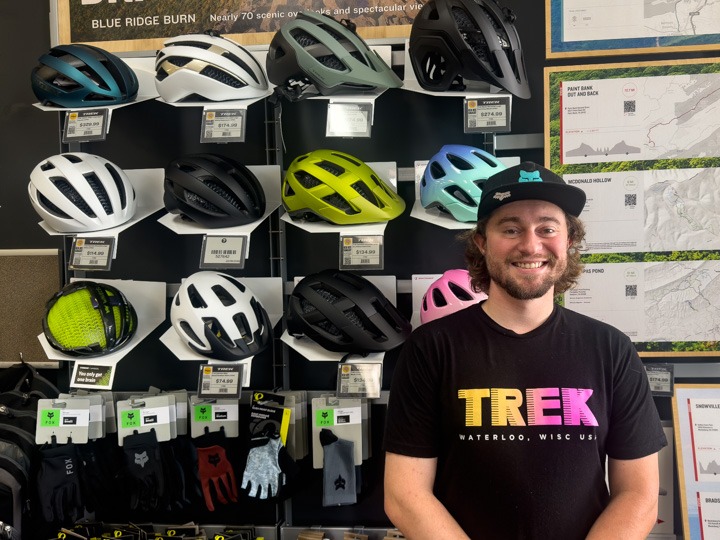
Mason Cherrics, manager at Trek Bicycle Blacksburg, stands in front of helmets at the store in Blacksburg, Virginia. Photo by Alex Guerra, 2026.