By Andrew Honaker, arts, culture & sports reporter
Virginia Tech softball has built one of its strongest starts in program history, combining talent, teamwork, and determination to dominate early in the season. The Hokies have shown consistency at the plate and on the mound while fostering strong chemistry both on and off the field. With a 25–4 record, Virginia Tech continues to prove itself as a top contender in the ACC and looks to carry this momentum through the remainder of the regular season and into postseason play.
-Virginia Tech’s next series is vs NC State on March 20th-23rd
By Andrew Honaker, arts, culture & sports reporter
Virginia Tech has battled injuries and lineup changes throughout the season while remaining in contention. With several games decided in the final seconds, the Hokies now turn their focus to execution as they travel to North Carolina and Virginia to end the regular season and prepare for the ACC Tournament.
By Andrew Honaker, Arts, Culture and Sports reporter
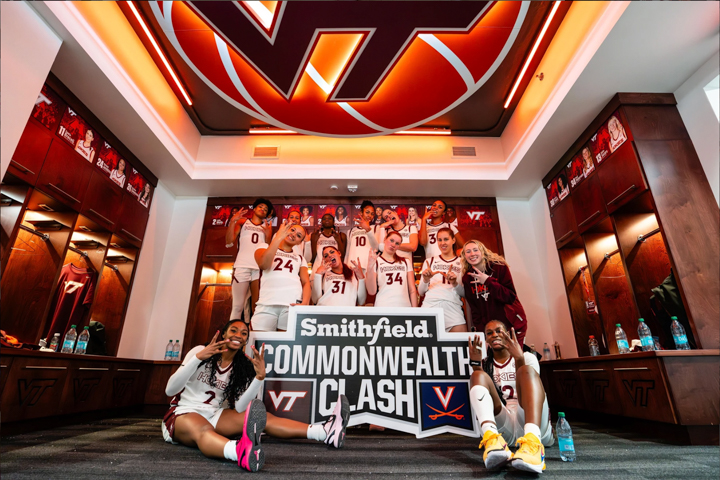
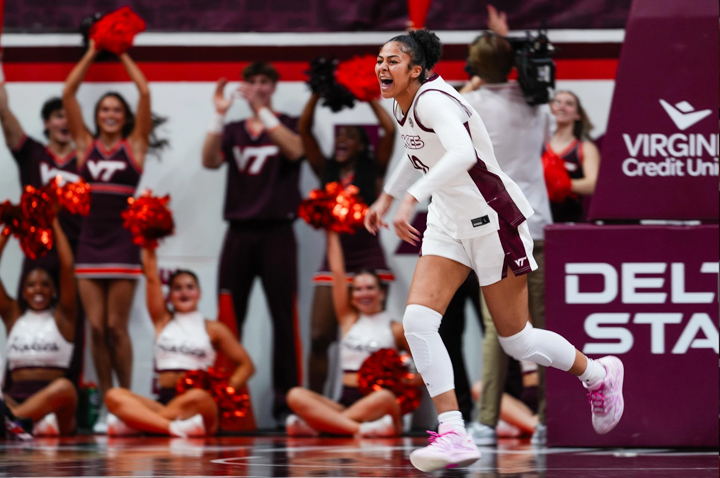
Virginia Tech women’s basketball celebrates after their win over Virginia in the Commonwealth Clash. (Courtesy of Virginia Tech)
Virginia Tech women’s basketball has already experienced the full arc of a season, an uneven start, a statement surge and now a defining stretch with postseason stakes looming.
At 19-7 overall and 9-5 in ACC play, the Hokies sit sixth in the conference standings with four regular season games remaining. After opening league play 1-3, they responded with seven consecutive wins before dropping two games. A win over Stanford on Thursday night steadied their momentum, keeping their ACC tournament positioning and NCAA tournament hopes very much in play.
The turnaround reshaped the narrative of their season.
“The trajectory is very high right now,” Virginia Tech play-by-play broadcaster Evan Hughes said. “For them to go from 1-3 to winning seven in a row and putting themselves right back in the NCAA tournament conversation, that’s impressive.”
Evan Hughes, the play-by-play broadcaster for Virginia Tech women’s basketball. (Courtesy of Evan Hughes)
With the ACC tournament approaching, Tech remains within reach of a top four finish and the coveted double bye that comes with it. Nationally, ESPN bracketologist Charlie Creme currently lists Virginia Tech among the “Last Four In” teams in his projected NCAA tournament field, a reminder that the margin between safely in and sweating on Selection Sunday is slim.
But this season has not been defined by projections. It has been defined by response.
After early losses to top tier ACC opponents, the Hokies were forced to reassess. Hughes said the shift was visible not just in results, but in approach.
“They had to look themselves in the mirror a little bit,” Hughes said. “And during that win streak, you saw them playing their best basketball of the Megan Duffy era.”
That stretch included a comeback victory over Clemson that Hughes believes encapsulates the team’s identity. Trailing by double digits late in the third quarter, Tech flipped the game in the fourth, closing on an 11-0 run.
“Good teams have to find ways to win in different kinds of ways,” Hughes said. “Sometimes you’re not playing your best and you’ve got to grind one out. That’s what they did.”
Defense has become the foundation of that grit.
Under second year coach Megan Duffy, the Hokies have prioritized forcing turnovers and converting defense into offense. During the seven-game win streak, Tech held six opponents to 68 points or fewer.
“If they can keep teams in the 50s or low 60s, that’s a recipe for success,” Hughes said. “That’s the identity.”
The defensive emphasis has also complemented a more balanced offensive structure compared to previous seasons. Rather than relying heavily on one or two primary scorers, Tech has distributed production across multiple contributors, including guard Carleigh Wenzel and forwards Carys Baker and Kilah Freelon.
“There’s a lot of different people who can score,” Hughes said. “It’s more spread out across the board.”
Baker sees that balance as part of the team’s steady growth through the grind of conference play.
“I think the team is playing well,” Baker said. “There is always room for improvement in conference play, as every team goes through different things throughout the season, but I am proud of how our team is growing every day.”
Virginia Tech women’s basketball player Carys Baker. (Courtesy of Virginia Tech)
For Baker, the biggest area of development has been managing the length of the season itself.
“Basketball season is lengthy, so learning how to stay in a consistent flow throughout the long season,” she said.
That consistency will determine whether the Hokies climb into the top four of the ACC standings or remain in the middle of the pack heading into Greensboro. The difference is significant: a double bye provides both rest and a clearer path to the semifinals.
From courtside at Cassell Coliseum, public address announcer Tyler Painter has witnessed the program’s evolution over nearly a decade. When he began in 2016, crowds were modest. In recent seasons, especially during postseason runs, the arena has transformed.
“It’s increased so much,” Painter said of attendance and atmosphere. “Even on a weekend game, we’re getting four or five thousand people, which is awesome.”
Painter believes that growth in fan engagement parallels the team’s development.
“When the team’s performing well, the atmosphere is better,” he said. “You can see players feed off that energy.”
Hughes described Cassell as a tangible advantage.
“There’s just something about the magic of Cassell Coliseum,” he said. “It is the 12th man.”
Virginia Tech students react during a free throw attempt by a Virginia player in the Hokies’ win over their in-state rival. (Courtesy of Virginia Tech)
That home court edge could prove critical down the stretch as Tech faces NCAA caliber opponents in its final four games. Sustaining defensive intensity and late game execution are a must for Virginia Tech during the end of this season.
“I think it’s continued scoring contributions, continuing to be aggressive on the glass and continuing to defend,” Hughes said. “You don’t win seven in a row without executing late.”
The recent two game skid serves as a reminder of how thin the margin is in the ACC. Nearly every opponent poses a resume shaping opportunity or risk.
Baker said the team’s focus remains internal rather than on standings projections.
“Keeping consistency and hard work going into the final stretch of the regular season,” she said. “We are hungry to keep improving and win games for Virginia Tech.”
The season’s arc, stumbling early, surging mid season and trying to finish the season strong, reflects a group still solidifying its identity under Duffy. It is a team that has proven capable of correcting course and building momentum.
Now, the next four games will determine whether that midseason run becomes a launching point or simply a highlight.
For a team once 1-3 in conference play and now squarely in the NCAA conversation, the opportunity remains in front of it. The Hokies have already shown they can respond.
The question is whether they can finish.
Editor’s note: The Hokies’ next game is February 15 at Cal. Tipoff is at 5pm on ACC Network Extra
By Andrew Honaker, Arts, Culture and Sports reporter
Scott Wise, Manager of Data and Analytics for Virginia Tech athletics
Data analytics has become a behind the scenes driver of decision making within Virginia Tech Athletics, influencing everything from ticket pricing to in game strategy as the department navigates a rapidly changing college sports landscape.
As financial pressures increase and competitive margins shrink, athletic departments across the country are turning to analytics for clarity. At Virginia Tech, that shift has expanded the role of data beyond performance metrics, embedding it into business strategy, fan engagement, and long term planning.
Scott Wise, who works with athletic leadership on data and analytics initiatives, helps translate complex information into practical decisions for administrators and coaches. In an interview, Wise explained how analytics is currently used across the department, the misconceptions surrounding sports data, and where he sees its future impact. His responses were edited for clarity and length.
How would you describe your role in data and analytics within Virginia Tech Athletics?
We’re fortunate to have leadership that genuinely wants to use data to make better decisions. Whether it’s data science or analytics, they want information that helps them choose the best path forward rather than relying solely on instinct.
A large part of my role focuses on pricing studies, revenue projections, and budgeting. Those areas are where analytics can have immediate impact. We’ve been able to evaluate pricing across all sports to better understand demand, maximize revenue, and still consider the fan experience.
What’s made this effective is trust. Leadership wants to make informed decisions, and they’re willing to act on the data we provide. That allows analytics to actually shape outcomes instead of just supporting decisions that have already been made.
How is data analytics currently being used within Virginia Tech athletic programs?
On the team side, softball is a strong example. They have a very forward thinking staff that constantly looks for ways to improve, even by small margins. When you’re one game away from the College World Series, those details matter.
We’ve analyzed several years of historical data to identify what has led to success and what hasn’t. From there, we model potential outcomes to help guide in game strategy. That includes decisions like whether to steal, bunt, adjust the batting order, or choose a specific pitcher in a given situation.
What makes that partnership effective is buy in. Not every program is willing to adapt based on analytics, but softball has embraced it, which allows data to become a competitive advantage rather than just background information.
What is one way analytics influences decisions that fans would never expect?
Pricing decisions are a big one. Fans sometimes think prices are raised randomly or without regard for their experience, but that’s rarely the case.
We analyze household income, discretionary spending, demand trends, and how different segments of fans behave. The goal is to balance financial sustainability with accessibility. While we do need to generate revenue to operate, we also can’t ignore how fans respond to pricing changes.
It’s never as simple as increasing prices because a game sold out the previous year. Every decision requires weighing multiple variables and understanding the potential consequences.
How do you make analytics useful for coaches instead of overwhelming them?
Coaches can get overwhelmed quickly if they’re given too much information. The key is simplifying the output while maintaining strong analysis behind the scenes.
Some staffs are excellent at blending analytics with qualitative insight, like how a player looks physically or how an opponent is reacting in real time. Others struggle if they’re presented with too many numbers.
What’s been most effective is narrowing things down to one or two metrics that resonate with them and presenting those visually, often through dashboards. That allows coaches to make decisions without feeling buried by data.
What types of data are most valuable to the department right now?
Consumer analysis is one of the most valuable areas right now. We’re focused on understanding who attends games, who doesn’t, and why.
With changes in college athletics and new leadership in football, there’s excitement, but excitement alone doesn’t guarantee attendance. Data helps identify fans who haven’t traditionally come out and determine how to re-engage them.
Understanding fan behavior has become just as important as understanding what happens on the field.
How has the role of analytics in college athletics changed in recent years?
It’s changed dramatically. When I first started, only a handful of schools had dedicated analytics roles. Now, departments across the country are creating positions focused on data science and analytics.
That shift is driven by necessity. Every dollar is under more scrutiny than ever before, and departments need to justify decisions with evidence. Analytics helps ensure resources are allocated responsibly and strategically.
Data driven decision making is no longer optional, it’s becoming standard.
What misconceptions about sports analytics do you encounter most often?
A common misconception is that probability equals certainty. If a model shows a 51 percent chance of something happening, people assume that outcome is guaranteed, which isn’t true.
Analytics doesn’t predict the future. It provides information about what is likely to happen. The value comes from using that information to adjust strategy and reduce risk, not from assuming outcomes are predetermined.
Understanding that difference is critical for applying analytics correctly.
How do you measure whether analytics is actually making a difference?
Tracking impact is essential. Financially, that can be straightforward. If we conduct a pricing study, implement recommendations, and see increased revenue the following year, that’s a clear indicator.
The same approach applies to attendance or performance metrics. It’s about defining expected outcomes and comparing them to actual results. Being able to show that connection helps demonstrate the value of analytics.
What challenges come with implementing analytics at the Power Four level?
Buying in remains the biggest challenge. Some people in college athletics don’t trust data or believe it can’t account for real world situations.
That’s not accurate. We can incorporate both quantitative and qualitative factors into models. The challenge is getting people comfortable using analytics as part of their decision making process.
Fortunately, Virginia Tech’s leadership is forward thinking, which puts us in a strong position compared to many programs.
Looking ahead, where do you see analytics having the biggest impact at Virginia Tech?
The biggest opportunity is integrating business data with performance data. That alignment is rare in college athletics, but it’s where analytics can be most powerful.
If we can evaluate everything from ticket sales and fundraising to on field performance within a unified framework, we can make smarter decisions across the entire department. That’s where I see Virginia Tech continuing to grow.




 > THE NEWS FEED <