
By Aaliyah Kinsler, arts, culture & sports reporter
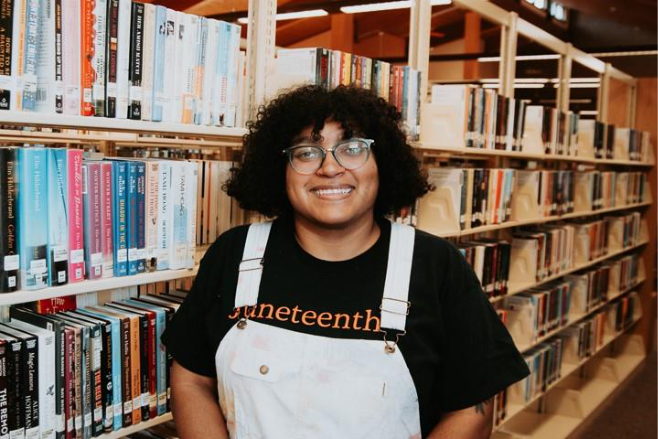
CHRISTIANSBURG, Va. (Feb. 11, 2026)– Salena Sullivan, Christiansburg Library branch manager, stands between book stacks inside the Christiansburg branch of the Montgomery-Floyd Regional Library. (Aaliyah Kinsler, Newsfeed NRV)
Book challenges and removal requests at public libraries across the New River Valley remain infrequent, even as debates over library collections continue nationally, according to officials with the Montgomery-Floyd Regional Library system.
Library officials say formal requests to reconsider books or materials have been rare locally and have not increased in recent years. This comes despite a growing public attention to book challenges across the country and high-profile cases reported in other parts of Virginia and the United States.
“I’ve been here since 2017, and there have been challenges to the collection, but we certainly haven’t seen an increase over the past few years,” said Montgomery-Floyd Regional Library Director Karim Khan. “It’s infrequent, not something that happens every week or every month.”
Public libraries operate under formal policies and legal standards when evaluating materials rather than responding to individual complaints alone. The Montgomery-Floyd Regional Library system uses a written request for reconsideration process tied to collection development policy, state law and professional library standards that guide how materials are selected, and when necessary, reevaluated.
Library officials say these policies help create consistency and transparency when requests do occur. The system’s collection development policy outlines how materials are selected, how these requests are reviewed, and how final decisions are made. The process usually involves reviewing professional evaluations, collection criteria and community need while making sure decisions remain aligned with legal standards and library ethics principles.
“It’s not a big deal because we’re prepared,” Khan said. “A public library should have policies in place approved by its governing authority. We give our full attention every time somebody puts in a request for reconsideration.”
The library system serves Montgomery and Floyd counties through four branches located in Blacksburg, Christiansburg, Floyd, and Shawsville. Requests must come from people eligible for library cards tied to the service area, which includes local residents, students, and others with qualifying ties to the community. Library officials say this structure ensures the reconsideration process reflects the communities that directly support and fund the library system.
While public discussion often frames book challenges through political or ideological lenses, library leadership in the New River Valley says that the local experiences have been more varied. They say concerns most often focus on perceived content suitability for children or accuracy of factual information rather than a single political viewpoint.
“I think what tends to unify a significant chunk of them is people trying to make sure children are ‘safe,’” Khan said. “It’s either that or, ‘This is scientifically inaccurate.’”
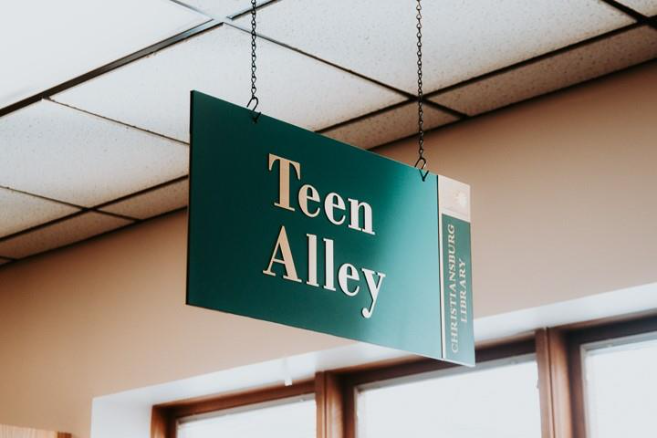
CHRISTIANSBURG, Va. (Feb. 11, 2026)– A “Teen Alley” sign marks the teen section inside a public library, where materials are organized by age groups and audiences. (Aaliyah Kinsler, Newsfeed NRV)
Library officials say many concerns begin as conversations between patrons and staff rather than formal written requests. Front-line employees are often the first point of contact when patrons have questions or concerns about materials, allowing libraries to explain how collections are built and why certain materials are included.
At the branch level, staff say public libraries serve broader roles beyond book circulation, including acting as information centers, study spaces and community gathering spaces for people of all backgrounds.
“Libraries play a very important role in our community as a place where people have access, access to information, access to leisure and access to community,” said Christiansburg Library Branch Manager Salena Sullivan. “It’s one of the only places where you don’t have to pay to be here.”
Sullivan said strong library systems often reflect overall community health, noting that library access often supports education and lifelong learning across age groups.
“Having a robust library in your community is a really good indicator of a healthy community,” Sullivan said.
Library management say public trust plays a significant role in how collections are built and maintained. Officials say collections and programming are designed to meet the needs of different populations across the New River Valley, including families, students, working adults and rural residents with varying information needs and interests.

CHRISTIANSBURG, Va. (Feb. 11, 2026)– Books sit on display shelves inside a Montgomery-Floyd Regional Library branch in the New River Valley. (Aaliyah Kinsler, Newsfeed NRV)
“Libraries’ collections and programming should reflect the needs of the community,” Sullivan said. “We’re here to serve as an information resource.”
Library officials say individuals and families ultimately decide what materials are appropriate for themselves or their children. While libraries organize materials by age group and intended audience, officials say they are not responsible for making individual reading decisions for patrons.
They say legal definitions, particularly around obscenity, are determined by courts rather than library staff. Libraries rely on legal standards and established review processes when evaluating materials rather than subjective personal standards.
“If it’s not obscene according to the law, then it’s not obscene,” Khan said. “It’s a legal term and we are no judge of that.”
Library officials say their goal is to maintain broad access to materials while following professional standards and legal requirements. Officials say public libraries are designed to serve entire communities, even when individual patrons may disagree with certain materials or viewpoints represented in a collection.
Across the New River Valley, library leaders say community relationships and open communication have helped to keep reconsideration requests relatively rare compared to trends reported in some other parts of the country. Officials say continuing conversations with patrons and maintaining transparent processes remain the biggest priorities moving forward.
 > THE NEWS FEED <